Reading Posted Signs on Ranch Land Before You Ride
There's nothing quite like the allure of Nebraska's wide-open spaces, especially when you're looking to hit the trails on your ATV or UTV. But before you unload your machine and feel the rush of the open range, there's a crucial step many riders overlook: truly understanding and respecting the posted signs on ranch and private land. This guide is all about navigating those often-confusing messages, validating your frustrations with unclear access, and ensuring you have a safe, legal, and respectful ride every time you venture out in Nebraska.
The Lure of Nebraska's Open Spaces and the Reality of Private Land
Nebraska offers some absolutely breathtaking scenery, from the rolling Sandhills to the rugged Pine Ridge. It’s no wonder so many of us dream of exploring these vast landscapes on our ATVs and UTVs. The feeling of freedom, the fresh air, the unique terrain – it's an experience unmatched. However, what often gets lost in that dream is the fundamental reality that the vast majority of Nebraska's land is privately owned. That sweeping vista you're admiring, the seemingly endless stretch of pasture, or that intriguing timberline? Chances are, it belongs to someone else.
The Dream vs. The Deed: Why Access Isn't Assumed
It's a common frustration, isn't it? You see what looks like the perfect trail winding off into the distance, perhaps a two-track leading to a hidden creek or an old farm road that promises adventure. Your heart starts to beat a little faster, and you imagine the thrill of the ride. But then, you spot it – a weathered sign, or maybe just a subtle change in the fence line, and suddenly, that dream ride comes to a screeching halt. The truth is, in Nebraska, access to private land for recreational purposes, including ATV and UTV riding, is never assumed. Unless you have explicit permission, you simply cannot ride there. Landowners have legal rights to control who is on their property, and those rights are taken seriously. It's not about being unneighborly; it's about protecting their livelihood, their livestock, and their personal space.
Common Misconceptions About Public vs. Private
Many riders, especially those new to the area or new to off-roading, carry some understandable but ultimately incorrect assumptions about land access. One common misconception is that if a piece of land isn't fenced, it must be public. This simply isn't true in Nebraska. Just because there isn't a physical barrier doesn't mean the land is open to the public. Property lines exist whether there's a fence or not, and entering without permission is still trespassing. Another belief is that if there's already a well-worn trail or two-track, it must be an open riding area. Again, not necessarily. These trails could be used by the landowner for ranch work, by hunters with specific permission, or even by neighbors who have a long-standing arrangement. Just because others have used it doesn't mean it's open for general public recreation. Understanding [Nebraska Trespass Law for Riders] is absolutely essential before you ever leave a designated public trail or road. Always err on the side of caution: if you don't know for certain it's public land, treat it as private and inaccessible without explicit permission.
Decoding the Language of Posted Signs on Nebraska Ranch Land
When you're out riding, or even just scouting potential new areas, you're bound to encounter various signs. These aren't just suggestions; they are legal notices that carry significant weight in Nebraska. Learning to read and respect these signs is paramount for responsible ATV and UTV use.
The "No Trespassing" Sign: A Clear and Unequivocal Message
Let's start with the most obvious one: the "No Trespassing" sign. This isn't just a friendly reminder; it's a direct legal warning. In Nebraska, a properly posted "No Trespassing" sign means exactly what it says: you are not permitted to enter or remain on that property for any reason without the landowner's express permission. These signs can take many forms. Sometimes they're simple metal signs nailed to a fence post. Other times, you might see bright yellow or purple paint marks on trees or fence posts at regular intervals – this is another legally recognized way for landowners to designate their property as off-limits. There's no room for interpretation here. If you see such a sign, your options are clear: turn around. The consequences of ignoring these signs can range from fines to your machine being impounded, and even potential legal action from the landowner. While specifically geared towards roads, the spirit of [Nebraska Penalties for Illegal Road Riding] (referring to the legal consequences of improper riding) applies broadly to any illegal operation of an ATV, including trespassing on private land.
"Private Property," "Posted," and Other Variations
Beyond "No Trespassing," you'll often see other signs that convey the same message, perhaps in a slightly softer but equally firm tone. "Private Property" signs are ubiquitous and serve as a clear indicator that you need permission to enter. Similarly, a sign simply stating "Posted" typically means the same thing as "No Trespassing" in many rural areas, indicating that the landowner wishes to restrict access.
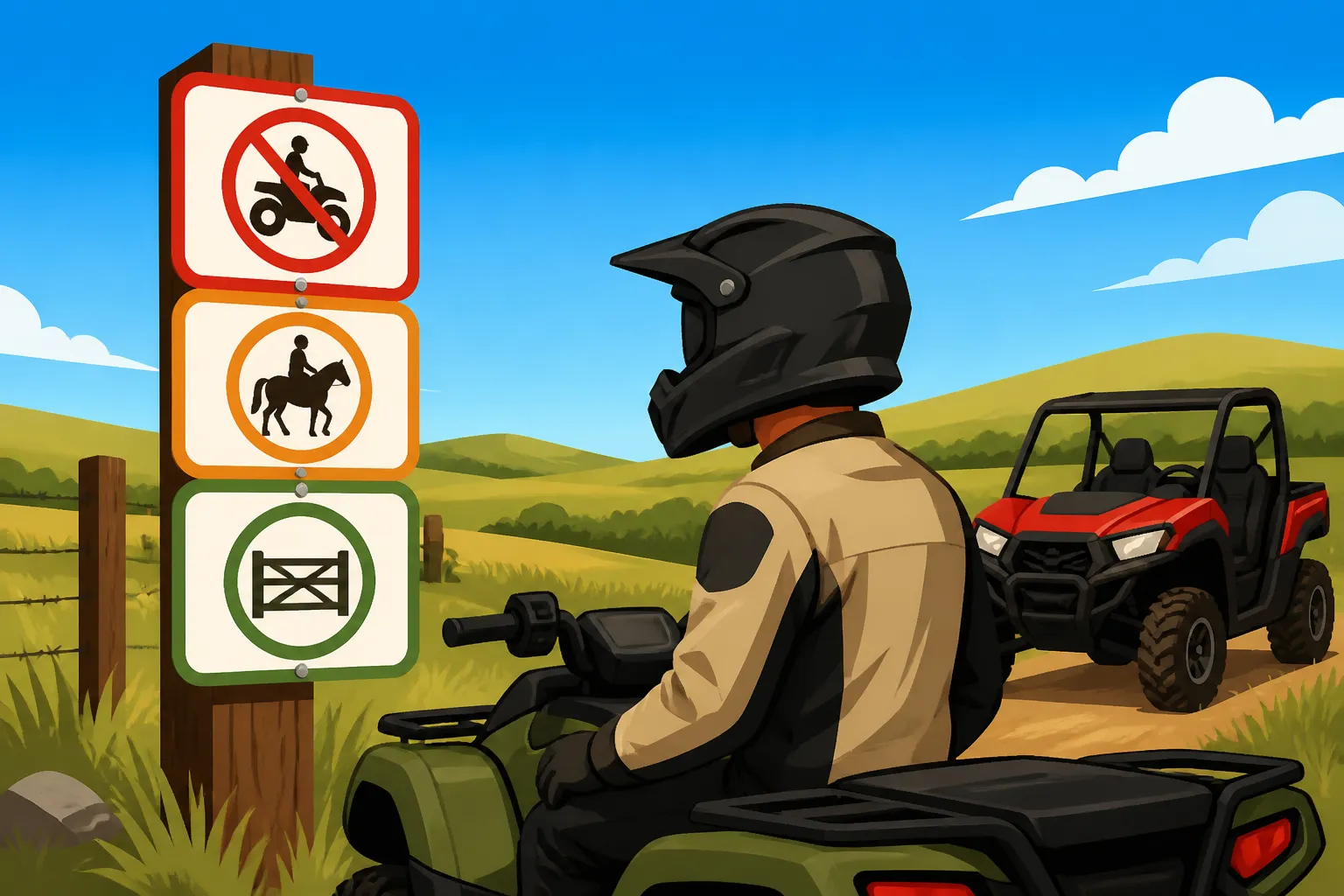
You might also encounter signs that are more specific, like "No Hunting," "No Fishing," or "No Motorized Vehicles." While these might not explicitly say "No Trespassing," they strongly imply a general lack of public access for recreational activities. If a landowner is taking the time to prohibit specific activities, it's a strong signal that general ATV riding is also not welcome. Furthermore, some signs might state "Authorized Personnel Only" or "By Permission Only." These are important variations. They don't mean absolutely no one can enter, but they make it very clear that you must have prior authorization. It means the landowner isn't arbitrarily barring everyone, but rather controlling who comes and goes. This is where the concept of gaining permission really shines.
The Importance of "Written Permission"
If you're serious about expanding your riding opportunities beyond public trails, securing written permission from landowners is the absolute gold standard. Verbal permission, while sometimes given, can lead to misunderstandings or complications down the road. "He said I could ride whenever I want" can quickly become "I never said that!" when there's an issue. Written permission leaves no doubt.
What should written permission include? Ideally, it should specify:
- The names of the landowner and the rider(s).
- The dates or duration of permission (e.g., "for the 2024 riding season" or "October 10-12, 2024").
- A clear description of the property boundaries where riding is permitted (e.g., "south pasture only," "along the main ranch road," "excluding the wetlands area").
- A description of the ATV/UTV (make, model, VIN) if the landowner wants to be specific.
- The purpose of the ride (e.g., "recreational," "checking fence lines," "hunting access").
- Any specific rules or restrictions (e.g., "no night riding," "stay on existing trails," "gates must be closed").
- Emergency contact information for both parties.
- Signatures from both the landowner and rider(s).
This level of detail protects everyone involved. It shows you're a responsible rider, and it gives the landowner peace of mind. Many landowners in Nebraska are incredibly generous, especially if you approach them respectfully. In fact, we have a whole article dedicated to [Getting Written Permission From a Ranch Landowner] that you'll find incredibly helpful. When you’re out on a private ranch with permission, having the right gear is also key. For instance, if you're navigating rough, overgrown paths, a heavy-duty winch from a brand like SuperATV can be a lifesaver if you get stuck, ensuring you don't damage the landowner's property trying to get free.
| Sign Type | Meaning for ATV/UTV Rider | Action Required |
|---|---|---|
| No Trespassing | Legal prohibition from entry | Do not enter, turn around |
| Private Property | Land is privately owned, entry requires permission | Do not enter without explicit permission |
| Posted | Land is privately owned, restricted access | Do not enter without explicit permission |
| No Hunting/Fishing | Implies general restricted access | Do not enter without explicit permission for riding |
| Authorized Personnel Only | Only specific individuals may enter | Do not enter unless you are authorized |
| By Permission Only | Entry requires prior authorization | Seek and obtain written permission before entering |
| Purple Paint Marks | Legal "No Trespassing" indicator in Nebraska | Do not enter, turn around |
What to Do When You Encounter a Sign (or Lack Thereof)
So, you're out there, cruising along, and you spot a sign. Or perhaps you don't see one, but you're not entirely sure about the land you're approaching. What's the protocol?
When There's a Sign: Turn Around, Don't Look Back
This is the simplest advice, and perhaps the most crucial: if you see a "No Trespassing," "Private Property," or any other sign indicating restricted access, you absolutely must turn around. Do not try to reason with yourself that you'll only go "just a little bit further." Do not assume "they won't mind." Do not think you can "sneak in." Ignoring a posted sign is a direct violation of property rights and Nebraska law. The risks far outweigh any potential fun you might have. You could face legal repercussions, your machine could be impounded, and you'll certainly sour the relationship with the local community and landowners, making it harder for all ATV riders in the long run. If you happen to be carrying a copy of your machine's title (which can be a good idea for any ride, as detailed in [Carrying Your Title Copy on a Ranch Road]), that paperwork won't mean a thing if you're trespassing. Respect the sign, respect the law, and respect the landowner. It's that straightforward.
When There's No Sign: Still Assume Private and Seek Permission
Here's where many riders get into trouble. They see a beautiful, seemingly untouched area with no fences and no signs, and they assume it's open for riding. This is a dangerous assumption. As we discussed earlier, most land in Nebraska is private. The absence of a "No Trespassing" sign does not mean implied consent for public access. It merely means the landowner hasn't explicitly posted it, perhaps because they assume common courtesy, or because they simply haven't gotten around to it.
Your best course of action when encountering unmarked land that isn't clearly public (like a designated OHV park or publicly managed trail system) is to assume it's private and then actively seek permission. This usually means finding out who owns the land and making a polite, respectful inquiry. Local county assessor offices often have online maps or records that can help you identify landowners. Once you have a name, you might try knocking on a door (during reasonable hours, of course!) or sending a letter. Be prepared to explain who you are, what kind of machine you ride, where you'd like to ride, and assure them you'll respect their property, especially if they have livestock or crops. This is often how long-standing relationships between riders and landowners are forged. For example, if you're looking at land that's part of a working farm or ranch, knowing the [Nebraska Rules for Riding Farm Ground] or [Nebraska Rules for Riding a Pasture] can help you have a more informed conversation with the owner. To help you stay within agreed-upon boundaries, especially on a large property, a robust GPS system from SuperATV can be incredibly useful, allowing you to upload specific waypoints or boundary lines provided by the landowner.
Respecting the Land: Even With Permission
Even when you've secured that coveted written permission, your responsibility doesn't end there. In fact, it's just beginning. Being granted access to private land is a privilege, not a right, and it's essential to uphold that trust. This means adhering to any specific rules the landowner has laid out, such as staying on existing trails, avoiding certain pastures, or being mindful of livestock. It also means following general principles of responsible land use. Always remember to [Leaving Pasture Gates the Way You Found Them] – if it was closed, close it; if it was open, leave it open. Don't leave trash behind, avoid creating new trails, and be extra cautious about fire risks, especially in dry conditions. If you're using your ATV for ranch work, like hauling supplies or checking fences, consider equipping your machine with durable skid plates from SuperATV. These not only protect your ATV from unexpected obstacles but also help prevent unnecessary ground disturbance, showing respect for the land's condition. Additionally, carrying proof of your permission, alongside any other relevant documents [What Paperwork a Deputy Can Ask to See] and [Nebraska Equipment Checks by Deputies], is a smart move. Demonstrating respect for the land and the landowner ensures that you, and potentially other responsible riders, will be welcomed back in the future.
Disclaimer
This article is for general informational purposes only and does not constitute professional advice. Laws, prices and regulations vary by location and change over time. Consult a qualified professional for guidance on your specific situation.