Where You Can Park on a Wildlife Management Area
Parking on a Nebraska Wildlife Management Area is not the same as permission to ride anywhere on the property. The safe choice is to use a marked parking area or other location specifically allowed by the site’s signs and rules, then keep your truck, trailer, and ATV out of travel lanes and closed areas. Here’s how to plan your arrival and avoid a parking mistake.
Start with marked parking areas and posted instructions
On a Wildlife Management Area, look for a designated parking lot, signed parking area, or other clearly permitted place to leave your vehicle. Do not assume that a wide shoulder, field entrance, gate pull-off, or open patch of ground is intended for parking. It may be needed for farm or agency access, emergency vehicles, or other visitors.
Posted signs and gates matter. A sign may identify where to park, restrict access, or close a road or portion of the area. If signs at the entrance or at a parking area give instructions that differ from general expectations, follow the site-specific directions. When there is no clear parking direction, avoid blocking access and contact Nebraska Game and Parks or the relevant land manager before unloading.
Parking permission is also separate from permission to operate an ATV or UTV. Leaving a machine at a legal parking spot does not make nearby roads, trails, shorelines, or fields open to riding. Nebraska WMAs generally limit motorized travel to designated roadways, and conditions or signs at an individual area can impose additional restrictions. Review Nebraska WMA Vehicle Rules and Nebraska WMA Designated Roadways Only before planning a ride.
A practical way to think about it:
| Situation | Safer approach |
|---|---|
| Marked WMA parking lot | Park within the marked or obvious parking area and follow posted signs |
| Road or access lane | Keep it open unless signs specifically allow parking there |
| Gate, entrance, or narrow pull-off | Do not block it; use another designated place |
| Unmarked field or grass area | Do not treat it as a parking lot without confirmation |
| ATV or UTV use after parking | Check whether the route is designated and open to motorized travel |
| Unclear signs or boundaries | Ask the land manager before unloading or riding |
A designated parking area can be easy to miss, especially if you arrive after dark, during hunting season, or when vegetation hides a small sign. Slow down as you approach the entrance. If you cannot tell whether a spot is an authorized lot or merely a place where a vehicle can physically fit, do not use it as your default.
Park the truck and trailer without blocking access
A vehicle and trailer take up more space than a passenger car, so a spot that looks workable at first may still obstruct a road or another visitor. Before unloading, check whether other vehicles can pass, whether a gate can open fully, and whether equipment or emergency vehicles could get through. Keep the entire combination inside the parking area where possible; do not leave the trailer extending into the roadway.
Avoid parking across a gate, in front of a sign, or where your vehicle could prevent access to a road or facility. Do not assume a closed gate is a suitable place to stop just because the ground nearby is level. A gate may be part of a boundary or access-control system, and blocking it can interfere with land management or authorized users.
If a lot is full, do not create a new parking area by driving onto grass, into a crop field, or around a barrier. Look for another approved access point or postpone unloading until you can park without obstructing the area. Wet ground is another reason to stay on established parking surfaces: a truck or trailer can rut the soil, damage vegetation, or become stuck, even when the surface initially appears firm.
For a group ride, agree on where everyone will meet before arriving. Several trucks and trailers can quickly fill a small lot, and parking informally along an access road may make it impossible for other visitors to pass. Keep the group compact and leave space for people who arrive later. If the group is large, contact the land manager in advance rather than assuming the lot can accommodate everyone.
A quick arrival check helps:
- Read signs at the entrance and parking area before driving past them.
- Confirm that the parking surface is intended for vehicles and can support your truck and trailer.
- Leave gates, roadways, and turnarounds clear.
- Unload only where the vehicle and trailer can remain without blocking others.
- Recheck the rules for the route you intend to ride.
The broader Nebraska WMA Parking Rules are worth reviewing before you travel. Parking can be allowed in one part of an area while motorized use is restricted elsewhere. Keep those decisions separate: first determine where the vehicle may be left, then determine whether the planned route is open to your machine.
Understand what parking does not authorize
A common source of trouble is treating a parking spot as a staging area for unrestricted riding. On a WMA, parking your ATV or UTV at an approved location does not itself authorize travel over grass, across a field, along a shoreline, or on a path that is not designated for motorized use. Follow the marked roads and any closures.
This distinction is especially important for hunters and other visitors who use machines to reach a location. Hunting access rules, landowner permission, and motorized vehicle rules are separate questions. A hunting license or an open hunting season does not automatically authorize riding wherever you want. See Nebraska Hunting Land Access by Machine for the separate access issue, and check Nebraska WMA Access for a Quad for machine-specific considerations.
Do not drive around a barrier to reach a preferred parking location or route. A barrier may mark a seasonal closure, protect sensitive habitat, or prevent vehicles from using a road that remains open to pedestrians. Likewise, a path that appears well traveled may not be an authorized motorized route. The applicable rule is not whether a route looks suitable; it is whether the managing agency permits that use there.
If the WMA has designated roadways for motorized travel, stay on those roadways and observe posted restrictions. A road that connects a parking area to another part of the property may still be closed to public motorized use. If the signs are missing or difficult to interpret, do not guess based on tire tracks or another rider’s presence. Check with the agency responsible for that area.
Conditions can change, too. A road or parking area that is usable in dry weather may become soft or unsafe after rain, snowmelt, or seasonal flooding. Avoid driving around a muddy section to make your own bypass. That can widen the disturbed area and damage habitat. If the designated lot is unusable, seek current guidance rather than creating an informal one.
Frozen water is a distinct case, not a general parking exception. Some WMA rules address riding on frozen water under specific conditions, but that does not mean vehicles can be parked anywhere along the shoreline or that every frozen lake is open. Check Nebraska WMA Frozen Lake Exception and obey signs identifying closed ice areas.
Check the specific area before you leave home
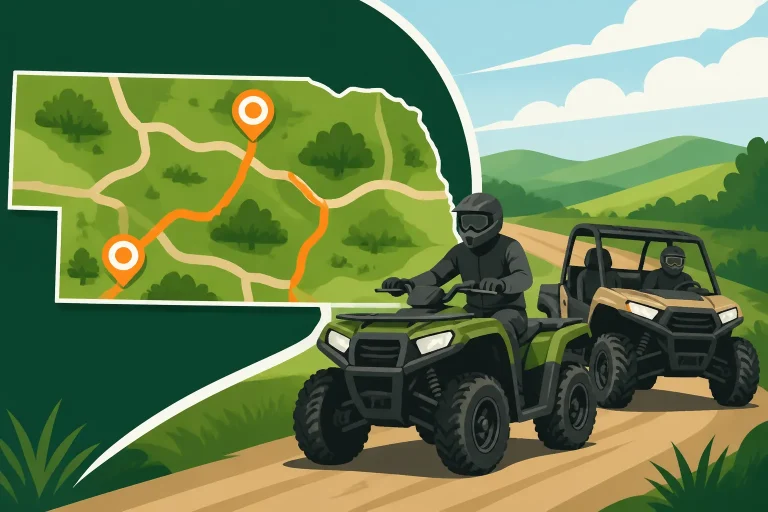
Wildlife Management Areas do not all have the same layout. One may have a clearly marked lot near its entrance; another may have limited access points or posted restrictions that affect where vehicles can go. Check the particular property’s current information before setting out, then read every sign when you arrive. Do not rely only on a map pin, an old online comment, or tracks left by previous visitors.
When looking up an area, confirm:
- The exact WMA entrance and the location of its authorized parking.
- Whether a truck and trailer can fit without extending into an access road.
- Which roadways are open to motorized vehicles and whether an ATV or UTV is allowed.
- Any seasonal closure, construction, flooding, or other restriction.
- Whether the area has a specific permit or access requirement.
- Whether overnight parking, camping, or staging is allowed, if you need any of those activities.
A map can help you find the access point, but it may not show current closures or clearly distinguish a parking lot from a road shoulder. If the property’s instructions do not answer your question, contact Nebraska Game and Parks or the office responsible for the site. Give them the WMA name and describe your setup, including whether you are bringing a trailer. That makes it easier to ask a precise question, such as whether a particular parking area can accommodate the vehicle combination.
If you are carrying proof of ownership or other machine paperwork, keep it accessible without leaving documents exposed in an unattended vehicle. For what may be relevant while riding, see Nebraska Proof of Ownership on the Trail. Paperwork does not replace permission to park or ride, but being prepared can make a day on public land less stressful.
The most dependable rule is simple: park only where the site allows it, keep every access route clear, and ride only on routes open to your machine. When the parking boundary or road status is uncertain, confirm it before unloading. A short check can prevent a blocked entrance, damage to the property, or a citation.
Disclaimer
This article is for general informational purposes only and does not constitute professional advice. Laws, prices and regulations vary by location and change over time. Consult a qualified professional for guidance on your specific situation.