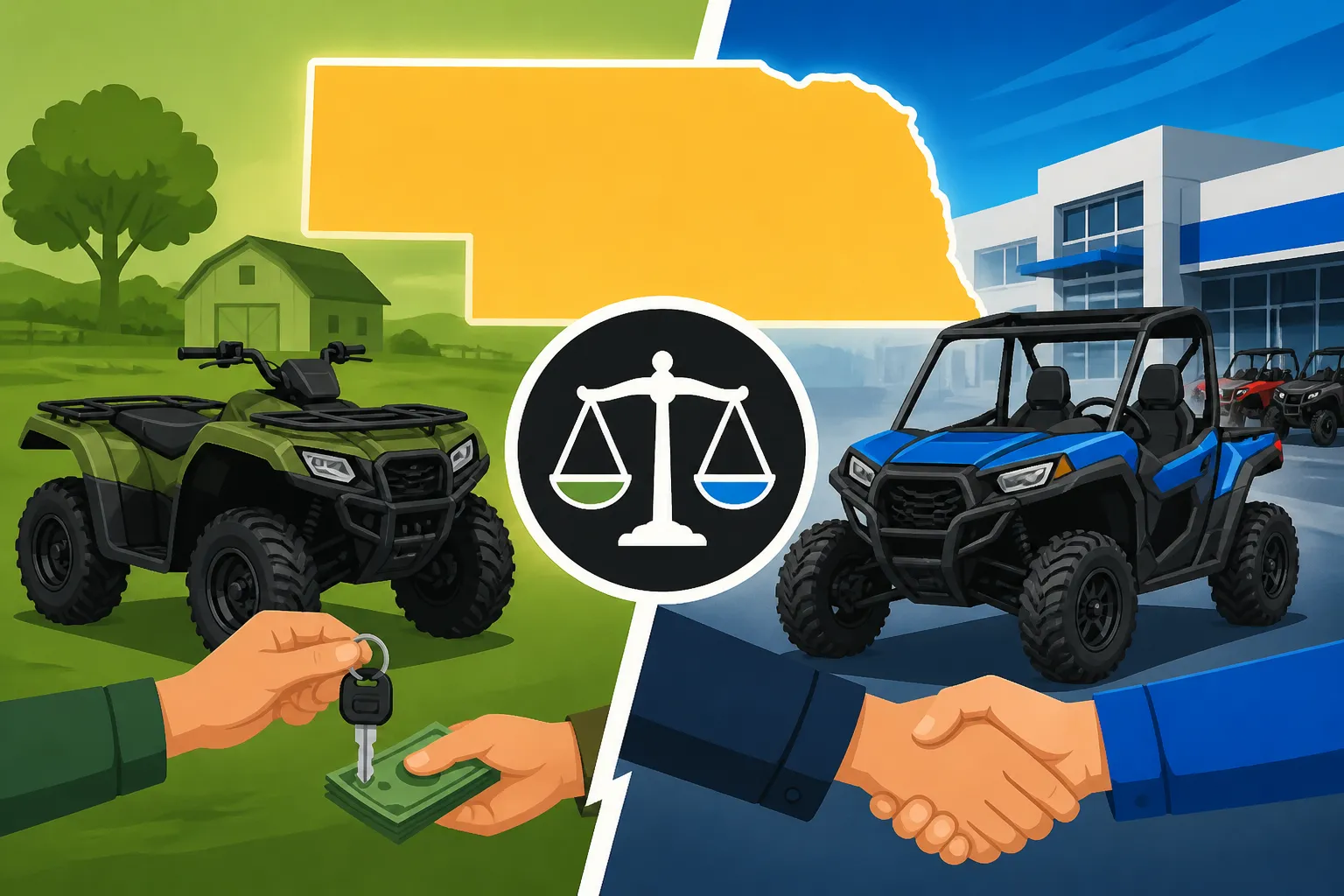
Nebraska Private Sale vs Dealer Purchase
Choosing between a private seller and a dealer in Nebraska affects more than the price on the listing. The seller changes how much you can verify, which paperwork you handle, how tax is reported, and what help is available if something goes wrong. Here’s how to compare the full transaction and choose the route that fits your budget, experience, and tolerance for risk.
The practical difference between buying privately and buying from a dealer
A private sale is a transaction between individuals. The seller may be a neighbor, a rancher, or someone advertising a used ATV or UTV online. You typically negotiate directly, inspect the machine yourself, and take responsibility for making sure the ownership documents are correct.
A dealer sale involves a business that sells machines as part of its regular operation. A dealer may offer new or used inventory, financing options, trade-ins, and help with delivery paperwork. That support can make the process smoother, but it does not mean every cost is included in the advertised price or that every used machine is in perfect condition.
| Purchase factor | Private seller | Dealer |
|---|---|---|
| Price and negotiation | Often more room to negotiate, but condition and demand matter | May include dealer charges; ask for a complete written price |
| Machine history | Depends on the seller’s records and answers | May have service or acquisition records, but ask what is actually available |
| Inspection | Usually arranged by the buyer | Inspection may be possible; confirm whether it is independent or dealer-performed |
| Title and ownership documents | Buyer and seller must confirm the transfer paperwork is complete | Dealer may prepare or submit paperwork, but confirm exactly what it handles |
| Sales tax and titling | Buyer generally handles tax reporting and title application at the county level | Dealer may assist with documents; confirm who handles each step and whether tax is paid |
| Financing | Often requires cash or a separate loan from a bank or credit union | May offer financing through the dealer or a lender |
| Recourse if a problem appears | Often limited; the written agreement and applicable law matter | Depends on the sales contract, any written warranty, and applicable law |
| Best fit | Buyers who can inspect carefully and manage paperwork | Buyers who value a more guided process or want to compare dealer services |
Neither route is automatically the better deal. A low private-sale price can be offset by repairs, missing paperwork, or the time needed to resolve title problems. A dealer’s higher written total may include useful services, or it may include charges you want to question. Compare the machine, the documents, and the full out-the-door cost rather than choosing based on the seller category alone.
Nebraska titles ATVs and UTVs, but a title is not the same as state registration or permission to ride on public roads. Start with Nebraska ATV Title Requirements and Do You Need to Register an ATV in Nebraska? to separate ownership paperwork from riding rules.
What to compare before you commit
The advertised price is only one part of the decision. Before you hand over a deposit or sign a sales agreement, compare the exact machine, its condition, its paperwork, and the total amount you will have to pay.
Compare the same kind of machine
A sport quad, a utility ATV, and a side-by-side may serve different purposes even if the asking prices look similar. Consider how you plan to use the machine: hauling supplies, working around a ranch, riding trails, carrying passengers, or taking it to a designated riding area. An expensive feature you will not use may not be worth paying for, while a machine that is underpowered or configured poorly for your work can become a costly compromise.
Check the machine’s year, make, model, trim, engine size, and stated equipment. For a UTV, confirm seating capacity and whether the listed accessories are included in the price. For either type, ask whether the seller has changed tires, added a winch, replaced a belt, modified the exhaust, or altered other components. Modifications can be useful, but they can also affect maintenance, fit, noise, or resale.
Do not assume that two machines with similar hours or mileage have had similar use. A machine used for careful recreational rides may have a different wear pattern from one that has spent years working in dust, mud, or heavy loads. Look for service records and inspect the parts that carry wear, such as tires, brakes, steering components, suspension, and the drive system.
Compare condition against the asking price
For a used machine, estimate what it would take to make it safe and reliable for your intended use. A worn tire set, damaged plastics, a weak battery, a leaking seal, or a belt near the end of its life can change the real cost substantially. Ask for a cold start when possible, listen for unusual sounds, and check for leaks, smoke, warning lights, and signs of impact or repair.
A dealer inspection can be helpful, but ask what it covers. A basic check is not necessarily a full mechanical evaluation, and a dealer’s inspection is not a substitute for an independent inspection if you want a separate opinion. A private seller may allow an outside mechanic to inspect the machine, or may not. If the seller refuses reasonable verification, decide whether you are comfortable proceeding with that uncertainty.
For more detail, use What to Inspect First on a Used Machine and Engine Hours Versus Odometer Miles on a Used Quad. If the machine has a service history, How Service Records Change a Machine’s Resale Value can help you think through how much weight to give those records.
Compare the documents, not just the seller’s explanation
Ask to see the ownership document before agreeing to buy. Compare the name on the title with the seller’s identification and confirm that the vehicle identification number on the machine matches the number on the document. Do not treat a registration card, an old receipt, a handwritten note, or a seller’s verbal assurance as a replacement for a valid title.
Look for lien information, title brands, corrections, missing signatures, and mismatched names. A seller may have a reasonable explanation for a discrepancy, but the explanation does not make the paperwork ready for transfer. Pause the sale until the issue has been resolved or the county treasurer confirms what documentation is acceptable.
If a lender has a recorded lien, ask how it will be released and how the payoff and title transfer will be coordinated. Do not assume that a promise to pay a loan later gives you clear ownership now. For help understanding the paperwork, see Nebraska Title and Lien Records and How a Lien Is Recorded on an ATV Title.
How the sale route changes the total cost
A fair comparison starts with the full amount you will pay to own and use the machine, not just the amount written in the advertisement. Some costs are tied to the sale, others to title and tax, and still others to what you will need after the machine is yours.
Private-sale costs to plan for
In a private sale, the agreed purchase price is usually the most visible cost. You may also need to budget for tax, title paperwork, repairs, transportation, and any inspection you arrange. If the seller has no trailer or cannot deliver the machine, hauling it home can add a separate expense.
A private seller may accept a trade, but do not assume the trade will be treated like a dealer trade-in for tax purposes. Ask the county treasurer how the transaction should be documented and whether a trade-in adjustment is allowed for the specific sale. Keep a clear written record of any money, machine, or other property exchanged.
Private sellers generally do not provide the kind of financing process a dealership can offer. You may need to arrange a personal or vehicle-related loan separately, and the lender may have requirements for the title, seller, machine age, or purchase documentation. Get the lender’s requirements before promising the seller a payment date.
Dealer costs to ask about
A dealer’s advertised price may not include every charge. Ask for a written breakdown showing the machine price and each additional amount, such as freight, setup, documentation, accessories, delivery, or other dealer charges. These items vary by business and transaction. Check the provider’s current figures rather than relying on a general estimate.
A dealer may offer financing, but compare the complete financing terms rather than focusing on a monthly payment. Ask about the total amount financed, the interest rate, the length of the loan, required down payment, optional products, and whether early payoff has conditions. A lower monthly payment can result from a longer loan rather than a lower overall cost.
If the dealer offers a trade-in, ask for the trade value in writing and compare it with the new machine’s price before looking at tax. A trade can make a transaction convenient, but convenience alone does not show whether the overall offer is competitive. Compare the dealer’s trade amount with what you might receive by selling the old machine yourself, while accounting for the time and effort involved.
For additional cost planning, see Buying an ATV in Nebraska: Taxes and Fees, Nebraska Dealer Doc Fees, and Nebraska Dealer Out-the-Door Price. The point is not to reject every added charge; it is to understand what it covers and decide whether you want it.
Tax and title costs still need attention
Nebraska ATV and UTV purchases involve tax and title paperwork. Do not assume that the seller’s description of “tax included” or “ready to ride” answers how the transaction must be reported. Ask who will submit the title application, where tax is paid, what forms are required, and which charges are already included in the written total.
For these machines, buyers commonly handle the tax statement and payment as part of titling through the county treasurer. Form 6ATV is associated with ATV tax reporting. Dealers may help prepare or submit documents, but get a clear answer about whether they are handling the paperwork or merely giving it to you. If you buy privately, expect to take a more direct role in completing the tax and title process.
Tax can depend on the purchase details and where the buyer lives. A trade-in, rebate, purchase from another state, gift, or auction transaction may require different documentation or treatment. Keep the bill of sale, payment records, trade paperwork, and any dealer statement together. Confirm the current instructions with the county treasurer before the transaction if a tax detail could change your budget.
See Nebraska Sales Tax Paid at Titling, Nebraska Form 6ATV Explained for Buyers, and Nebraska Tax When You Buy Across a State Line for related details. For a private sale, Signing the Sales Tax Statement at a Private Sale can help you understand why both parties may need to provide accurate transaction information.
Private-sale paperwork and buyer protections
A private sale can be straightforward when the title is clear and both parties complete the documents carefully. It can become difficult when the seller is not the titled owner, the title is missing, a lien remains, or the transaction details are not recorded correctly.
Verify the seller’s authority to sell
The person selling the machine should have the legal authority to transfer it. Check that the name on the title matches the seller. If there are two owners, both may need to sign, depending on how the title is written and applicable transfer rules. If the seller is acting for an estate, business, or another owner, ask for documentation showing authority to make the sale.
If the title lists a lienholder, do not treat the seller’s statement that the loan is “almost paid off” as proof the lien has been cleared. Agree on a process that confirms payoff and title release, and get the county treasurer’s guidance if you are unsure how to complete the transfer.
The machine’s VIN should be legible and consistent across the machine and ownership documents. If the number is damaged, altered, or missing, stop before paying. Resolving a serial-number problem after purchase can be difficult and may require additional review. Do not remove, restamp, or alter identification marks yourself.
Make a complete bill of sale
A bill of sale gives both parties a written record of the transaction. It should identify the buyer and seller, the date, the purchase amount, and the machine by make, model, year if known, and VIN. It should also describe any included equipment or separate property that is part of the deal.
Record how payment was made and whether the sale includes a trade. If the seller has made a specific statement about known damage, missing parts, or recent repairs, consider putting that detail in writing rather than relying on a conversation. The bill of sale does not replace the title, but it helps document what was agreed and can support tax reporting.
Do not sign a form with blank fields that could later be completed differently. Before signing, review every entry for accuracy and keep copies of the completed documents. If the title has an error, a missing signature, or a correction, resolve it before the sale where possible. Fixing a Missing Signature on an ATV Title and Correcting a Misspelled Name on an ATV Title cover problems that can delay a transfer.
Be cautious with deposits and payment
A deposit may hold a machine while you arrange an inspection or financing, but the terms should be clear. Write down whether the deposit is refundable, what condition must be met before the sale proceeds, and when the remaining payment is due. Avoid sending money before confirming the seller’s identity, seeing the machine, and checking the ownership document.
For a larger payment, use a method that creates a reliable record and allows both sides to confirm when funds are available. Be cautious if the seller asks you to pay a third party who is not named in the paperwork, ship the machine before the title is signed, or complete a transaction in a way that prevents you from inspecting the vehicle. A rushed transfer can leave the buyer with little practical leverage if the machine or documents are not as represented.
A private sale usually offers less structured support after the transaction. That makes the steps before payment more important: inspect, verify ownership, document the agreement, and do not accept a paperwork problem simply because the price seems attractive.
Dealer purchase: what the process may include and what to verify
Buying from a dealer can reduce paperwork friction, especially for a new machine, but the buyer still needs to understand the transaction. Dealers differ in how they prepare titles, collect documents, arrange delivery, and handle financing. Ask direct questions instead of assuming the process is identical everywhere.
Confirm what the dealer will do
Before signing, ask whether the dealer will submit the title application, provide the ownership documents, prepare the tax statement, and tell you when or where any payment is due. Ask what you will receive at delivery and what documents you must bring to the county treasurer yourself.
For a new machine, confirm that you will receive the manufacturer’s ownership paperwork needed for titling, along with a detailed receipt and any warranty documents. For a used machine, ask whether the dealer has the title in hand and whether any lien or transfer issue remains. A dealer’s involvement does not eliminate the need to match the VIN and review the paperwork.
Get all promises in writing. If the dealer says a part, delivery service, first service, or repair is included, ask to see it in the contract or an attached document. If a date for paperwork or delivery matters to you, confirm it before signing.
Read the full contract and ask about optional products
Review the purchase agreement line by line. Separate the machine’s selling price from dealer charges, accessories, protection products, and financing costs. Ask whether each add-on is optional and whether declining it changes any other term. Do not judge an offer only by the monthly payment or a verbal estimate.
If the dealer is arranging financing, compare the offer with a separate lender before signing when possible. Ask whether a quoted rate depends on a particular down payment, loan term, credit approval, or optional product. If financing is conditional, clarify what happens to your deposit and the machine if the loan is not approved on the terms you expected.
Keep a copy of the signed contract, financing agreement, tax and title documents, warranty terms, and delivery checklist. These records can help answer questions later about what was sold, what was paid, and what was promised.
Understand what a warranty does and does not cover
A new machine may come with manufacturer warranty terms, while a used machine may be sold with a written dealer warranty, a separate service contract, or no additional coverage. Do not infer coverage from a salesperson’s broad description. Read the document for covered parts, exclusions, claim procedures, maintenance requirements, and who is responsible for authorized repairs.
A warranty is not the same as a full mechanical inspection, and a service contract is not necessarily equivalent to a manufacturer warranty. Ask who administers the coverage, whether repairs must be approved in advance, and whether you can use a repair shop near home. If the machine is used, ask whether the warranty transfers to you and when it begins.
A step-by-step buying process for either route
A consistent process helps prevent the most common problems, whether the seller is a dealer or an individual.
- Define the job. Decide whether you need an ATV or UTV, how many riders it must carry, what terrain and workload it will face, and how you will transport it. Make a short list of requirements before comparing listings.
- Set a full budget. Include the agreed price, possible tax and title costs, transportation, inspection, immediate repairs, insurance, safety gear, and any accessories you genuinely need. Keep a reserve for maintenance rather than spending the entire budget on the purchase.
- Compare written totals. For a dealer, request a complete breakdown. For a private seller, write down the purchase terms and any separate equipment included. Compare similar machines and account for condition, service history, and paperwork.
- Inspect the machine. Check the VIN, controls, brakes, steering, tires, suspension, lights, leaks, and signs of repairs or impact. Test the machine only in a safe, lawful setting and with the seller’s permission. Consider an independent inspection for an expensive or mechanically complex purchase.
- Review ownership documents. Match the VIN on the vehicle to the title or manufacturer paperwork. Check names, liens, signatures, and any title brands or corrections. If something does not match, stop and get guidance before paying.
- Agree on the transaction in writing. Record the price, date, machine identity, included accessories, payment terms, trade details, and any promises. Do not leave blanks or rely on an unwritten agreement.
- Confirm tax and title steps. Contact the county treasurer if you are unsure about the required forms, tax treatment, or supporting documents. Confirm whether the dealer is filing anything on your behalf or whether you must complete the process yourself.
- Complete payment and transfer together. Coordinate payment with the signed title and other required documents. Keep copies of the bill of sale, title paperwork, tax statement, receipts, and financing documents.
- Meet the title deadline. Nebraska has a titling deadline after purchase. Do not put the paperwork aside while waiting for the riding season. Review Nebraska’s 30-Day Titling Deadline and confirm the current deadline and filing instructions with the county treasurer.
- Prepare for use separately. A title proves ownership; it does not automatically make an ATV or UTV legal to ride on every road, trail, or public area. Check the rules for the specific place you plan to ride, and arrange insurance if your intended use requires it.
The title transfer is not an administrative detail to leave for later. A buyer who misses the filing window or discovers an incomplete document may face delays and additional steps. What Happens If You Miss the 30-Day Title Deadline explains why prompt follow-through matters.
Which option fits your situation?
A private sale may suit you if you are comfortable evaluating used equipment, checking ownership records, arranging an inspection, and completing the county paperwork. It can also work well when you know the seller or can verify how the machine was used. The lower asking price is meaningful only if the machine and documents hold up to scrutiny.
A dealer may be a better fit if you want to compare multiple machines in one place, prefer help organizing the paperwork, need financing, or want access to a written warranty or service arrangement. Those benefits may be worth added charges, but only if they are clearly described and useful for your needs. A dealer does not remove the need to inspect, read the contract, and verify the title process.
Use this decision check:
| Your situation | Route that may fit better | What to verify |
|---|---|---|
| You know how to inspect a used machine and can manage title paperwork | Private sale | Clear title, matching VIN, lien release, bill of sale, and condition |
| You want financing options presented during the purchase | Dealer | Total financing cost, loan terms, optional products, and deposit rules |
| The lowest advertised price is your priority | Either | Compare repair needs, tax, fees, transport, and documents before deciding |
| You want a written warranty or dealer support | Dealer | Exact coverage, exclusions, claim process, and repair location |
| The seller cannot show a title or explain a VIN mismatch | Neither until resolved | Ask the county treasurer what documentation is required before paying |
| You are buying a machine from out of state | Either, with extra checks | Title transfer, tax treatment, and Nebraska requirements before delivery |
If you are uncertain about a document, a tax adjustment, or whether a person can legally sell the machine, pause the transaction and ask the county treasurer. A short check before payment can be far easier than trying to correct a title or tax problem after the machine is in your possession.
Frequently Asked Questions
Is a dealer purchase automatically safer than a private sale?
No. A dealer may offer more structured paperwork, financing, or written coverage, but you still need to inspect the machine, review the contract, and confirm the title details. A private sale can be sound when the ownership documents are clear and the machine checks out.
Does buying from a dealer mean the sales tax is already paid?
Not necessarily. Ask the dealer in writing who reports and pays the tax and what documents you will receive. Confirm the current process with the county treasurer, especially if the purchase includes a trade, rebate, or out-of-state transaction.
Can I buy an ATV or UTV privately if the seller has no title?
Do not pay until you understand how ownership can be established and what the county treasurer will accept. A bill of sale alone may not resolve a missing-title problem. The seller should address the issue before the transfer whenever possible.
Does a Nebraska title let me ride the machine on roads?
No. A title documents ownership; it is not a general road-use permit or statewide registration. Check the separate requirements for the roads, trails, and public areas where you plan to ride.
Disclaimer
This article is for general informational purposes only and does not constitute professional advice. Laws, prices and regulations vary by location and change over time. Consult a qualified professional for guidance on your specific situation.