Halsey’s Hand-Planted National Forest and Its OHV Trails
A ride near Halsey can look straightforward on a map, then turn into a different day once you factor in trail access, staging, weather, and spotty cell service. This guide explains what to expect at Nebraska’s hand-planted National Forest, how its OHV riding areas differ, and what to check before loading your machine and heading out.
Why Halsey’s Forest Is a Distinctive Riding Destination
A forest planted on the Sandhills
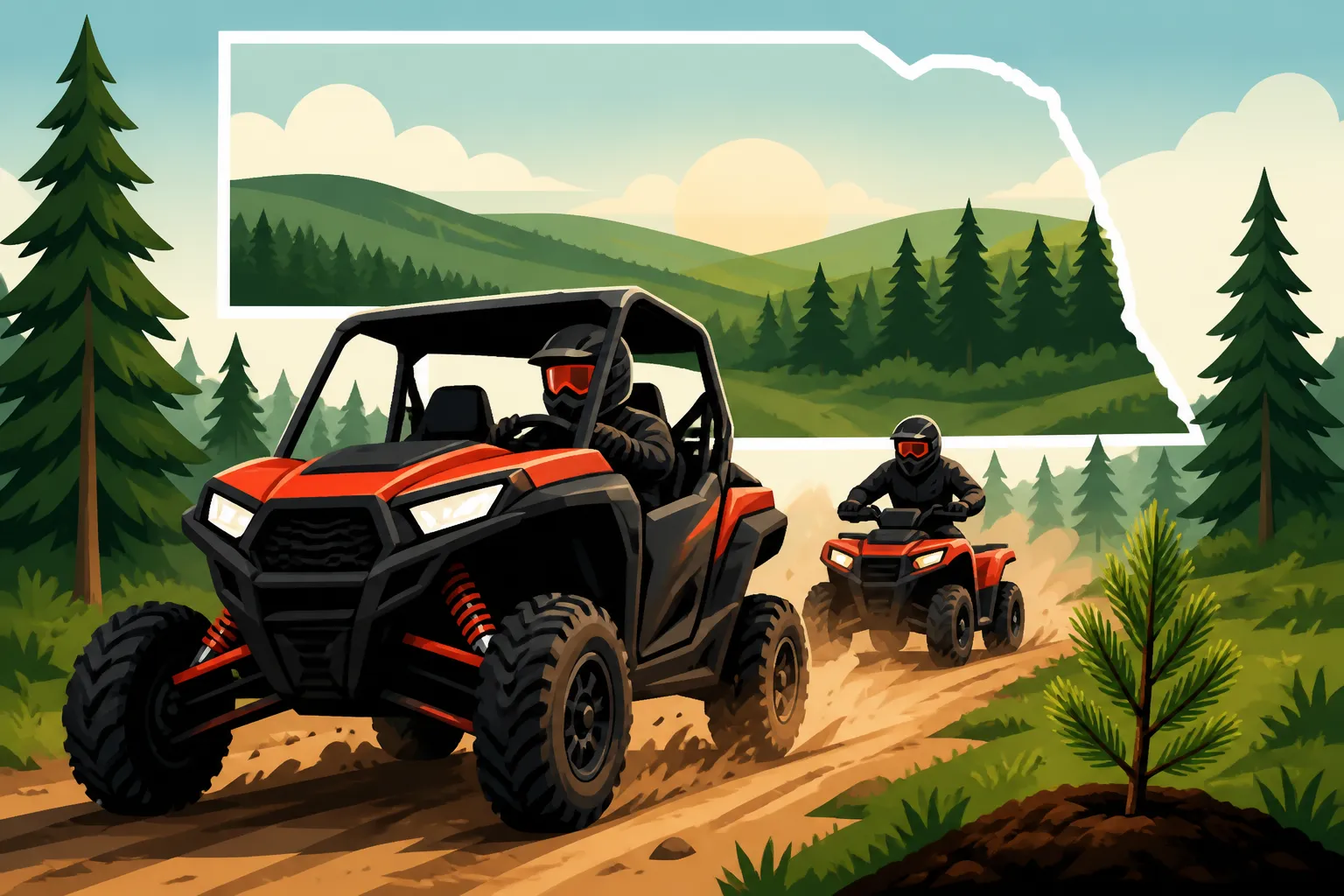
Near Halsey, the Bessey Ranger District manages a remarkable landscape: a large forest planted by people in the Nebraska Sandhills. The trees stand out against the surrounding open country, and the mix of forest, grassland, and sandy terrain gives the area a different feel from a typical wooded trail system.
That landscape is part of the appeal, but it can also make expectations tricky. Riders may picture a continuous, shaded trail network. In reality, conditions and scenery vary across the recreation complex, and open riding areas feel quite different from trails that wind through trees. Check the map and current riding information so you know what kind of terrain you are setting out for.
The forest’s history and the riding layout are connected, but they are not the same thing. The fact that the area was planted for forestry does not mean every forest road or track is open to motorized use. Stay on routes and in areas designated for riding, and treat posted closures as part of the trail system—not as suggestions.
Trails, riding areas, and staging are not interchangeable
The name “Bessey” can refer to a broad recreation area, while individual trailheads and riding zones have their own access points and conditions. Riders often encounter descriptions of roughly 36 miles of forest trail, as well as separate open areas that provide a different kind of ride. These are useful starting points, but a mileage figure alone does not tell you what the surface, difficulty, or layout will feel like.
For an overview of the riding network, see [Bessey OHV Trails at Halsey in Nebraska] and [Bessey's 36 Miles in Nebraska]. Before you set off, compare the route information with the specific places you intend to visit. A trail loop, an open riding area, and a staging area solve different needs; assuming they are all one connected playground can lead to a frustrating arrival.
It also helps to separate riding access from park access. Nebraska state parks and the national forest are not governed by one universal set of ATV rules. In particular, a state park permit does not automatically make a machine legal on every trail, and a forest riding area is not the same as a state park. For the wider distinction, read [Nebraska National Forest Riding] and [Nebraska State Parks Ban ATVs].
Choosing the Right Bessey Riding Area
Forest trails for a more contained ride
Forest trails may suit riders who want a route-based outing rather than an open area where they choose their own line. A marked route can make a day feel more manageable for a group with different experience levels, but riders should still be ready for changing surface conditions, turns, and uneven ground.
Before choosing a loop, check that the route is open to your machine type and that the trail information applies to the date you plan to visit. Do not assume that a route shown in an older screenshot or saved map remains open. Weather, maintenance, fire conditions, or land-management decisions can affect access. For a useful before-you-go checklist, see [Nebraska Trail Conditions Before You Tow].
A printed or downloaded map is especially helpful when a group spreads out or takes a wrong turn. Mapping apps such as onX Offroad can help riders review routes and prepare navigation before leaving home, but do not rely on a phone connection to retrieve information once you are deep in the forest. Save maps for offline use where available, and carry a paper backup.
The Hill Climb and Dismal open areas
Bessey’s Hill Climb area and Dismal area are commonly discussed as distinct riding destinations, not simply as extensions of the forest trail loops. Open terrain can give riders more room to choose lines and explore, but it can also make it harder to judge distance, spot other vehicles, or regroup with people who are riding at different speeds.
The Hill Climb area may appeal to riders looking for a more challenging experience than a straightforward trail loop. That does not mean every hill is appropriate for every machine or skill level. Walk unfamiliar sections when it is safe to do so, avoid following another rider into a line you cannot assess, and agree with your group in advance about when to stop and regroup.
The Dismal area offers another setting and should be researched on its own terms. Read [Bessey's Hill Climb Area in Nebraska] and [Bessey's Dismal Area in Nebraska] before deciding which one fits your group. If you are travelling with beginners, children, or a mix of ATVs and side-by-sides, discuss terrain and expectations before leaving the staging area.
| Riding option | What it may suit | What to check before you ride |
|---|---|---|
| Forest trail routes | Riders who prefer following a defined route | Current closures, route markings, machine access, and surface conditions |
| Hill Climb area | Riders seeking more demanding terrain | Skill level, safe lines, group separation, and posted limits |
| Dismal area | Riders wanting to explore a separate open riding area | Access details, boundaries, current conditions, and staging |
| Trailhead or staging area | Unloading, preparing, and organizing a ride | Parking rules, fee information, space for trailers, and where riding is permitted |
Planning the Trip Before You Tow
Confirm access and parking details
The easiest way to spoil a riding weekend is to assume that the last trip’s parking or access arrangement still applies. Before you leave, check current information for the area you plan to use, including where you can stage, whether a fee applies, what the fee covers, and whether any part of the riding area is temporarily closed.
Do not treat parking as an afterthought. A truck-and-trailer combination needs a suitable place to unload without blocking roads, other visitors, or emergency access. If your group arrives in several vehicles, agree on where everyone will meet and how you will handle a full or busy lot. The article [Planning a Long Trailer Haul to the Bessey Trails] can help you think through the drive and arrival, while [Nebraska Trailheads With Trailer Parking] covers the practical issue of staging with a trailer.
Fee information can be easy to misunderstand because a parking charge and permission to ride are not necessarily the same thing. Read [Where to Pay the Fee at Bessey Recreation Complex] and [What the Bessey Parking Fee Covers] to clarify the distinction. Follow the instructions posted at the site, and keep any required proof of payment available during your visit.
Prepare for limited service and changing conditions
Cell service can be unreliable in forest and rural areas. Download route information before leaving a town with dependable coverage, and tell someone at home where you intend to ride and when you expect to return. If plans change, update your group and your check-in contact rather than assuming everyone has the same information.
If you use onX Offroad or another navigation app, check that the relevant map data is available offline before you depart. A live map that depends on a signal may not be useful when you need it most. Carrying a paper map and knowing how to orient it can be a simple backup, especially if a device battery dies or a phone is damaged on the trail. See [Planning for No Cell Service on a Forest Ride] and [Why You Still Carry a Paper Trail Map].
Weather can change the ride, too. Rain may make some routes unpleasant or difficult, while dry and windy conditions can increase dust and reduce visibility. Check conditions close to departure, not only when you first reserve time for the trip. If recent weather raises concerns, adjust your plans rather than trying to force a full day on a route that no longer suits your group.
Riding Safely and Respectfully
Match the ride to the least experienced person
A group ride is only as manageable as the plan you make for its least experienced rider. Before setting off, agree on a pace, a regrouping point, and what to do if someone needs to stop. On open terrain, it can be surprisingly easy to lose sight of a rider who has moved over a rise or taken a different line.
Encourage new riders to be honest about what they are comfortable attempting. They should not feel pressured to follow a more experienced rider up a steep section, through loose ground, or onto a route they do not understand. If the group includes different machine types, remember that an ATV and a side-by-side can handle terrain differently and may not fit the same route equally well.
A navigation app such as onX Offroad can help the group discuss planned routes before riding, but it should support—not replace—clear communication and sensible judgment. Set a turnaround point and make sure everyone understands how to get back to staging. If a rider loses sight of the group, a simple plan to stop safely and wait in a known location is better than continuing to guess.
Stay on authorized routes and respect other visitors
Follow signs, barriers, and route markings, even when an unmarked path looks tempting. Cutting across vegetation or bypassing a closure can damage the area and put the group in conflict with land-management rules. If you are uncertain whether a route is open to motorized use, stop and confirm before proceeding.
Share space courteously with other visitors. Keep speeds appropriate for visibility and terrain, slow down around staging areas, and give other riders room to pass safely. Dust can travel farther than expected, particularly on dry days, so spacing out can improve visibility and make the ride more comfortable for everyone.
Good trail etiquette also means leaving the place ready for the next group. Pack out trash, avoid blocking access, and do not leave damaged equipment or supplies behind. If you find a hazard or a confusing closure, note its location and report it through the appropriate land-management channel rather than moving signs or creating a new route around it.
A Practical Checklist for a Halsey Riding Day
Before leaving home
Start with the ride itself: choose the area, confirm current access, and decide whether your group wants forest trails, an open riding area, or both. Then verify the machine rules and staging details for those locations. If you are comparing destinations, use [Nebraska ATV Trails: Where to Ride] as a broader starting point, but confirm local information for Bessey before towing.
Check your trailer, tie-downs, tires, fuel, and basic tools. Bring drinking water, food, protective gear, and a first-aid kit suited to your group. Charge phones and navigation devices, download maps for offline use, and pack a paper map if you have one. Tell someone where you are going, especially if you expect to be out of cell range.
Make sure the whole group knows what to expect. Share the meeting point, the planned route, the approximate return time, and a backup plan if access is closed or conditions are poor. That short conversation can prevent the familiar trailhead argument where one person expected an easy loop and another arrived ready for a technical ride.
At the trailhead and on the way home
When you arrive, take a few minutes to read posted signs and confirm that the area is open. Unload without blocking traffic or other visitors, secure loose gear, and check that everyone is ready before leaving staging. If anything on the ground conflicts with your saved route, trust the current signs and official directions.
During the ride, maintain a pace that keeps the group together and stop before small problems become larger ones. A rider who is tired, overheated, or uncomfortable with a section should be able to say so without being teased or hurried. Conditions at a riding area can shift as the day goes on, so reassess rather than sticking rigidly to a plan.
After riding, inspect machines for damage and remove mud, sand, or plant material as appropriate before hauling home. Confirm that all riders and equipment are accounted for, and let your check-in contact know you have returned. A little care at the end of the day makes the next visit easier—and helps keep Halsey’s forest and OHV areas enjoyable for the people who ride after you.
Disclaimer
This article is for general informational purposes only and does not constitute professional advice. Laws, prices and regulations vary by location and change over time. Consult a qualified professional for guidance on your specific situation.