What Joining the Off-Highway Vehicle Association Gets You
Joining an off-highway vehicle association can sound worthwhile until you wonder what membership actually changes: Will it open more trails, help you find riding partners, or simply support a cause? In Nebraska, where riding access depends on the specific trail, land manager, and local rules, this guide explains what an association may offer—and what it cannot replace.
What an OHV association can do for Nebraska riders
Support rider advocacy and public-land access
An off-highway vehicle association can give riders a shared place to discuss access, trail conditions, and issues affecting motorized recreation. That matters when a concern is bigger than one person’s ride: a trail closure, unclear signage, limited places to ride, or a proposed rule that could affect many users. A group can help members follow those discussions and decide whether they want to participate.
Membership does not automatically give you a vote in every land-management decision, and it does not guarantee that a trail will stay open. Public agencies and private landowners make access decisions under their own processes. An association may help riders understand how to submit comments, attend a meeting, or contact the appropriate office, but it is still worth asking what the organization actually does before you join.
For Nebraska riders, the useful question is not just whether an organization supports OHV access in general. Ask whether it follows issues relevant to the places you ride, such as Bessey OHV Trails at Halsey, Cedar Run ATV Trail, or riding areas closer to home. If local advocacy is important to you, ask which projects or decisions the association is currently focused on. You can also read [Nebraska Off-Highway Vehicle Association] to explore that topic further.
Build a stronger riding community
Associations can make it easier to meet people who understand the practical side of riding: which trailer fits a particular machine, what equipment to bring, how to plan a group ride, and where to look for current access information. A new rider who has mostly ridden on private property may appreciate meeting people familiar with public trail etiquette. Experienced riders may value a chance to share what they have learned or help with local projects.
A group also gives you a place to compare notes without relying on a single social-media post. One rider may have visited a trailhead recently; another may know that a route is subject to seasonal restrictions; someone else may have contacted the land manager. Those conversations can be helpful, but treat them as leads rather than final authority. Confirm rules and closures with the responsible land manager before you haul your machine.
Before joining, find out whether the association actually holds events, meetings, work days, or informal gatherings—and whether those activities fit your schedule. Some people want an active club calendar. Others are happy to support the work without attending often. Neither is the “right” kind of member; the important thing is knowing what kind of participation is available.
Possible benefits beyond paying dues
Learn about trail etiquette and responsible riding
A membership can connect you with riders who care about keeping riding areas usable. That may mean learning to slow down near campgrounds, share narrow routes safely, avoid riding when conditions are vulnerable to damage, and leave gates and staging areas as you found them. These habits are especially useful when riders with different machines and experience levels use the same area.
Good etiquette is not just about being considerate. It can affect how other trail users, nearby residents, landowners, and managers view motorized recreation. A loud or inconsiderate group can leave a poor impression that lasts beyond one weekend. On the other hand, riders who follow posted rules, pack out trash, and cooperate with other users help show that access comes with responsibility.
An association may provide a setting to discuss these expectations, but it is not a substitute for the rules at a specific riding area. Check the local guidance before each trip. If you are planning a larger outing, review [Nebraska Trail Etiquette Locals Expect] and [Nebraska Trail Difficulty Ratings] so your group can talk through pace, skill levels, and how to handle changing trail conditions.
Find riding information and plan outings with better context
Riders often join a group hoping it will make trip planning easier. Members may share firsthand impressions of a trailhead, discuss where they staged, or compare what they found on a recent visit. This can help you decide what questions to ask before leaving home, particularly if you are towing a trailer a long distance or taking children or newer riders along.
But a recommendation from another rider is not a guarantee that a route is open, suitable for your machine, or appropriate for your group. Conditions can change after rain, during maintenance, or when land managers adjust access. Ask when the information was gathered and verify important details through the trail operator or public land office. For routes with limited cell coverage, plan as though you may not be able to check updates once you arrive.
Digital mapping can also be one part of a sensible plan. Some riders use onX Offroad to review mapped routes and organize trip details, while still checking official sources for closures and access rules. A map can help with orientation; it does not grant permission to ride on land, confirm that a route is open, or replace posted signs. For a longer outing, pair your digital tools with a paper backup and a clear plan for regrouping if the group gets separated. Related planning topics include [Nebraska ATV Trail Map Downloads] and [Nebraska Trail Conditions Before You Tow].
What association membership does not provide
Membership is not a trail pass or permission slip
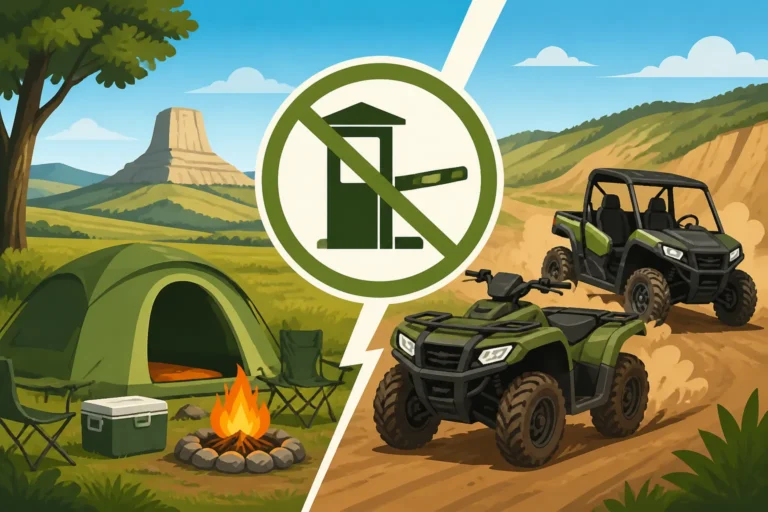
This is one of the easiest misunderstandings to make: joining an association does not, by itself, authorize you to ride a particular trail, forest road, private property, or wildlife management area. Access comes from the land manager’s rules, a landowner’s permission, and any permits or other requirements that apply to that location.
The same goes for a membership card, club sticker, or association event announcement. Those items should never be treated as proof that a route is open to your machine. A route shown in a map or mentioned by another member may cross land with different rules from the trailhead where you started. Follow signs and verify route boundaries before proceeding.
Before every outing, identify who manages the riding area and check that manager’s current instructions. For national forest riding, start with the appropriate Forest Service office or official forest information. For a private riding park, check the park’s own rules. For other public lands, read the agency’s access guidance. [Nebraska Has No OHV Permit or Sticker] is a useful reminder that a statewide sticker is not the same thing as permission to ride at a specific location.
Membership does not replace machine paperwork, insurance, or safety planning
An association generally cannot take the place of title paperwork, insurance requirements, or legal obligations that apply to your machine and the way you ride it. Nebraska titles ATVs but does not register them statewide in the same way some riders may expect. Road use, city rules, public-land access, and private-park requirements are separate questions, so do not assume that joining a group settles any of them.
Insurance is another area where it helps to keep the issues separate. A group may share general advice, but your coverage depends on your policy and intended use. If you plan to ride on roads where insurance is required, check your policy and the applicable rules rather than relying on a club conversation. You can review [When Nebraska Riders Are Required to Carry Insurance] for a closer look at that distinction.
Safety planning still belongs to each rider. Think about protective gear, machine condition, weather, fuel, water, communications, and the abilities of everyone in your group. A club event may have its own procedures, but those do not automatically cover every ride you take independently. If you are bringing a child or an inexperienced rider, ask about supervision, passenger rules, and whether the route is suitable before you leave.
How to decide whether joining is worth it
Match the association’s activities to your reasons for joining
Start by writing down what you hope to get from membership. Maybe you want to support trail access, meet other Nebraska riders, help with trail work, learn more about local riding areas, or receive information about organized events. A membership is more likely to feel worthwhile when its activities line up with your actual reason for joining.
Then ask practical questions. Does the organization serve riders in the part of Nebraska where you live? Does it communicate regularly? Are meetings or activities accessible to you? Does it welcome different kinds of machines, experience levels, and schedules? A group with an active calendar may be a great fit for someone who wants frequent participation, while a low-key organization may better suit someone who mainly wants to support advocacy.
Also ask what membership does and does not include. Find out whether events require separate registration, whether volunteer work is optional, how the group handles safety, and whether members are expected to follow a code of conduct. Those details help you understand the commitment without assuming that every association works the same way.
Compare joining with other ways to participate
Joining is not the only way to learn about riding or support access. You can attend a public meeting, volunteer for a one-time cleanup, contact a land manager with a question, or join an organized ride as a guest if that is allowed. These options can help you get a feel for the group before making a longer-term commitment.
A useful comparison is the kind of value you want. If you are looking for companionship, an informal group ride may be more immediately helpful. If your priority is sustained advocacy or organized volunteer work, an association may provide a more structured way to contribute. If your biggest challenge is simply finding legal places to ride, start by researching the locations and their rules; membership alone will not solve that access question.
| What you want | What an association may help with | What you should verify separately |
|---|---|---|
| More riding contacts | Introductions, events, and shared planning | Whether events suit your schedule and machine |
| Better access information | Rider discussions and updates | Current rules with the land manager |
| A voice on access issues | Coordinated discussion and participation | The association’s actual advocacy work |
| Safer group outings | Shared experience and riding norms | Event procedures and your own preparation |
| Permission to ride | Usually not provided by membership alone | Land access, permits, and posted restrictions |
If you are unsure, ask whether you can attend a public meeting or participate in a volunteer activity before joining. You might discover that the association is an excellent fit—or that a different way of participating better matches your time and goals.
Making membership useful after you join
Be an informed member, not just a name on a list
If you join, take a little time to learn how the organization communicates and what members can contribute. Read announcements carefully, ask where information comes from, and distinguish firsthand trail observations from official notices. If a member reports that a route was open last weekend, that is useful context, not confirmation that it remains open today.
You can also contribute in ways that fit your experience. New riders can ask thoughtful questions and share what was confusing about planning a first trip. Longtime riders may be able to help newcomers prepare, volunteer at an event, or describe how a route has changed over time. If you have a concern about access, share the location and details clearly rather than repeating an unverified rumor.
OnX Offroad or another mapping tool can help you keep a trip organized, but be careful about how you share routes with others. A line on a map can be misunderstood as an approved trail. Include the source and date of any access information you pass along, and encourage riders to confirm it with the land manager. That small habit can prevent a well-intended recommendation from becoming a trespass problem.
Help protect the places you want to keep riding
Access depends in part on how riders behave. Staying on designated routes, respecting closures, avoiding unnecessary noise, and leaving staging areas clean are simple actions that matter over time. When the ground is soft or a route is closed, turning around may be frustrating—especially after a long tow—but ignoring a restriction can create damage and make future access harder for everyone.
For a group ride, set expectations before anyone starts the engine. Confirm the route and meeting point, discuss how the group will handle a breakdown, and agree not to split up without a plan. Make sure riders know the rules for the area, including any limits on machine type or route use. A calm, prepared group is easier to manage than a collection of riders all making decisions on the fly.
You can also learn from the places you visit. Ask what the land manager wants riders to know, look for posted updates, and report a safety concern through the appropriate channel. If an association organizes stewardship work, consider whether you can contribute. Small, consistent efforts—following closures, helping keep a staging area clean, and sharing accurate information—are practical ways to support responsible riding in Nebraska.
Disclaimer
This article is for general informational purposes only and does not constitute professional advice. Laws, prices and regulations vary by location and change over time. Consult a qualified professional for guidance on your specific situation.