Campers Who Pay No Trail Fee
A camping reservation can make a Bessey riding weekend simpler, but it can also leave you wondering whether you owe a separate trail or parking fee. The key is to distinguish the cost of your campsite from the fee charged to trailhead users, then confirm that your camping location qualifies for the camper exemption before you unload your machines.
How the camper trail fee exemption works
A campsite charge and a trail fee are different things
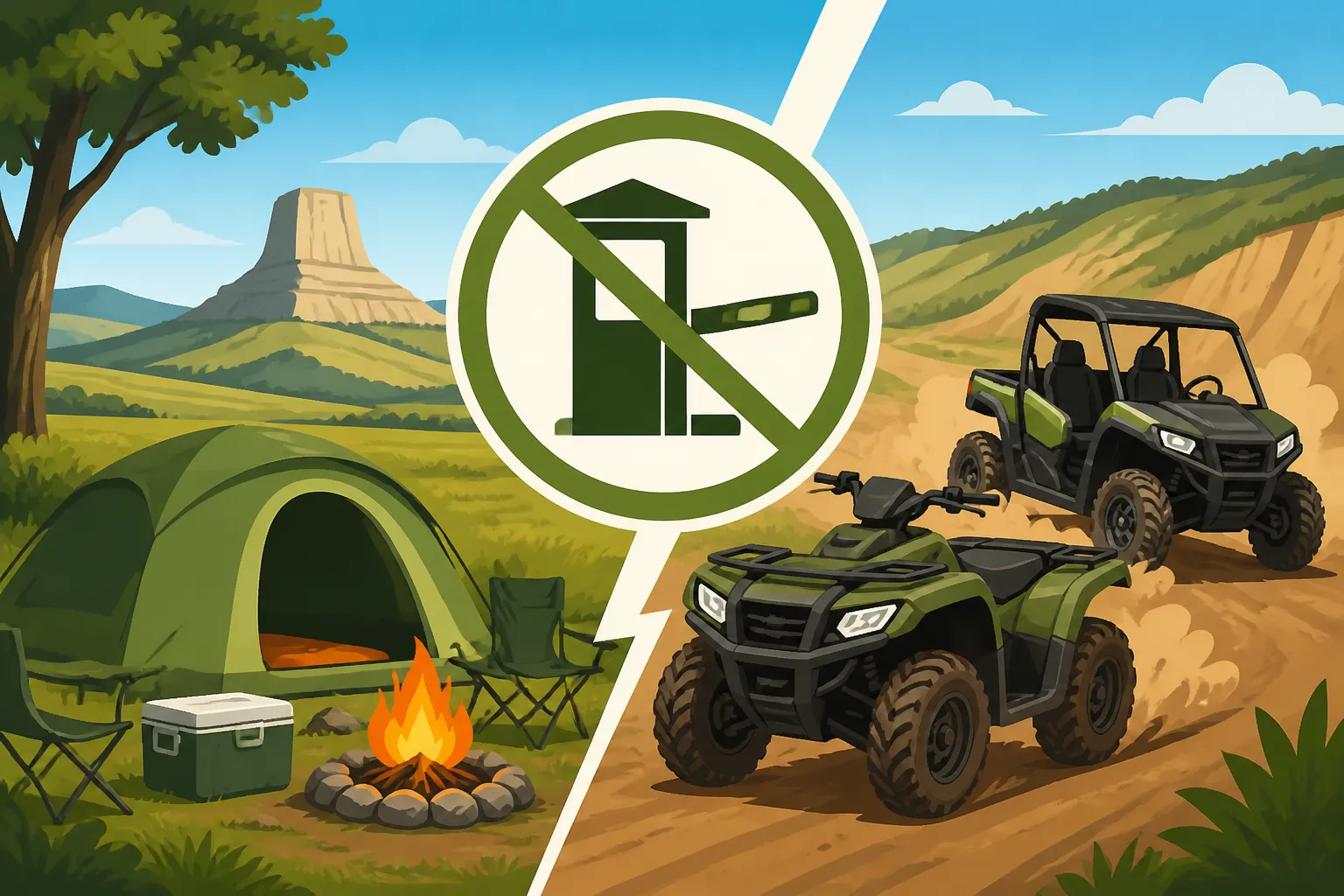
At Bessey, campers who qualify for the applicable campground arrangement may not have to pay a separate trail fee. That does not mean the camping itself is free. Your campsite charge and any other required campground costs still apply; the exemption is about not paying the separate fee that would otherwise apply to trail access or parking.
That distinction matters when you’re building a weekend budget. A family might reserve a campsite, bring a truck and trailer, and assume the campsite charge covers every vehicle and every kind of use. Or they might pay a trailhead fee without realizing their campground stay could affect whether a separate charge applies. Before you go, check the current directions for your specific campground and the fee instructions posted at the trailhead.
The distinction is especially useful when comparing [Camping at Whitetail in Nebraska] with [Camping at a Main Campground in Nebraska]. A campsite near a riding area is not automatically covered by the same arrangements as a campground that is part of, or specifically connected with, the riding complex. Confirm the details for the place where you’ll actually sleep—not just the nearest place listed on a map.
What the exemption does and does not cover
A camper exemption should be treated as a narrow fee rule, not as an all-access pass. It does not establish that every person in your group can ride anywhere, that every vehicle is covered, or that all campground services are included. It also does not replace any separate park permit or other requirement that may apply to a different destination or activity.
| Situation | What to check |
|---|---|
| Staying at the campground connected to the riding area | Whether campers there are exempt from the separate trail fee |
| Camping somewhere else nearby | Whether that location qualifies, rather than assuming proximity is enough |
| Bringing more than one vehicle or trailer | Whether the fee instructions apply to each vehicle or to the camping party |
| Riding in a different area during the trip | Whether that location has separate access, parking, or permit rules |
| Arriving before your campsite is available or staying after checkout | Whether the exemption applies during those hours |
| Unsure where payment is handled | Ask the campground host or follow the posted instructions at the fee station |
When instructions are unclear, do not guess based on what another group paid last weekend. Ask the campground host or contact the relevant recreation office before you head out. You can also review [What the Bessey Parking Fee Covers] and [Where to Pay the Fee at Bessey Recreation Complex] to understand the fee setup and where visitors are directed to handle it.
Who should confirm eligibility before relying on the exemption
The campground location matters
The easiest mistake is assuming that “camping near the trails” and “camping at a qualifying campground” mean the same thing. They may not. A privately operated campground, a dispersed camping spot, or a site in another recreation area could have different arrangements from a campground associated with the riding complex.
For example, imagine you’ve booked a site outside the main riding area because it has more room for your trailer. You may still be close enough to ride, but that does not automatically make you eligible for the same fee treatment as someone staying at the campground covered by the exemption. Confirm the name and location of the campground, then ask directly whether campers there pay a separate trail fee.
This is also worth checking if your plans change at the last minute. If the campground you intended to use is full and you move elsewhere, the original assumption about the fee may no longer hold. Keep the campground name and reservation details handy so you can give the host or office precise information instead of asking a general question that could produce a confusing answer.
Your arrival time and group setup can change the practical answer
Groups often arrive in stages. One truck may reach camp early to set up, while another family arrives later with the ATVs. If the exemption depends on being a registered camper, ask whether the late-arriving vehicles or riders need to show proof of the reservation or follow another check-in process.
Likewise, if you plan to use the trails before check-in or after checkout, clarify whether the exemption applies during that part of the visit. Do not assume that a campsite reservation automatically covers trailhead parking at any hour or for an unlimited length of time. The important details are the campground’s terms and the current fee instructions, not simply whether someone in your group has a reservation.
If you’re traveling with several machines, a side-by-side and a trailer, or multiple vehicles, ask how the arrangement applies to your whole setup. It is much easier to sort that out by phone or at check-in than while blocking a busy entrance and trying to interpret a sign with a line of riders behind you. For a focused list of questions, see [Questions Worth Asking a Ranger District Office].
Planning a camping and riding weekend at Bessey
Check the riding area, route, and conditions before towing
Bessey offers a substantial riding experience, but a long trail network doesn’t mean every route suits every machine or rider. Review the route information, riding-area boundaries, and current conditions before towing from home. [Bessey's 36 Miles in Nebraska] can help you understand the scale of the trail system, while [Nebraska Trail Conditions Before You Tow] is a useful reminder to check conditions before committing to a long drive.
A paper plan is still helpful even if you use a phone. Mark the campground, trailhead, fuel stop, and a backup route before you leave. An app such as onX Offroad can be useful for reviewing off-road mapping and organizing your intended route, but don’t treat a digital map as permission to ride on a closed trail or across land where access is not allowed. Check local signs and follow official closures.
Cell coverage and battery life can also become practical concerns once you’re away from town. Download or save the information you’ll need before the trip, carry a way to navigate if your phone loses service, and make sure everyone knows the meetup point if the group gets separated. A map tool such as onX Offroad is most useful when it is part of a backup plan rather than your only source of directions.
Make the campground work for the whole group
Think through the trailer and campsite layout before you arrive. A narrow site, a tight turn, or a full parking area can make unloading stressful, especially if you reach camp near dusk. Check whether your reservation includes space for your tow vehicle and trailer, and whether additional vehicles need to park elsewhere. If those details are not clear, ask in advance rather than assuming the site can accommodate every vehicle in your group.
Pack for a weekend where the riding day may run longer than expected. Bring water, basic first aid supplies, repair items suited to your machine, and clothing for changing weather. Let a person who is not riding know where you plan to go and when you expect to return. Those small preparations make a bigger difference when a mechanical issue or a slower-than-planned trail day pushes the group’s schedule.
For a longer haul, plan the towing leg as carefully as the trail time. Secure machines properly, check the trailer before departure, and decide where the group can safely stop if someone needs a break. [Planning a Long Trailer Haul to the Bessey Trails] can help you think through the travel side before you set off. If you’re comparing possible fee arrangements along the way, [When an Annual Parking Pass Beats Paying Daily] may help you identify questions to ask, though a pass should not be assumed to replace campground-specific instructions.
What to do when you arrive
Follow posted instructions and keep proof of your stay handy
When you get to camp, check in first and confirm the fee instructions for your specific reservation. Keep your confirmation accessible, whether as a printed copy or on your phone. If a fee station or sign asks campers to take a particular action, follow that direction even if you believe the exemption applies. A reservation record can make it easier for staff to confirm your status and resolve misunderstandings.
Then look over the trailhead signs before unloading. Fee instructions, route closures, and other notices can be different from what you remember from a previous visit. If a sign appears to require payment but you believe your campsite makes you exempt, ask the host or designated office before proceeding. A quick clarification is better than leaving the vehicle in the wrong place or discovering a problem after the ride.
The exemption is not the same thing as a Nebraska ATV registration sticker. Nebraska’s statewide rules and a specific recreation area’s parking or access arrangements are separate questions. For background on the state-level distinction, see [Nebraska Has No OHV Permit or Sticker]. Don’t confuse that general rule with the fee policy at a particular campground or trailhead.
Use a simple pre-trip checklist
Before leaving home, confirm the campground name, reservation details, and whether campers there are exempt from a separate trail fee. Ask how the rule applies to your vehicles, arrival time, and any riding before check-in or after checkout. If you’ll visit more than one riding area, check the access rules for each destination instead of carrying the Bessey arrangement over to another location.
At arrival, check in, read the current signs, and follow any payment or registration instructions. If you need clarification, ask before riding. Save the answer or note who provided it, particularly if your group is arriving in separate vehicles. This can spare you an awkward debate at the trailhead and help everyone start the weekend on the same page.
Finally, keep the exemption in perspective: it can remove one separate fee for eligible campers, but it does not remove the need to respect campground rules, trail closures, land boundaries, or safe riding practices. A little confirmation before the trip lets you focus on the reason you came—to camp, ride, and enjoy the Nebraska outdoors without an avoidable surprise at the fee station.
Disclaimer
This article is for general informational purposes only and does not constitute professional advice. Laws, prices and regulations vary by location and change over time. Consult a qualified professional for guidance on your specific situation.