Two Trailheads With No Fee
Finding a free place to unload can make a Nebraska ATV trip easier, especially when you are towing to the Bessey OHV trails near Halsey. But “no fee” can mean no parking charge at a particular trailhead—not permission to ride anywhere or camp for free. This guide explains how to check the two no-fee trailheads, plan your arrival, and avoid confusing parking costs with other rules.
What no-fee trailhead access means at Bessey
A free place to park is not a blanket pass
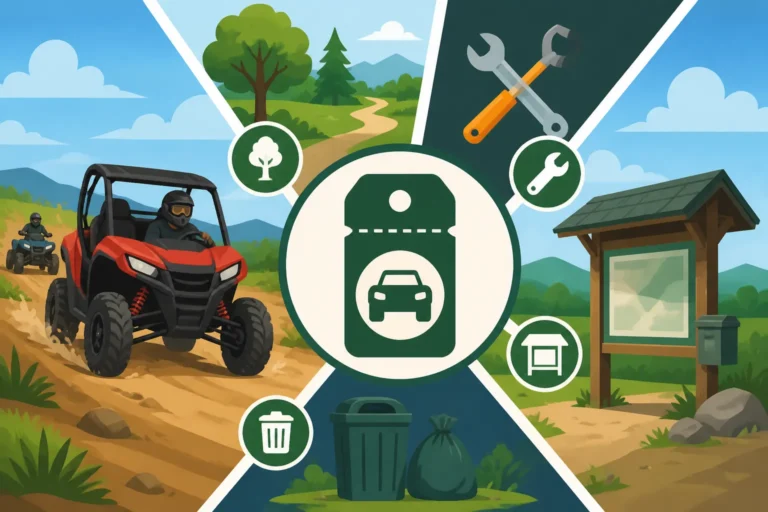
Bessey’s trail system is in the Nebraska National Forest near Halsey, in the Sandhills. When riders talk about two trailheads with no fee, the important distinction is that the claim concerns access or parking at particular trailheads. It does not automatically mean every lot, campground, recreation area, or service nearby is free.
That distinction matters when you arrive with a truck, trailer, and several machines. You may be able to park without paying at one trailhead while a different parking area has a fee. Camping, using developed facilities, or visiting a separate recreation site can also involve different rules. Treat the location you plan to use as the deciding factor, not a general statement that “Bessey is free.”
Before leaving home, check the trailhead’s posted information and the managing agency’s current notices. If a sign at the entrance gives instructions about payment, parking, hours, or closures, follow the sign even if an online map or an older trip report describes the area differently. For a broader look at where charges may apply, see [Which Bessey District Trailheads Charge You to Park](Which Bessey District Trailheads Charge You to Park).
Trail fees, parking fees, and park permits are different things
A fee associated with parking at a trailhead is not necessarily a fee to ride every mile of trail. Likewise, a state park entry permit is not the same as a parking charge at a National Forest trailhead. Riders often mix these up because the costs can all show up during the same weekend: one at the parking area, another at a campground, and perhaps a separate permit for another destination.
For example, a rider might stage at a no-fee Bessey trailhead in the morning, then drive to a state recreation area later in the weekend. The free parking at the first location does not settle the permit question at the second one. Nebraska’s broader public-land rules are worth checking before you make a multi-stop itinerary; [Nebraska State Park Entry Permits](Nebraska State Park Entry Permits) explains why a park permit and ATV access are separate questions.
The same care applies to riding access itself. A no-fee parking area does not mean every nearby road, open space, or unmarked track is open to motorized use. Stay on routes designated for your vehicle and obey closures and posted restrictions. A useful starting point for planning around the Bessey system is [Bessey's 36 Miles of Forest Trail at Halsey](Bessey's 36 Miles of Forest Trail at Halsey).
How to confirm which trailhead is free
Do not rely on a vague map label such as “trail access” or “parking.” Look for the actual trailhead name, entrance location, and any associated fee instructions. If you are comparing two possible unloading spots, make sure the directions take you to the specific parking area—not just to the general Bessey or Halsey vicinity.
An app such as onX Offroad can help you compare your planned route with mapped access points and avoid arriving at the wrong turnoff. Use it as a planning aid, not as the final word on fees or closures. Check for current signs and official information before you unload, and be prepared to use another designated lot if the one you reach has a posted charge or restriction.
| What you are checking | What to look for | Why it matters |
|---|---|---|
| Trailhead identity | The exact name and entrance shown for your intended lot | Nearby access points may have different rules |
| Parking charge | Posted fee instructions at the lot | A trailhead-specific fee may not apply to every location |
| Riding access | Designated routes and any closure notices | Free parking does not make every track rideable |
| Camping or facilities | Separate campground or recreation-area rules | Parking and overnight-use charges may differ |
| Vehicle fit | Whether your ATV or UTV is permitted on the route | A trail may have restrictions that do not apply to the parking lot |
Plan your arrival before towing to the trails
Choose your unloading point before you leave
The best trailhead is not always the one that looks closest on a general map. A narrow approach, a crowded lot, or a route that is not suitable for your trailer can turn a simple arrival into a stressful one. Decide where you intend to unload, then check the route from the highway to that specific parking area.
If you are towing from a distance, save the location and directions before you lose cell service. onX Offroad can be useful for comparing mapped roads and access points, but it should not replace signs at the site. A digital route can help you orient yourself; it cannot tell you that a gate has been closed or that a posted notice has changed the day’s access.
Think about the whole group, too. A two-person trip with one small trailer has different staging needs from a family convoy with several machines. If you are meeting friends, agree on one specific lot and a backup location. “Meet at Bessey” can mean different things to different drivers, particularly if some are following a navigation app and others are using older directions.
Arrive ready to pay if the signs require it
Even when you are aiming for one of the no-fee trailheads, build a little flexibility into your plans. You may find a lot is full, temporarily restricted, or not the access point you expected. If you need to move to another designated parking area, you do not want a payment question to derail the ride.
Read the payment instructions at the parking area before unloading. Note whether the instructions refer to parking, overnight use, or another specific activity. Keep any receipt or pass where it can be found, and follow directions about displaying it if required. For practical details about the payment location and process, consult [Where to Pay the Fee at Bessey Recreation Complex](Where to Pay the Fee at Bessey Recreation Complex).
If the instructions are unclear, pause and ask the relevant office or staff member before assuming that no payment is due. This is easier than discovering after the ride that you misunderstood a sign. A quick check also helps separate a real fee question from a separate concern, such as a closed route or a restriction on a particular type of machine.
Make a backup plan for busy days
A popular weekend, a local event, or a stretch of good riding weather can make convenient parking harder to find. A backup plan should name another suitable, designated place to stage—not simply a nearby field, road shoulder, or open patch of ground. Parking safely and legally matters as much as getting your trailer off the road.
Before setting out, check whether the place you might use as a backup has a different fee or camping arrangement. If you are considering an overnight stop, do not assume that a no-fee trailhead allows camping. Read the site’s posted rules and use designated camping areas where permitted. [Nebraska OHV Camping With Trail Access](Nebraska OHV Camping With Trail Access) can help you think through the difference between parking near trails and choosing a place to stay.
Ride responsibly after you unload
Treat maps as planning tools, not permission
Digital trail maps are handy for seeing where routes appear to connect and for keeping your group oriented. onX Offroad can help with that planning, especially when you want to compare a proposed route with the trail system before the drive. Still, a map is not a substitute for current land-management information, posted signs, or route markers on the ground.
This is especially important where a wide road or sandy track looks inviting but is not clearly marked as an ATV route. Do not assume that a route is open just because it appears on a screen, because another rider used it in the past, or because it seems to lead toward the trail. If a sign closes a route or directs riders elsewhere, follow it.
Keep your group together when possible, and agree on a turnaround point if anyone becomes uncertain about the route. Riders who are unfamiliar with the area can also review [Nebraska National Forest Riding](Nebraska National Forest Riding) and [Nebraska Trail Conditions Before You Tow](Nebraska Trail Conditions Before You Tow) while planning. Those checks are particularly useful when rain, maintenance, or seasonal conditions could affect access.
Be considerate in the parking area
A trailhead can become cramped quickly when trucks and trailers arrive at the same time. Park within marked spaces, leave room for other vehicles to maneuver, and avoid blocking access roads or emergency routes. If you are unloading multiple machines, organize straps, helmets, and gear so they do not spill into travel lanes or neighboring parking spaces.
Keep noise and dust in mind, too. A trailhead may sit near other visitors, campers, or forest users who are not part of your ride. Start machines only when you are ready to move, and avoid revving or testing equipment beside other people’s vehicles. Pack out your trash and leave the staging area in the condition you would want to find it.
If you are arriving with a group, assign one person to help direct trailers into spaces and another to keep an eye on children or riders moving around the lot. A few minutes of coordination can prevent a blocked lane, a backing mishap, or a tense exchange with someone trying to leave.
Prepare for limited service and changing conditions
Cell coverage can be unreliable in rural and forested areas. Download or save the information you need before you arrive, and tell someone at home where you plan to ride and when you expect to return. Bring a paper map or another offline navigation option, particularly if your group is splitting into more than one riding party.
Carry basic repair and safety supplies suited to your machine and the length of your ride. That might include water, a first-aid kit, a tire repair option, and tools for minor adjustments. The Sandhills can feel exposed on hot or windy days, so plan for weather rather than assuming you can quickly return to the truck from every point on the route. For a useful preparation checklist, see [Planning for No Cell Service on a Forest Ride](Planning for No Cell Service on a Forest Ride).
A simple checklist for a no-fee trailhead visit
Before you leave home
Confirm the exact trailhead you intend to use and check whether its parking instructions identify it as a no-fee location. Review access notices, route designations, and any restrictions that could affect your machine. If you are planning to camp or visit another public recreation area, check those rules separately instead of assuming that the trailhead’s fee status applies elsewhere.
Save directions and any useful maps offline. onX Offroad may help you compare access points and plan your approach, but verify the final location using signs and official information. Give your group a clear meeting point and a backup plan in case the preferred lot is full or unavailable.
At the trailhead
Read all posted notices before unloading. Confirm that you are in the intended parking area, follow any payment instructions, and keep access lanes clear. If the signs do not match what you expected, stop and resolve the question before riding rather than guessing.
Stay on designated routes, respect closures, and keep the trailhead tidy. A no-fee parking option can be a welcome way to make a riding day more affordable, but it still comes with the responsibility to follow local rules and share the area thoughtfully. For a broader view of the public-land distinctions involved, see [Nebraska Public Land Rules Compared to Private](Nebraska Public Land Rules Compared to Private).
Disclaimer
This article is for general informational purposes only and does not constitute professional advice. Laws, prices and regulations vary by location and change over time. Consult a qualified professional for guidance on your specific situation.