What the Bessey Parking Fee Covers
A fee sign at Bessey Recreation Complex can leave riders wondering whether they are paying just to park, for trail access, or for a whole list of services. The distinction matters when you arrive with a truck, trailer, and several machines. This guide explains what the parking fee is generally for, what it should not be confused with, and how to check the rules before unloading.
What the Bessey parking fee is for
The fee is tied to a recreation site, not your ATV title
Bessey Recreation Complex is associated with the Nebraska National Forest near Halsey, where riders use designated areas and trailheads to access off-highway vehicle riding opportunities. A fee posted at a recreation-site parking area is generally a site-use or parking fee. It is separate from ownership paperwork and does not change the title status of your ATV or UTV.
That distinction can be easy to miss when you are sorting out several kinds of costs on one trip. Nebraska titles machines but does not register them statewide, and there is no general state OHV sticker that substitutes for a fee posted at a particular riding area. For background on that difference, see [Nebraska Has No OHV Permit or Sticker] and [Nebraska Titles ATVs but Does Not Register Them].
At Bessey, treat the fee instructions posted at the lot or trailhead as the authority for that location. They should tell you which parking area the fee applies to, how payment is handled, and whether any listed pass or exemption applies. Do not assume a payment made at one recreation area automatically covers a different site.
The fee supports access and upkeep, not a private service package
Recreation fees generally help support the operation and maintenance of the site where they are collected. That can include basic visitor-area upkeep and facilities provided at the recreation complex. It does not mean each fee buys a separate, guaranteed service, such as a trail escort, repair assistance, security for a trailer, or a freshly groomed trail on the day you arrive.
It is also worth separating “the fee supports the site” from “every trail feature is maintained to a particular standard.” Conditions can change with weather, use, and maintenance needs. A parking payment should not be read as a promise that every route is open, dry, or suitable for every machine. Check the posted information and any official trail notices before riding.
If you are planning around a specific feature or facility, verify that it is available at the location you intend to use. A picnic shelter, restroom, campground, or staging area may be somewhere in the broader recreation complex without being beside every trailhead. The fee sign and site information are more useful than assumptions based on the word “complex.”
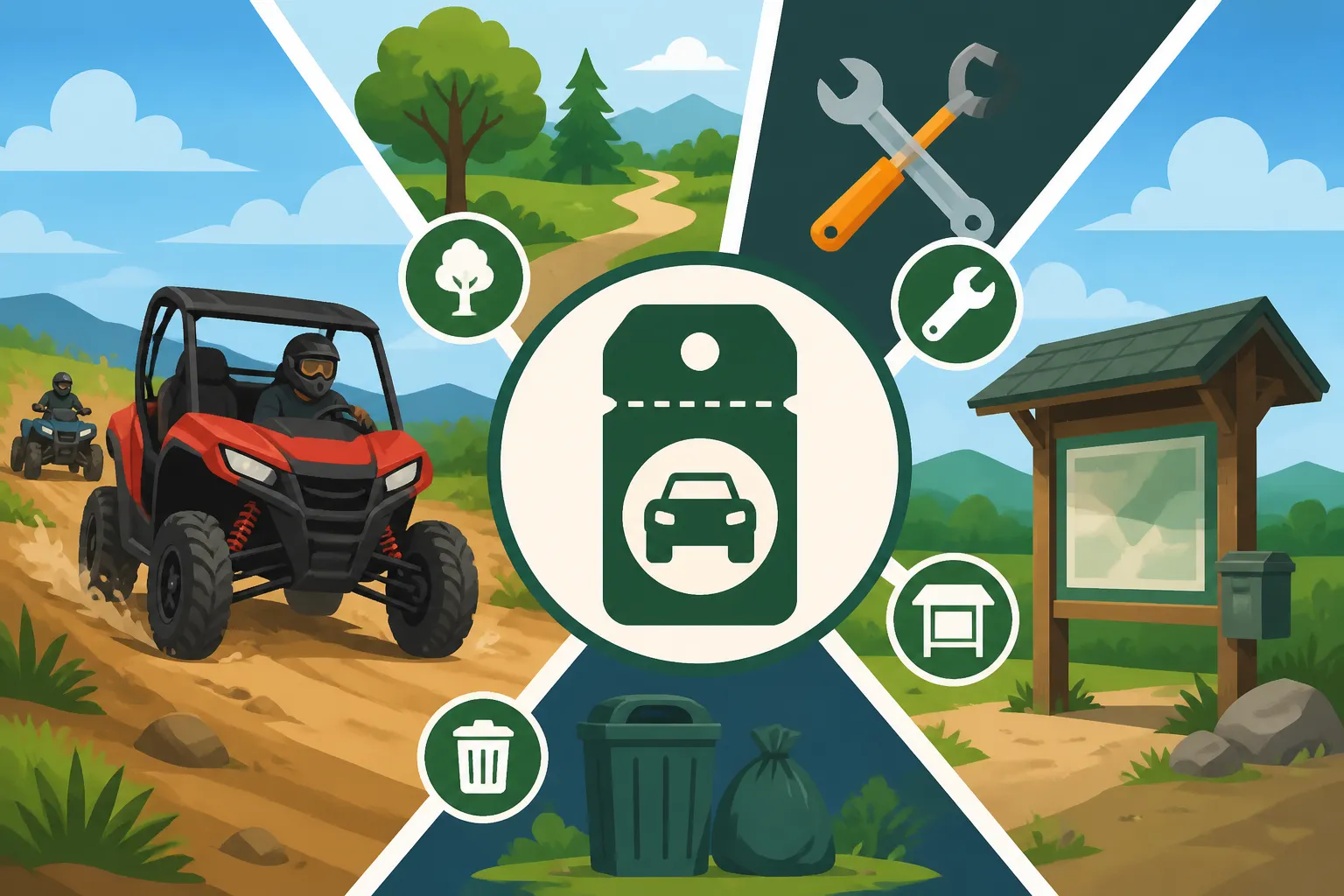
What the fee may cover and what it does not
A practical way to understand the charge
The simplest way to think about the Bessey parking fee is that it is connected to use of a designated recreation-site parking area. Depending on the posted rules, the fee may be required for a vehicle parked there while its occupants visit the riding area. The exact payment method, fee unit, and pass acceptance can vary by location, so read the sign before leaving your vehicle.
| Item | What to expect |
|---|---|
| Parking at a fee-designated area | Follow the fee instructions posted at that specific lot or trailhead |
| Access to a riding area | Confirm what the site’s posted fee covers; do not assume every nearby trailhead has identical rules |
| Trail maintenance or conditions | A fee may support site upkeep, but it does not guarantee a particular trail condition |
| ATV or UTV title | Separate ownership paperwork handled through the appropriate Nebraska process |
| Statewide OHV sticker | Not the same as a site parking fee; Nebraska does not have a general OHV sticker |
| Campground use | Check campground-specific rules and charges rather than assuming parking payment includes a campsite |
| Vehicle or machine insurance | Separate from recreation-site fees and relevant to the way you use the machine |
The table is a planning aid, not a substitute for the instructions at the lot. When a sign lists a particular payment arrangement or vehicle category, use that information rather than relying on what you paid during a past visit. If you are unsure whether a pass applies, ask the relevant Forest Service office before your trip.
For a broader look at what riding at the complex involves, [Bessey OHV Trails at Halsey in Nebraska] and [Bessey's 36 Miles in Nebraska] can help you build a picture of the area. Trail descriptions are useful for planning, but they do not replace fee notices or closure information at the site.
Expenses the parking fee does not replace
A parking payment is not an ATV title, a state registration, or proof that a machine is legal for every kind of road use. Nebraska’s title rules are separate from the rules for public-road operation, local ordinances, and access to a recreation area. Riders who are planning to use roads as part of a trip should review [Can You Drive an ATV on the Road in Nebraska?] rather than assuming trail access means road access.
The fee also does not automatically cover camping. If you plan to stay overnight, check the campground’s own rules and payment instructions, including whether your chosen spot requires a separate reservation or charge. “Parking,” “camping,” and “trail use” can be treated differently even when they are close together on the same trip.
Finally, the fee does not guarantee that your truck, trailer, or machines are protected from damage or theft. Choose a sensible place to park, secure your gear, and avoid blocking access lanes or other visitors. The fee is a site-use charge, not a promise of supervised storage.
How to check the fee before unloading
Read the sign at the exact parking area
Bessey has more than one place a visitor might use to stage a ride. A fee rule at one lot does not necessarily apply in precisely the same way at another. When you arrive, look for the fee notice at the area where you actually park, not just a sign you passed on the way in.
Pay attention to the details that tell you how to comply: where payment is made, whether a receipt needs to be displayed, which vehicles or parking areas are included, and whether a pass is accepted. If the sign refers to a fee envelope or self-service station, follow those instructions carefully. A receipt tucked away in a truck console may not help if the posted directions say to display it.
It is tempting to unload quickly, especially after a long haul from Omaha, Lincoln, or farther east. Take a moment first. A short check can prevent the frustrating situation of discovering that your group paid at the wrong place or misunderstood which vehicle the fee applied to.
Verify pass acceptance and exceptions
Do not assume that an annual pass, another agency’s pass, or a payment made at another trailhead applies at Bessey. Pass acceptance can depend on the managing agency and the particular site. Check the wording on the pass and the posted Bessey instructions. For related planning questions, see [Whether the Annual Pass Works at Every Trailhead] and [Two Trailheads With No Fee].
If you are camping, check whether a campground arrangement changes the parking-fee process. Some recreation sites handle overnight visitors differently from day users, while others keep parking and camping rules distinct. The important thing is not to infer an exemption from the fact that you have a campsite reservation; look for the actual rule.
When the sign is unclear, contact the appropriate Forest Service office before making a long drive. Ask a specific question, such as: “Does this pass cover the lot I plan to use?” or “Does the parking charge apply to my truck and trailer, or to each vehicle?” A clear question is more likely to get you a useful answer than asking generally whether Bessey is “free.”
Use maps for navigation, not as fee permission
Digital trail maps can help you orient yourself, identify route options, and prepare for a day with limited cell coverage. onX Offroad can be useful as a planning aid, particularly when you want to review a route before you tow to the trailhead. But a map app should not be treated as proof that a route is currently open or that a parking fee has been paid.
Before departing, compare your planned route with official site information and signs on the ground. Download or save useful map information in advance if you expect patchy service, and keep a paper map or written directions as a backup. This is especially helpful if your group arrives in separate vehicles or someone needs to find the correct staging area after the others have unloaded.
Use onX Offroad alongside—not instead of—official notices. If a route is closed, a fee station has moved, or a lot has different instructions, the posted information and managing agency guidance take priority. A map helps you plan where to go; it does not settle the administrative rules for a specific parking area.
Planning a Bessey visit without fee surprises
Prepare the truck, trailer, and group before you leave
Before the drive, decide which parking area you intend to use and make sure everyone in your group knows the plan. If riders arrive in multiple trucks, do not assume one payment covers all vehicles. Confirm the fee instructions for each vehicle and give the group a simple plan for where to meet if someone gets separated on the way.
Pack a payment method that works with the instructions posted at the site, along with a pen if the process requires written information. Keep any receipt where it can be displayed or retrieved as directed. These small preparations can matter when you arrive after a long drive and are eager to get the machines off the trailer.
Also check your tie-downs, trailer lights, fuel, water, and basic repair supplies before leaving home. A parking fee does not include help with a flat tire or mechanical trouble. For a more detailed preparation checklist, [Planning a Long Trailer Haul to the Bessey Trails] and [How to Unload and Stage Without Blocking Anyone] are useful companion topics.
Check conditions and closures close to the trip
A fee payment does not mean every trail or riding area is open on the day you arrive. Weather, maintenance, fire danger, or other site conditions can affect access. Check official notices before departure and again when you reach the complex. Recent rain can make trail conditions particularly important to consider, so review [Nebraska Trail Closures After Rain] when the forecast has been unsettled.
If you are relying on a digital map, save information in advance and make sure the group understands which routes are only planned options. onX Offroad can support route planning, but avoid treating a colored line on an app as confirmation of current access. At the trailhead, follow closures, barriers, and signs even if a digital route appears to continue.
Build flexibility into the day. If your intended trail is closed or conditions are unsuitable, it is better to adjust the ride than to push through a posted restriction. A little time spent checking conditions can save the group from a wasted drive, a difficult recovery, or an avoidable access problem.
Common misunderstandings about Bessey parking fees
“I paid once, so every nearby area is covered”
That assumption can cause confusion when a group moves between parking areas or uses a different trailhead later in the day. Fee rules are tied to the posted site instructions, not to a general idea of being “at Bessey.” Check the notice wherever you park, particularly if you move your truck and trailer.
The same caution applies to passes. One pass may be valid only at certain locations or under certain conditions. If the sign lists accepted passes, compare that list with the pass you have rather than relying on its name or on what worked elsewhere.
If your group is unsure, resolve the question before unloading. It is much easier to confirm the rule at the parking area than to discover later that you misunderstood the payment requirement.
“The fee means the trail is open and everything is included”
A parking payment is not a trail-condition report. It does not promise that every route is open, every facility is available, or every type of machine is permitted on every trail. Use current official notices and on-site signs to confirm what you can ride and where.
It also does not bundle unrelated expenses such as camping, insurance, fuel, or Nebraska title paperwork. Keeping those categories separate makes budgeting and trip planning less stressful. For camping-specific planning, see [Nebraska OHV Camping With Trail Access].
The useful rule is simple: treat the parking fee as one part of a Bessey visit, then verify access, camping, passes, and machine rules separately. That may feel like extra homework, but it is much easier than sorting out a misunderstanding once the trailer is already unloaded.
Disclaimer
This article is for general informational purposes only and does not constitute professional advice. Laws, prices and regulations vary by location and change over time. Consult a qualified professional for guidance on your specific situation.