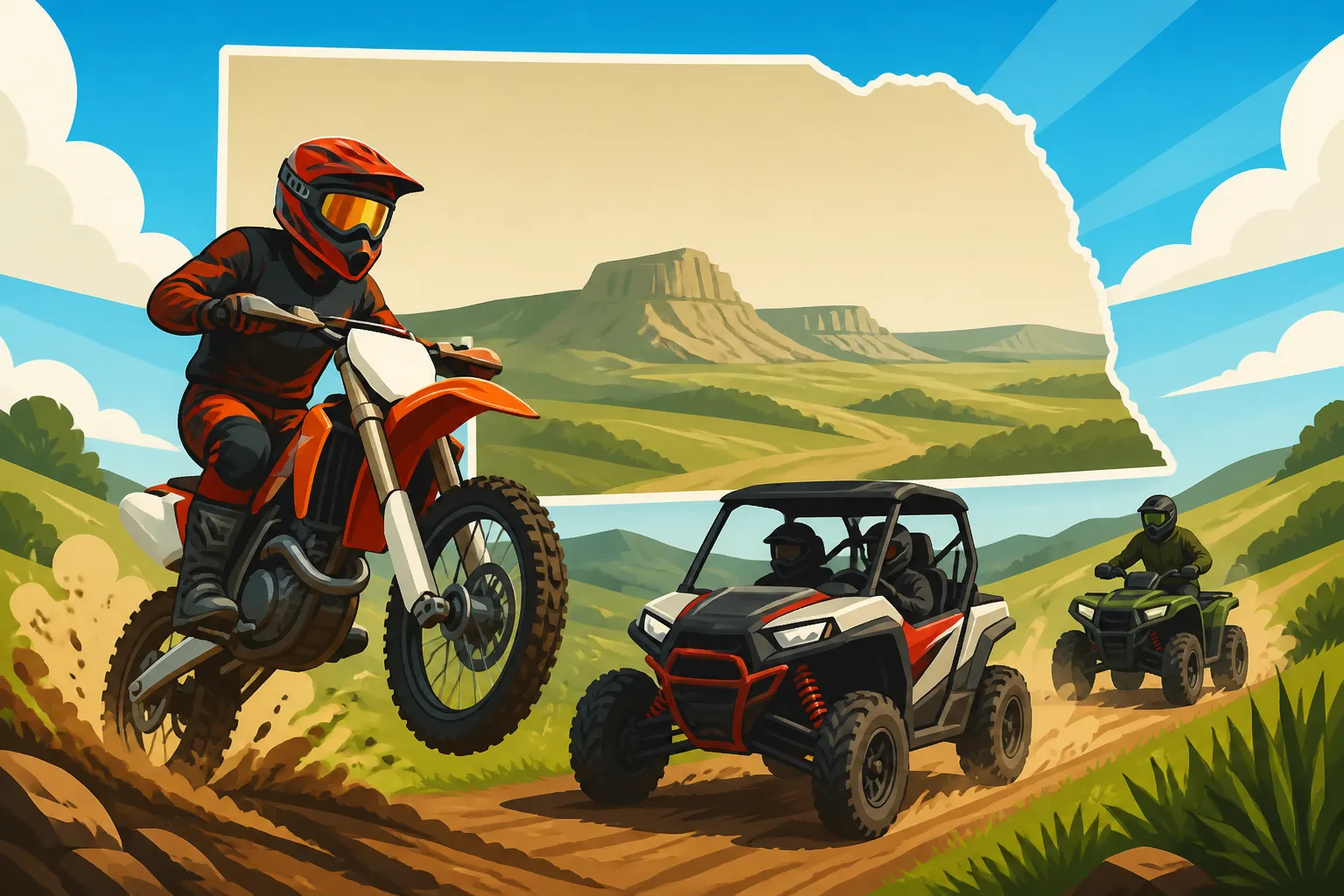
Nebraska Trails That Allow Dirt Bikes
Finding Nebraska dirt bike trails can be confusing: an area may welcome off-highway vehicles generally while restricting certain routes by vehicle type, season, or conditions. This guide explains the best places to investigate, how to confirm that motorcycles are allowed, and what to check before you load up and tow across the state.
Where to Look for Dirt Bike Riding in Nebraska
Nebraska has fewer places for motorized trail riding than its wide-open landscape might suggest. Public riding areas are limited, and a trail described as an ATV or OHV trail is not automatically open to every motorcycle. Start with established riding areas, then verify the specific trail rules before making plans.
Bessey OHV trails near Halsey
Bessey Recreation Complex, near Halsey in the Nebraska National Forest, is one of the first places many riders investigate. The area has designated OHV riding opportunities, but you should confirm that the routes you plan to use allow dirt bikes. “OHV” can refer to multiple vehicle types, and access rules may differ between trails or open riding areas.
Before leaving home, look at the current information for [Bessey OHV Trails at Halsey in Nebraska] and [Nebraska National Forest Riding]. Check the route map, any posted vehicle restrictions, seasonal closures, and whether the riding area has conditions or equipment requirements that apply to your bike. If you are unsure, contact the responsible ranger district rather than relying on an old forum post or a map label alone.
Bessey is also a place where a little practical planning can prevent a frustrating day. Confirm where you can park and unload, whether your intended trailhead has space for a truck and trailer, and whether the route suits your experience level. For a broader look at the area, see [Nebraska Riding Near Halsey].
Flat Rock Riders OHV Park
Flat Rock Riders OHV Park near Edgar is a private riding destination to investigate if you want a managed setting rather than an unfamiliar stretch of public land. Private parks set their own access rules, so riders should check directly whether dirt bikes are welcome, which riding areas are open to motorcycles, and whether separate tracks or trails are designated for different vehicle types.
The park’s rules matter as much as the map. Ask about entry procedures, operating hours, age and supervision rules for younger riders, and whether a waiver or advance planning is required. If you are bringing both dirt bikes and ATVs, do not assume they can use the same sections. See [Flat Rock Riders OHV Park in Nebraska] for a starting point, then confirm details with the park before towing.
Private facilities can be a good fit for riders who want a defined place to ride and clear on-site rules. They are not a substitute for checking the current conditions, however. Rain, maintenance, events, or temporary closures can affect the day’s options.
Cedar Run and other OHV areas
Cedar Run ATV Trail at Harlan County Lake is another named motorized riding area riders may come across while searching for Nebraska trails. Its name and public descriptions are not enough to confirm that dirt bikes are permitted. Check directly with the managing agencies for the current vehicle rules before counting it as a motorcycle destination. You can begin with [Cedar Run ATV Trail in Nebraska] and [Nebraska Riding Near Republican City].
That distinction is worth taking seriously. If a page says “ATV trail,” it may be describing access intended for ATVs rather than all off-highway motorcycles. Likewise, a trail that permits motorcycles may have restrictions on bike size, route direction, or where you can ride. Look for explicit wording about motorcycles or dirt bikes, not just a general reference to motorized recreation.
When a trail’s rules are unclear, treat the uncertainty as a reason to ask—not as permission. A quick call to the site manager can save you a long drive and help you avoid riding somewhere that is closed to your machine.
| Riding area to investigate | Type of access | What dirt bike riders should confirm |
|---|---|---|
| Bessey near Halsey | Designated OHV recreation area | Whether the specific trails or riding zones allow motorcycles |
| Flat Rock Riders near Edgar | Private OHV park | Motorcycle access, park rules, open sections, and arrival requirements |
| Cedar Run at Harlan County Lake | Named ATV trail area | Whether motorcycles are specifically permitted |
| Other public land | Rules vary by land manager | Whether motorized riding is allowed at all, and on which designated routes |
For extra route-planning context, some riders use a mapping tool such as onX Offroad to review mapped roads and trails before a trip. Treat any app map as a planning aid, not final permission: confirm access and closures with the land manager.
How to Confirm a Nebraska Trail Allows Dirt Bikes
The most important part of finding a trail is not spotting a line on a map. It is establishing that your motorcycle is permitted on that route on the day you plan to ride. Nebraska land is managed in different ways, and rules can change from one property or trail system to another.
Look for motorcycle-specific wording
Read the trail information for terms such as “motorcycle,” “motorcycle trail,” or a clearly defined list of permitted vehicle classes. “OHV” is a broad category, and listings do not always explain whether it includes dirt bikes. An ATV-only designation should not be read as an open invitation for motorcycles.
If the site only mentions ATVs, ask the agency or park directly. Be specific: tell them you mean an off-highway dirt bike, identify the area or route you are considering, and ask whether that machine may ride there. If there is a map, ask whether the rules apply to the whole trail system or only certain sections.
For a reliable trip plan, use more than one reference. A trail listing, a current land-manager notice, and a map can help you spot inconsistencies. onX Offroad may help you review mapped routes and organize a ride, but a mapped route is not proof of legal access. Confirm unclear details with the agency or property owner.
Check who manages the land
A trail’s location does not tell you who sets its rules. A route may cross or sit beside land managed by a federal agency, a local organization, a private operator, or another public authority. Each can have different rules for vehicles, hours, closures, and parking.
Nebraska state parks are not a safe assumption for dirt bike riding. The state’s park rules restrict ATVs, and motorized use can be prohibited in places where visitors expect to find recreational trails. Review [Nebraska State Parks Ban ATVs] and check the rules for the exact property you plan to visit. Do not assume that a road, campground, or walking path inside a recreation area is open to dirt bikes.
Wildlife management areas also have specific vehicle rules. Access may be limited to designated roads or certain uses, and riding a dirt bike cross-country is not automatically allowed. Before you go, review [Nebraska WMA Riding Rules] and the site-specific signs and rules.
Check for current closures and conditions
Even an approved trail may be temporarily closed. Heavy rain can make some routes vulnerable to damage, while maintenance, fire conditions, or seasonal restrictions can affect access. Check [Nebraska Trail Closures After Rain] and [Nebraska Trail Conditions Before You Tow] as part of your planning.
Mapping apps can help you understand the general layout and plan where to stage, and onX Offroad can be one tool in that process. Still, apps may not reflect a new closure, a changed property boundary, or a vehicle restriction posted by the land manager. Check official updates close to your departure, and look for signs when you arrive.
If you reach a gate, closure notice, or sign that conflicts with your plan, do not ride around it. Pick another permitted route or save the ride for another day. Turning back is aggravating after a long haul, but it is better than damaging a trail or getting into a dispute over access.
Planning a Dirt Bike Ride in Nebraska
Once you have confirmed access, plan the day around the practical details that often get overlooked: loading and parking, weather, route difficulty, and what you will do if conditions change. These checks are especially helpful if you are riding somewhere new or traveling with a group.
Match the route to your group
A route that looks short on a map can feel very different on a dirt bike, particularly if it is sandy, rutted, rocky, or unfamiliar. Look for trail descriptions and difficulty guidance, and be honest about the least experienced rider in your group. If you are taking a younger rider, choose a route and setting that allow them to ride at a comfortable pace.
Ask whether the area separates motorcycles from larger vehicles or has designated riding sections. Mixed-use trails can require extra care around blind corners and narrow stretches. Read [Nebraska Trail Difficulty Ratings] and [Nebraska Trail Etiquette Locals Expect] for useful planning context.
Mapping tools, including onX Offroad, can help riders sketch out a route and keep track of potential turnoffs. Keep a second way to navigate, too. Cell service may be unreliable in some areas, and a downloaded map or paper backup is useful when a phone signal disappears.
Plan your arrival and equipment
Before towing, confirm the correct entrance and staging area. Check whether trailers can park there, whether parking is limited, and if you need to pay or follow a specific check-in process. These are small details, but they matter when you arrive with several bikes and a vehicle that cannot easily turn around.
Pack the basics for the trail and the weather: water, appropriate protective gear, a basic repair kit, and a way to contact someone if your ride runs longer than expected. Inspect the bike before leaving, including tires, controls, chain, fuel, and any protective equipment you rely on. If you are riding with others, agree on a meeting point and what to do if someone gets separated.
Respect the trail and the people sharing it. Stay on routes that are open to your machine, slow down around other users, and avoid riding when conditions could cause lasting damage. For more background on what riders may encounter at different areas, browse [Nebraska Trail Etiquette Locals Expect].
Keep a backup plan
Nebraska has a limited number of places to ride, so a backup can keep a trip from turning into a wasted day. Identify another permitted destination or have a non-riding plan nearby in case the trail is closed, the weather turns, or the area does not allow dirt bikes after all.
Do not use a second location as a reason to skip checking its rules. Confirm motorcycle access and current status there, too. A trail being open to the public does not necessarily mean it is open to motorized vehicles, and a route open to one kind of OHV may not allow another.
If you are traveling from outside the area, add time for a call to the land manager and a final check of conditions. A few minutes of preparation can be the difference between unloading at a legal trailhead and discovering that the place you drove to is not an option for your bike.
Common Mistakes Dirt Bike Riders Can Avoid
A little caution helps protect both the ride and future access. The most common problems are usually not complicated: assuming a broad label means every vehicle is allowed, trusting an outdated map, or overlooking a sign once you reach the property.
Assuming every OHV trail includes motorcycles
An OHV label is a useful clue, not a complete rulebook. Some sites distinguish motorcycles from ATVs and side-by-sides; others may use broad wording that needs clarification. If you are comparing vehicle access across areas, [Nebraska Trails That Allow Side-by-Sides] can help illustrate why trail-specific rules matter—but side-by-side access does not establish dirt bike access.
When you contact a park or agency, ask about your actual machine rather than asking only whether “OHVs” are allowed. If you are unsure how to describe it, say that it is an off-highway motorcycle or dirt bike and provide the model or size if requested.
Treating a map as permission
A route line can appear on a digital map even when access is restricted, changed, or subject to a seasonal closure. That is why it helps to compare maps with current land-manager information and posted signs. onX Offroad can support route planning, but it cannot replace permission from the people responsible for the land.
Also pay attention to property boundaries and trail connectors. A legal route can lead close to private land or a closed section. Stay on marked routes, and do not cross a boundary just because the terrain looks rideable.
Leaving without checking the local rules
The rules can differ by area, and so can details such as staging, parking, noise, hours, and allowed routes. Make a short pre-trip checklist: confirm dirt bike access, check closures, find the correct entrance, review parking instructions, and tell your group where to meet.
If the information you find does not clearly answer whether motorcycles are allowed, pause and ask the site manager. That simple step is often the most dependable way to avoid a wasted trip and help keep Nebraska’s limited riding opportunities open.
Disclaimer
This article is for general informational purposes only and does not constitute professional advice. Laws, prices and regulations vary by location and change over time. Consult a qualified professional for guidance on your specific situation.