Nebraska Campgrounds Next to a Riding Area
Finding a Nebraska campground beside an ATV trail can save you from loading and unloading the machine every morning, but “nearby” does not always mean you can ride straight from your campsite to the trail. This guide explains what to look for, how Bessey and other riding areas compare, and what to confirm before you tow the trailer.
What to Look for in a Nebraska ATV Campground
Separate trail access from campground proximity
A campground can be close to a riding area without being connected to it by a legal riding route. You may need to load your ATV or UTV onto a trailer and drive to the trailhead, even if the campground is only a short distance away. Before booking, ask whether riders may travel between the campground and trail system on the roads or paths in between. Do not assume a county road, forest road, or campground access lane is open to off-highway vehicles.
The most convenient setup is a campground with a clearly identified trailhead nearby and a permitted route from your campsite to the riding area. The next-best option is a campground where you can park the truck and trailer, then haul the machine a short distance to an approved staging area. If you are comparing potential sites, [Nebraska OHV Camping With Trail Access] can help you think through the difference between camping close to trails and having actual trail access.
Ask about the details that affect your daily routine: where trailers can be parked, whether there is room to turn around, and whether a campsite can accommodate both your vehicle and your camping setup. A tight site can be frustrating when you arrive after dark with a trailer, gear, and a tired family. If trailer parking is a priority, review [Nebraska Trailheads With Trailer Parking] and confirm the specific arrangements with the campground or trail manager.
Match the campground to your group and machine
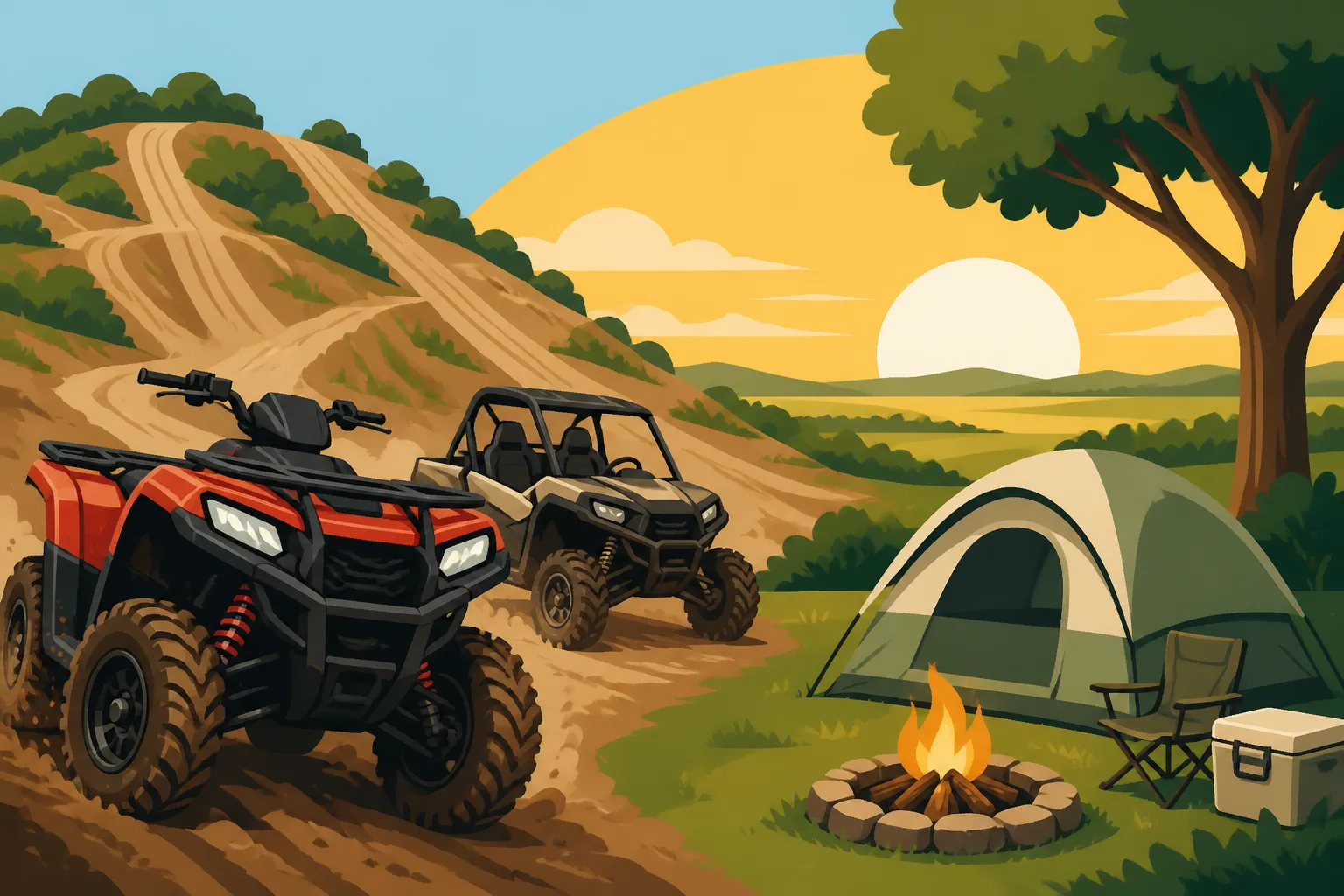
A tent site beside a trailhead may suit a quick weekend ride, while a family traveling in a large RV may need a developed campground with more space and reliable facilities. Think through the whole trip, not just the riding: sleeping arrangements, cooking, toilets, water, power, shade, and a safe place to keep helmets and riding gear. Those needs become more important when the weather turns windy or rainy, or when the group includes young riders.
Also check that the riding area allows your particular machine. A trail system may have size or vehicle restrictions, and a route that works for a narrow ATV may not suit a wider side-by-side. Ask about trail difficulty, current closures, and whether routes are appropriate for the least experienced rider in your group. A little advance planning can prevent an awkward first morning spent discovering that the route you expected to ride is not suitable for your machine.
| What to compare | Why it matters | What to ask |
|---|---|---|
| Trail connection | “Near” does not necessarily mean ride-in access | Is there a legal route from the campground to the trailhead? |
| Trailer parking | Large trailers need space to park and maneuver | Can the site or staging area accommodate my truck and trailer? |
| Machine rules | Trail access may depend on vehicle type or size | Are ATVs and side-by-sides both permitted? |
| Facilities | Comfort needs vary by group and trip length | Are water, toilets, power, or showers available? |
| Current conditions | Weather and maintenance can affect access | Are trails open, and are any routes closed or muddy? |
| Local requirements | Public-land and campground rules may differ | Are permits, parking fees, waivers, or registrations required? |
Nebraska Campgrounds Near Riding Areas
Bessey Recreation Complex near Halsey
For riders looking for a campground associated with an established off-highway riding area, the Bessey Recreation Complex near Halsey is a natural place to investigate. The area is associated with the Bessey OHV trails in Nebraska National Forest, and camping options in the complex make it possible to plan a stay around riding rather than commuting from a distant town. Read [Bessey OHV Trails at Halsey in Nebraska] alongside campground information so you understand the riding area and the camping arrangements as separate parts of the trip.
Bessey camping options may differ in setting and facilities, so check the details for the specific campground you are considering. For example, [Camping at Whitetail in Nebraska] and [Camping at a Main Campground in Nebraska] are useful starting points for comparing campground choices in the area. Confirm whether the campground you select is the one that best fits your group, and whether its location gives you convenient access to the trailhead you intend to use. Do not rely on a map pin alone to establish that you can ride directly from your campsite.
Before towing to Halsey, check the current trail status, staging arrangements, parking requirements, and any seasonal restrictions. A trail shown on a map may be closed or unsuitable after heavy rain, and the campground may have separate rules about machine movement, quiet hours, or trailer placement. If you use a mapping app such as onX Offroad to plan the drive and understand the area, treat it as a planning aid rather than permission to ride. Verify access and closures with the relevant land manager before setting out.
Cedar Run and other riding areas
Cedar Run ATV Trail near Harlan County Lake is another Nebraska riding destination to consider when you are planning a trip with camping. In this case, check the campground and trail locations carefully: a place to camp near the lake is not automatically connected to the ATV trail. Ask how far the campground is from the legal staging area, whether the route requires trailering, and whether your trailer can be left at the trailhead while you ride.
Other Nebraska riding areas may have different camping arrangements, including nearby public campgrounds, private facilities, or no practical overnight option at the trail itself. Flat Rock Riders OHV Park, for instance, is a distinct riding destination, so confirm camping availability and policies directly rather than assuming that nearby lodging or a public campground allows riding access. Check whether a campground welcomes off-highway vehicles, has a designated place to park trailers, and permits riders to wash or service machines on site.
Do not confuse camping near a riding area with permission to ride on all surrounding public land. Nebraska state parks generally are not open to ATV riding, and wildlife management areas have their own restrictions. Review [Nebraska State Park Entry Permits] for the separate question of park access and permits, and check the specific land rules for your chosen destination. A campground’s proximity to a park, lake, or forest does not override the rules governing where machines can travel.
Plan the Trip Before You Tow
Confirm the details with the campground and trail manager
Call or contact the campground and the riding area separately. They may be managed by different organizations, and each can answer questions the other cannot. The campground can explain reservation procedures, site dimensions, facilities, trailer parking, pets, and quiet hours. The trail manager can confirm which routes are open, where to stage, what machines are allowed, and whether a fee or parking arrangement applies.
Make a short checklist and get clear answers before leaving home:
- Is the campground open for your planned dates, and do you need a reservation?
- Are ATVs or UTVs allowed on the campground property?
- Is there a legal route to the trail, or must you trailer to the trailhead?
- Where can you park the truck and trailer while riding?
- Are there machine-width, sound, or trail-use restrictions?
- Are there current closures, weather concerns, or seasonal limitations?
- What fees, waivers, permits, or proof of ownership might apply?
Nebraska does not have a general statewide OHV sticker for trail riding, but that does not mean every riding location is free or that no local requirements apply. A campground, private riding park, or public-land recreation site may have its own fees, parking rules, or conditions of use. See [Nebraska Has No OHV Permit or Sticker] for the statewide distinction, then check the rules for the specific site you plan to visit.
Use maps for preparation, not as the final word
A mapping app can help you estimate driving distances, see where trailheads sit relative to campgrounds, and organize a route before the trip. onX Offroad may be useful for reviewing mapped routes and saving trip information, especially when you expect limited cell service. Download or save what you need before you leave a reliable connection, and bring a backup plan for navigation.
Still, a line on a screen is not proof that a route is open or legal. Roads may be private, gates may be closed, and trail conditions can change after rain, maintenance, or seasonal restrictions. Use onX Offroad as one planning tool, then compare your route with official signs and information from the land manager. The same caution applies to route distances and campground pins: they help you plan, but they do not replace local confirmation.
If a route is muddy or recently damaged, consider postponing that section rather than trying to push through. Riding damaged trails can make conditions worse and can create problems for other visitors. Check [Nebraska Trail Conditions Before You Tow] shortly before departure, and follow closures even when a route appears passable. For a longer stay, check conditions again during the trip; a change in weather can alter both access and safe riding choices.
Make Camp and Trail Time Work Together
Pack for the campground as well as the ride
A riding weekend is easier when you separate camp gear from riding gear before loading. Keep helmets, gloves, eye protection, boots, and basic repair items easy to reach. Pack a first-aid kit, water, food, and clothing for changing Nebraska weather. If you expect to ride in open areas, plan for sun and wind exposure; if you are camping in a wooded setting, bring layers for cooler evenings.
Think about the machines when setting up camp. Park them where they do not block roads, neighboring sites, or emergency access. Secure keys and valuables, and keep fuel and maintenance supplies stored according to campground rules. If you plan to wash a muddy machine, first ask whether washing is allowed and where runoff should go. A campground that is convenient for riders may still prohibit certain repairs, washing, or engine noise during quiet hours.
Build flexibility into the schedule. A late arrival, a crowded trailhead, or a wet trail can change the day’s plan. Rather than trying to squeeze in a long ride immediately after setting up camp, consider using the first evening to check the route, organize equipment, and confirm the next morning’s staging plan. This is especially helpful for a mixed-experience group, where someone may need extra time to learn the controls or get comfortable with the terrain.
Respect the campground and riding area
Good trail manners matter even when you are camping beside the riding area. Keep noise down early and late, follow posted campground speed limits, and avoid riding through campsites unless an approved route specifically permits it. On the trail, slow down near other visitors, give people room, and avoid spinning tires or cutting corners. The practical guidance in [Nebraska Trail Etiquette Locals Expect] is worth keeping in mind whether you are riding a busy weekend or a quiet weekday.
Stay on designated routes and obey posted signs. Do not use an unmarked track simply because it looks like an established trail. In forest, lake, or wildlife areas, land boundaries and use rules can change quickly, and a short detour can take you into a closed or restricted area. When using onX Offroad or another map, check the display against signs on the ground and leave the route when a closure or land manager instruction requires it.
Before you head home, pick up litter, check the campsite for small items such as straps and drink cans, and secure the machine and trailer properly. Take note of any access or camping details you would want to remember next time, but recheck them before a future trip because openings, closures, and facility arrangements can change. A little courtesy helps keep campgrounds pleasant and riding areas available for the next group.
Disclaimer
This article is for general informational purposes only and does not constitute professional advice. Laws, prices and regulations vary by location and change over time. Consult a qualified professional for guidance on your specific situation.