Whether the Annual Pass Works at Every Trailhead
If you have an annual pass in the glove box, it’s easy to assume it covers every Nebraska ATV trailhead. It doesn’t. A pass is usually tied to a particular recreation area or parking program, while other sites may have different fees—or no parking fee at all. This guide explains what to check before you unload your machine.
Does a Nebraska annual pass work at every ATV trailhead?
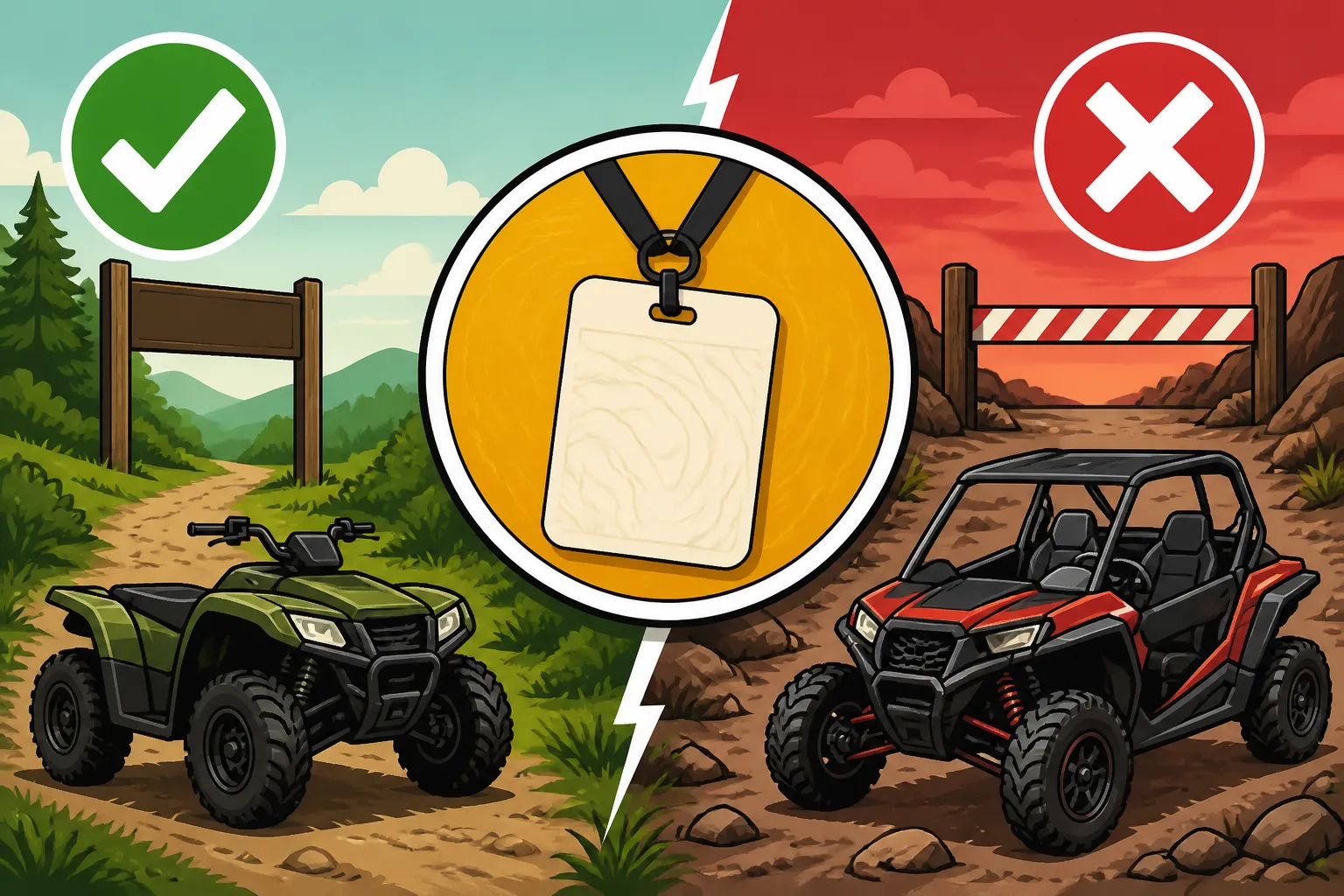
No. An annual parking pass should not be treated as a statewide ATV pass. Nebraska does not have a universal OHV sticker that gives riders access to every trailhead, and a pass for one recreation area does not automatically cover parking or entry somewhere else.
The distinction is easy to miss because people use “trail pass,” “parking pass” and “park permit” interchangeably. But those terms can refer to different things. A pass may cover parking at a specific site, while a park permit may be required for a vehicle entering a state park or recreation area. Neither one necessarily gives permission to ride on a trail.
| What you have | What it may cover | What it does not automatically cover |
|---|---|---|
| Annual parking pass | Parking at the locations named in its terms | Parking at every Nebraska trailhead or riding access to every trail |
| Daily parking fee | Parking at the particular site where it is paid | Other trailheads or separate park entry requirements |
| Nebraska park permit | Vehicle entry to applicable state park or recreation areas | Permission to ride an ATV where ATVs are prohibited |
| Local or private-site pass | Access under that site’s rules | Public lands or a different private riding park |
For example, a pass associated with parking at the Bessey Recreation Complex should be understood within that site’s rules. It is not a statewide credential for places such as Cedar Run or other riding areas. Before relying on a pass, read the wording on it and check the rules for the exact trailhead you plan to use.
This is especially important when your day includes more than one stop. You might pay a parking fee at one trail system, then drive to a different trailhead that has its own fee arrangement—or no fee. A single pass may not carry over simply because both places are in Nebraska or both are used for OHV riding.
For broader context on how fees and access differ from one place to another, see [Nebraska Has No OHV Permit or Sticker] and [Nebraska Trail Fees Worth Checking].
A parking pass is not riding permission
A parking pass answers a limited question: whether you have satisfied a parking or site fee under that pass’s terms. It does not necessarily determine whether your ATV or side-by-side can legally use the trail.
The trail itself may have separate rules about permitted vehicle types, seasonal closures, trail conditions, group use or other restrictions. A trailhead can also be open for parking while a particular route is closed. Conversely, an area might have no parking charge but still restrict where motorized vehicles can travel.
Before you ride, confirm both parts of the plan: where you are allowed to park and where your machine is allowed to go. [Nebraska Trail Etiquette Locals Expect] is useful background for understanding how to share riding areas responsibly, but posted site rules should always guide your decisions on arrival.
How to check whether your pass applies to a trailhead
The safest approach is to check the exact parking location rather than relying on a broad description such as “Nebraska annual pass.” Identify the trailhead by name, confirm which agency or organization manages it, and look for the current fee and pass instructions for that specific site.
Match the pass to the managing agency
Start by reading the pass itself. Look for the name of the recreation area, agency, land manager or fee program. If the pass names a particular complex or set of parking locations, do not assume it applies outside that scope. A pass issued for one forest recreation area may have no connection to a county site, a state recreation area or a privately operated OHV park.
Then check the trailhead’s own posted information. A map pin, social media post or old trip report can help you find a location, but it may not tell you whether that site accepts your pass today. If the rule is unclear, contact the managing office before making the drive. That small check can spare you the frustration of reaching a trailhead with a trailer and discovering that your pass is not accepted there.
Mapping tools can help you identify the route and nearby access points. For instance, onX Offroad may help you plan around trail locations and navigation, but a map layer is not proof that a pass is valid or that a route is open. Use it to orient yourself, then confirm access, fees and closures with the land manager.
Check the exact parking location, not just the trail name
A riding area may have more than one trailhead, staging area or parking lot. Fee arrangements can differ between them. One lot may require payment, another may be free, and a third may be intended for campers or a different type of visitor. The phrase “I’m riding at Bessey” may not be specific enough to determine which parking rule applies.
When you plan, save the exact trailhead name or map pin, not only the general area. If you are using onX Offroad or another navigation app, compare the selected access point with the official site information. Check that the pin is actually the place where you intend to unload, rather than a nearby road junction or an entrance to a separate facility.
For Bessey-specific planning, [Which Bessey District Trailheads Charge You to Park] can help frame the question: the relevant detail is not just whether you are going to Bessey, but where you will park. Also see [What the Bessey Parking Fee Covers] for the difference between paying to park and having permission to ride.
Read the pass conditions and display instructions
Even when the location accepts an annual pass, there may be conditions about which vehicle it applies to, where it must be displayed or whether it covers parking only. Do not assume that a pass attached to one vehicle can be used for a second vehicle or a friend’s truck. Check the written terms, and follow any instructions at the fee station or trailhead.
Make sure the pass is easy for staff to see if display is required. If the pass is digital, keep the confirmation accessible and check whether the site expects a printed copy, a visible permit or another form of proof. A screenshot can be useful if cell service is unreliable, but it should not replace the pass’s actual requirements.
If you are unsure, take a moment at the fee kiosk to read the posted information before unloading. It is much easier to resolve a question while you are parked than after your group has started down the trail.
Bessey and other Nebraska riding areas
Bessey is a common place for riders to ask whether an annual pass is worthwhile, but the answer depends on the parking locations and the pass’s terms. Do not assume that every trailhead in the Bessey area charges the same way or accepts the same pass. Some access points may have different arrangements, and site-specific information matters.
Bessey parking is not the same as statewide trail access
A Bessey parking pass should be thought of as a parking arrangement for the locations it identifies, not a Nebraska-wide OHV pass. It does not make a closed trail open, override vehicle restrictions or grant access to unrelated areas. Likewise, paying a daily parking fee at a Bessey location does not automatically cover a later stop somewhere else.
If you are deciding whether an annual pass is useful, compare your actual plans with the pass terms. A rider who repeatedly uses eligible parking locations may find an annual option convenient. Someone visiting only once, or visiting trailheads outside the pass’s coverage, should check whether a daily fee or another requirement applies instead. The practical comparison is about where you park and how often—not simply how many times you ride in Nebraska.
For background on what the Bessey system includes, [When an Annual Parking Pass Beats Paying Daily] may help you think through the choice. If you expect to use more than one access point, [Two Trailheads With No Fee] is also a reminder to verify each location rather than assuming every lot follows the same fee pattern.
Cedar Run and other areas have their own rules
A pass from one site does not automatically apply at Cedar Run or another Nebraska riding area. Each place may have its own manager, parking setup and access rules. A visitor who parks at Bessey in the morning and heads to another trail system later should expect to check that second location separately.
Do not treat “no parking fee” as the same thing as “no rules.” A free trailhead can still have restrictions on which vehicles are allowed, where riders may travel, or whether a route is temporarily closed. Similarly, a paid parking area does not necessarily mean every nearby road or trail is open to OHVs.
When mapping a multi-stop day, use a route planner to get oriented, then confirm each stop with the relevant official information. onX Offroad can be useful for understanding where trail routes and access points sit relative to one another, but fee rules and closures still need to be confirmed independently. You can also review [Nebraska ATV Trails: Where to Ride] and [Nebraska Trail Conditions Before You Tow] before setting out.
State park permits are a separate question
Nebraska state park permits are not interchangeable with a trailhead parking pass. A park permit may address vehicle entry to a state park or recreation area, but it does not create permission to ride an ATV where motorized riding is prohibited. Nebraska state parks generally do not function as ATV trail systems, so do not assume a park permit opens riding access.
This distinction matters when your destination is near a lake, campground or recreation area. You may need to consider vehicle entry, parking and machine access as separate questions. A pass that covers one requirement does not necessarily take care of the others.
For a clearer breakdown, see [Nebraska Park Permits at $35 for Residents], [Nebraska Daily Park Permits] and [Why a Park Permit Does Nothing for Your ATV]. Check the applicable site information before you travel, especially if you are bringing a truck, trailer and machine into a managed recreation area.
A practical checklist before you haul out
A quick check before leaving can prevent a frustrating arrival. This is particularly helpful if you are traveling from Omaha, Lincoln or farther west with a trailer, since a small misunderstanding about a pass can turn into a long detour.
- Name the exact trailhead. Record the parking lot or staging area, not just the general riding destination.
- Identify the land manager. Find out whether the location is managed by a forest office, another public agency, a local entity or a private operator.
- Read the pass terms. Confirm the locations covered, vehicle conditions and display instructions.
- Check for separate entry requirements. A park permit, parking fee and riding permission are not necessarily the same thing.
- Verify the route is open and allows your machine. Check for closures, vehicle restrictions and seasonal conditions.
- Save the information for offline use. Cell service can be unreliable at remote trailheads, so keep directions and fee details accessible before you lose signal.
- Ask if anything is unclear. Contact the site manager rather than assuming a pass will be accepted.
A map app can help you keep your route organized, and onX Offroad may be useful for locating trail access points. Still, treat navigation information as a planning aid. It does not replace posted signs, current land-manager instructions or the written terms of a pass.
If you are heading to Bessey, look specifically at the parking rules for the trailhead you intend to use. If you are going elsewhere, check that area’s rules independently. That is the reliable answer to whether an annual pass works at every trailhead: no—confirm that the specific pass covers the specific parking location, and check riding access separately.
Disclaimer
This article is for general informational purposes only and does not constitute professional advice. Laws, prices and regulations vary by location and change over time. Consult a qualified professional for guidance on your specific situation.