Can You Get a DUI Riding on Private Pasture?
It's a question that echoes across many a campfire and garage gathering: "If I'm just out on my buddy's back forty, far from any public road, can I really get a DUI on my ATV or UTV?" It's a common misconception that private land offers a free pass from alcohol-related driving offenses, but the reality in Nebraska can be far more nuanced and, frankly, a lot less forgiving than many riders assume. This guide will dive deep into Nebraska's laws, helping you understand where the lines are drawn and what could happen if you mix riding with alcohol, even when you feel like you're completely off the grid.
The Nuance of "Operating a Vehicle" in Nebraska
One of the biggest misunderstandings when it comes to DUIs on private property, especially a vast expanse like a pasture, revolves around the definition of "operating a vehicle" and what constitutes a "vehicle" under Nebraska law. Many people assume that if you're not on a paved road, a gravel county road, or some clearly marked public path, the rules simply don't apply. But this isn't always the case.
Nebraska's DUI statutes are broadly written. They don't specifically say "motor vehicle on a public road." Instead, they often refer to "operating or being in actual physical control of any motor vehicle." This broad language is crucial because it doesn't automatically exclude private property. The focus shifts from the location to the act of operating the machine while impaired. Your ATV, UTV, dirt bike, or even a minibike, falls squarely under the definition of a "motor vehicle" in this context. While common sense might tell you that a vast, open pasture is miles away from public concern, the law sometimes sees things differently. For instance, if that "private" pasture is accessible to the public in any way, even if it's just a well-worn path that's generally open to friends and family, or if there's an implied invitation for others to enter (like during hunting season or a large family gathering), the interpretation of "public access" can get blurry.
Consider a scenario: you're at a large family reunion on a rural ranch, and after a few beers, you decide to drive your UTV across the pasture to retrieve something from a barn. The pasture is technically private, owned by your uncle. However, if a sheriff's deputy, called to the property for an unrelated issue, observes you operating the UTV while clearly impaired, you could absolutely face a DUI charge. The core principle isn't whether the land is public or private, but whether you are in control of a motor vehicle while under the influence. It's about impairment and the potential danger that poses, regardless of where that machine is being operated. You can find more specific details about these laws in [Nebraska DUI Law and Off-Road Machines].
What Constitutes "Actual Physical Control"?
The term "actual physical control" is another legal concept that often trips people up. It doesn't necessarily mean the engine has to be running, or that the vehicle has to be moving. Imagine you've been riding your ATV around a private field, enjoying the fresh air, and then decide to pull over, shut off the engine, and have a couple of beers before heading back to the house. If a law enforcement officer arrives on the scene and finds you sitting in the driver's seat, keys in the ignition, even if the engine is off, you could still be considered in "actual physical control" of the vehicle.
The idea here is that you have the immediate capability to operate the vehicle. If you're simply sitting there, ready to start up and drive away, you might be deemed to be exercising control. The courts interpret this to prevent situations where someone could consume alcohol, then argue they weren't "driving" because they had just stopped, only to resume driving moments later. So, even if your machine isn't actively moving, if you're in a position to quickly start and operate it, that could be enough for a DUI charge. It's about intent and capability, not just motion. This is why many legal experts advise that if you're going to consume alcohol, you should not be in the driver's seat with the keys anywhere near the ignition.
When Private Land Gets Complicated: Implied Public Access and Trespass
While the general rule in Nebraska leans towards DUI laws applying regardless of land ownership, there are specific situations where private land can become a gray area, often blurring the lines with public access or perception. It's not always as simple as "my land, my rules."
The "Private Property Open to the Public" Clause
Nebraska law has provisions that can extend the reach of certain statutes, including DUI, to private property if that property is generally "open to the public." Now, a private pasture isn't typically "open to the public" in the same way a grocery store parking lot or a private campground might be. However, context is everything. If the pasture is regularly used by a wide circle of friends, family, or even hired hands, and especially if there are no clear "No Trespassing" signs or barriers, the argument could be made that it has an implied level of public access.
Consider a large farming operation where multiple employees come and go, using various paths and fields. If a ranch hand, after a long day and a few drinks, is operating a UTV on the private fields, and an incident occurs that brings law enforcement onto the property, that "private" land might be viewed differently. The presence of multiple people, even if they are all authorized, can complicate the "private" designation. This is particularly true if the land abuts a public road and riders are frequently seen coming and going without strict controls. While it's a stretch, the legal interpretation hinges on whether a reasonable person might perceive the area as having some level of public availability, even without explicit permission. This concept is distinct from [Nebraska Trespass Law for Riders], which specifically deals with unauthorized entry.
Navigating Landowner Permission and Boundaries
The best defense against many legal headaches, including potential DUI issues on private land, is clear communication and respect for property boundaries. If you're riding on someone else's pasture, always ensure you have [Getting Written Permission From a Ranch Landowner]. This not only protects you from trespass accusations but also ensures you understand the landowner's expectations regarding conduct, including alcohol use.
Even with permission, remember that the landowner's permission doesn't negate state laws. They can't give you permission to break a DUI law. They can, however, set rules for their property that are stricter than the law, such as an absolute ban on alcohol consumption while operating vehicles. As a rider, you are still subject to state laws regardless of the private land status. If you're crossing section lines or riding ditches that might technically be public access ways, even if they feel like part of the pasture, you are unequivocally on public-access property and fully subject to all road laws, including DUI. Always know your boundaries, especially when riding after dark, as visibility decreases and the risk of straying into less clear areas increases. [Nebraska Rules for Riding a Pasture] generally assume you have landowner permission and are aware of the land's specific conditions.
Practical Implications and Risk Management for Private Land Riders
Understanding the legal definitions and potential interpretations is the first step, but how does this translate into real-world risk management for those who enjoy riding their ATVs or UTVs on private property? It means adopting a mindset of caution and responsibility, regardless of where your wheels are taking you.
Why Law Enforcement Might Be On Private Land
Many riders believe that because they're on private land, law enforcement has no reason or right to be there. This is another misconception that can lead to trouble. Deputies can be called to private property for a variety of reasons:
- Accidents: If an ATV or UTV accident occurs, especially one involving injury, emergency services will respond, and law enforcement will typically follow. If alcohol is suspected, an investigation will ensue. Details on reporting crashes are covered in [Nebraska Accident Reporting for an ATV Crash].
- Noise Complaints: Even in rural areas, neighbors can make noise complaints, particularly if riding is happening late at night or is excessively loud.
- Trespass: If someone else calls to report trespassers, law enforcement will investigate.
- Other Illegal Activities: If there's suspicion of other illegal activities, law enforcement may have reason to be on the property, especially if it's visible from a public road or if consent to enter is given.
- Welfare Checks: Concerns about someone's well-being can also bring deputies to private land.
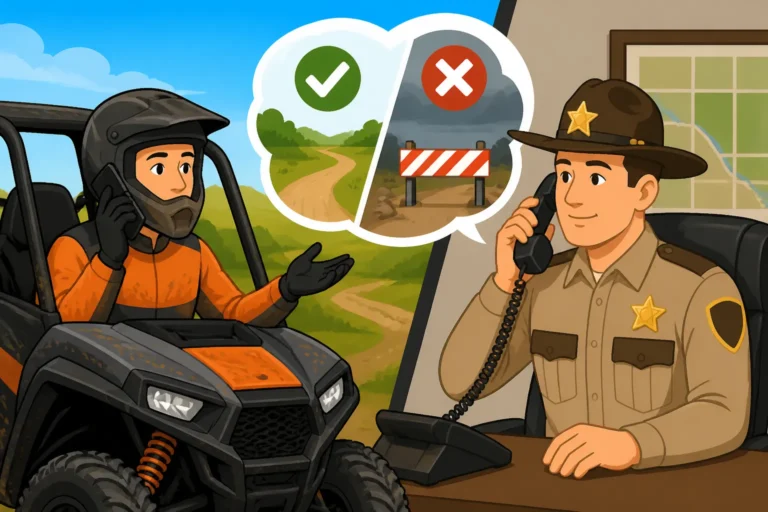
Once an officer is legitimately on private property, if they observe someone operating a motor vehicle while appearing impaired, they have probable cause to investigate for DUI. The simple fact that they are on private land does not automatically shield you from the consequences.
Insurance Implications and Liability
Another often-overlooked aspect of mixing alcohol with riding on private land is the impact on your insurance. While [Nebraska Insurance Required Only on Roads] for liability might be true for road use, your personal ATV/UTV policy might have clauses that deny coverage if an accident occurs while the operator is impaired. Most insurance policies have exclusions for illegal acts.
Consider this: you're riding on private pasture, have a few drinks, and unfortunately, you have an accident. Maybe you hit a tree, or worse, you have a collision with another rider or cause damage to property. If your insurance company finds out you were operating the machine under the influence, they could deny your claim. This means you'd be personally responsible for medical bills, property damage, and any legal fees. The financial repercussions alone could be devastating, far outweighing the momentary enjoyment of a drink while riding. This is true whether you purchased your machine from a dealer or found a great deal on a used machine through [Buying From a Private Seller in Nebraska].
| Scenario | Public Road Applicability | Private Pasture Applicability | Insurance Coverage (Likely) |
|---|---|---|---|
| DUI Charge | Yes | Potentially, depending on circumstances | Denied |
| Accident Reporting | Yes | Recommended, especially with injury | Denied (if DUI) |
| Liability for Damages | Yes | Yes | Denied (if DUI) |
| License Suspension | Yes | Yes (DUI conviction leads to suspension) | N/A |
| Machine Impoundment | Yes | Yes | N/A |
| Criminal Record | Yes | Yes | N/A |
Safety First: Avoiding Impairment for All Rides
At the end of the day, the safest and most responsible approach is to completely separate alcohol and riding, no matter the location. Whether you're navigating challenging trails at Bessey OHV Trails at Halsey or simply cruising across your own acreage, riding an ATV or UTV requires focus, quick reflexes, and sound judgment. Alcohol, even in small amounts, impairs all of these critical abilities.
Many riders invest in high-quality gear and accessories for safety and performance, from robust skid plates to advanced lighting systems. Brands like SuperATV offer a wide range of products designed to enhance your machine's capabilities and your safety. But no amount of aftermarket protection can compensate for impaired judgment. If you wouldn't get behind the wheel of your truck after a few drinks, you shouldn't get on your ATV or UTV either.
Instead of taking risks, if you plan to enjoy alcoholic beverages, park your machine and stay off it until you are completely sober. Designate a sober driver if you're with a group, even on private land, to move machines if needed. Consider taking [Nebraska Voluntary Safety Courses] to sharpen your skills, which will be much more effective when you're clear-headed. Your safety, and the safety of those around you, should always be the top priority. Remember, a single mistake could lead to a lifetime of regret, legal troubles, and financial burdens that far outweigh the brief pleasure of combining riding with alcohol.
Disclaimer
This article is for general informational purposes only and does not constitute professional advice. Laws, prices and regulations vary by location and change over time. Consult a qualified professional for guidance on your specific situation.