Do Nebraska National Forest Trails Require a Spark Arrester?
A spark arrester is easy to overlook when you’re preparing an ATV or UTV for a ride, especially if it is built into the exhaust. On Nebraska National Forest trails, the practical answer is to ride with an approved, working spark arrester and confirm that your machine’s exhaust still has one. Here’s how to check before you tow, and what to verify at the trailhead.
The short answer: plan to use a spark arrester
When you operate an ATV or UTV on National Forest System land, you should expect the machine to need a spark arrester that is in effective working order and meets the applicable Forest Service standard. Nebraska’s National Forest system includes the Bessey Ranger District, where riders use the OHV trails near Halsey. The requirement is about the machine’s equipment, not whether you have a Nebraska registration sticker or an OHV permit.
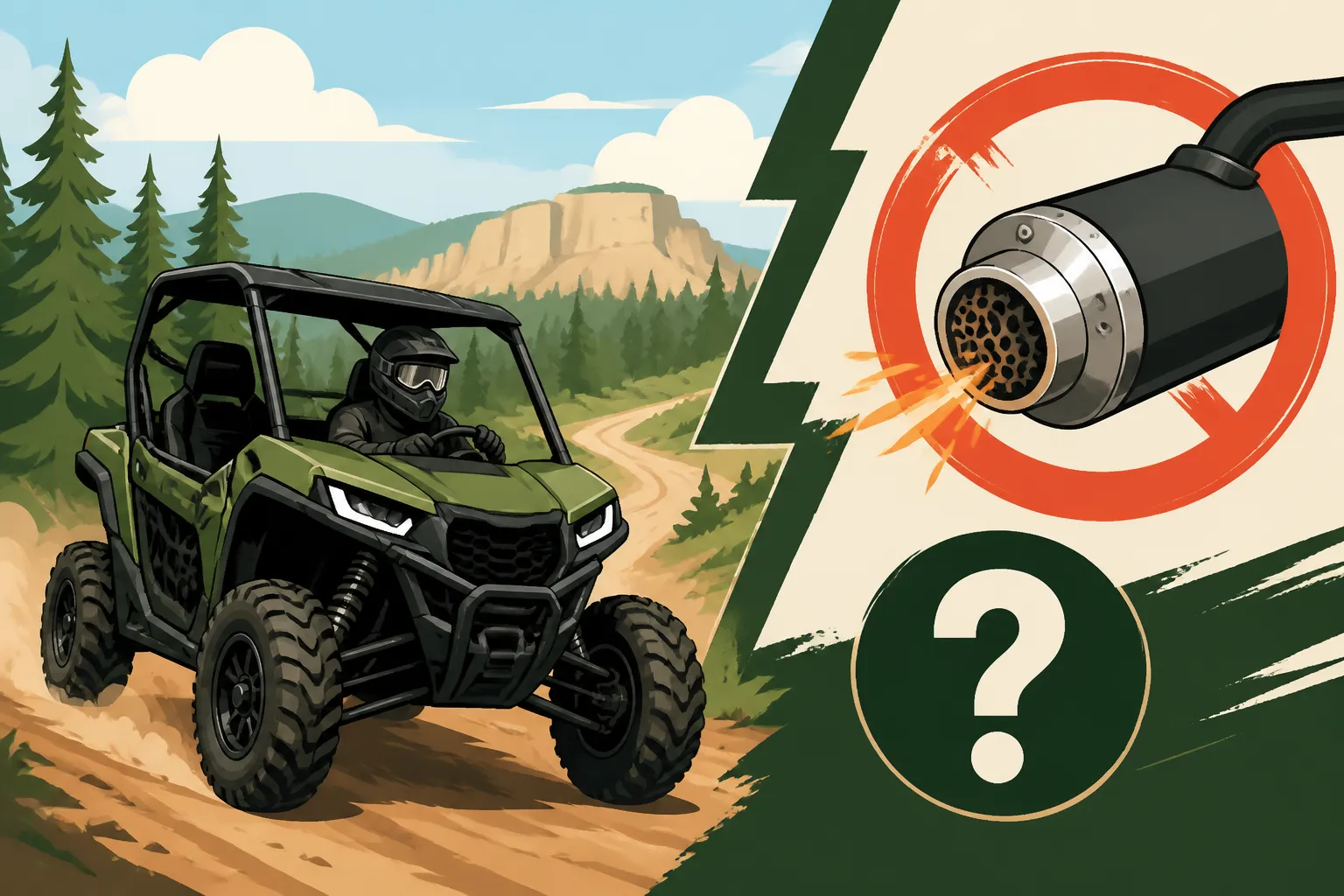
A spark arrester is a device designed to prevent hot particles from escaping an engine’s exhaust. It may be a separate component or built into the muffler or exhaust assembly. It is not simply another name for a quiet muffler, catalytic converter, or exhaust screen. Those parts may be present without serving as a compliant spark arrester.
The most useful rule for trip planning is straightforward: don’t assume your machine qualifies just because it is new, quiet, or has its original-looking exhaust. Check the owner’s manual and exhaust documentation for confirmation that the system includes a spark arrester approved for off-highway use. If the exhaust has been replaced or modified, verify the replacement system rather than relying on what came with the machine.
For a broader look at where forest riding is available, see Nebraska National Forest Riding and Bessey OHV Trails at Halsey in Nebraska. Trail access and equipment rules are separate questions: a trail being open to ATVs does not mean every machine can use it regardless of exhaust equipment.
The rule also isn’t a substitute for checking current conditions. A forest or trail manager may issue temporary fire restrictions or close an area when conditions warrant. Those restrictions can affect where or how you may ride, even if your spark arrester is in good condition. Check for current notices before leaving home and again at the trailhead.
How to check whether your ATV or UTV has one
Start with the exact machine and exhaust combination you plan to ride. A spark arrester may be inside the muffler, at the exhaust outlet, or integrated into a replacement exhaust system. Its location and service procedure vary, so use the manufacturer’s information rather than guessing from appearance.
Check the manual and exhaust documentation
Look in the owner’s manual for terms such as “spark arrester,” “spark arrestor,” or “arrester screen.” The manual may explain whether the part is standard equipment, where it is located, and how to inspect or clean it. If the manual is missing, check with the machine or exhaust manufacturer using the model and year of your ATV or UTV.
An exhaust manufacturer may identify whether a system meets the relevant Forest Service requirements. Keep any documentation with your maintenance records, particularly if you installed an aftermarket exhaust. A product description that says an exhaust is “off-road,” “quiet,” or “performance” does not, by itself, confirm that it includes a compliant arrester.
If you’re considering a replacement part, match it to the machine’s exact model and exhaust. That applies whether you buy from a local dealer or shop through Amazon. Confirm the part’s fit and its spark-arrester specifications with the manufacturer or seller before ordering; don’t rely only on a similar-looking product photo.
Inspect it as the manufacturer directs
A spark-arrester screen can become clogged with carbon or damaged by heat, vibration, corrosion, or improper cleaning. A clogged screen can affect performance, while a missing, damaged, or altered part may no longer provide the intended protection. Follow the manufacturer’s inspection and cleaning procedure, including any cautions about handling a hot exhaust.
Do not drill, enlarge, remove, or otherwise alter the screen to improve exhaust flow. An alteration can defeat the part’s purpose and leave you unable to show that the machine meets the requirement. If the screen is damaged or you can’t establish that the installed exhaust has an approved arrester, postpone the forest ride until you resolve the issue.
| What to check | What to look for | What to do if unclear |
|---|---|---|
| Owner’s manual | Whether the machine has a spark arrester and where it is located | Contact the machine manufacturer or dealer |
| Exhaust system | Whether the installed muffler or system includes an arrester | Check the exhaust manufacturer’s specifications |
| Condition | A present, intact component that has been maintained as directed | Repair or replace it before riding |
| Modifications | Whether aftermarket parts retain the required arrester | Verify the exact system with its manufacturer |
| Current trail information | Open status, closures, and fire-related restrictions | Check official forest or trail notices before travel |
A quiet exhaust is not proof of compliance. Likewise, a machine that has never caused a visible spark is not proof that its exhaust meets the standard. The equipment check is based on the installed component and its condition, not a rider’s observation of the machine during a previous trip.
For additional context about inspections on forest land, see Does a National Forest Check Your Spark Arrestor?. Do not treat the possibility of an inspection as the only reason to maintain the part: an effective arrester is a basic precaution against starting a fire.
What to check before riding Nebraska National Forest trails
A little preparation can prevent a long tow followed by a ride-ending equipment problem. Before heading to Bessey or another National Forest System riding area, check both your machine and the area’s current rules.
- Identify the land and trail. Confirm that your destination is open to your type of machine. Trail designations and local restrictions can differ, and public land does not automatically mean motorized access is allowed everywhere.
- Verify the spark arrester. Use the manual or manufacturer information for your exact exhaust setup. Check that the component is present, intact, and maintained as instructed.
- Review closures and fire notices. Look for current restrictions that could affect trail access or equipment use. Conditions can change after you make your plans.
- Check other machine and riding rules. Width limits, designated routes, and local trail requirements may matter in addition to the spark-arrester rule.
- Recheck at the staging area. Read posted notices and follow any updated instructions. If a sign or official notice conflicts with an old trip plan, follow the current direction.
Trail information is especially important when weather or fire danger affects access. Before making a long drive, check Nebraska Trail Conditions Before You Tow. For general differences between public-land and private riding rules, see Nebraska Public Land Rules Compared to Private.
A useful distinction: Nebraska does not have a statewide OHV permit or sticker requirement for ordinary off-road riding, but that does not remove federal land rules or the possibility of area-specific conditions. A permit question and a spark-arrester question are separate. Read Nebraska Has No OHV Permit or Sticker for the state permit issue, and check the land manager’s notices for trail access and equipment requirements.
If your machine’s exhaust has been modified, or you cannot confirm whether it has an approved arrester, contact the manufacturer or the appropriate forest office before you travel. Give them the machine model, year, and the make and model of the exhaust if it is aftermarket. A general description such as “stock muffler” may not be enough if components have been changed over time.
Common mistakes that can spoil the ride
The most common mistake is assuming every factory exhaust is still in its original condition. Used machines may have had the muffler replaced, the screen removed during cleaning, or an aftermarket system installed by a previous owner. A quick check of the manual and the actual exhaust can catch those changes.
Another mistake is confusing a spark arrester with a noise-control part. A muffler reduces exhaust noise; a spark arrester is designed to stop sparks or hot particles from leaving the exhaust. One assembly can perform both functions, but a quiet machine is not automatically equipped with an effective arrester.
Riders can also overlook maintenance. If the manufacturer specifies that the screen should be inspected or cleaned, follow that procedure. Don’t substitute an improvised screen or make a repair that changes the exhaust design. When the part is damaged, missing, or uncertain, the safer approach is to have it properly repaired or replaced before using the machine on forest trails.
Finally, don’t rely on old information about a trail or fire restriction. Access can change, and temporary notices may apply even when the trail is normally open. Check official notices close to your departure, then read the signs when you arrive. If you cannot verify that your machine meets the spark-arrester requirement, choose a different activity until you can.
Disclaimer
This article is for general informational purposes only and does not constitute professional advice. Laws, prices and regulations vary by location and change over time. Consult a qualified professional for guidance on your specific situation.