Free Riding Claims Worth Checking
A trail listed as “free” can still leave you paying for parking, a park permit, or access to a neighboring recreation area. Nebraska riders can avoid a wasted drive by checking who manages the land, what kind of riding is allowed, and which costs apply before loading the ATV or UTV. This guide explains how to test free-riding claims and verify the details.
What “Free ATV Riding” May Actually Mean in Nebraska
“Free” is not always a complete description. It might mean there is no charge to use a particular trail, while parking or other access requirements still apply. It could also refer to land that is open to the public for one purpose but does not allow motorized riding. Before you treat a free-riding claim as a green light, find out exactly what is free—and what activity is permitted.
Separate trail access from parking and permits
A listing may say that a trail is free because there is no riding charge at the trail itself. But if you need to park in a recreation area, campground, or managed trailhead, a separate permit or parking charge may apply. The reverse can also be true: a general park permit might cover vehicle entry but not authorize riding an ATV on park land.
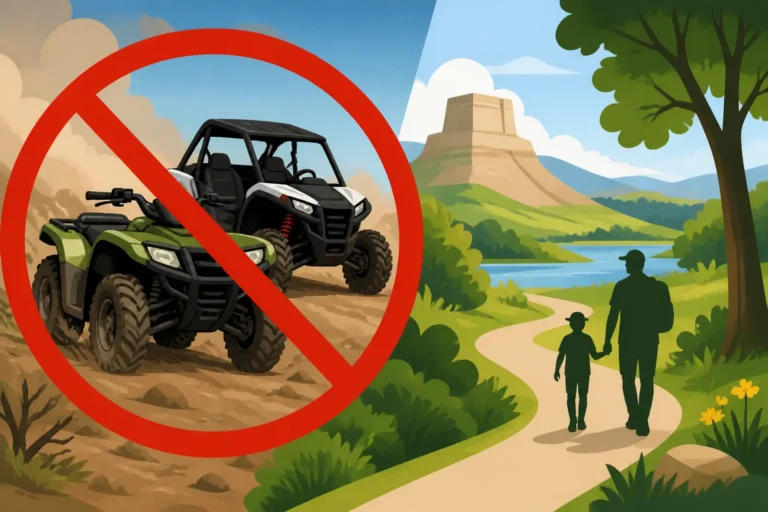
Nebraska’s state parks and state recreation areas are not general-purpose ATV riding areas. A park permit does not make an otherwise prohibited ride legal. That distinction is easy to miss when a map shows a trailhead near a park or when an online post uses “park access” and “trail access” as if they mean the same thing. For details on the difference, see [Why a Park Permit Does Nothing for Your ATV] and [Nebraska State Parks Ban ATVs].
It also helps to ask what the charge covers. A fee could be for parking, camping, or entry to a larger recreation site—not for the trail itself. If you are comparing options, keep the costs in separate categories rather than relying on a single word like “free.” [Nebraska Trail Fees Worth Checking] is a useful companion when you are sorting out possible trailhead and parking charges.
Public land does not automatically mean public riding
Land that belongs to the public is not necessarily open to every vehicle or every kind of recreation. Some public areas allow motorized use only on specifically designated roads or routes. Others may prohibit ATVs altogether, except under a narrow, clearly defined exception. Wildlife management areas are a good example of why riders need to check the rules for the particular area rather than assume that public ownership means open access. See [Nebraska WMA Riding Rules] before planning a ride on a wildlife management area.
Rules can also differ between neighboring parcels. A route may pass close to a public road, forest, lake, or recreation site without being an authorized ATV trail. A map can help you understand the surrounding geography, but it does not, by itself, establish permission to ride. Confirm both the land boundary and the route rules with the agency or property manager responsible for that location.
Nebraska does not have a general statewide OHV sticker that turns an otherwise restricted place into an authorized riding area. That does not mean every ride is free or that every place is open. It means you need to check the requirements for the specific destination, route, and land manager. [Nebraska Has No OHV Permit or Sticker] explains why the absence of a statewide sticker should not be confused with permission to ride anywhere.
How to Check a Free-Riding Claim Before You Tow
A quick search can uncover candidate riding areas, but it often leaves important questions unanswered: Is the trail still open? Are side-by-sides allowed? Is the route on public or private land? Is there a parking requirement? A short verification routine can save a long, frustrating drive to a locked gate or a place where riding is not allowed.
Identify who manages the land
Start by finding the name of the trail or riding area and identifying its manager. Depending on the location, that might be a state or federal agency, a local government, a private park, or a landowner. Look for the manager’s own rules and contact information. A third-party listing can point you toward a place, but the manager’s information is the better source for current access conditions and restrictions.
For example, Nebraska riding discussions often mention Bessey Recreation Complex near Halsey, Cedar Run ATV Trail, and Flat Rock Riders OHV Park. Those are useful starting points for research, not proof that the same rules or costs apply at all three. A forest trail system, a trail near a lake, and a private riding park may each have different access arrangements. Read [Bessey OHV Trails at Halsey in Nebraska], [Cedar Run ATV Trail in Nebraska], and [Flat Rock Riders OHV Park in Nebraska] for destination-specific context, then confirm the current details with the relevant manager.
When a trail is near a campground or a larger recreation area, check whether the riding route and the campground are managed separately. One may be available without charge while the other has its own fees, reservation process, or operating rules. If the information online is unclear, contact the managing office and ask about the trail, parking, and any permit requirement as separate questions.
Verify the route, vehicle, and operating conditions
Do not stop after confirming that “ATVs are allowed.” Find out whether the rule includes your machine. A route might allow certain off-highway vehicles but have limits affecting side-by-sides, vehicle width, or other equipment. Ask about any restrictions that apply to your ATV or UTV, and check whether the trail is open to the public on the day you plan to ride.
Then look for seasonal closures, maintenance notices, weather-related conditions, and local restrictions. A route shown on a map may be closed after heavy rain or temporarily unavailable for another management reason. If you are towing several hours, a final check shortly before departure is a practical safeguard. [Nebraska Trail Conditions Before You Tow] covers why conditions deserve a separate check from the basic access rules.
Mapping tools, including onX Offroad, can help you inspect an area, follow a route, and spot nearby land boundaries or access points while planning. Use a mapping app as a planning aid—not as the final authority on whether riding is permitted. Compare what you see with information from the land manager, especially where boundaries are close together or a route appears to cross more than one type of property.
A Practical Comparison of “Free” Claims
Use this table as a first-pass screen when you find a place described as free. It does not replace the land manager’s rules; it helps you identify what to verify before you go.
| What the listing says | What it may mean | What to check before riding |
|---|---|---|
| Free trail | No charge may apply to trail use itself | Whether parking, entry, or another permit is required |
| Free public land | The land is publicly managed, but vehicle access may be restricted | Whether ATVs or UTVs are allowed on that parcel and route |
| Free parking | A specific parking area may have no charge | Whether the route from that lot is open to your machine |
| Free entry | Entry to a broader site may not include motorized trail access | Whether ATV riding is authorized separately |
| Open year-round | A general schedule may not account for temporary closures | Current notices, weather conditions, and seasonal restrictions |
| No sticker needed | No statewide OHV sticker may be required | Local permits, park rules, private-park requirements, or parking charges |
Ask specific questions instead of asking only whether it is free
When you call or email a site manager, “Is it free?” can produce a technically accurate but incomplete answer. Try questions that separate the parts of the visit:
- Is this particular trail open to ATVs, UTVs, or both?
- Are there width, vehicle, or equipment restrictions?
- Is there a charge to ride the trail itself?
- Is there a separate fee or permit for parking or entering the area?
- Is the route open on the date I plan to visit?
- Are there any closures or temporary restrictions?
- Where is the approved staging area, and can I park a truck and trailer there?
If the person answering is unsure, ask which office or agency handles the trail. A site may have multiple contacts for recreation access, campground reservations, and land management. Getting directed to the correct office is better than assuming that one general answer covers every part of your trip.
It can also help to write down the date you checked and the specific route you asked about. That gives you a clear reference if information from a map, an older forum post, and a current agency notice do not match. For route planning, onX Offroad may help you keep track of candidate trails and access points, but verify the rules separately before unloading.
Use maps to plan, not to grant permission
Digital maps are useful for spotting roads, trailheads, and nearby public or private land. They can make it easier to notice that a proposed route crosses a boundary or approaches a sensitive area. That is particularly helpful when a trail description is vague or when you are unfamiliar with the landscape around Halsey, Harlan County Lake, or another destination.
Still, a line on a screen is not the same as an approved ATV route. Map layers may not show every seasonal restriction, current closure, landowner condition, or vehicle-specific rule. A route that looks continuous might include a segment where motorized travel is not allowed. Confirm the legal route with the managing agency or property owner, and do not use an app to justify crossing a gate or entering land without permission.
onX Offroad can be one tool in a broader planning routine: identify the possible route, note the access points, then compare the plan with official rules and current notices. If the information conflicts, pause and ask the manager rather than choosing the answer that is most convenient. That extra call is far less aggravating than arriving with a trailer and discovering that the route is closed or not open to your machine.
Common Nebraska Riding Situations That Need a Second Look
Some free-riding claims are not deliberately misleading; they are simply missing context. A person may have ridden there years ago, a listing may describe a different activity, or a site may be open to the public but not to motorized vehicles. A little skepticism is useful when details are vague, especially if the claim comes from an old post or an informal map pin.
“It’s public land, so we can ride there”
Public ownership does not settle the question. A wildlife management area, national forest, state recreation area, and local trail system can each have different rules. Even within a broader property, motorized use may be limited to designated routes. Check the exact parcel and route rather than relying on a broad statement about the area.
National forest land also requires careful route-by-route planning. The fact that a forest has an OHV trail system does not mean every forest road or unmarked track is open to ATVs. For a closer look at the relevant setting, see [Nebraska National Forest Riding]. When reviewing routes around Bessey, use the official trail information to confirm which sections are intended for riding and whether parking arrangements are separate.
Private land needs its own permission, even if it appears unused or is reached by a road that the public commonly travels. A trail app, a visible tire track, or a neighbor’s account does not replace permission from the landowner. If a proposed route crosses private ground, get clear permission for the route and the date of your visit before unloading.
“We do not need a permit, so the ride costs nothing”
Not needing one particular permit does not prove that the full trip has no cost. Parking, camping, a private park’s entry requirements, or access to a neighboring facility may be separate. Likewise, the absence of a statewide OHV sticker does not erase local rules. Keep “state sticker,” “site entry,” “trail access,” and “parking” as separate questions.
A rider visiting a place with a vehicle permit requirement should also check whose permit is needed and where it must be displayed. A park permit may apply to the towing vehicle or the site rather than the ATV itself, and it may not authorize riding on the property. If you are evaluating a particular destination, read its rules directly and then compare them with [Nebraska Permit Questions Riders Ask].
Finally, treat “free” as a claim to verify, not as a promise. Keep the manager’s contact details with your trip notes, confirm the route before you leave, and have a backup destination in mind if conditions change. That modest preparation can turn a confusing search result into a much more predictable ride.
Disclaimer
This article is for general informational purposes only and does not constitute professional advice. Laws, prices and regulations vary by location and change over time. Consult a qualified professional for guidance on your specific situation.