Nebraska Trails for Kids
Finding a Nebraska ATV trail that feels manageable for a child can be harder than picking a destination. A route that looks easy on a map may include sand, steep sections, loose gravel, or long stretches without a quick exit. This guide compares family riding areas, explains how to assess a route, and helps you plan a safer day with young riders.
How to choose a Nebraska trail for kids
Match the route to the least experienced rider
The best family trail is not necessarily the shortest or closest one. It is the route that suits the youngest or least confident rider in your group. A child who is comfortable riding around a yard may still feel overwhelmed by deep sand, blind corners, uneven ground, or the noise and speed of other machines.
Before you go, think about what your child has already handled comfortably. Can they stop and start without help? Can they keep control through a turn and respond to simple instructions? Have they ridden on uneven ground, or only on a flat surface? Those answers matter more than a trail’s reputation as “easy.”
Choose a place where you can keep the ride short and turn around if needed. A quick, low-pressure first loop is usually better than planning a full day and hoping everyone has the stamina for it. For more ideas about family-friendly destinations, see [Nebraska Kids' Riding Areas](Nebraska Kids' Riding Areas).
Check the riding area’s rules before loading up
Rules can vary between public riding areas, private parks, and land managed by different agencies. A location may have age limits, helmet requirements, passenger rules, vehicle-size restrictions, or waiver requirements. Some parks set their own minimum ages, so do not assume that a child who can legally ride elsewhere will automatically be allowed through a particular gate.
Confirm whether the area allows your specific machine. A trail open to ATVs may not accommodate every side-by-side, and a route suitable for a small youth quad may not be the right place for a larger adult machine traveling at a different speed. Ask about trail closures, one-way routes, riding hours, and whether children must be accompanied by an adult.
It also helps to ask how the area handles a rider who needs to stop early. Look for clear staging areas, nearby parking, and a way to return without making the child complete the whole loop. These practical details can turn a stressful outing into a flexible one. For broader preparation, read [Nebraska Trail Etiquette Locals Expect](Nebraska Trail Etiquette Locals Expect).
Nebraska riding areas families can investigate
Bessey OHV Trails at Halsey
Bessey OHV Trails at Halsey offer a substantial riding area in the Nebraska National Forest. The trail system is often discussed as a destination for ATV riding, but that does not mean every route is a good fit for every child. Terrain, rider skill, machine size, and conditions all affect how demanding a ride feels.
For a family visit, start by checking the current trail information and identifying a short section that matches your group’s experience. Ask about trail conditions before unloading, especially if recent rain or dry weather could have changed the surface. Sand and loose ground can make a route feel more tiring than its mileage suggests, and a child may need more breaks than an adult expects.
Keep the first outing modest. Agree on a stopping point before you start, and make sure every rider knows how to signal that they need a break. The riding area’s details are covered in [Bessey OHV Trails at Halsey in Nebraska](Bessey OHV Trails at Halsey in Nebraska), and [Best Nebraska ATV Trails for Beginners](Best Nebraska ATV Trails for Beginners) can help you think through what “beginner-friendly” should mean for your own family.
Cedar Run ATV Trail
Cedar Run ATV Trail is another Nebraska riding area families may want to research. Its setting and layout may appeal to riders looking for a designated trail experience, but it is still important to check current access, conditions, and machine rules rather than relying on an old recommendation or a map listing.
For a child’s first visit, find out where you can stage, how the trail connects to the parking area, and whether there are natural places to stop. A shorter ride near the trailhead is often easier to manage than a longer loop with no convenient way back. Ask whether the surface is muddy, sandy, or uneven, and whether any sections are currently closed.
If your child rides a youth machine, confirm that the trail and the rules suit that vehicle. A parent’s machine may be capable of handling more terrain, but the child’s machine, reach, braking ability, and experience should set the pace for the group. Learn more about the area through [Cedar Run ATV Trail in Nebraska](Cedar Run ATV Trail in Nebraska).
Flat Rock Riders OHV Park
Flat Rock Riders OHV Park is a smaller riding destination to look into when comparing Nebraska options. A compact area can be appealing for families because it may be easier to keep the group together and take breaks close to the staging area. Still, a small footprint alone does not guarantee easy terrain or make a venue suitable for every age.
Contact the park before you travel. Ask what types and sizes of machines are allowed, whether youth riders are permitted, what safety equipment is required, and whether the terrain includes features that may be challenging for beginners. If the park has separate tracks or designated areas, ask whether any are intended for younger or less experienced riders.
Private riding areas may have rules that differ from public land, including waivers and supervision requirements. Read those rules before arrival so you are not trying to sort out paperwork with an excited child waiting beside the trailer. See [Flat Rock Riders OHV Park in Nebraska](Flat Rock Riders OHV Park in Nebraska) and [Nebraska Private Park Age Minimums](Nebraska Private Park Age Minimums) when researching the visit.
| Riding area | What families should investigate | A practical first-ride approach |
|---|---|---|
| Bessey OHV Trails at Halsey | Trail conditions, vehicle rules, staging, and route difficulty | Pick a short section and check whether sand or changing conditions may challenge a new rider |
| Cedar Run ATV Trail | Current access, trail surface, closures, and youth-machine suitability | Ask where a short ride can begin and end near the staging area |
| Flat Rock Riders OHV Park | Park rules, age limits, waiver requirements, and machine restrictions | Confirm whether the park has an appropriate area for a child’s skill level |
Plan a safer ride with children
Prepare the machine and safety gear
A child should ride a machine that fits them—not one they are expected to grow into on the trail. They need to be able to reach the controls, operate the brakes, and maintain a stable riding position. If they struggle to control the machine while stationary, a trail ride is not the time to see whether they can manage it once the terrain gets rough.
Use a properly fitted helmet and appropriate protective clothing, including sturdy footwear, gloves, and eye protection. Check the machine before leaving home: tires, brakes, throttle response, controls, and fuel all deserve attention. For a youth machine, confirm that any speed-limiting or safety features are set as intended. Do not rely on an adult’s quick glance if something feels loose or unusual.
Make sure the child understands basic signals and what to do if the group stops. Agree on simple instructions such as staying behind the lead adult, not passing, and pulling over only when directed or when there is a safe place to do so. A safety course can help teach foundational habits; see [Nebraska Safety Course Options](Nebraska Safety Course Options).
Set a pace children can maintain
Children often want to keep up with adults even when they are tired or nervous. Adults can help by making the pace deliberately slow and treating stops as part of the plan—not as a sign that the ride is going badly. If a child is tense, quiet, or repeatedly falling behind, pause and check in rather than encouraging them to push through.
Use a lead rider and a sweep rider when the group is large enough. The lead adult can choose the route and watch for hazards; the last adult can make sure no one is left behind. Keep machines spaced out, especially where dust limits visibility. On narrow trails, let the group gather in a safe spot before making decisions or changing direction.
A simple agreement helps: anyone can ask to stop, and no one rides ahead alone. If the child wants to turn back after a short loop, take that seriously. Ending on a positive note makes it easier to try again another day. For route planning, [Nebraska Trail Difficulty Ratings](Nebraska Trail Difficulty Ratings) is a useful topic to review alongside the specific area’s current information.
Pack for delays and changing conditions
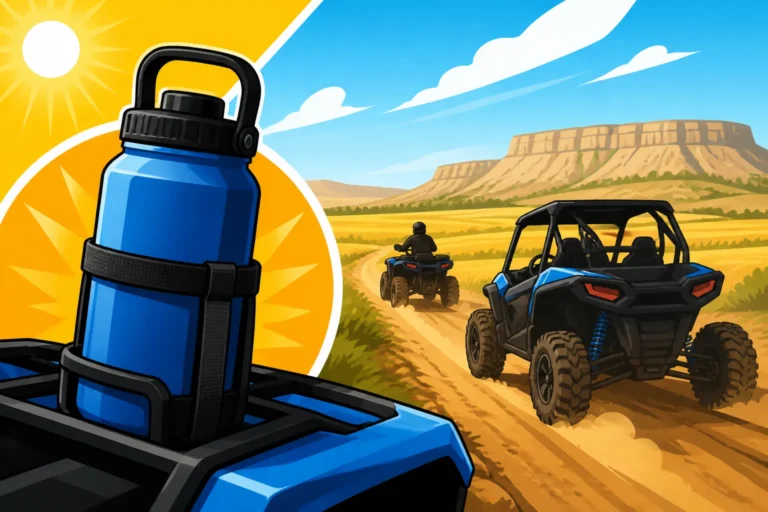
A family ride can take longer than expected. Bring enough drinking water, snacks, basic first-aid supplies, and any medication your child may need. Dress for changing Nebraska weather, and consider how wind, heat, dust, or a sudden temperature change will affect a young rider who is exposed on an open trail.
Before you leave, tell someone where you plan to ride and when you expect to return. Check whether phone service is likely to be available, but do not make a phone your only navigation or emergency plan. An offline map tool such as onX Offroad can help with route planning and identifying your general location, but confirm trail access and rules directly with the land manager or riding area. A digital map does not establish that a route is open or appropriate for your machine.
Carry a paper map or written directions if available, and agree on a meeting point in case the group gets separated. Keep the route conservative if weather or visibility worsens. You can find more planning advice in [Packing a First Aid Kit for a Long Loop](Packing a First Aid Kit for a Long Loop) and [What to Pack for a Hot Dry Riding Day](What to Pack for a Hot Dry Riding Day).
A simple first-ride planning checklist
Before you leave home
Start with the destination, then verify the details that can change: open areas, trail conditions, allowed machines, youth rules, fees, parking, and required safety equipment. Contact the riding area if any part of the rules is unclear. This is especially worthwhile when you are bringing a child’s machine or a side-by-side, since permitted vehicle types and youth requirements may differ by location.
Choose a route that offers an easy exit and avoid building the day around a long ride. Make sure each child’s machine fits, inspect the equipment, and pack water, snacks, protective gear, and basic supplies. If you are using onX Offroad or another mapping app, download any map information you may need before leaving an area with reliable service, and treat it as a planning aid—not a substitute for posted signs or land-manager guidance.
At the trailhead
Take a few minutes to orient the group before starting. Point out the trail entrance, the direction of travel, the planned turnaround point, and where everyone should stop if the group becomes separated. Review hand signals and spacing. Give children a chance to ask questions before the machines are moving.
Watch the child’s comfort level during the first stretch. If the terrain feels more difficult than expected, turn around or choose a simpler option if one is available. Do not let pressure to “get your money’s worth” or complete a loop override the rider’s safety and confidence. A short ride that ends with everyone feeling good is a successful family outing.
After the ride
Give children time to cool down, drink water, and talk about what felt comfortable and what did not. Their feedback can help you choose a better route next time. Check the machines for damage or debris before loading, and follow the riding area’s rules for parking and waste.
If a trail was too challenging, that is useful information—not a failure. You can build confidence with practice on a more suitable route and return to a harder area later. For additional destination ideas, browse [Nebraska Trails for Kids](Nebraska Trails for Kids) and [Nebraska Trails That Allow Side-by-Sides](Nebraska Trails That Allow Side-by-Sides), then verify the current rules for the specific place you plan to visit.
Disclaimer
This article is for general informational purposes only and does not constitute professional advice. Laws, prices and regulations vary by location and change over time. Consult a qualified professional for guidance on your specific situation.