Nebraska Park Rules for ATVs
Nebraska’s park rules can be confusing because a park permit, an ATV title and permission to ride are different things. In general, you cannot ride an ATV or UTV in a Nebraska state park or state recreation area. A narrow frozen-water exception and separate rules for wildlife management areas make it important to check the exact place before unloading.
The basic rule for Nebraska parks
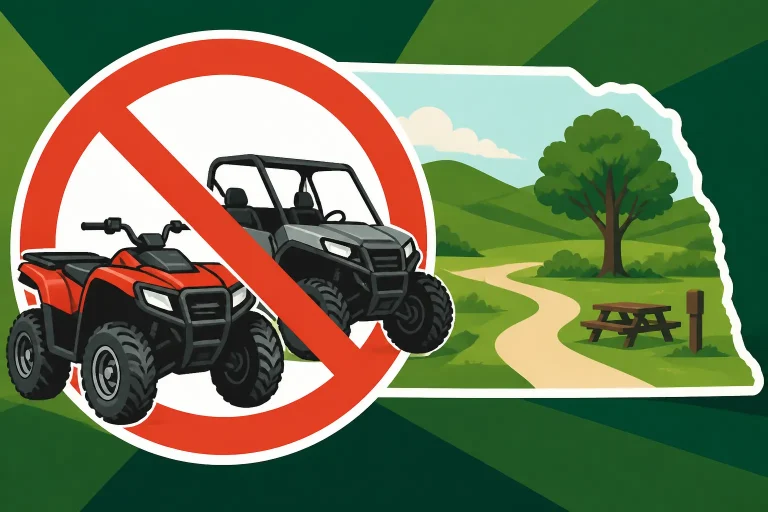
Nebraska state parks and state recreation areas are not places to ride ATVs or UTVs. The restriction also covers other off-road machines, including three-wheelers, scooters and minibikes. Having a title, an out-of-state registration, insurance or a state park entry permit does not give you permission to operate an off-road machine where riding is prohibited.
That distinction matters because “park permit” can sound like a vehicle-use pass. A Nebraska park entry permit covers entry by the vehicle for which it is required; it does not open ATV trails or turn a closed road into an authorized riding route. The same goes for a sticker or registration from another state. Nebraska does not have a general state ATV sticker that grants access to parks, and an out-of-state credential does not override a local closure.
Before hauling a machine to a park, separate these questions:
- Can the truck or tow vehicle enter the park? Check the park’s vehicle-entry permit and access requirements.
- Can the ATV or UTV be unloaded and ridden there? Check the specific site’s rules. At state parks and recreation areas, the general answer is no.
- Is there a designated exception or separate riding area? Confirm it with the managing agency before you go.
A park permit may still be needed for the vehicle carrying your machine, depending on the place and how you enter. It is not an ATV riding permit. For details on how park entry permits work, see Nebraska State Park Entry Permits and Why the Park Permit Belongs on Your Truck.
The practical mistake to avoid is assuming that a place with roads, beaches, campgrounds or a boat launch is automatically open to ATVs. Access for cars and trucks is not the same as access for off-highway vehicles. Likewise, parking a truck legally does not authorize unloading the machine and riding around the campground, on an access road or along the shoreline.
| Location or credential | What it generally means for an ATV or UTV |
|---|---|
| Nebraska state park | Riding is generally prohibited |
| Nebraska state recreation area | Riding is generally prohibited |
| State park entry permit | Covers eligible vehicle entry, not ATV riding permission |
| Out-of-state ATV registration | Does not grant access to Nebraska parks |
| Wildlife management area | Follow designated roadway, parking and closure rules |
| Frozen water | A limited exception may apply where the area is open and conditions allow |
| Private riding park | The operator sets site rules; check before arrival |
Rules and closures can differ by site and may change. If a sign, map or current notice closes an area, do not treat a general exception as permission to ride there.
The frozen-water exception is narrow
Nebraska has an exception that can allow ATVs on frozen water in certain circumstances. It is not a blanket winter pass for every lake, reservoir or park. The area must be open to that use, and posted signs and site-specific restrictions still matter.
A frozen surface can look consistent while having weak spots, thin areas or hazards hidden by snow. Ice conditions can change across the same body of water, and a route that was usable earlier may no longer be safe. A legal opening also does not guarantee that the ice can support a machine. Check current conditions and closures, follow posted directions, and do not ride onto ice when its safety is uncertain.
The exception should not be read as permission to ride on a park’s roads, trails, beaches or campground whenever the ground is frozen. It concerns frozen water, not a general opening of the surrounding property to off-road vehicles. Nor does it automatically apply to a wildlife management area or a private lake; each site has its own management rules.
Before considering frozen-water riding:
- Confirm the exact waterbody and access point. A nearby lake or adjoining property may have different rules.
- Look for current signs and closure notices. An exception does not cancel a posted restriction.
- Ask the managing agency if the rule is unclear. Do not rely on an old map, a social media post or another rider’s recollection.
- Assess ice safety independently. Legal access is not a statement that the surface is safe for a machine.
- Stay off adjacent closed land. Reaching an open ice area does not authorize riding through a closed park or across a prohibited shoreline.
For more detail, see Nebraska Frozen Lake Riding Rules and Frozen Water as an Exception. If signs close a frozen area, follow them; Reading the Signs That Close a Frozen Lake explains why a general ice exception may not be enough to determine access.
Wildlife management areas have different limits
A wildlife management area is not interchangeable with a state park, and its rules are not a general invitation to ride. Nebraska wildlife management areas commonly limit motorized travel to designated roadways. A machine may be allowed on a marked or otherwise authorized route while being prohibited on trails, grass, fields, shoreline or other ground nearby.
Use the posted signs and the area’s current instructions to identify where a vehicle may travel and where it may park. Do not assume that a two-track, service route or visible tire marks are proof that public ATV use is allowed. A road that serves management work may not be open for recreational riding.
The restrictions are especially important for riders visiting during hunting seasons. A hunting license does not create motorized access, and a machine’s title does not establish permission to cross habitat or use an unmarked route. Check the area’s rules before using an ATV for access or game retrieval. See Nebraska WMA Access for a Quad, [Nebraska WMA Roadway Rules] and Your Hunting License Does Not Open Any Trails.
Frozen water can be a separate consideration at a wildlife management area, but the same caution applies: verify the exact location, look for closures and do not assume that an open-water exception makes nearby roads or land open. Parking rules can also be separate from riding rules. A vehicle may need to remain in a designated parking area even if a particular route is open. Where You Can Park on a Wildlife Management Area and Which Management Area Trails Stay Closed to ATVs can help clarify those distinctions.
When the rules are not obvious, contact the land manager or ask the relevant agency before the trip. Give the exact area name and describe the machine and the route you intend to use. “Can I ride here?” is more useful when it means “Can this ATV travel on this named road or reach this specific frozen area?” rather than asking about a broad region.
How to plan a legal ride
A little checking before loading can prevent a long drive to a place where the machine must stay on the trailer. Use this process for state parks, recreation areas, wildlife management areas and other public properties.
- Identify who manages the site. A place called a park may be managed by a state agency, a local government, a federal land manager or a private operator. The name alone does not tell you which rules apply.
- Find the rules for the exact property. Check the current official page, map, signs or agency instructions. Look for restrictions on ATVs, UTVs, roads, parking and frozen water.
- Confirm the route, not just the destination. A riding area may be open while a road leading to it is not. Verify where you can unload and how you can reach the authorized route.
- Treat signs and closures as controlling. Do not ride around a barrier or assume an unsigned-looking path is open. Ask the manager if the boundaries are unclear.
- Check what the vehicle needs for the trip. A park entry permit for a tow vehicle, proof of ownership, insurance requirements for road use and local riding rules are separate matters. None replaces permission to use a particular trail or property.
- Have a backup destination. If the site is closed, the ice is unsafe or the permitted route is unsuitable for your machine, use a designated riding area instead.
Nebraska does have places intended for off-highway riding, but access depends on the specific site and its operating rules. National forest trails and private riding parks, for example, have their own permitted routes, equipment restrictions, closures and fees. A park that allows camping or vehicle access is not necessarily an ATV riding venue. Start with Nebraska ATV Trails: Where to Ride or Nebraska National Forest Riding when you want a place designed for motorized trail use.
A private riding park can set rules that differ from public land rules. Before heading there, ask whether your machine type and width are allowed, whether reservations are needed, what equipment is required and whether trails are closed after weather. A private waiver or day-use arrangement applies only to that operator’s property; it does not grant access to nearby public land.
For a visiting rider, the main takeaway is simple: do not rely on a state permit or another state’s registration as proof that an ATV can be ridden in a Nebraska park. Confirm the exact property, route and current conditions with the manager. When state parks and recreation areas are off limits, look for an authorized riding location rather than trying to interpret a general park entry permit as trail access.
Disclaimer
This article is for general informational purposes only and does not constitute professional advice. Laws, prices and regulations vary by location and change over time. Consult a qualified professional for guidance on your specific situation.