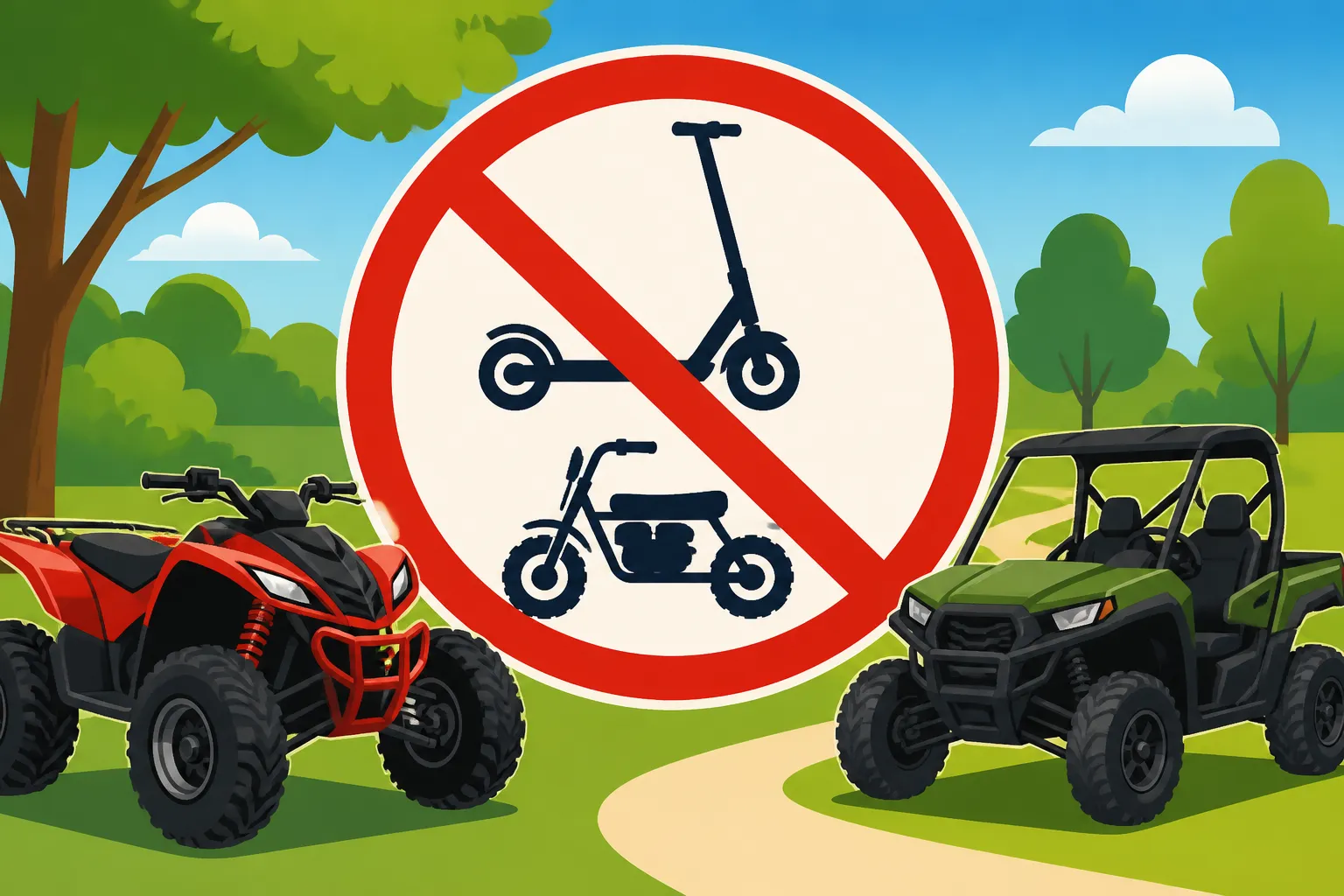
Scooters and Minibikes Are Banned in Parks as Well
Scooters and minibikes can look like smaller, easier-to-manage alternatives to an ATV, but that does not automatically make them welcome on Nebraska public park trails. The important distinction is where you plan to ride and what kind of machine you mean. Here’s how to think through the restriction, avoid confusing park permits with riding permission, and check the rules before unloading.
What the restriction means in Nebraska parks
A recreational scooter or minibike is not automatically allowed just because it is smaller than an ATV. In Nebraska state parks and recreation areas, motorized off-road riding is restricted, and scooters and minibikes are among the types of machines that should not be assumed to be permitted. The ban is about the machine and where it is being operated, not simply its size or the name on its registration paperwork.
That distinction matters because everyday language is loose. One person may use “scooter” for a small motorized trail vehicle; another may mean a mobility device used by a person with a disability. A small minibike may have pedals, a low-power engine, or equipment that makes it resemble a bicycle. Those differences can matter under specific rules, but they do not create a general right to ride a recreational motorized machine on a park trail.
| Machine or situation | What to assume before you go |
|---|---|
| ATV or UTV on a Nebraska state park trail | Do not assume riding is allowed |
| Recreational minibike on a park trail | Treat it as a motorized off-road machine and check the site rules |
| Recreational motorized scooter in a park | Do not assume it is allowed because it is small |
| Mobility device used by a person with a disability | Ask the park about the applicable access rules and route conditions |
| Machine on a public road near a park | Road-use rules are separate from park-trail rules |
| Machine at a private riding park | The operator’s rules apply; check before arriving |
The practical starting point is the same for all three recreational machines: identify the exact property and ask what types of vehicles it allows. A state park, recreation area, wildlife management area, national forest, and private riding park can have different rules. A machine allowed at one kind of site is not necessarily allowed at another.
For the state-park restriction in particular, see Nebraska State Parks Ban ATVs and Nebraska Recreation Areas Closed to ATVs. The underlying issue is not solved by describing a minibike as a toy or a scooter as a compact vehicle. If it is a motorized recreational machine being used off-road, check the property’s rules before riding.
There is also an important difference between access to a property and permission to ride a machine there. A park may allow people to enter, camp, picnic, or use roads in a vehicle while prohibiting recreational off-road riding. Being able to bring a truck and trailer into a park does not mean you can unload a minibike and use it on a footpath, campground loop, or shoreline.
Why a small scooter or minibike is not automatically an exception
It is tempting to assume that a restriction is aimed only at large, fast, or heavy machines. But size alone is a poor guide to whether a park allows a vehicle. A minibike can still have a motor, travel off-road, create noise, damage a trail surface, or conflict with pedestrians. A scooter designed for recreational riding may raise similar concerns even if it is lighter than an ATV.
Nor does the absence of a state OHV sticker settle the question. Nebraska does not have a general state OHV permit or sticker that grants access to public park trails. That does not mean every machine can ride wherever there is no sticker requirement. A property can prohibit a type of vehicle even when the state does not issue a statewide off-highway permit. For the broader distinction, see Nebraska Has No OHV Permit or Sticker.
A state park entry permit is also not an off-road riding permit. It concerns entry to the park by the vehicle or visitor as described by the applicable park rules. It does not turn a prohibited machine into an allowed trail vehicle. Why a Park Permit Does Nothing for Your ATV explains why it is important to keep entry requirements separate from vehicle-use rules.
The same caution applies to labels. A seller’s description, a manufacturer’s classification, or the vehicle’s road paperwork may help identify what the machine is, but it does not independently establish permission to ride on a particular park trail. If the rule or sign names a category that seems unclear, describe the machine’s features when asking the park: its type of motor, whether it is designed for off-road use, and how you plan to operate it.
Mobility devices deserve separate consideration. A recreational minibike or scooter should not be treated as interchangeable with a mobility device used to address a disability. If you need a mobility device to access a park, contact the property about the route, applicable access requirements, and any limitations. Do not rely on a general statement about recreational scooters to answer a question about disability access.
Finally, public land rules are not one single statewide trail policy. Wildlife management areas, for example, have their own vehicle restrictions and may limit motorized use to designated roadways or other permitted areas. Check Nebraska WMA Vehicle Rules if your destination is a wildlife management area rather than a state park. A machine that cannot be ridden on a state park trail may be subject to a different rule elsewhere, but that is not the same as blanket permission.
How to check the rule before you unload
A quick check before a trip is much easier than resolving a disagreement at a trailhead. Use the exact name of the property and ask about the exact machine, rather than asking only whether “scooters” or “minibikes” are allowed. Those words can refer to different vehicles, and staff need enough information to give a useful answer.
- Identify who manages the property. Confirm whether it is a state park, recreation area, wildlife management area, national forest, or private riding facility.
- Read the current rules for that specific place. Look for restrictions on ATVs, UTVs, minibikes, scooters, motorcycles, and other motorized vehicles. Also check signs at entrances and trailheads.
- Describe your machine clearly. Give its general type and explain whether it is a recreational off-road vehicle or a mobility device. Do not rely only on its size or the term used in an online listing.
- Ask where it may be operated. A property might distinguish between a public road, parking area, campground, designated route, and pedestrian trail. Permission for one area does not automatically extend to another.
- Confirm any separate access requirements. Park entry permits, parking rules, and riding permissions are different questions. Check each one separately.
- Keep the answer and follow posted signs. If staff clarify the rule by phone or email, save the information for the trip. Follow any closure or restriction posted on-site, even if older information suggests otherwise.
When asking, a useful question is: “I have a recreational minibike with a motor. Is it allowed to be operated on this property, and if so, on which routes?” For a scooter, describe whether it is a recreational motorized vehicle or a mobility device. This avoids a yes-or-no answer based on an assumption that you mean a different machine.
A machine’s ability to travel on a nearby road is not proof that it can be used on park trails. Road rules and property rules answer different questions. If you are considering road use, review Can You Drive an ATV on the Road in Nebraska? and the rules for the particular road and municipality. Do not use a road-use allowance as a reason to ride off-road where the property prohibits it.
Where private parks and other destinations differ
A private riding park may allow vehicles that public parks do not, but access is controlled by the operator’s own rules. Those rules can cover which machine types fit the trails, minimum rider ages, helmets, passengers, noise, equipment, and where vehicles may be operated. Permission at a private facility does not carry over to a state park or public-land trail. Before loading up, check Nebraska Private Park Waivers and Rules and contact the facility about your specific scooter or minibike.
A private park may also have practical restrictions beyond the basic question of whether a minibike is permitted. Narrow trails, steep terrain, surface conditions, or mixed use can make a particular machine unsuitable even when it is technically allowed. Ask whether the facility has a dedicated route or area for that vehicle type, and whether its current conditions change what is open.
For public destinations, verify the property manager and the precise area you intend to use. A park can include roads, campsites, beaches, and trails with different rules. A sign at one entrance may not describe every route, so look for trail-specific signs and closures as well. If the wording remains ambiguous, do not treat uncertainty as permission; ask a ranger, office, or site manager before riding.
The simplest rule for trip planning is to separate three questions: Can you enter the property? Can you bring the machine onto it? Can you operate that machine in the area you have in mind? A “yes” to the first does not answer the other two. That distinction helps prevent a common mistake: buying an entry permit or finding an open campground and assuming that a small motorized vehicle can then use the trails.
If the destination is a Nebraska state park or recreation area, plan on not riding a recreational scooter or minibike unless the managing authority confirms a specific allowance. If it is a private riding park, check the operator’s machine and trail rules. If it is another public land unit, consult that unit’s rules rather than assuming that a rule from a nearby park applies.
Disclaimer
This article is for general informational purposes only and does not constitute professional advice. Laws, prices and regulations vary by location and change over time. Consult a qualified professional for guidance on your specific situation.