Nebraska WMA Parking Rules
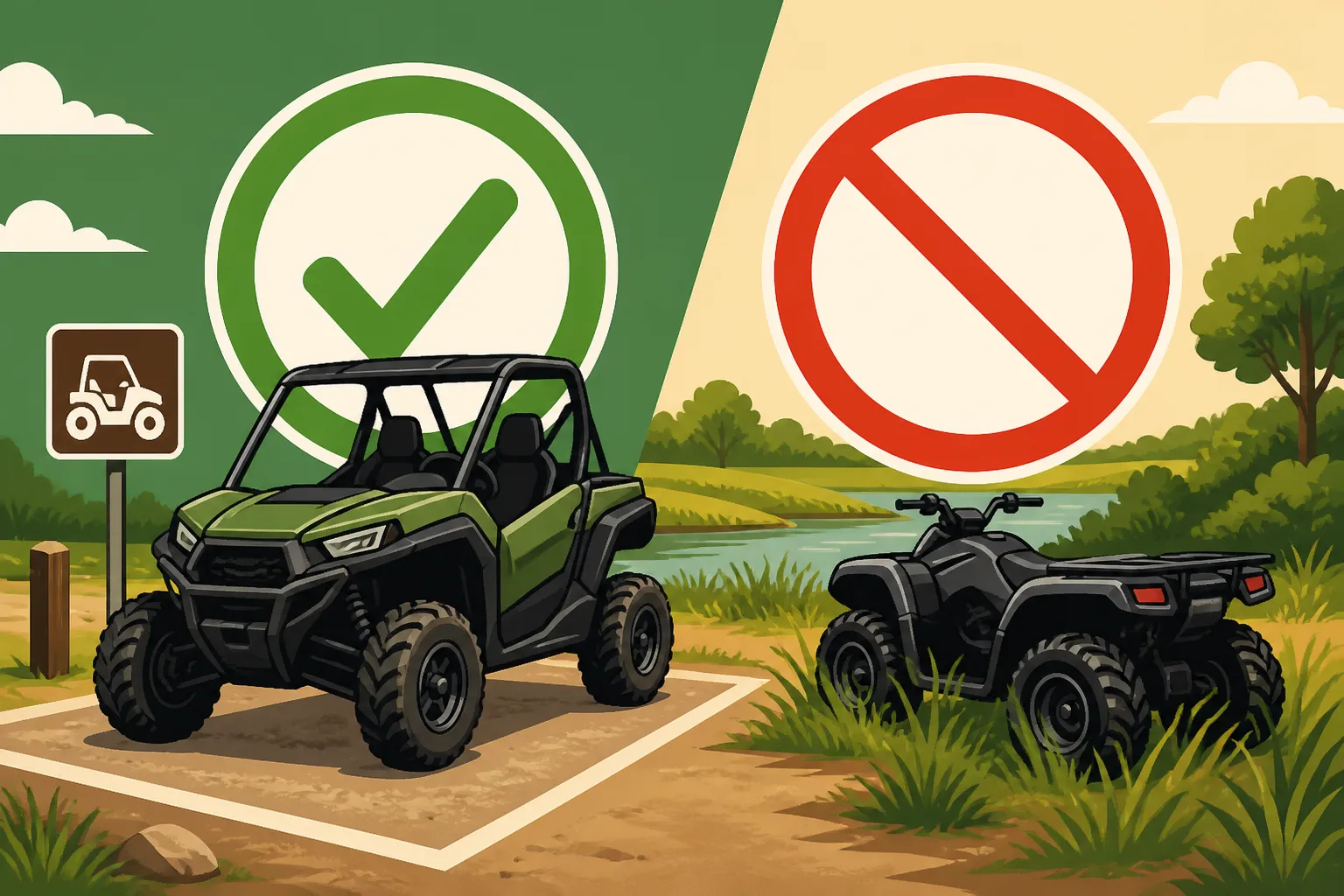
Parking an ATV or UTV at a Nebraska Wildlife Management Area is not the same as parking at a trailhead with open riding access. A signed lot may be available even when machines are restricted to certain roads or riding is not allowed. The safest approach is to check the specific area’s signs and access rules before unloading, then park only where the area permits.
Parking and riding are separate questions
A Wildlife Management Area, or WMA, is public land managed for wildlife and outdoor recreation. Public access does not mean every road, field, parking spot, or trail is open to motorized vehicles. A place to park your truck and trailer is not proof that you may ride an ATV or UTV from that spot.
Nebraska WMA rules generally limit motorized vehicle use to designated roadways and parking areas. The designation matters: a visible track, field edge, or path through grass is not automatically an approved route. If you leave a designated roadway to reach a preferred parking spot, unload, or ride across a field, you may be outside the allowed vehicle area.
Check Nebraska WMA Vehicle Rules and Nebraska WMA Roadway Rules before your trip. These are useful distinctions to keep in mind:
- A parking area is for parking. It does not necessarily connect to a legal ATV route.
- A designated roadway is not necessarily open year-round. Signs or temporary closures may restrict access.
- Public access does not remove vehicle limits. Walking, hunting, or wildlife viewing may be allowed where riding is not.
- Rules can vary by WMA. An area that permits a particular type of vehicle access does not set the rule for every other area.
When in doubt, treat the marked parking area and marked roadway as separate permissions. Park first, read the signs, and confirm that the route you intend to ride is open to your machine. If you cannot establish that the route is designated and available, do not ride it.
| Situation | Safer assumption | What to confirm |
|---|---|---|
| A signed parking lot is open | Parking may be allowed there | Whether ATVs or UTVs may continue onto a roadway |
| A road looks drivable | Appearance alone does not establish access | Signs, gates, maps, or current management information |
| A vehicle is parked near a gate | The location may not be an authorized parking area | Whether parking blocks access or sits beyond a restriction |
| Other riders are using a track | Other people’s use does not establish permission | Whether that route is designated and currently open |
| A lake is frozen | Ice access does not automatically allow riding | Whether the WMA permits it and whether signs close the area |
Choosing a legal place to park
Use the area’s signed parking space or another location clearly identified for public parking. Park your tow vehicle and trailer so they do not block a roadway, gate, access point, or space needed by other visitors. Avoid driving over vegetation to make room, even if the ground looks firm.
The same care applies after unloading. Keep the ATV or UTV in the parking area until you have confirmed where motorized travel is allowed. Do not ride around the lot or take an informal shortcut to a roadway unless the area’s signs or other official information make that use clear.
If the parking area is full, do not treat the shoulder, a field entrance, or the area beside a closed gate as a convenient overflow lot. A blocked access point can prevent management or emergency vehicles from getting through. It can also interfere with hunters, maintenance crews, or other visitors arriving at the area. If there is no clearly suitable space, choose another location or postpone unloading.
To identify where parking is allowed:
- Check signs at the entrance. Look for parking instructions, vehicle restrictions, closures, and notices about specific roads or activities.
- Read signs again at junctions and gates. A route may be open for part of its length and restricted beyond a barrier or sign.
- Use official area information as a supplement. A map can help with planning, but posted signs and current closure information should guide your decision on arrival.
- Do not rely on tire tracks or other visitors. They can show where someone has driven, not whether that route is authorized.
- Ask the managing agency when the instructions are unclear. For Nebraska WMAs, confirm details with Nebraska Game and Parks or the local contact identified for that area.
More detail on locating suitable spaces is available in Where You Can Park on a Wildlife Management Area. If you are planning a ride rather than just a stop, also review Nebraska WMA Access for a Quad. Parking permission and riding permission still need to be considered separately.
Common WMA parking situations
Parking a truck and trailer
A trailer can take up more room than a passenger vehicle, so plan for the full combination before turning into a small lot. Do not leave the trailer where it narrows a roadway or blocks another parking space. If the lot cannot safely fit your truck and trailer, do not assume you may unload on nearby land.
Before setting out, check whether the area information identifies a parking area suitable for a trailer. If it does not, contact the manager rather than driving onto an unmarked road or field to look for more space. An approved parking spot for a car may not be practical for a large tow vehicle, and that is a reason to choose a different access point—not a reason to create one.
Parking beside a road or gate
A gravel road can look like a good place to pull over, but it may be an active access route. Likewise, an open gate does not necessarily mean that the ground beyond it is available for public parking. Do not park in a way that blocks a gate, sign, narrow roadway, or turnout another visitor needs.
If a road is marked closed, do not drive past the sign to find a place to turn around or unload. If you reach a gate and are unsure whether parking is allowed nearby, stay on the permitted side and look for an identified parking area. Leaving room for access is especially important on working public land, where staff and emergency responders may need to reach places that visitors cannot.
Unloading and moving the machine
Unload only where it is safe and allowed, then check the route before riding. A legal parking area does not create a right to ride across surrounding grass or connect to a trail that is not designated for motorized use. Keep the machine in the marked area until you have verified the route.
Do not use a short off-road cut to reach a road or trail that appears nearby. Even a brief detour can leave the designated route. If the approved road does not connect to the destination you expected, return to the parking area and reassess rather than continuing across unmarked ground.
Parking for hunting or wildlife viewing
Parking for a hunt does not change the rules for motorized travel. You may be able to park and continue on foot in places where riding is not allowed. A hunting license, permission to hunt, or access to public land should not be treated as permission to drive an ATV across the WMA.
Check Nebraska Hunting Land Access by Machine if your plan involves transporting equipment or retrieving game. Confirm where a vehicle can travel, where it can be left, and whether the particular activity has separate restrictions. The key point is simple: permission for an activity and permission to operate a motor vehicle are not the same thing.
Visiting when a lake is frozen
Some WMA rules include a limited exception for riding on frozen water, but that does not mean every frozen lake or shoreline is open to ATVs. The exception may depend on the area and on current signs or closures. Parking near a lake also does not authorize riding across its shoreline, wetland, or surrounding land.
Check Nebraska WMA Frozen Lake Exception and Nebraska WMA Ice Riding Rules before planning an ice ride. If signs close the ice or identify a restricted area, follow them. Do not use the frozen-water exception as a reason to ride to the lake over an undesignated road or across land where vehicle use is prohibited.
What a park permit or registration does not tell you
WMA access can be confused with access to a state park or recreation area. A park entry permit, where required for a park, is not a general authorization to ride an ATV on a WMA. Similarly, an ATV title or out-of-state registration is not proof that a particular WMA road is open to motorized use.
The useful question is not only, “Do I have the right paperwork?” It is also, “Is this machine allowed on this route, and where may I leave it?” Review Nebraska WMA Roadway Rules for vehicle access and Nebraska Park Rules for ATVs if your trip includes a state park or recreation area. Different public lands can have different restrictions.
Do not assume that a machine’s title notation, a city registration, or permission to ride on private land answers the WMA parking question. Those documents and permissions address different issues. If you are crossing from a public road onto a WMA, confirm that the entrance and the route beyond it are open to your machine.
A short checklist before you unload
Use this checklist at home and again at the WMA entrance:
- Identify the exact WMA and the access point you plan to use.
- Check current area information for vehicle restrictions, seasonal closures, and designated parking.
- Confirm that your truck and trailer can fit without blocking access.
- Read posted signs before unloading and at every road junction or gate.
- Confirm that the intended ATV or UTV route is designated and open.
- Keep the machine within the marked parking area until you know where riding is allowed.
- Do not park on vegetation, beyond a closure sign, or where you obstruct a gate or roadway.
- If the instructions conflict or are unclear, contact Nebraska Game and Parks or the area manager before riding.
These checks can prevent a frustrating tow, a blocked access route, or an avoidable violation. They also help protect wildlife habitat and keep WMA access usable for other visitors. If no legal parking spot or approved route is clear, the practical choice is to leave the machine unloaded and find another riding area.
Disclaimer
This article is for general informational purposes only and does not constitute professional advice. Laws, prices and regulations vary by location and change over time. Consult a qualified professional for guidance on your specific situation.