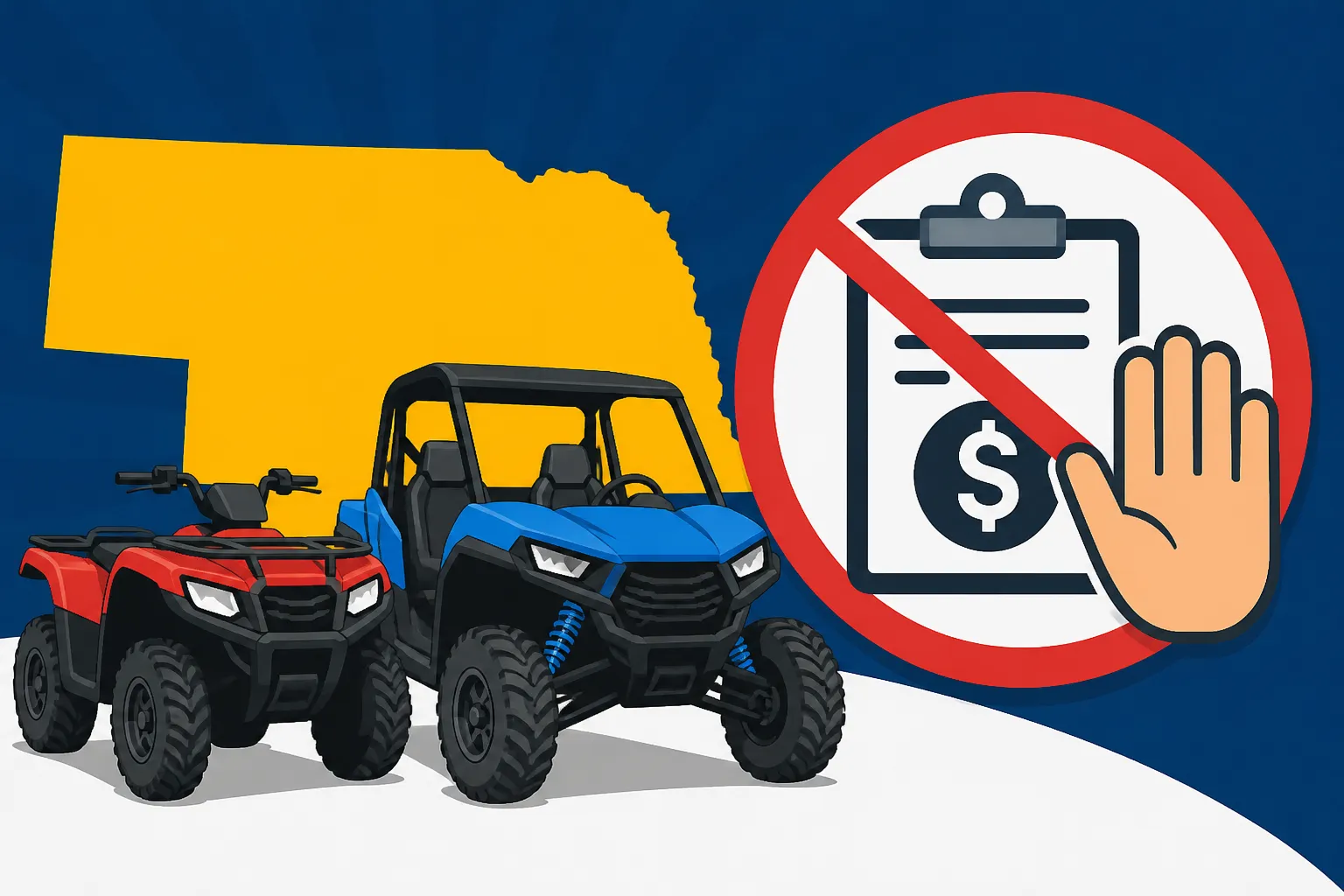
Nebraska Dealers Do Not Collect the Tax
Nebraska ATV and UTV buyers may expect to pay sales tax when they sign at the dealership. In the usual titling process, however, the county treasurer collects the tax when you apply for the title. Knowing who collects it, what paperwork to bring, and how the taxable amount is figured can prevent a surprise bill or a second trip.
Why the dealer does not collect the tax
For an ATV or UTV purchase in Nebraska, the sales or use tax is generally paid during the title process, through the county treasurer. It is not ordinarily collected by the dealer as part of the machine’s purchase price at delivery. That means your dealer’s invoice may show the machine price and other transaction charges without including the tax you will owe when you title it.
This distinction can feel counterintuitive. Buyers often expect the dealership to collect sales tax on a vehicle before handing over the keys. But Nebraska’s ATV and UTV process ties tax payment to titling: the county treasurer handles the title application and collects the applicable tax and title-related amounts at that stage. The tax is still due; it is simply paid through a different office and at a different point in the transaction.
The county treasurer is not acting as the dealership’s cashier. The treasurer processes the title application, reviews the transaction information, and collects the required tax based on the details you provide. For a closer look at the timing, see Nebraska Sales Tax Paid at Titling.
A dealership can still help you prepare for that step. Staff may explain what paperwork you’ll receive, provide an estimate of the tax, or help submit title paperwork. Those services do not necessarily mean the dealer is collecting the tax itself. If the paperwork says tax is included in the amount due at delivery, ask who will receive that payment and whether it will be remitted to the county treasurer on your behalf.
Separate the purchase price from tax and title costs
When comparing offers, keep the machine’s purchase price separate from the costs you will handle when titling it. A dealer quote might include some charges at delivery and leave other expenses for your county treasurer visit. A clear estimate should tell you which costs are due to the dealership and which are still due when you apply for the title.
Do not assume that a line labeled “tax,” “title,” or “filing” tells the whole story. Ask what the line covers, who collects it, and whether you will receive a receipt showing the payment was made. If you are unsure what belongs in your budget, Nebraska Title Costs at Purchase explains how to think about title costs alongside the other purchase expenses.
Why an invoice can still be confusing
A dealer’s buyer’s order or retail contract may have a space for tax even when the tax will be paid later at titling. It may also list an estimate, a filing service, or another charge that is not the tax itself. Read the description rather than relying on the heading alone.
Before signing, ask the dealer to identify:
- The machine’s purchase price before tax
- Any dealer discount or manufacturer rebate
- The value and description of a trade-in
- Any delivery, setup, or documentation charges
- Any amount collected for title filing or other services
- Whether sales or use tax is due at delivery or at the county treasurer’s office
If the dealer says it will file your paperwork, ask whether you must still make a separate tax payment and how you will know the title application has been submitted. Nebraska Dealer Paperwork at Delivery covers useful questions to settle before you leave with the machine.
What you pay and how the tax amount is determined
The tax due is not necessarily just a percentage of the first number you see in an advertisement. The treasurer needs enough information to determine the taxable transaction amount and the applicable state and local tax. The purchase documents matter because they show the actual deal, including any discount, trade-in, rebate, or other item that may affect the calculation.
Nebraska’s state sales tax applies along with any applicable local sales tax. Rates and local requirements can change, so do not rely on an old estimate or assume that a dealer’s estimate is final. The county treasurer can confirm what rate and documentation apply to your title transaction. For more about the calculation, see Nebraska Sales Tax at the Treasurer’s Counter and Nebraska Local Sales Tax on a Machine.
Purchase amount, discounts, and trade-ins
Keep the buyer’s order or bill of sale that records the amount you agreed to pay. If the dealer gives you a discount, make sure it appears clearly in the paperwork rather than being mixed into an unexplained total. The county treasurer uses transaction documents to understand how the stated price was reached.
A qualifying trade-in may affect the taxable amount, but the allowance needs to be shown correctly. A trade-in is not the same as a cash down payment: the paperwork should identify the machine you traded and the value allowed for it. If the trade-in is recorded as a generic payment instead, the treasurer may not be able to treat it as a trade-in credit. Keep the trade-in details with your purchase documents and review Nebraska Trade-In Credit on a Machine before you submit the tax statement.
Rebates and other incentives can also make the final price harder to interpret. Ask the dealer to show the rebate separately and explain whether it has reduced the amount used in the tax calculation. The tax treatment can depend on the kind of incentive and how the transaction is documented, so do not assume that every promotional amount is handled the same way. If the tax statement and buyer’s order appear to show different amounts, get clarification before signing.
Local tax and the buyer’s address
The buyer’s location can matter when the applicable local tax is determined. Make sure the address on the title paperwork is current and matches the address you are using for the transaction. If you have recently moved, are titling the machine at a different address, or keep the machine at a second home, ask the treasurer which address and location details are needed.
A dealer in one town may not be able to give you a final tax figure for a buyer who lives in another local tax area. That is one reason a dealer’s estimate should be treated as an estimate rather than the final amount due. For broader context on where the tax is paid, see Tax Paid Where You Live.
Buying across a state line
If you buy from a dealer outside Nebraska, do not assume that the other state’s sales tax settles your Nebraska obligation. The purchase may still require Nebraska title paperwork and a Nebraska tax review. Whether tax paid to another state can be credited or how a difference is handled depends on the transaction and applicable rules; bring proof of any tax paid and ask the county treasurer to review it.
Keep the out-of-state purchase contract, payment receipt, and any tax receipt together. Do not rely on a verbal statement that “everything is included” if you cannot tell which tax was paid, to whom, and for what purpose. The process is explained further in Nebraska Tax When You Buy Across a State Line.
Paperwork to bring when you title the machine
The county treasurer needs documents that establish what you bought, who owns it, and what the transaction cost. Requirements can vary with the machine’s history and the paperwork already supplied by the seller, so contact the office handling your title before making the trip. A complete packet can save time and help avoid returning to the dealer for a corrected form.
Commonly useful documents include:
- The manufacturer’s statement of origin or existing title, as applicable
- The dealer’s purchase agreement or bill of sale
- The completed sales and use tax statement, including Form 6ATV when required
- Identification and proof of the correct address, if requested
- Trade-in documentation, if the purchase included a trade
- Rebate documentation, if a rebate affected the transaction
- Proof of tax paid to another state, if applicable
- Lien or financing paperwork, if the machine was financed
The exact list depends on whether the ATV or UTV is new, used, brought from outside Nebraska, or being titled after a private sale. Before you go, check with the county treasurer that will process the title. The overview in Nebraska Form 6ATV Explained for Buyers can help you understand the tax statement, but the office can confirm which version and supporting documents it needs for your particular purchase.
Complete Form 6ATV carefully
Form 6ATV records information used to calculate and collect tax. Read each field and make sure the buyer, seller, machine, and transaction details match the supporting documents. A mismatch between the form and the bill of sale can delay processing or lead to questions about the amount reported.
Pay special attention to the purchase price, any trade-in, and any rebate or discount. If a number has been entered incorrectly, ask the dealer or treasurer how to correct it rather than making an unexplained change. Keep a copy of the completed form and the final purchase documents for your records. More detail is available in Why ATV Buyers Fill Out Form 6ATV.
Confirm who submits the title application
Some buyers take the documents to the county treasurer themselves. A dealer may offer to submit paperwork, which can be convenient, but it does not remove the need to understand what is being filed or when the tax is paid. Ask whether the dealer is submitting the application, whether you need to provide anything else, and how you will receive confirmation.
If you are handling the application yourself, make sure you know which county office to visit and whether it recommends an appointment or has specific submission instructions. Nebraska Titles Through a County Office explains the role of the county office, and Planning One Trip to the Treasurer’s Counter can help you prepare a complete visit.
A practical buying-to-titling sequence
A smooth transaction depends on treating delivery and titling as two connected steps, not assuming they happen at the same counter. Use this sequence to keep the price, tax, and title paperwork straight.
-
Before signing, ask for an itemized buyer’s order. Confirm the machine price, discounts, trade-in allowance, rebate, and dealer charges are shown separately. Ask whether sales or use tax is due at delivery or later at titling.
-
Ask for the paperwork you will need. Find out whether the dealer will give you the manufacturer’s statement of origin, a completed Form 6ATV, or other documents. If the dealer will file the title application, ask which parts you must still complete or sign.
-
Review every transaction amount. Compare the purchase agreement with the tax statement. Make sure any trade-in and rebate are recorded in the right places and that your name and address are correct.
-
Contact the county treasurer before you go. Confirm the documents needed for your specific machine and transaction, the payment methods accepted, and the applicable tax calculation. If you bought out of state or have an unusual title history, explain that before arriving.
-
Submit the title and tax paperwork promptly. Nebraska has a title deadline after purchase. The commonly referenced deadline is 30 days, but check the current requirement and how it applies to your situation with the county treasurer. Do not wait until the paperwork is nearly due to discover that a signature or original document is missing. See Nebraska’s 30-Day Titling Deadline and What Happens If You Miss the 30-Day Title Deadline.
-
Keep copies and receipts. Save the buyer’s order, bill of sale, tax statement, title application receipt, and any evidence that a dealer or other party submitted paperwork for you. These records are useful if the tax amount, title status, or payment recipient is later unclear.
This sequence is especially helpful when financing is involved. A lender may have an interest recorded on the title, and the dealer may coordinate paperwork with the lender. Still, clarify who is responsible for the tax payment and title submission. Do not treat a financing contract or delivery checklist as proof that the county has received the tax or title application.
If the amount due is different from the estimate
The final tax amount may differ from a dealer’s estimate because the estimate used a different local rate, did not include all transaction details, or was prepared before the county reviewed the documents. Ask the treasurer to explain how it calculated the amount and which figures it used.
If you believe the purchase price, trade-in, or rebate has been entered incorrectly, show the supporting paperwork and ask what needs to be corrected. Avoid paying based on an assumption that a correction will be automatic later. If the dealer’s paperwork is wrong, ask the dealer to prepare a corrected document and confirm with the treasurer whether a revised tax statement is needed.
If an invoice appears to show tax already collected, bring it with you. Ask whether the amount is tax, a filing service, a deposit, or another charge. If the dealer collected money specifically for tax, request written confirmation of how it will be remitted and ask the county treasurer what records it needs to verify the payment. This is a practical safeguard, not an accusation: paperwork can label charges in ways that are easy to misunderstand.
Common mistakes and how to avoid them
The most common problem is budgeting only for the dealership payment. Because tax is generally collected at titling, the amount due after delivery can catch a buyer off guard. Before agreeing to the purchase, ask the dealer for an estimated out-the-door amount and separately set aside money for the county treasurer. Treat an estimate as provisional until the treasurer confirms it.
Another mistake is assuming that a title application will happen automatically. Even when a dealer helps with paperwork, ask whether you need to visit the treasurer, provide an original document, or make a separate payment. If the dealer is filing for you, get a clear explanation of the timeline and the proof you will receive.
Other avoidable errors include:
- Using an old address. An outdated address can complicate local tax calculations or title records. Correct it before the application is submitted.
- Leaving the trade-in off the tax statement. If you traded a machine, make sure it is identified and valued in the transaction paperwork.
- Treating a cash down payment as a trade-in. A down payment and a machine given to the dealer are different parts of a sale. Have each recorded accurately.
- Discarding the original purchase documents. Keep them until the title process is complete and retain copies afterward.
- Assuming out-of-state tax eliminates Nebraska paperwork. Bring proof of any tax paid elsewhere and let the treasurer determine how it applies.
- Waiting too long to address a missing signature. Ask for a correction as soon as you notice a problem, especially when a deadline is approaching.
- Confusing a dealer service charge with tax. Ask who receives each amount and what service it covers.
For a used machine bought from a private seller, the seller does not replace the county treasurer as the office that handles title and tax processing. Keep a properly completed bill of sale and the existing title, and confirm the paperwork for your situation. See Nebraska Sales Tax on a Private ATV Sale and Nebraska Titles After a Private Sale for related details.
The main takeaway is simple: do not assume the dealer’s invoice includes all tax due. In the standard Nebraska process, the county treasurer collects the applicable tax when you apply for the ATV or UTV title. Get an itemized purchase record, confirm what Form 6ATV and supporting documents you need, and verify the payment and filing steps before the title deadline.
Frequently Asked Questions
Do I pay Nebraska ATV or UTV tax at the dealership?
Usually, the applicable sales or use tax is paid through the county treasurer when you apply for the title, rather than to the dealer at delivery. Ask the dealer to identify any charges it collects and confirm the remaining amount with the treasurer.
Can a dealer file the title paperwork for me?
A dealer may offer to help submit title paperwork. Ask whether it will file the application, whether you must pay tax separately, and how you will receive confirmation. Do not assume that a filing service means tax has been paid.
What if the dealer’s tax estimate differs from the county treasurer’s amount?
Ask the treasurer which purchase figures and local tax rate it used. Compare those details with your buyer’s order, trade-in records, and rebate paperwork. If a document is wrong, request a correction before the application is completed.
Do I still owe Nebraska tax if I bought the machine in another state?
The purchase may still require Nebraska title and tax processing. Bring the out-of-state contract and proof of any tax paid elsewhere so the county treasurer can determine how the transaction should be handled.
Disclaimer
This article is for general informational purposes only and does not constitute professional advice. Laws, prices and regulations vary by location and change over time. Consult a qualified professional for guidance on your specific situation.