Nebraska Bans ATVs on State Highways
It can be incredibly frustrating to feel like your ATV or UTV is locked away on private land or dedicated trails, especially when you need to get from one field to another, access a hunting spot just down the road, or simply make a quick trip to the general store in a small town. The reality for many Nebraskan riders is that the open road, particularly state highways, remains largely off-limits, often leading to confusion and even citations. This guide will meticulously break down why Nebraska generally bans ATVs on state highways, explore the very limited exceptions, and clarify the specific rules and requirements you must follow for any legal road use in the Cornhusker State, helping you navigate the complex world of ATV and UTV regulations.
Understanding Nebraska's General Ban on State Highways
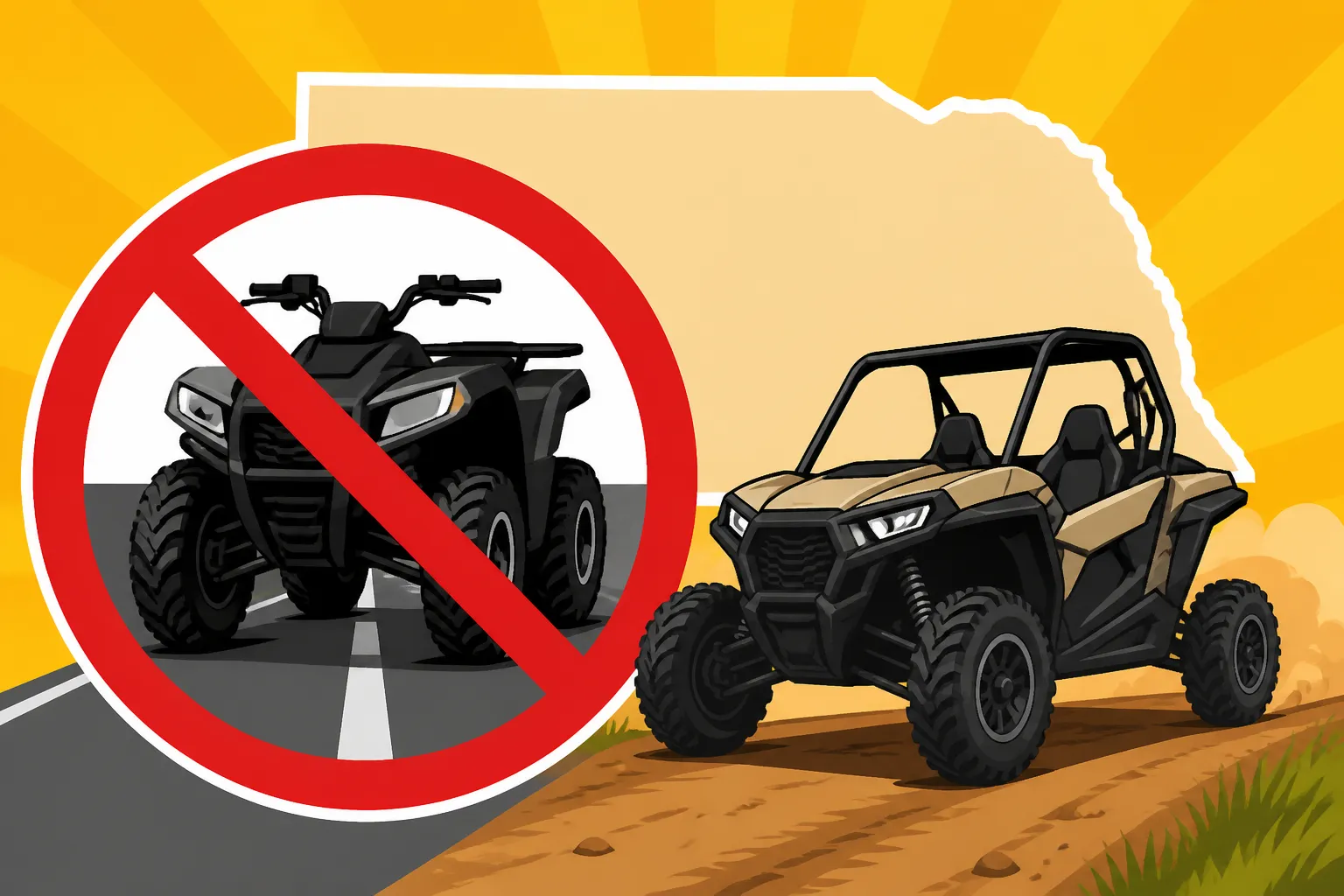
Let's get straight to it: for the most part, you simply cannot ride your ATV or UTV on Nebraska's state highways. This isn't just a suggestion; it's a fundamental aspect of the state's motor vehicle laws. Many riders move here from other states or have friends in places where the rules are different, leading to a lot of head-scratching and, unfortunately, often disappointment. The intention behind this statewide ban is rooted deeply in safety and the fundamental design differences between off-highway vehicles and street-legal automobiles.
The Intent Behind the Restriction
The primary reason state highways are off-limits for ATVs and UTVs boils down to safety. State highways are designed for faster-moving, enclosed vehicles, not open-air machines that typically have a lower top speed and less robust protection in the event of a collision. Think about the speed differentials: a typical ATV might max out at 40-50 mph, while highway traffic often cruises at 60-75 mph. That's a recipe for disaster. The sheer weight and speed of passenger cars and semi-trucks on these roads create an extremely dangerous environment for smaller, more vulnerable ATVs and UTVs. The state's lawmakers have long recognized this inherent risk, and the regulations are a direct reflection of that concern. It's not about punishing riders, but about preventing serious accidents.
These machines also lack many of the safety features common on road-legal vehicles, such as extensive crumple zones, airbags, or even full roll cages in some cases. While modern UTVs from brands like Polaris or Can-Am offer significant improvements in occupant protection, they still aren't engineered for highway speeds and impacts in the same way a car is. The state highway system is a critical transportation network, and maintaining safety for all users, including the vast majority in conventional vehicles, is paramount.
Defining "State Highway" in Nebraska
So, what exactly is considered a state highway? In Nebraska, these are typically the routes designated and maintained by the Nebraska Department of Transportation (NDOT). They often have route numbers like US-6, NE-92, or I-80, and they are generally marked with distinct state highway shields or interstate markers. These aren't your gravel county roads or the paved streets within a small town. State highways are characterized by higher speed limits, multiple lanes, and often divided roadways. They are built for long-distance travel and higher traffic volumes, connecting major cities and regions across the state.
It's crucial not to confuse a "state highway" with a "county road" or a "city street." The rules are very different for each. A gravel road that happens to connect two state highways might still be a county road, and thus potentially open to ATVs under certain conditions, which we'll discuss later. But if you see that state highway shield, consider it a red flag for your off-highway machine. Always pay attention to road signs and markings; they are your best indicators of the road's classification and, therefore, what rules apply to your ATV or UTV.
The Title Notation That Bars Road Registration in Nebraska
Adding another layer of clarity (or sometimes, confusion) is the specific notation found on ATV and UTV titles in Nebraska. If you've ever looked at your Nebraska ATV title, you'll likely see the phrase "NOT TO BE REGISTERED." This isn't just a random stamp; it's a deliberate legal indicator. It directly signifies that the machine is not eligible for regular road registration and, by extension, is generally prohibited from operating on public roads, especially state highways. [Why an ATV Title Says Not To Be Registered]
This notation is a clear signal that the state views ATVs and UTVs as off-road vehicles. While they are titled in Nebraska, this titling process is primarily for proof of ownership, tracking sales tax, and establishing a clear chain of custody, not for granting street-legal status. It’s a common misconception that having a title means you can register it for the road like a car. In Nebraska, for ATVs, that's simply not the case, and this notation on your title is a constant reminder of that legal distinction. It means you won't be getting a license plate for your quad to cruise down I-80.
The Specifics of Highway Crossing and Exceptions
While outright riding on state highways is largely prohibited, the reality of navigating Nebraska's landscape with an ATV or UTV means that sometimes, crossing a state highway is unavoidable. Fortunately, the law does provide specific, highly restricted conditions under which these crossings are permitted. These are not loopholes to ride down the highway; they are precise rules designed to minimize risk during necessary transitions.
Crossing at a Ninety-Degree Angle
If you find yourself needing to cross a state highway, the law is very clear: you must do so at as near a ninety-degree angle as practicable. This isn't a suggestion; it's a hard rule. The reason for this specific requirement is safety. Crossing at a perpendicular angle minimizes the amount of time your machine is exposed to oncoming traffic lanes and makes your path more predictable to other drivers. Imagine trying to merge or turn onto a highway with an ATV; it’s slow, awkward, and leaves you vulnerable for too long. [Crossing a Highway at a Ninety-Degree Angle]
This rule means no diagonal crossings, no riding parallel to the highway for a short distance before turning off, and certainly no using the shoulder as a temporary travel lane. You approach the highway, stop, ensure the way is clear, and proceed directly across the shortest possible path. It's a quick, decisive maneuver designed for minimal interaction with high-speed traffic. For instance, if you're moving cattle between two pastures divided by a state highway, you'd bring your machine to a complete stop, look both ways, and then cross as straight as possible to the other side, minimizing your time on the pavement.
Yielding and Stopping Requirements
Before you even think about crossing a state highway, you have absolute responsibilities: you must come to a complete stop, and you must yield to all oncoming traffic. This is non-negotiable. You cannot assume other drivers see you, nor can you expect them to slow down or move over for an ATV or UTV. The onus is entirely on you, the ATV operator, to ensure the crossing is safe and clear. [Do You Have to Stop Before Crossing a Highway?]
Picture this: you're waiting at the edge of a field, about to cross a busy two-lane highway. You need to come to a full stop, ideally where you have a clear line of sight in both directions. Then, you patiently wait until there's an ample gap in traffic, far more than you might need to cross a quiet gravel road. You're looking for a window where no vehicle is approaching from either direction that would require you to rush or cause another driver to react suddenly. Safety is paramount here, and rushing a crossing can have catastrophic consequences. The law is designed to place the highest burden of caution on the ATV operator due to the vehicle's vulnerability.
Farm Use as a Limited Exception
While riding on state highways is generally a no-go, Nebraska law does acknowledge the practical needs of the agricultural community. There are provisions that allow ATVs and UTVs to operate on public roads, including crossing state highways, when used for bona fide agricultural purposes. This isn't a blanket permission slip for joyriding; it's a narrowly defined exception. For example, a farmer might legally drive an ATV on a county road, and cross a state highway, to move equipment between fields, check fence lines, or retrieve livestock. [When Farm Use Makes an ATV Road Trip Legal]
However, even with this agricultural exception, the fundamental rules of crossing at a ninety-degree angle, stopping, and yielding still apply. Furthermore, this exception typically does not permit extended travel down a state highway, even if you are engaged in farm work. The spirit of the law is to facilitate necessary farm operations, not to make state highways accessible routes for ATVs. You're expected to take the shortest, most direct route possible for your agricultural task. Using an ATV to check irrigation pivots in different fields that require crossing a highway would fall under this, but driving it several miles down a state highway just to save time getting to the next farm would likely be seen as a violation.
Local Ordinances: A Glimmer of Hope for Street Legal Use
While state highways are mostly off-limits, it's crucial for riders in Nebraska to understand that the rules can change dramatically once you enter the boundaries of certain cities, towns, or even unincorporated villages. Many local jurisdictions have taken it upon themselves to create ordinances that permit the use of ATVs and UTVs on their specific streets. This patchwork of regulations can be confusing, but it also offers opportunities for legal road use in localized areas.
How City Ordinances Can Open Streets
Numerous cities and towns across Nebraska have recognized the growing popularity and utility of ATVs and UTVs, particularly for residents who use them for quick errands, snow removal, or simply getting around their community. As a result, many have passed local ordinances that allow these machines on designated city streets. [Nebraska Cities That Adopt ATV Ordinances] These ordinances typically come with their own set of rules regarding hours of operation, required safety equipment, age restrictions for drivers, and often a local registration fee.
For instance, a small town might decide to open all its streets with speed limits of 35 mph or less to ATVs, requiring riders to have a valid driver's license, insurance, and specific lighting and flag requirements. The intention is often to provide convenience for residents while maintaining safety on lower-speed, lower-traffic municipal roads. It's a fantastic development for local riders, but it's vital to remember that these permissions typically end abruptly at the city limits. You can't assume that because your town allows it, the next town over will, or that it extends to county roads, let alone state highways. Always check with the specific city hall or police department for their current, local rules.
County Board Resolutions for Unincorporated Villages
Beyond city limits, county boards also have the authority to pass resolutions that open certain roads within their jurisdiction, particularly in unincorporated villages or small communities that don't have their own municipal government. This is especially common in the more rural areas of Nebraska where residents rely on ATVs for daily tasks and transportation. [Nebraska County Board Resolutions for Villages] A county board might pass a resolution stating that all roads within a specific unincorporated village are open to ATV traffic, mirroring many of the conditions found in city ordinances.
These resolutions are similar to city ordinances in their intent and effect: they aim to provide legal access to roads for off-highway vehicles in specific, localized areas. However, like city ordinances, they do not grant universal road access. These permissions are strictly confined to the areas defined by the county resolution. You could, for example, live in an unincorporated village where your county board has permitted ATV use on all local roads. You might then use your UTV, perhaps a heavily accessorized model from SuperATV with enhanced lighting and mirrors, to run errands within that village. But as soon as you exit that designated area, the default state and county rules typically revert, which means no riding on most public roads, and definitely no state highways.
The Limitations of Local Ordinances
While local ordinances and county resolutions offer welcome opportunities for ATV and UTV riders, it's crucial to understand their inherent limitations. The most significant limitation is geographical: these permissions are hyperlocal. They only apply within the specific boundaries defined by that city's ordinance or that county's resolution. They do not magically extend to neighboring towns, surrounding county roads outside the specified village, or, critically, they do not override the state ban on ATVs on state highways.
This means you could legally drive your ATV on Main Street in one town, but a block later, when you cross the city limit line, you could be in violation of state or county law. It creates a "pocket" of legality rather than a continuous network. Always verify the exact boundaries and rules. Relying on what "everyone else does" or assuming consistency from one jurisdiction to the next is a common and often costly mistake. If you plan to ride on any public road, even a seemingly innocuous village street, confirm the local ordinance and its specific requirements before you ever turn the key.
Essential Requirements for Any Legal Road Use
Even in the limited instances where an ATV or UTV is permitted on a public road in Nebraska – whether it's crossing a state highway for farm use or navigating the streets of a town with a local ordinance – there are stringent equipment, licensing, and operational requirements you must meet. Simply having permission to be on the road isn't enough; your machine and your actions must comply with specific safety standards. Ignoring these can lead to tickets, fines, and even more severe penalties.
Mandatory Equipment: Lights, Flags, and More
If you're going to operate an ATV or UTV on any public road where it's legally permitted, your machine needs to be properly equipped. This isn't just about making your ride look good; it's about making it visible and safe for yourself and others. One of the most common requirements is a five-foot safety flag. This flag, typically triangular and day-glow orange, must be mounted at least five feet above the ground. [Why Road-Legal ATVs Need a 5-Foot Safety Flag] It's crucial for increasing visibility, especially on rolling terrain or around larger vehicles.
Beyond the flag, adequate lighting is non-negotiable. This means working headlights and taillights. Your headlights must be on at all times, even during daylight hours, when operating on a public road. Taillights are equally important, ensuring you're seen from behind. [Nebraska Lighting Requirements on a Machine] Many riders enhance their visibility with aftermarket LED light bars or additional reflective tape, which is a smart move given the size difference between ATVs and other vehicles. For instance, reputable aftermarket companies like SuperATV offer a range of lighting solutions and mirrors that can significantly improve your machine's compliance and safety on roads. Turn signals and brake lights, while not always explicitly mandated by state law for all permissible road use scenarios (though they often are for local ordinances), are always a good idea for clarity and safety.
Licensing and Insurance Obligations
Just like driving a car, operating an ATV or UTV on a public road in Nebraska (even where allowed) comes with licensing and insurance responsibilities. For the operator, a valid Class O operator's license is generally required. This is your standard Nebraska driver's license. If you're under 18 and riding for agricultural purposes, a farm permit might be an alternative. [Nebraska Requires a Class O License or Farm Permit] You cannot simply have a learner's permit or no license at all and expect to operate an ATV on a public thoroughfare legally.
Furthermore, liability insurance is an absolute must. If you're going to be on a public road, you are required to carry liability coverage. This protects you financially in case you are at fault in an accident involving property damage or injury to another person. [Nebraska Requires Liability Insurance on Roads] The minimum coverage amounts are typically established by state law, and it's always wise to ensure your policy meets or exceeds these figures. Don't assume your homeowner's policy or existing auto insurance will cover your ATV for road use; specialized ATV/UTV insurance is usually necessary. Always carry proof of insurance with you, just as you would in your car, as a deputy can ask to see it.
Speed and Daylight Restrictions
Even when you're legally permitted on a public road, there are still strict operational rules to follow, particularly concerning speed and time of day. Nebraska law generally limits the speed of ATVs and UTVs on public roads to 30 mph. [Nebraska's 30 mph Road Limit] This is a hard limit, designed to keep these machines operating at speeds where they are more manageable and less likely to pose a hazard to themselves or others. You won't be doing 55 mph down a county road, even if the posted limit for cars is higher.
In addition to speed limits, most legal road operation is restricted to daylight hours, typically from sunrise to sunset. [Sunrise to Sunset Only] This ensures maximum visibility for everyone. There can be specific, very narrow exceptions, such as for snow removal purposes, but for general transport or agricultural use, plan to have your machine off the public roads once the sun goes down. These restrictions underscore the state's cautious approach to integrating off-highway vehicles into the public road system, prioritizing safety above all else.
Penalties and Risks of Illegal Road Riding
Given the specific and often restrictive nature of Nebraska's ATV and UTV road laws, it's easy to make a mistake or unintentionally find yourself in violation. However, ignorance of the law is not an excuse, and the penalties for illegal road riding can range from inconvenient fines to severe legal consequences, including the impoundment of your machine. Understanding these risks is crucial for any responsible rider.
What Happens When You're Pulled Over
If a law enforcement officer observes you riding your ATV or UTV illegally on a state highway, or any other road where it's prohibited, you can expect to be pulled over. The initial interaction will likely involve questions about where you're coming from and going, proof of ownership, and whether you're aware of the road use laws. The officer will be looking for violations related to where you're riding, lack of proper equipment (like lights or a safety flag), no valid driver's license, or lack of insurance. [Nebraska Penalties for Illegal Road Riding]
Unlike a minor traffic stop in a car, an ATV stop often carries higher scrutiny due to the general prohibition on public roads. The officer might view your presence on the road as a more significant violation from the outset. Depending on the severity of the offense and the officer's discretion, you could receive a warning, but it's far more likely you'll be issued a citation, leading to fines and potentially a court appearance. In some cases, especially with repeat offenses or dangerous operation, the machine itself could be impounded.
Fines, Court Costs, and Impoundment
The financial consequences of an ATV road violation can quickly add up. A simple ticket for riding where prohibited can carry a significant fine. On top of the fine, you'll almost certainly incur court costs, even if you just pay the ticket without appearing before a judge. These costs vary but can easily add another substantial sum to your bill. [Nebraska Ticket Costs for Road Riding] Moreover, if your machine is deemed to be operated unsafely or without proper registration/insurance, it could be impounded.
Impoundment means your ATV will be towed and stored at a facility, incurring towing fees and daily storage fees, which can quickly become exorbitant. Retrieving your machine will require paying all outstanding fines, court costs, and impoundment fees, which could easily total hundreds or even thousands of dollars. Imagine buying a new accessory from SuperATV only to have your machine impounded and then have to shell out even more just to get it back. This financial hit is often a rude awakening for riders who underestimated the seriousness of the regulations. Beyond the direct costs, repeated violations could also impact your driving record, potentially leading to increased insurance rates or even license suspension in severe cases.
Safety Concerns and Accident Risks
While the legal and financial penalties are significant, the most serious risk associated with illegal road riding is the potential for an accident. As mentioned earlier, ATVs and UTVs are simply not designed for the speeds and traffic volumes found on state highways, or even many higher-speed county roads. Their open design, lack of traditional safety features, and often lower top speeds make them extremely vulnerable to collisions with larger, faster-moving vehicles. [Nebraska Accident Reporting for an ATV Crash]
An accident involving an ATV on a public road, especially a highway, is highly likely to result in severe injuries or even fatalities for the ATV operator and any passengers. The consequences aren't just legal; they're life-altering. Beyond direct collisions, the instability of ATVs at higher speeds, particularly during evasive maneuvers, can lead to rollovers or loss of control. The laws are in place precisely to prevent these tragic outcomes. Riding responsibly means understanding and respecting these safety parameters, prioritizing your well-being and the safety of others over convenience or a misguided sense of freedom.
Comparing Nebraska's Rules to Neighboring States
For riders who live near Nebraska's borders or frequently travel with their ATVs and UTVs, it's easy to assume that rules are consistent across state lines. However, nothing could be further from the truth. ATV and UTV road laws can vary dramatically from one state to the next, and what's perfectly legal in Iowa might be a serious violation in Nebraska, and vice versa. Understanding these differences is crucial to avoid unwanted surprises when crossing state lines.
Similarities and Differences with Iowa and Kansas
Let's look at Iowa and Kansas, two of Nebraska's immediate neighbors. When it comes to titling, Nebraska and Iowa have some similarities, but road use is a different story. Iowa, for example, has historically offered more avenues for ATV and UTV road use, particularly on secondary roads, with specific registration and equipment requirements. [Nebraska Title Compared to Iowa] A rider from Iowa might be accustomed to operating their machine on certain public roads in their home state, provided it's registered and equipped correctly. When they bring that machine into Nebraska, however, those Iowa permissions do not travel with them. [Nebraska Rules for a Visiting Iowa Rider]
Kansas also has its own distinct set of rules, which can include provisions for specific types of off-road vehicles on certain public roads, often tied to agricultural use or local ordinances, much like Nebraska. However, the exact speed limits, equipment requirements, and definitions of what constitutes a "road-legal" machine can differ. It’s a common scenario for a rancher in southeastern Nebraska to cross into Kansas for a land lease. They need to be keenly aware that the rules change the moment they cross the state line. What might be allowed for their UTV on a gravel road in Nebraska might require different lighting or a different permit in Kansas.
Contrasting with Colorado and South Dakota
Moving west to Colorado or north to South Dakota, the differences in ATV and UTV road laws can become even more pronounced. South Dakota, with its vast open spaces and strong tourism focus on outdoor recreation, has historically been more permissive regarding ATV and UTV road use, especially on county and township roads. They often have provisions for "street legal" conversions with specific equipment mandates, allowing riders to traverse long distances on public roads to access trails or recreational areas. [Nebraska Title Compared to South Dakota] This starkly contrasts with Nebraska's generally restrictive stance, especially regarding state highways.
Colorado, while also a haven for outdoor enthusiasts, has a more nuanced approach, with some counties and municipalities opening roads and others remaining closed. Their focus is often on allowing access to trailheads rather than general road travel. What's accepted for a side-by-side in the mountains of Colorado might be completely illegal in the flatlands of Nebraska. [Nebraska Rules for a Visiting South Dakota Rider] These different philosophies mean that riders cannot simply assume that their experiences in states known for more open access will translate to Nebraska. Every state, and often every local jurisdiction, has its own unique interpretation and enforcement of off-highway vehicle laws.
What Out-of-State Riders Need to Know
For out-of-state riders planning to bring their ATVs or UTVs to Nebraska, the most critical takeaway is this: your home state's registration and road-legal status almost certainly do not apply here. Nebraska does not reciprocate most out-of-state ATV registrations for general public road use. [Nebraska Rules for an Out-of-State Machine] If your machine is street-legal in South Dakota, it is not automatically street-legal on Nebraska's public roads or state highways.
You must abide by Nebraska's specific laws for all road operations, including farm-use exceptions or local ordinances. This means ensuring your machine meets Nebraska's equipment requirements (like the safety flag), you possess a valid driver's license that Nebraska recognizes, and you understand where you can and cannot legally operate. Before you tow your machine into the Cornhusker State, do your homework, specifically checking the regulations for the county or city where you plan to ride. It will save you a lot of headache, fines, and potential legal trouble.
| Feature | Nebraska (General) | Iowa (Example) | South Dakota (Example) |
|---|---|---|---|
| State Highways | Banned (except 90-degree crossing for farm use) | Generally restricted, some exceptions for crossing | More permissive, specific legal conversions exist |
| County Roads | Generally restricted; farm use exception, local ordinances | More permissive, with registration | Often open with specific equipment/registration |
| City Streets | Permitted only by local ordinance | Varies by municipality | Varies by municipality, some open |
| Titling | Required for ATVs/UTVs, includes "NOT TO BE REGISTERED" | Required for ATVs/UTVs, different notation | Required, may allow for "street legal" designation |
| Registration | No statewide road registration | Required for public road use | Required for public road use |
| Safety Flag | 5-foot flag often required for legal road use | Specific requirements for visibility | Specific height/color requirements for road use |
| Driver's License | Class O (standard car) required for road use | Standard driver's license required | Standard driver's license required |
| Liability Insurance | Required for all public road use | Required for public road use | Required for public road use |
| Speed Limit | 30 mph on public roads where permitted | Varies by road type/local ordinance | Varies, often matches posted car limits where allowed |
| Out-of-State Machines | Must comply with Nebraska laws; no reciprocity for road use | Must comply with Iowa laws | Must comply with South Dakota laws |
Disclaimer
This article is for general informational purposes only and does not constitute professional advice. Laws, prices and regulations vary by location and change over time. Consult a qualified professional for guidance on your specific situation.