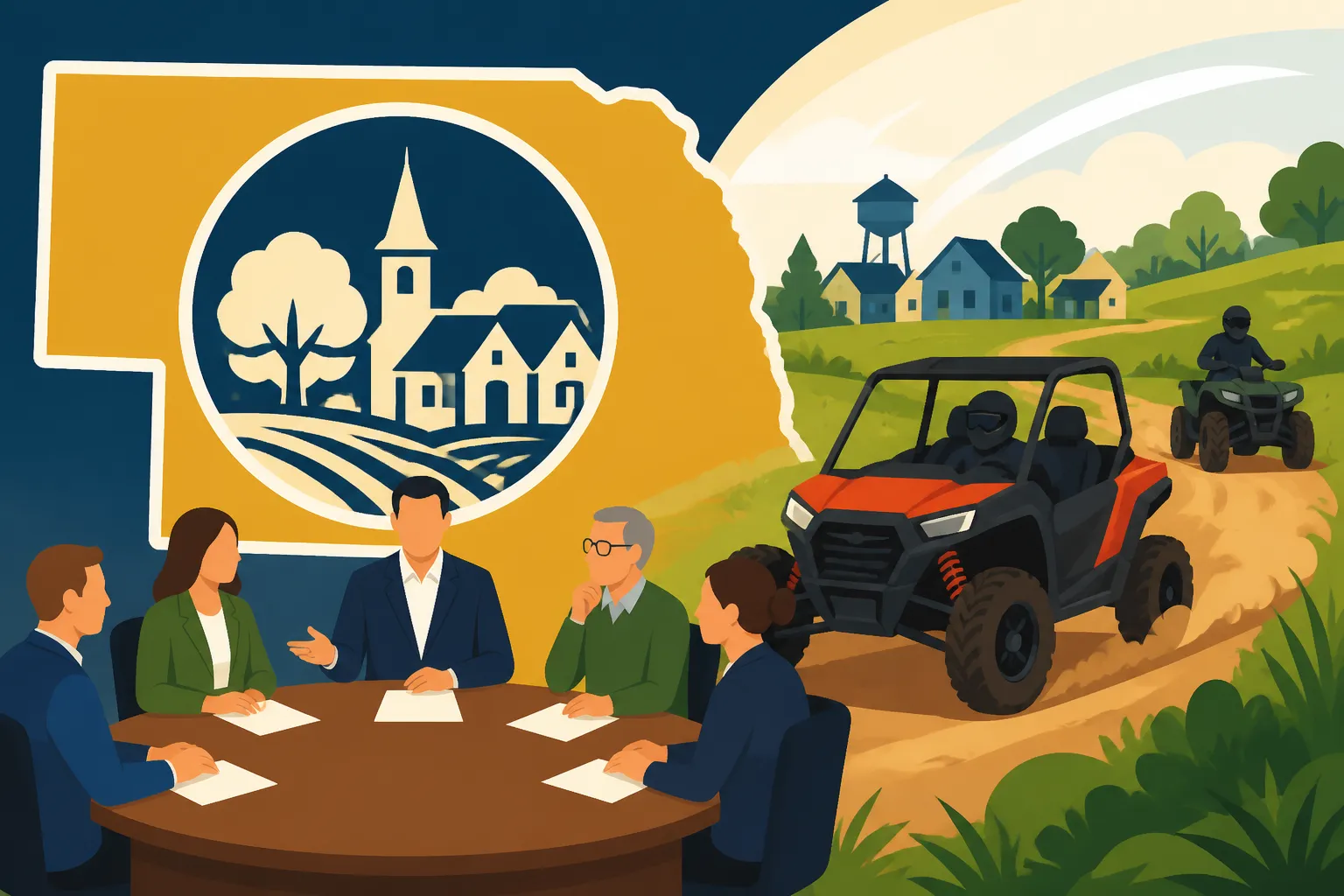
Nebraska County Board Resolutions for Villages
It can be incredibly frustrating to live in a charming Nebraska unincorporated village, own an ATV or UTV, and feel completely disconnected from the possibility of using your machine for simple tasks like visiting a neighbor down the street, running to the local gas station, or even just enjoying a leisurely ride around your community. State law often feels too restrictive, and without a formal city government, it's easy to assume there's no path to legal street access. This guide is here to shed light on how Nebraska county boards can actually step in, using resolutions to open up the streets of unincorporated villages to ATV and UTV traffic, and what that means for you as a rider.
Understanding Nebraska's ATV Road Rules Landscape
Navigating the rules for riding ATVs and UTVs on public roads in Nebraska can feel like trying to untangle a ball of yarn after a kitten has had its way with it. Many riders assume that if their machine isn't street-legal from the factory, it's completely banned from public roads everywhere. While it's true that Nebraska state law generally prohibits ATVs and UTVs on state highways and most public roads, there are some really important exceptions that many folks don't even know about, and these exceptions are absolutely crucial for local communities.
One of the biggest misunderstandings is about where the authority lies. The Nebraska Department of Motor Vehicles handles car registrations, but when it comes to ATVs, things are a little different. Instead, it's the county treasurers who handle ATV titles, not the DMV. This distinction hints at how localized some of the rules can become. For example, a titled ATV still has no plate, which just goes to show how different the rules are for these machines compared to your typical car or truck. Because ATVs and UTVs are primarily designed for off-road use, the state rules are built around that premise, aiming to keep them off high-speed, high-traffic thoroughfares for safety reasons.
However, the state law, specifically Nebraska Revised Statute 60-6,356, does carve out some very specific allowances. It permits ATVs and UTVs on public roads for agricultural purposes, such as checking cattle or moving equipment between fields, provided certain conditions are met like a safety flag and proper lighting. But what about just getting around your small community? That’s where local government steps in. Cities have the power to pass ordinances to open their streets, but for those of us living outside city limits, in the smaller, often forgotten unincorporated villages, the local county board is our champion. They have the ability to make resolutions that change the game entirely for local riders.
The General State Prohibition and Its Exceptions
Let's be clear upfront: generally speaking, you can't just hop on your quad and drive it down a Nebraska state highway. The law is pretty firm on that. These machines are built for dirt, sand, and mud, not asphalt and high speeds. The state aims to keep everyone safe by limiting where these powerful vehicles can operate. However, this isn't a blanket ban on all roads. There are nuances, and knowing them is key to understanding how your local county board can make a difference.
Agricultural use is a prime example of an exception to the general prohibition. If you're using your ATV or UTV for farming or ranching operations, say to haul a small feeder to the livestock or to perform maintenance on irrigation pivots, you might be allowed on certain public roads. The machine needs to be equipped with a 5-foot safety flag, headlights, taillights, and you must have a valid driver's license or farm permit. You're also generally limited to 30 mph on these roads. But what if you're not a farmer? What if you just want to drive your side-by-side to a friend's house a few blocks away in your little village? That's where the state has also given power to local governmental bodies – specifically, city councils for incorporated cities and county boards for unincorporated villages – to create their own specific rules that expand ATV access. This localized control is exactly what enables [Nebraska County Board Resolutions for Villages] to exist.
These local allowances acknowledge that many smaller communities don't have the same traffic volume or road conditions as major cities, and an ATV or UTV might actually be a practical and safe mode of transportation for residents. It recognizes that these machines are more than just recreational toys for some; they are essential tools for daily life, even outside the farm. The state provides the framework, but it's up to local elected officials to decide if and how they want to implement greater access for their specific communities, which is a powerful thing for rural Nebraska residents.
Why Unincorporated Villages Need a Special Solution
If you live in a larger incorporated city in Nebraska, they might have their own city ordinances that allow ATVs or UTVs on their streets. You might have even heard about [Nebraska City Ordinances That Open Streets] and wondered why your village doesn't have the same opportunities. That's because incorporated cities have their own municipal government, complete with city councils, mayors, and the authority to pass and enforce local laws, including those that specifically address ATV use on city streets. They can set their own registration fees, age limits, and equipment requirements, creating a tailored legal framework for their residents.
Unincorporated villages, on the other hand, don't have that same direct municipal structure. They fall under the jurisdiction of the county government. This means they can't pass their own ordinances in the same way a city can. This often leaves residents of these villages feeling in limbo, caught between restrictive state laws and the lack of a local governing body that can create specific allowances for them. It's a common frustration: you might see people riding their UTVs down the street in a nearby town, but you can't do the same in your own community, even if the roads are virtually identical.
This is precisely where the county board steps in. Recognizing this gap, Nebraska law empowers county boards to pass resolutions that effectively grant the same kind of street access to unincorporated villages within their county that a city ordinance would provide for its residents. It's a vital mechanism to ensure that rural residents in these smaller communities aren't left behind when it comes to local transportation options. Without these resolutions, every trip to the neighbor's house or local store by ATV would technically be illegal, leaving residents vulnerable to citations and penalties for illegal road riding.
The Power of County Boards: Opening Village Streets to ATVs
This is where the rubber meets the road, or perhaps more accurately, where the tires meet the gravel roads of your hometown! For residents of unincorporated villages in Nebraska, the county board holds the key to legally operating your ATV or UTV on local streets. While cities pass ordinances, county boards pass resolutions. It's essentially the same outcome for riders: regulated, legal access to the roads within their specific community. This authority is a lifeline for many, as it offers a practical solution to a common problem.
Imagine living in a small, close-knit community where the distances between homes are short, and the traffic is minimal. For many, an ATV or UTV is not just a toy; it's a convenient and efficient way to get around. Hauling groceries from the tiny general store, taking the kids to a friend's house, or simply enjoying the fresh air on a short ride becomes much easier. Without a county board resolution, these simple acts could lead to trouble. The resolution formalizes these activities, making them legitimate and regulated, ensuring both rider safety and community harmony.
This local control is also a testament to Nebraska's understanding of its diverse communities. What works in downtown Omaha certainly won't work in a village like Cairo or Pleasanton. By delegating this power to county boards, the state allows for decisions to be made by people who understand the unique needs and characteristics of their local populations. It’s about tailoring the law to fit the landscape, both literally and figuratively, of Nebraska's many small towns and rural areas.
How a County Board Resolution Works for ATV Access
So, what exactly is a county board resolution in this context? Think of it as a formal declaration by the elected officials of your county that states, "Within these specific unincorporated villages, ATVs and UTVs are now permitted on public roads under certain conditions." It's a legislative act, just like a city ordinance, but it's enacted at the county level for the areas that don't have their own city government. This resolution effectively creates a localized set of rules that supersede the general state prohibition for those designated village roads.
The resolution will typically outline very specific parameters. It won't just say "ride wherever you want." Instead, it will detail which roads are open (usually all public roads within the specified village limits, excluding state highways that might run through), what hours riding is permitted (often sunrise to sunset, with exceptions for things like snow removal), and what equipment is required on the machine. You can expect requirements like headlights, taillights, brake lights, a horn, mirrors, and that ubiquitous 5-foot safety flag that's a must for [Nebraska's 5-Foot Safety Flag Rule]. It might also specify age limits for operators, and, crucially, it will likely require riders to carry liability insurance on roads, just like any other vehicle.
The beauty of a resolution is its clarity. Once passed, it provides a clear legal framework for residents. No more guessing, no more relying on vague local customs. It empowers law enforcement to ensure compliance with defined rules, leading to safer riding conditions for everyone. For riders, it means peace of mind, knowing that their quick trip down Main Street in their UTV is entirely legal, as long as they follow the resolution's specific provisions.
Distinct Rules for Specific Unincorporated Villages
One crucial aspect of county board resolutions is that they can be incredibly specific. A single county board might have several unincorporated villages under its jurisdiction, and it's entirely possible that a resolution could be passed for one village but not another. This isn't necessarily unfair; it often reflects the unique characteristics, resident requests, and even road layouts of each community. For example, a tiny hamlet with only gravel roads and a handful of residents might have different needs and concerns than a larger unincorporated community that sees more pass-through traffic.
This means that if you live in an unincorporated village, you can't assume that just because a neighboring village in the same county has ATV access, your village does too. Each situation usually requires its own discussion and formal action by the county board. This specificity is both a challenge and an opportunity. It means community members in each village need to advocate for themselves, but it also means the rules can be finely tuned to what makes sense for that specific place. So, while the county board has the power to open up [Nebraska Unincorporated Villages and County Boards] to ATV access, it's often a village-by-village decision.
For instance, the resolution for Village A might stipulate that ATVs are permitted only on roads with a speed limit of 35 mph or less, while for Village B, with its even quieter roads, it might allow access on all county roads within its boundaries. Riders should always, always verify the exact language of any resolution that applies to their specific community. Ignorance of the law is no excuse, and unknowingly riding where it's not permitted could still lead to fines or other penalties, even if you thought you were within your rights.
Navigating the Process: Getting Your County Board to Act
So, you live in an unincorporated village and you're tired of feeling like you can't use your ATV or UTV for simple errands or recreation within your community. You've heard about these county board resolutions, and now you want one for your village. This isn't something that just happens automatically; it usually requires some proactive steps from residents. It's about community engagement, making a clear case, and working with your elected officials to make it happen.
The process typically starts with identifying your county board representatives. These are the folks who represent your district on the county board and are there to listen to the concerns of their constituents. You'll want to gather support from other residents in your village who also see the benefit of legal ATV access. A petition, or simply a group of individuals presenting a unified request, carries far more weight than a single person's plea. This collective voice demonstrates broad community interest and helps the board understand that this isn't just an isolated desire.
Remember, county board members are balancing many different interests and concerns across the entire county. Making a well-reasoned, safety-conscious proposal will be key to gaining their support. It’s not just about demanding access; it’s about demonstrating how it can be done safely, responsibly, and for the benefit of the community. Think about the economic benefits, the convenience for residents, and how it aligns with the rural character of the village.
Petitioning Your County Board
The first practical step in getting a resolution passed is often to formally petition your county board. This involves more than just a casual conversation; it's about presenting a structured request that outlines your community's desire for ATV and UTV access on village streets. A well-organized petition will include signatures from a significant number of residents, clearly stating their support for such a measure. It shows the county board that there's substantial local interest, not just a few individuals wanting to ride.
When preparing your petition, consider including key information. Beyond just signatures, you might want to briefly explain the reasons why this is important for your village – perhaps for local transportation, assisting with property maintenance, or enhancing community enjoyment. You could also include proposed safety measures, such as requiring lights, flags, and insurance, to show that riders are committed to responsible use. The more thoughtful and comprehensive your petition, the more seriously the county board is likely to take your request. Remember, you're building a case for [How a County Board Opens a Village to ATVs].
Once your petition is ready, you'll typically submit it to the county clerk or the county board directly. Be prepared for it to be placed on a future meeting agenda, and make sure you or a representative from your village is there to speak during the public comment period. This is your chance to articulate the community's needs directly to the decision-makers and answer any questions they might have. Persistence and a polite, factual approach are crucial during this stage.
Presenting Your Case to Elected Officials
After submitting your petition, the next vital step is to formally present your case to the county board during a public meeting. This is your opportunity to flesh out the arguments for legal ATV access in your village and to address any potential concerns the board members or other residents might have. It's not just about showing up; it's about being prepared, articulate, and respectful. You're there to advocate for your community, so come armed with facts and a clear vision.
Consider bringing along a small group of residents who can also speak briefly to their individual needs or experiences. Hearing diverse voices from the community can be very impactful. Highlight how other counties or cities have successfully implemented similar programs, demonstrating that this isn't a radical idea but a proven solution. You might even want to suggest specific regulations that your community would be willing to abide by, mirroring requirements like those for [Nebraska Rules for Riding After Dark] or the general [Nebraska Rules for Riding a County Road], to show that you're thinking about safety and compliance.
Be prepared to answer tough questions. Board members might ask about potential noise, dust, safety for pedestrians, or enforcement challenges. Having well-thought-out answers that emphasize responsible riding, equipment requirements, and community benefits will go a long way. For instance, you could point out that many modern UTVs are designed with quiet engines, or that safety equipment like mirrors and a horn (perhaps a high-quality kit from SuperATV) greatly enhances visibility and communication in traffic. Showing that you've considered these aspects demonstrates foresight and commitment to safety.
Life After the Resolution: What Riders Need to Know
Congratulations! Your county board has heard your plea and passed a resolution allowing ATVs and UTVs on the streets of your unincorporated village. This is a huge win for local riders, but the journey doesn't end there. Now, the responsibility shifts to you, the rider, to understand and strictly adhere to all the provisions of that resolution. Just because you can ride doesn't mean you can ride any way you want. These resolutions come with rules, and following them is essential to maintaining the privilege for everyone in your community.
The resolution will almost certainly detail specific equipment requirements for your machine. This isn't just a suggestion; it's the law within your village. You'll need working headlights, taillights, brake lights, a horn, mirrors, and, of course, that ever-important safety flag standing tall at least five feet above the ground. Many riders find durable and well-designed accessories from brands like SuperATV invaluable for ensuring their machines meet these standards and are ready for safe village cruising. Ensuring your machine is up to par is the first step toward responsible riding.
Beyond equipment, there will be rules about how you operate your machine. Expect speed limits, potentially age restrictions for operators, and rules about passengers. There will also be requirements to have proper insurance, specifically liability coverage, as you are now operating on public roads. Disregarding these rules isn't just risking a ticket; it could jeopardize the entire resolution for your community. One irresponsible rider can unfortunately create a negative perception that impacts everyone else, so understanding and following the rules is paramount.
Understanding Local Regulations and Equipment Requirements
Once a county board resolution is in place, your top priority is to get your hands on a copy and read it thoroughly. Don't skim it; truly understand every single point. This document is your new bible for riding in your village. It will spell out exactly which roads are open, what times of day you can ride, and crucially, all the specific equipment your ATV or UTV must have. This might include turn signals, which aren't standard on all ATVs, or perhaps even a windshield for UTVs if the resolution aims for greater safety or comfort.
Think of it like this: your machine needs to transform from a pure off-road vehicle into one that can safely share the road with cars, bicycles, and pedestrians. This often means adding specific components. You might need to install an aftermarket horn, turn signal kit, or even a full street-legal kit if your machine doesn't have these features. Companies like SuperATV offer a wide range of accessories designed to help you meet these kinds of requirements, from durable mirrors that provide better visibility to lighting upgrades that ensure you're seen day or night. It's an investment in safety and compliance that pays off in peace of mind.
Furthermore, the resolution might specify rules about passengers, especially on ATVs that are generally designed for single riders. Many resolutions will require that passengers only ride on machines specifically designed and equipped for multiple riders, like a side-by-side UTV. Always confirm age restrictions for operators – even if you have a driver's license, the resolution might set a higher minimum age for ATV operators on village streets. Compliance with these local specifics is not optional; it's the basis for continued legal access.
Insurance and Operator Licensing Essentials
Riding an ATV or UTV on public roads in your village, even under a county board resolution, almost universally comes with two non-negotiable requirements: proper insurance and a valid operator's license. Just like driving your car, you're now part of the public roadway system, and that means being financially responsible for potential accidents. [Nebraska Requires Liability Insurance on Roads] for any motorized vehicle, and your ATV is no exception once it hits the asphalt or gravel of a village street.
The type of insurance you'll need is liability coverage, which protects others if you're at fault in an accident. This covers bodily injury and property damage to third parties. While comprehensive and collision coverage are great for protecting your own machine, liability is usually the minimum required by law. It's smart to check with your insurance provider to ensure your policy specifically covers ATV/UTV use on public roads and meets any minimums outlined in the county resolution. Don't assume your existing car insurance or homeowner's policy will cover it; dedicated ATV insurance is almost always necessary.
As for licensing, you will almost certainly need a valid Class O operator's license (a standard driver's license) to operate your ATV or UTV on village streets. While there are some exceptions for farm permits under specific agricultural circumstances, for general village use, your standard license is the key. Make sure your license is current and always carry it with you when riding. These requirements are in place to ensure that all operators have a basic understanding of road rules and traffic laws, contributing to everyone's safety within the community. [Do You Need a License for an ATV in Nebraska?] when riding on roads, the answer is generally a resounding yes.
Respecting the Privilege and Community Harmony
Having the privilege to ride your ATV or UTV on village streets is a fantastic benefit, but it's a privilege that comes with significant responsibility. The success and continuation of your county board's resolution depend heavily on how responsibly and respectfully riders operate their machines. One person riding recklessly, generating excessive noise, or tearing up lawns can quickly sour public opinion and lead to calls for the resolution to be repealed.
This means being a good neighbor. Keep your speed in check, especially in residential areas. Many resolutions will specify speed limits, often mirroring the general flow of traffic or posting lower limits for ATVs. Be mindful of noise levels; while SuperATV might offer performance exhausts, ensure they don't violate any local noise ordinances. Always yield to pedestrians and bicycles, and never, ever trespass on private property, even if it looks like a fun shortcut. Remember, you’re riding on [Nebraska Rules for Riding a City Street] even if it's an unincorporated village.
The goal is for ATVs and UTVs to integrate seamlessly and positively into the community. When riders act responsibly, these machines become a valuable part of village life. When they don't, they become a nuisance, risking the hard-won access for everyone. Encourage fellow riders to follow the rules, and if you see someone being irresponsible, a friendly reminder from a community member can sometimes be more effective than a citation. It’s all about maintaining that precious balance of freedom and responsibility.
Comparing County Board Action to City Ordinances
While both county board resolutions for unincorporated villages and city ordinances for incorporated cities achieve the same goal – legal ATV/UTV access on local streets – there are some subtle but important differences in their scope, the process of getting them passed, and how they apply. Understanding these distinctions is key to navigating the world of Nebraska ATV road legality, regardless of whether you live in a bustling town or a quiet, unincorporated hamlet. Both aim to solve the same problem, but they approach it from different governmental structures.
For one, city ordinances are typically more detailed and can often include specific provisions about local registration fees, annual renewals, and even unique age requirements that might differ from state guidelines. They have their own dedicated law enforcement (city police) to patrol and enforce these rules directly. County board resolutions, on the other hand, are generally enforced by the county sheriff's department. While the essence of the rules is similar, the administrative and enforcement layers can vary.
Another key difference lies in the process. Cities have their own established councils and regular meeting schedules, making the petitioning process somewhat standardized. For county boards, especially when dealing with specific unincorporated villages, the process might feel a bit more informal or require more grassroots effort from residents to bring the issue to the forefront. However, both methods ultimately rely on community input and the willingness of local elected officials to act on behalf of their constituents.
Here's a quick comparison of some common aspects:
| Feature | City Ordinance (Incorporated City) | County Board Resolution (Unincorporated Village) |
|---|---|---|
| Governing Body | City Council | County Board of Commissioners/Supervisors |
| Geographic Scope | Within defined city limits | Within defined unincorporated village boundaries |
| Enforcement | City Police Department | County Sheriff's Office |
| Administrative Fees | Often includes specific city registration fees and renewals | Less common to have dedicated village registration fees, but possible |
| Process Initiation | Resident petition or council initiative | Resident petition or county board initiative |
| Legal Document Type | Ordinance | Resolution |
| Typical Requirements | Headlights, taillights, brake lights, horn, mirrors, safety flag, insurance, valid license, often city registration | Headlights, taillights, brake lights, horn, mirrors, safety flag, insurance, valid license |
| Example Link | [Nebraska City Ordinances That Open Streets] | [How a County Board Opens a Village to ATVs] |
Enforcement: Who Patrols Your Village Streets?
When a city passes an ordinance allowing ATVs on its streets, enforcement falls squarely on the shoulders of the city's own police department. These officers are familiar with the specific rules unique to their municipality, whether it's a particular speed limit on certain roads, where to put the city registration sticker, or specific age requirements for riders within city limits. They are on regular patrol, and their job includes ensuring compliance with all local laws, including those pertaining to ATVs.
In an unincorporated village, however, there isn't a city police department. Instead, law enforcement is provided by the county sheriff's office. This means that if your county board passes a resolution, it will be the county deputies who patrol your village streets and enforce those new rules. While the principles are the same, a deputy might cover a much larger geographical area and might not be as intimately familiar with the nuances of every single unincorporated village's specific resolution as a city officer would be with their city's ordinance.
This doesn't mean enforcement will be lax; it simply means the dynamics are a bit different. It's especially important for riders in unincorporated villages to know the exact details of their resolution, as deputies might rely heavily on the written document when making decisions. If you're ever stopped, being able to articulate that you are riding in accordance with a specific county resolution, and pointing out your compliant equipment, can go a long way. Always be respectful and cooperative with law enforcement, whether it's city police or a county deputy.
Potential for Registration and Fees
This is another area where city ordinances and county board resolutions can diverge. Many Nebraska cities that open their streets to ATVs and UTVs also implement a local registration system. This often involves an annual fee, a special sticker that must be displayed on the machine, and a process to renew it each year at city hall. These fees help offset the administrative costs of managing the program and sometimes contribute to road maintenance or enforcement.
For unincorporated villages operating under a county board resolution, the picture is usually a bit simpler. It is much less common for county boards to establish a separate "village registration" system with associated fees. Generally, if the county passes a resolution, riders are typically only required to meet the equipment, insurance, and licensing requirements outlined in that resolution and applicable state law. There's no additional county-level sticker or annual fee to pay.
However, it's always critical to consult the specific language of your county's resolution. While less common, a county board could technically impose some form of administrative fee or registration, especially if the program requires significant oversight. The general trend, though, is for county resolutions to focus primarily on safe operation and equipment rather than creating additional layers of administrative costs for residents. This can be a real benefit to riders in unincorporated areas, streamlining the process of getting their machines ready for limited road use.
Disclaimer
This article is for general informational purposes only and does not constitute professional advice. Laws, prices and regulations vary by location and change over time. Consult a qualified professional for guidance on your specific situation.