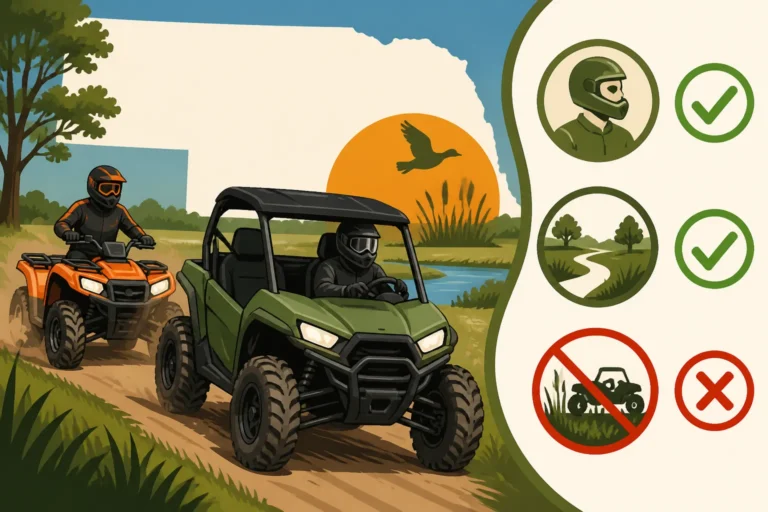
Nebraska State Parks Ban ATVs
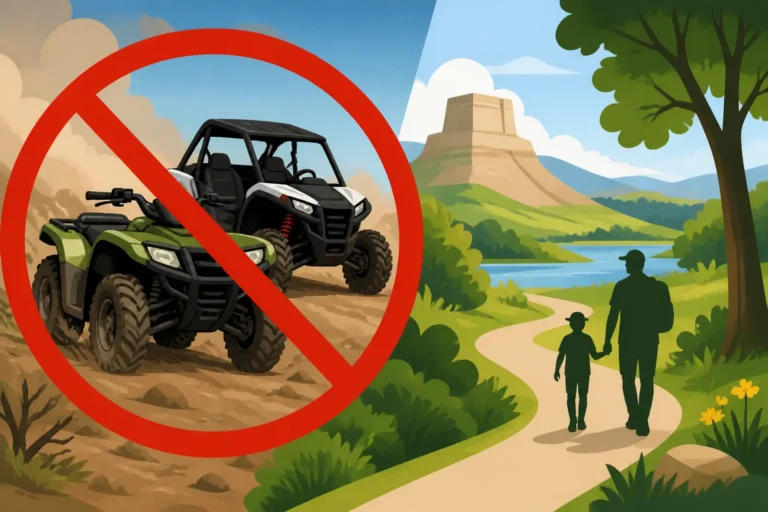
Nebraska’s state parks can be easy to mistake for ATV destinations: there are miles of scenic roads, open-looking ground, and plenty of room to unload a machine. But an ATV or UTV is not automatically allowed just because you have a park permit or see other motor vehicles nearby. This guide explains the restriction, where to check before you haul, and how to find legal alternatives.
What the state park restriction means
A park permit is not permission to ride an ATV
Nebraska state park entry permits allow visitors to enter designated park areas under the rules that apply there. They do not give ATVs or UTVs permission to ride trails, roads, parking areas, or open ground in a state park. A permit for your tow vehicle and a right to operate an off-highway machine are separate questions.
That distinction matters when you are planning a weekend. You might have a valid permit, a titled machine, and a trailer full of riding gear, then discover at the entrance that the park is not an ATV riding area. Treat the park permit as permission to enter in an eligible vehicle, not as an off-road vehicle permit. The same caution applies when a park has public roads, campground roads, or access points: a road being drivable by a car does not automatically make it a legal ATV route.
The simplest planning habit is to identify the exact place where you intend to ride, not just the nearest state park or lake. Check the rules for that specific property and the machine you plan to bring. If you are looking for a broad overview of how the permit and riding rules differ, see [Nebraska Park Rules for ATVs] and [Why a Park Permit Does Nothing for Your ATV].
Do not confuse state parks with every public riding area
Nebraska has several kinds of public land, and their rules are not interchangeable. A state park, state recreation area, wildlife management area, national forest, county property, and privately operated riding park may each have different access rules. A trail open to ATVs in one place does not establish permission somewhere else, even when both locations are managed by public agencies.
This is a common source of frustration because maps often show a patchwork of public land, lakes, campgrounds, and roads. A map may help you find a property boundary, but it may not explain whether ATVs are permitted on that parcel, which routes are open, or whether access changes by season. Before riding, match the property name to its managing agency and check the rules for that property directly.
For example, an off-road route in a national forest is not evidence that a nearby state park allows the same machine. Likewise, a private park’s riding rules cannot be applied to a public trailhead down the road. If your trip includes more than one destination, check each location separately rather than assuming one set of rules covers the whole itinerary.
Check the specific unit and its posted rules
The phrase “state park” can be used casually to describe a larger destination area, but the property may include distinct units with different management and access rules. A campground, recreation area, trailhead, wildlife area, or adjoining public road can have its own restrictions. Confirm the legal property name and boundary before unloading.
Look for the official park or agency information for the exact unit, then review posted signs when you arrive. Signs at entrances and trail junctions are particularly important because they can identify closed areas, restricted routes, seasonal conditions, or changes that are not obvious from an old map. If an online description and a sign appear to conflict, do not assume the more permissive interpretation is correct. Pause and ask the managing office or ranger before riding.
A useful pre-trip note includes the destination’s full name, the managing agency, the address or access point, the machine type, and the route you intend to use. That small bit of preparation can prevent a long drive from ending in an awkward conversation at the gate. It also helps you ask a precise question if you call an office: “May I operate a UTV on this named route?” is more useful than “Can I ride around the lake?”
Why the restriction is easy to misunderstand
Seeing cars and trucks does not mean ATVs are allowed
State parks need roads and parking areas for visitors, staff, maintenance, emergency response, and deliveries. The presence of cars, pickups, service vehicles, or campground traffic can make a property look broadly open to motorized use. But those vehicles are being used for their intended access purposes; they do not imply that recreational ATV or UTV riding is authorized.
The same issue comes up when people see a gravel road, an open meadow, or a wide maintenance track. The route may look suitable for a machine, but appearance is not permission. A trail can be closed to recreational vehicles even if a park employee uses it, and an access road can serve a campground without being an ATV trail.
When in doubt, separate three questions: Can you enter the property? Can your tow vehicle use the road or parking area? Can you operate the ATV or UTV there? The answer to the first two may be yes while the answer to the third is no. Keeping those questions distinct can save both time and a possible citation.
Public land is not automatically open land
People often hear “public land” and assume public use means unrestricted use. In reality, public ownership usually comes with rules designed for the particular site. A place may welcome hiking, fishing, camping, boating, or wildlife viewing while restricting motorized recreation to protect natural resources, visitor safety, or the purpose for which the land is managed.
That does not mean the restriction is arbitrary or that every public property has the same policy. It means the permission must come from the rules that apply to that parcel and activity. A state park intended for camping and general recreation may not be managed as an OHV riding area, while a designated off-highway route elsewhere may be set aside for motorized travel.
This is why relying on a friend’s memory can be risky. They may be describing a different agency’s land, an older rule, or a route that was open only for a particular purpose. Even a local rider who knows the area well may not know whether a boundary or route designation has changed. Verify the current rules for your intended property before your trip.
A machine’s title or registration status does not settle land access
A title can document ownership. A registration or permit may be relevant to a particular kind of road or land use. Neither one automatically grants access to every public property. The title on your machine does not turn a closed route into an open trail, and a state park entry permit does not convert a park road into an ATV route.
This distinction can be especially confusing for visitors bringing a machine from another state. A visitor may have paperwork that is valid at home and still need to follow Nebraska’s property-specific access rules. Likewise, Nebraska ownership paperwork does not mean a machine is allowed wherever a car can go. Ownership documentation and permission to ride are separate parts of trip planning.
Before you travel, check the relevant rules for the machine, the property, and the planned route. If you are coming from another state, [Do Out-of-State Riders Need a Permit to Ride?] can help frame the permit question, while [Nebraska Proof of Ownership on the Trail] addresses the separate issue of showing ownership information. Neither question replaces checking whether the trail itself is open.
How to confirm whether a Nebraska property allows ATV riding
Identify the land manager before planning a route
Start by finding out who manages the place you want to visit. The name on a travel brochure may describe a whole recreation destination, while the actual route you want to ride may cross land managed by a different agency. Look for the property’s official name, its entrance or trailhead, and the agency responsible for day-to-day rules.
Then search or contact that agency about motorized access for your specific machine. Ask whether the rule applies to ATVs, side-by-sides, dirt bikes, or all off-highway vehicles. Those categories are not always treated identically. If you ride a UTV, do not assume that an ATV-specific page fully answers the question; ask about the vehicle you will actually bring.
A mapping app can be useful for orienting yourself, but it should not be your sole authority on permission. onX Offroad can help riders inspect route lines and nearby access points while planning, but a line shown on a map is not, by itself, proof that the route is currently open or that your vehicle is allowed. Use mapping tools to prepare questions, then confirm access with the land manager and posted signs.
Ask precise questions instead of relying on a general answer
A short, specific question is more likely to get you an answer you can use. Instead of asking, “Can I ride at the lake?” provide the property name, the entrance or trailhead, your machine type, and the route or area you have in mind. Ask whether recreational ATV or UTV operation is permitted there, and whether any seasonal restrictions apply.
If the response is unclear, ask whether the answer refers to the entire property or only a particular road, campground, or access area. You can also ask where the permitted routes begin and whether there are signs or maps at the entrance. These details matter because “motor vehicles allowed” may mean ordinary traffic on a public road rather than recreational off-road riding.
Write down the date of the conversation and the name or office you contacted. This is not a substitute for following posted rules, but it can help you remember what was said and avoid mixing up advice about two nearby locations. If you arrive and the signs do not match what you expected, stop and confirm before unloading or riding.
Read signs and boundaries as part of the ride plan
Trail planning should continue after you leave home. At the entrance, look for notices about vehicle restrictions, temporary closures, trail direction, and seasonal conditions. At junctions, follow the signs for the route you are on rather than assuming a road continues to be open because its first section was accessible.
Pay attention to where one property ends and another begins. A route may leave an approved riding area and enter a state park, wildlife area, private parcel, or road corridor with different rules. It is easy to miss a boundary when the landscape looks continuous, especially around lakes, wooded areas, and broad prairie properties.
If you are using a navigation app such as onX Offroad, compare what it shows with the signs and official information on the ground. Save the property office’s contact details before you lose cell service, and consider carrying a paper map for remote areas. A device can help you stay oriented; it cannot make a closed route legal.
| What you are checking | Why it matters | What to confirm |
|---|---|---|
| Property manager | Rules differ across agencies and land types | Which agency controls the exact riding area |
| Machine type | ATV and UTV rules may not be identical | Whether your specific vehicle is allowed |
| Route or zone | A property may have limited motorized access | Which named trails or roads are open |
| Seasonal conditions | Closures can change with weather or management needs | Current dates, restrictions, and temporary closures |
| Entry permit | Entry permission and riding permission are separate | What the permit covers and what it does not |
| Posted signs | On-site notices may clarify or update access | Whether the route is open at the time of your visit |
Where to look for legal riding alternatives
Designated OHV areas are a better starting point
If your main goal is to ride, begin with destinations specifically identified as off-highway vehicle areas rather than trying to fit a machine into a state park visit. Designated areas are more likely to have information about trail access, vehicle categories, staging, fees, and facility rules. You will still need to verify details for your trip, but you are starting with a place intended for motorized recreation.
Nebraska’s options are not all alike. Some areas have established trail networks, some have limited riding space, and some have conditions that change with weather or land management. Check what kind of riding is available, how difficult the terrain may be, whether side-by-sides are permitted, and whether the area provides parking or camping nearby.
For a broader search, [Nebraska ATV Trails: Where to Ride] is a useful starting point. If you are considering a forest destination, look into [Nebraska National Forest Riding] and the specific conditions for the route you plan to use. Treat each listing as a lead to verify, not as blanket permission to ride every road or open space nearby.
Bessey and Cedar Run serve different kinds of trips
Bessey Recreation Complex near Halsey is one of the Nebraska destinations riders often investigate when looking for forest trails and OHV riding opportunities. A trip there calls for more than choosing a trail from a map: check the current access details, permitted vehicle types, parking arrangements, trail conditions, and any posted restrictions before leaving. Forest settings also bring practical considerations such as changing weather, limited cell coverage, and the need to stay on authorized routes.
Cedar Run ATV Trail is another destination riders may compare when planning an outing. Its trail layout and facilities may suit a different style of trip than a forest riding area, so decide what matters to your group: trail length, terrain, staging, nearby services, camping, or room for less experienced riders. Confirm details for the particular trailhead and route rather than assuming every facility or access point has the same rules.
These examples are alternatives to investigate, not reasons to assume every public recreation site permits ATVs. Check [Bessey OHV Trails at Halsey in Nebraska] and [Cedar Run ATV Trail in Nebraska] for destination-specific planning. For a broader comparison of settings, [Nebraska Trails That Allow Side-by-Sides] can help UTV riders focus on places where vehicle fit and access rules deserve particular attention.
Private riding parks may have their own rules
Privately operated riding areas can provide a different experience from public trails, but they are not rule-free. A park may set its own requirements for age, helmets, passengers, noise, speed, vehicle size, waivers, camping, or alcohol. Those rules can differ from one private property to another, so do not assume that a policy at one park applies elsewhere.
Before heading out, check whether the facility is open, what types of machines it accepts, whether reservations are needed, and what the posted admission and camping arrangements are. Ask about trail difficulty if your group includes new riders or children. A place that welcomes experienced riders on larger machines may not be the best fit for a first outing on a small youth quad.
Also ask what happens when weather affects the trails. Rain can change conditions, lead to temporary closures, or make certain routes unsafe. Make sure everyone in your group understands the facility’s rules before unloading. A private park is a potential alternative to a state park, but access depends on that operator’s current policies.
Plan the trip beyond the riding destination
Check permits, parking, and camping separately
A riding destination can involve more than one permission. You may need to consider access for your tow vehicle, parking at a trailhead, campground rules, and any trail-specific conditions. A permit to enter a park or recreation area does not necessarily cover a separate OHV activity, and an area that allows riding may still have its own parking or camping requirements.
Make a simple checklist for each overnight or day-trip location. Confirm whether trailers are accommodated, where machines may be unloaded, whether overnight parking is allowed, and how camping reservations or fees work. If the route begins in a forest or near a lake, check the rules for the actual trailhead rather than relying on information for a nearby campground.
Do not plan to leave an ATV unattended in a place where it could block traffic, access, or emergency routes. At busy trailheads, unload efficiently and leave room for other visitors. A little courtesy at the staging area helps prevent a manageable parking problem from becoming a conflict with other riders or land managers.
Prepare for trail conditions and changing weather
Nebraska riding conditions can vary considerably by region and season. Loose sand, mud, dust, wind, heat, cold, and sudden weather shifts all affect a trip. Check recent conditions before you depart, especially if you are traveling a long distance or taking a group with different experience levels. A trail that was comfortable in dry conditions can be difficult or vulnerable to damage after heavy rain.
Pack for the ride you intend to do, not just for the forecast at home. Bring water, basic tools, a first-aid kit, appropriate protective gear, and a way to contact help if service is limited. Tell someone where you plan to ride and when you expect to return. For remote areas, carry a paper map or offline navigation information and make sure someone in your group understands how to use it.
A map app such as onX Offroad can help you review the area before the trip and keep your group oriented. Still, plan for a dead battery, poor signal, or a route closure. Download or save useful information in advance, and do not continue along a route simply because a digital line remains visible when signs say it is closed.
Make a backup plan before the trailer is loaded
A backup destination is especially valuable if you are visiting from outside the area. If the intended property is closed, unsuitable for your vehicle, or affected by weather, you do not want your only alternative to be driving around hoping to find a permissive trail. Identify another verified riding destination before leaving home.
Be realistic about distance and timing. A nearby state park may make a pleasant stop for walking, fishing, or camping, but it may not solve the problem of finding legal ATV access. If you want to combine riding with a park visit, plan them as separate activities: ride at an authorized OHV area, then visit the state park under its own rules.
Your backup plan can include a shorter route, a different approved riding area, or a non-riding activity if conditions change. Let everyone in the group know the plan before departure. This is particularly helpful for families, where a child may be excited about riding and disappointed by a last-minute change. Having a realistic alternative makes the day less stressful.
Avoid common mistakes that can spoil a ride
Do not follow another vehicle onto a route
Seeing an ATV or UTV on a road does not prove that the road is open to recreational riding. The driver could be an employee, a landowner, a permitted user, or someone who is breaking the rules. A machine may also be traveling on an authorized route that connects to a closed area farther ahead.
Instead of following someone else’s tracks, use the official route information and signs. If you meet another rider, you can ask where they are headed, but treat their answer as informal guidance rather than confirmation. They may know the local area well, or they may be repeating a rumor. The agency responsible for the property is the better source for access questions.
This is especially important near boundaries and trail junctions. A route can change status without looking different under your tires. Stop where the rules become unclear, check the map or signs, and contact the managing office if needed. Riding a short distance into a closed area can create a problem that could have been avoided by asking first.
Do not treat an open gate or unmarked track as an invitation
An open gate may be open for ranch work, maintenance, emergency access, or another authorized use. A track worn into grass or soil can be a private route, a service road, or a path created by unauthorized use. Neither condition establishes public ATV access.
Stay off private property unless you have clear permission from the landowner. Do not cross fences, drive around barriers, or assume that a route is public because it appears on a consumer map. When a property boundary is unclear, stop and verify before proceeding. The consequences of a mistaken shortcut can include trespass concerns, damage to land, and a strained relationship between local landowners and riders.
Respecting boundaries also protects future access. Riders who stay on designated routes make it easier for land managers and communities to support legitimate motorized recreation. A shortcut that saves a few minutes can contribute to closures that affect everyone.
Do not assume an old post or map is current
Old forum posts, social media comments, and saved screenshots can be useful clues, but rules and access conditions can change. A trail may close temporarily, a property may revise its vehicle policy, or seasonal conditions may alter which routes are usable. The more important the trip is, the more worthwhile it is to confirm directly before leaving.
When you review online information, note when it was published and who maintains it. Prefer current information from the property manager, especially for closures, hours, access points, and permit questions. Keep a list of official contacts on your phone or written itinerary so you can clarify an issue while on the road.
Use maps as navigation aids, not legal permission slips. onX Offroad and similar tools can help organize route research, but a mapped line is not enough to establish access. Combine mapping with official land information and on-site signage, then turn around if a route is marked closed or the rules do not clearly permit your vehicle.
A practical pre-ride checklist
Before you leave home
Start with the exact destination and the agency that manages it. Confirm that your ATV or UTV is allowed on the route you plan to ride, and check for seasonal or temporary closures. If a state park is part of your trip, plan to use it for activities allowed there rather than treating it as an ATV riding area.
Next, confirm the practical details: trailhead location, parking and unloading arrangements, any required permits, hours, camping rules, and whether the vehicle fits the route. If you are traveling with a group, make sure everyone knows the destination and understands the difference between the driving route and the riding route.
Finally, prepare equipment and navigation. Carry basic safety gear and supplies, save official contact information, and bring a backup route or activity. If your group includes first-time riders, choose terrain and distances that match their abilities. A well-planned, moderate ride is usually more enjoyable than an ambitious route that leaves everyone tired or uncomfortable.
At the entrance and on the trail
Before unloading, read the entrance signs and confirm that you are at the correct property. Review any posted closure notices and verify that the trail or road you intend to use is open to your vehicle. If information is missing or ambiguous, call the managing office rather than guessing.
Once riding, stay on designated routes and follow speed, direction, and vehicle restrictions. Give other visitors room, avoid damaging wet or fragile ground, and yield where signs or trail conditions call for it. Carry out trash and leave gates, barriers, and trailhead facilities as you found them.
If you encounter a closure, turn around and use your backup plan. Do not bypass a barrier or continue because another group has done so. Ending one route early is frustrating; risking a citation, damaging the property, or creating a hazard is worse. Make a note of the issue and ask the land manager about alternate access for a future trip.
If you are still unsure
When the rule is not clear, the safest option is to pause riding until you have an answer. Tell the agency the property name, access point, machine type, and route you have in mind. Ask whether recreational use is allowed and whether any restrictions apply that day or season.
If you are already on site, follow the signs and avoid entering a route that appears closed or restricted. A map, an old recommendation, or a friend’s recollection cannot override posted instructions. If you cannot confirm access, move to a destination where permission is clear.
That extra check may feel tedious when the trailer is ready and the group is eager to ride. But it is far less frustrating than arriving at a state park expecting ATV trails, discovering the restriction at the gate, and scrambling to find an alternative. Nebraska has places to investigate for legal riding; the key is matching the machine to the right property and route before the trip begins.
Disclaimer
This article is for general informational purposes only and does not constitute professional advice. Laws, prices and regulations vary by location and change over time. Consult a qualified professional for guidance on your specific situation.