Separate Motocross and Quad Trails
A motocross track and a quad trail can look close together on a map but ride very differently. At a compact Nebraska park such as Flat Rock Riders OHV Park, knowing which area is intended for your machine helps you plan a safer day and avoid getting in another rider’s way. This guide explains the distinction, what to check before unloading, and how to choose a suitable route.
What separate motocross and quad trails mean
Motocross areas are designed around track riding
A motocross course is generally a defined circuit where riders travel around a marked route and encounter features such as berms, turns, rollers, or jumps. Its layout asks for active cornering, speed control, and awareness of riders moving through the same course. Even when a track looks quiet, someone may be approaching from behind or landing beyond a crest.
That makes a motocross area a different proposition from a casual trail ride. A rider who is comfortable cruising a gravel path may not be ready for a track with abrupt turns or changing elevation. Start by observing the course from a safe place, checking its posted rules, and deciding honestly whether your experience and machine are a good fit.
Motocross tracks can also be sensitive to conditions. Loose dirt, ruts, dust, and wet patches change how a bike or quad handles. A feature that feels manageable on one lap can become harder as the surface shifts or visibility drops. Follow the park’s directions about track use and closures rather than assuming the course is rideable because it is visible.
Quad trails offer a different kind of ride
Quad trails are typically routes intended for ATV travel rather than a motocross-style circuit. Depending on the site, they may have narrower turns, uneven ground, or a more natural, winding feel. They are not automatically easy: a short trail can still test steering, braking, and balance, especially for a newer rider or a child.
The key distinction is not simply “fast track versus slow trail.” It is the way each route is laid out and the type of riding it invites. A motocross course focuses on repeated laps around a set track. A trail ride is more about following a route and responding to its changing surface and turns.
At Flat Rock, the separation between motocross and quad trails is a reason to pay attention to signs and park directions before riding. The park is a small riding area, so being in the right place matters. For more background on the facility and its layout, see [Flat Rock Riders OHV Park in Nebraska] and [Flat Rock's 15 Acres in Nebraska]. The topic [Separate Motocross and Quad Trails] is also useful if you are comparing the two areas before a visit.
Separation helps reduce conflicts, but it is not a substitute for caution
Separate routes can help keep different styles of riding from mixing in the same space. A quad rider on a designated trail may have a very different pace and line from a motocross rider taking repeated laps. Keeping to the intended route gives both groups more room to focus on their own riding.
Still, separation does not remove the need to look out for others. Riders may be entering or leaving a route, stopping to regroup, or walking near the riding area. Stay alert at trail intersections and entrances, and do not stop where another rider could be coming around a corner or over a rise.
A useful rule is to treat the posted route as the boundary of your ride. Do not cut across a track, use a trail in the opposite direction, or follow a line simply because it looks rideable. If signs are unclear, pause in a safe spot and ask park staff or check the park’s current guidance before proceeding.
Choosing the right area for your machine and experience
Start with the machine, not just the rider’s confidence
Before choosing between a motocross course and a quad trail, confirm that the area allows your type of machine. “Quad trail” does not necessarily mean that every ATV, side-by-side, dirt bike, or three-wheeler is permitted. Width, turning space, equipment, and park rules can all matter.
This is especially important for UTV owners. A route that works for a narrower ATV may be unsuitable for a wider side-by-side, even if the terrain looks manageable. Check the site’s machine restrictions and route descriptions before you tow. [Nebraska Trails That Allow Side-by-Sides] offers broader context, but permission for a specific trail or park should be confirmed directly.
For a first-time visitor, make a simple machine check before setting out: confirm the vehicle type is allowed, check that it fits the route, and make sure it is in sound working order. Look over tires, brakes, throttle response, and steering. A mechanical problem is more stressful when it happens on a route you do not know.
Match the route to the least experienced rider in your group
Groups often include riders with different levels of experience. It is tempting to follow the most confident person, but a safer plan is to choose a route that the least experienced rider can handle comfortably. That does not mean the rest of the group cannot enjoy the day; it means avoiding a situation where someone feels pressured to attempt a feature they are not ready for.
For a younger rider, check the park’s minimum-age and supervision rules, then consider whether the child can operate their machine smoothly and stop when needed. A child who is nervous on turns may be better served by a manageable trail than by watching older riders take laps on a motocross track. Related guidance is available in [Nebraska Kids' Riding Areas].
Experience is also specific to the terrain. Someone who rides regularly on flat farm ground may still be new to a track, jumps, or tight turns. Take time to watch the route and begin at a pace that leaves room to react. If the group is split between track riders and trail riders, agree on a meeting point rather than trying to ride together on routes designed for different styles.
Use difficulty ratings as a starting point, not a guarantee
Trail labels can help with planning, but a rating does not capture every condition on the day you arrive. Rain, loose soil, ruts, dust, and recent use can change a route’s feel. A beginner-friendly trail can be demanding for a brand-new rider if visibility is poor or the surface is slick.
Before riding, look for posted difficulty information and ask how the route is riding. [Nebraska Trail Difficulty Ratings] can help explain how to think about route levels, but local signage and park guidance are the most relevant for a specific riding area. If the conditions feel harder than expected, turn around when it is safe rather than continuing because you have already started.
A map can help you understand where routes connect and where you may need to regroup. Some riders use onX Offroad to orient themselves and plan a route, but a digital map should not be treated as permission to ride anywhere. Compare what you see on the screen with signs, official park information, and marked boundaries.
| Consideration | Motocross area | Quad trail |
|---|---|---|
| Typical layout | A defined circuit intended for repeated laps | A route intended for trail travel |
| Riding focus | Corners, track features, speed and line choice | Steering, changing terrain and following the route |
| Useful for | Riders prepared for track-style riding | Riders seeking a trail-oriented experience |
| Main check before riding | Track rules, direction, conditions and rider ability | Machine restrictions, route difficulty and current conditions |
| Common mistake | Entering before understanding the track flow | Assuming every ATV or UTV can use the route |
Planning a visit to a compact Nebraska riding area
Check access, conditions, and parking before you tow
A small riding area can still require real planning, particularly if you are hauling more than one machine or bringing a group. Before leaving home, confirm that the area is open to riders, check for restrictions or closures, and make sure you understand where to park and unload. Do not assume that a trail is open simply because an older map shows it.
If you are traveling toward the Sutherland area, check your route and destination details before departure. [Nebraska Riding Near Sutherland] can help with regional planning, while [Nebraska Trail Conditions Before You Tow] is a useful reminder to verify conditions before committing to a long drive. For parking and unloading considerations, see [Nebraska Trailheads With Trailer Parking].
The onX Offroad app may help you plan and keep your bearings, especially when you are comparing route options. Check that any route information you rely on matches the park’s current directions, and do not use a map layer as a substitute for a posted closure, boundary sign, or staff instruction.
Keep your group organized at the trailhead
Before anyone starts riding, agree on where to meet if the group separates. Make sure everyone knows which route they plan to use and which areas are off-limits. This is particularly helpful when some riders prefer a motocross course while others want a trail. A clear meeting point prevents people from searching for one another on active routes.
At the unloading area, leave space for other visitors to park, turn around, and unload. Keep equipment and coolers out of travel lanes, and avoid blocking signs or access points. If a rider needs to stop, move to a safe, visible place well away from the active route.
A brief pre-ride conversation can prevent many avoidable problems. Cover the route choice, expected pace, hand signals or other group communication, and what to do if someone has a mechanical issue. Good habits from [Nebraska Trail Etiquette Locals Expect] apply at small parks just as much as on longer trail systems.
Respect the posted rules and shared space
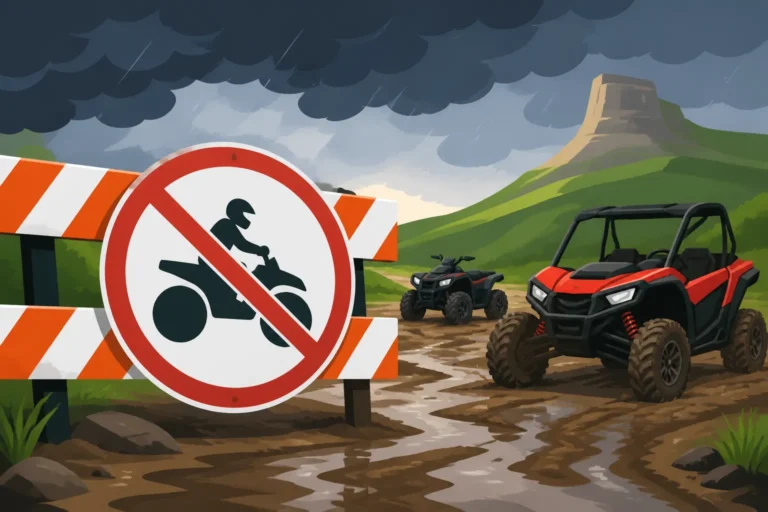
Use only routes that are marked or specifically identified as open to your machine. Do not ride around a closure, enter a track from an unmarked point, or assume that a trail is two-way. Direction and access rules may be posted at the site, and they can affect the safety of everyone using the area.
Keep your speed appropriate for sightlines and traffic. Dust can make it hard to see another rider, while a blind turn may conceal someone stopped ahead. Give other riders room, avoid crowding a machine that is struggling, and wait until there is a safe opportunity to pass.
If you use onX Offroad or another navigation tool, use it as a planning aid rather than a rulebook. The park’s signs and current instructions take priority. If a map appears to show a route that is not marked on the ground, do not assume that the route is open. Ask before riding it.
Making the most of the motocross and quad options
Observe before your first lap or trail run
When you arrive, take a few minutes to understand how the riding area is laid out. Find the entrance and exit for each route, read the signs, and watch how other riders move through the space. On a motocross track, notice the direction of travel and where riders tend to slow or change line. On a quad trail, look for intersections, narrow sections, and places where stopping might block the path.
If you are unsure whether your machine or experience level fits a route, ask before entering. A short conversation at the trailhead is far easier than discovering halfway through that the route is too challenging or not intended for your vehicle.
The same approach works for families and mixed groups. Let a new rider watch first, then choose the gentler option if there is any doubt. Build confidence gradually instead of treating the most challenging feature as a test everyone must pass.
Leave the route in good shape for the next riders
Ride within your ability and avoid creating avoidable damage. Spinning tires, cutting corners, or leaving the marked route can damage the surface and create hazards for the next person. If a section is too difficult, do not make a new line around it unless the park specifically directs riders to do so.
Take your belongings and rubbish with you, and keep the unloading area orderly. If you notice a damaged sign or an unexpected hazard, tell the appropriate park contact rather than assuming the next rider will spot it. Small, responsible choices make a real difference at a compact facility where riders share a limited area.
Most of all, think of “separate” as a practical safety feature: use the course or trail intended for your machine and riding style, follow current directions, and give others room to enjoy their ride. That simple approach helps motocross riders and quad riders share a Nebraska riding destination with fewer surprises.
Disclaimer
This article is for general informational purposes only and does not constitute professional advice. Laws, prices and regulations vary by location and change over time. Consult a qualified professional for guidance on your specific situation.