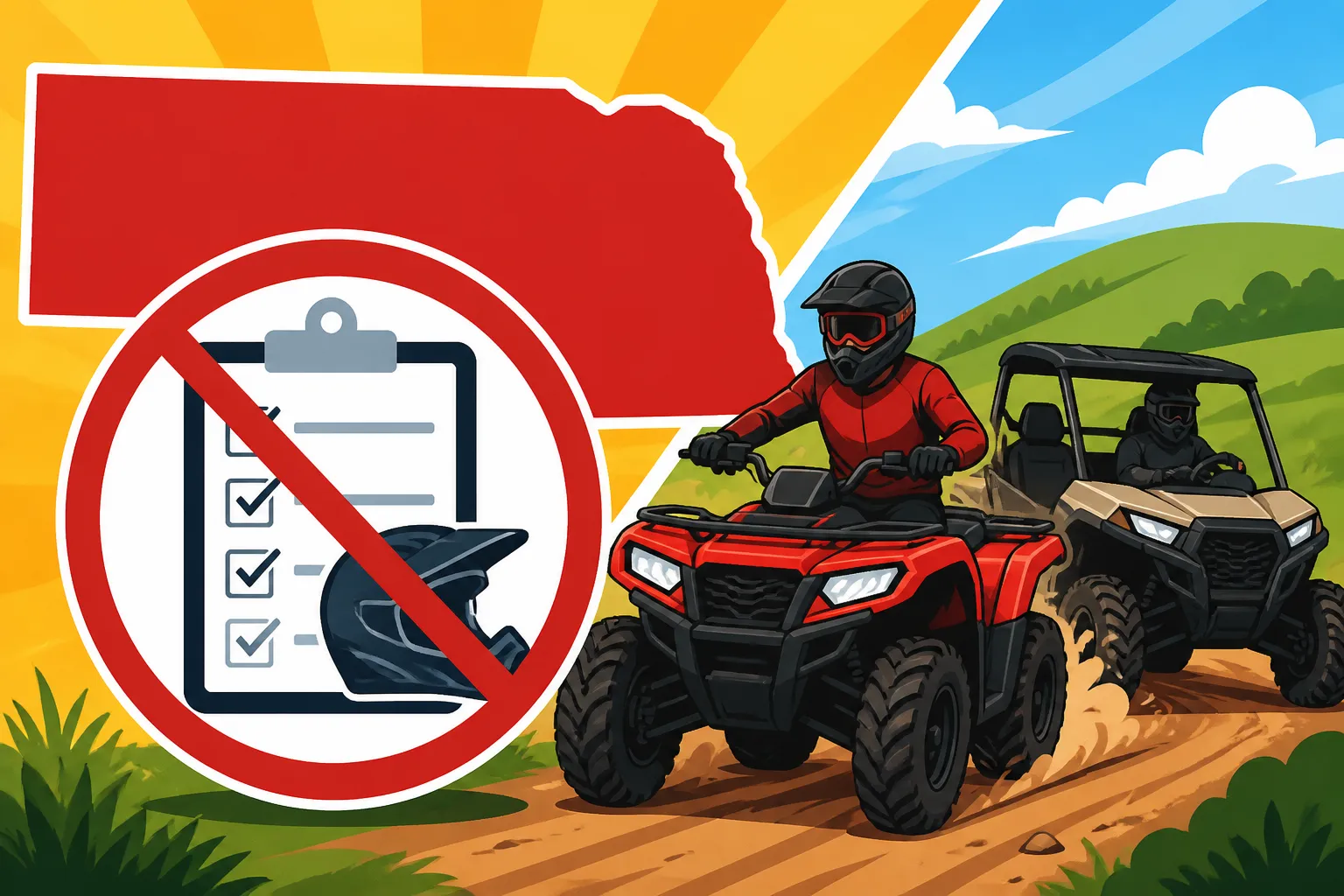
Nebraska Has No Mandatory Safety Course
A parent near Lincoln may assume a child needs a state-approved ATV safety card before riding, while a visitor hauling a quad into Nebraska may wonder whether an out-of-state course certificate counts. The key distinction is that Nebraska does not require a general ATV safety course statewide. That does not erase local rules, private-park requirements, or the practical value of training before a ride.
What Nebraska’s No-Course Rule Means
There is no statewide ATV safety-course requirement
Nebraska does not impose a general statewide safety-course requirement that every ATV or UTV rider must satisfy before riding. In other words, there is no universal Nebraska ATV safety card that every rider must earn simply because they plan to operate an off-highway machine in the state.
That can be a relief if you are trying to plan a family outing, arrange a visit with an out-of-state machine, or figure out what documents belong in the truck. But it is important to read “no mandatory course” narrowly. It does not mean every riding location is open to every rider, or that a course certificate overrides other requirements.
The distinction matters in real life. A rider may not need a state course card, but a private riding park can set its own admission conditions. A landowner can decide who may ride on private property. A particular road-use situation can involve separate licensing, insurance, equipment, or local-ordinance rules. Training is only one part of being ready to ride.
A safety course is different from a permit or permission
A training certificate, a park permit, proof of ownership, and permission to ride are different things. A course teaches skills or safety concepts. A permit may be required for a separate activity or place. Proof of ownership helps show that the machine is yours or that you have the right to use it. Permission determines whether you may ride on land where access is controlled.
For example, completing an online ATV course does not automatically authorize riding on a closed trail, a wildlife management area roadway that is not designated for motorized use, or private ground without the owner’s consent. Likewise, carrying a park entry permit does not automatically mean an ATV is allowed in every state park or recreation area. Nebraska has separate rules for areas and vehicles; see Nebraska Park Rules for ATVs and [Nebraska WMA Roadway Rules] when you are sorting out where you can ride.
A useful way to avoid confusion is to ask two separate questions: “Do I need training?” and “Am I allowed to ride here, on this machine, in this way?” The answer to the first may be no under statewide rules, while the second still depends on the location, land manager, local ordinance, and circumstances.
The rider’s situation can change the answer
A casual ride on private family land, a weekend at a private riding park, and a trip involving a public road are not interchangeable situations. The same rider and machine may face different requirements depending on where the ride happens and what the rider intends to do.
A parent planning a child’s first ride should not stop at the absence of a statewide course mandate. Check the machine’s fit, the child’s ability to follow instructions, supervision expectations, and any property-specific age or helmet rules. A rider taking an ATV onto a roadway should separately review the conditions for legal road use; training does not replace those requirements.
For out-of-state visitors, the absence of a Nebraska course mandate also does not settle every reciprocity question. A home-state registration, local permit, park entry permit, or private-facility requirement may be treated differently depending on the place being visited. Start by checking the destination’s rules rather than assuming that a course card or home-state document covers everything.
Where Training Rules Can Still Apply
Private riding parks can set their own conditions
A private riding park is not the same as a statewide public-road or vehicle rule. A park may set entry policies for age, supervision, protective equipment, waivers, machine type, or other safety conditions. Those policies can apply even though Nebraska does not require every rider to complete a course statewide.
Before towing to a private park, check its own posted rules or contact the operator. Ask specifically whether the facility requires a safety course, whether a certificate must be shown at check-in, and whether its rules differ for younger riders. If you are bringing a group, ask about every rider’s age and experience rather than relying on a general statement that “kids are allowed.”
Also ask whether the park distinguishes between an ATV and a side-by-side, and whether requirements change for passengers. A rule that applies to a youth riding alone might not be identical to a rule for a child riding as a passenger with an adult. For related planning, see Nebraska Private Park Age Minimums and Nebraska Private Park Helmet Rules.
Landowners and organized events may have additional expectations
On private land, the landowner controls access and can set reasonable conditions for use. One owner may be comfortable with experienced adults riding without formal training, while another may require instruction, direct supervision, or limits on where machines can travel. If you are invited to ride on a ranch, hunting property, or family acreage, ask before unloading rather than assuming that an invitation covers every rider and activity.
Organized rides can also have event-specific rules. An organizer may require a waiver, impose a minimum age, recommend or require protective gear, or ask participants to demonstrate that they understand the route and basic riding expectations. These are event or property policies, not proof that Nebraska has a universal course mandate.
If the answer matters to your plans, get it directly from the person responsible for the property or event. A quick conversation can prevent an awkward situation at the gate, particularly when you have driven a long distance or brought children who are eager to ride.
Road use is a separate question from course completion
Some Nebraska ATV and UTV road-use situations are governed by specific conditions, and those conditions are not replaced by a safety certificate. Depending on the route and circumstances, riders may need to consider licensing or an applicable farm permit, liability insurance, required equipment, speed limits, daylight restrictions, and local ordinances. A course card does not make an otherwise prohibited road trip legal.
This distinction is easy to miss because training often covers safe operation on roads and trails. Knowing how to cross safely is not the same as having legal authority to use a particular road. Before riding on or crossing a public road, check the rules for that exact type of road and the local jurisdiction. You can review Can You Drive an ATV on the Road in Nebraska? and Nebraska Rules for Crossing a Highway for the road-use side of the question.
A practical example: a rider may have completed a thorough safety course and have a well-maintained machine, but still be barred from using a particular highway. Conversely, a rider might be legally permitted to use a route under a specific exception but still be unprepared to manage traffic, loose gravel, or a sudden hazard. Legal permission and riding competence should be treated as separate checks.
Voluntary Courses and What They Can Teach
Why a voluntary course can be worthwhile
“Not mandatory” is not the same as “not useful.” A good course can help a new rider understand throttle control, braking, terrain, protective equipment, passenger risks, and the need to adjust speed to conditions. That foundation matters whether the ride is on a farm, at a riding park, or along a permitted route.
For a first-time rider, the most valuable lesson may be learning what not to do. Beginners often focus on how to accelerate, but safe riding also involves choosing a route that matches ability, scanning for changing terrain, keeping a safe following distance, and resisting pressure from more experienced riders. A course can give families a shared vocabulary for discussing those decisions.
Training is especially helpful when a household has more than one machine or rider. A parent may know how their own quad responds but still need to explain safe practices to a teenager or visiting relative. A course can provide structure for that conversation, while supervised practice gives the rider a chance to apply it at a manageable pace. For an overview of common course content, see What an ATV Safety Course Actually Teaches You.
Online learning and hands-on practice are not identical
An online course can be convenient when you want to learn at home, review basic concepts, or prepare for a first outing. It may cover safety principles, terminology, hazards, and decision-making. But it cannot show whether a particular rider can control a particular machine on a slope, stop smoothly on loose ground, or respond calmly when the route changes.
Hands-on instruction and supervised practice can fill that gap. A new rider can begin in a clear, controlled area, learn the controls while stationary, and practice starting, stopping, turning, and using the brakes before attempting uneven terrain. A parent or instructor can watch for habits that a quiz cannot reveal, such as looking down at the handlebars, riding too close to another machine, or accelerating when uncertain.
If you choose an online option, treat it as preparation rather than a substitute for practice. Verify what the course actually includes, whether it offers practical instruction, and whether a park or event accepts its completion certificate if that is why you are taking it. See Nebraska Online Safety Courses and Taking the Voluntary Online ATV Safety Course for related guidance.
Keep course records in perspective
A completion certificate can be useful to keep with your personal records, particularly if a private park, organized ride, employer, or landowner asks about training. But do not assume that every certificate is accepted everywhere or that having one creates a legal entitlement to ride.
If an organizer says a course is required, ask what qualifies. They may have a specific provider, format, age group, or documentation requirement in mind. If you are taking training for a child, confirm whether the certificate is issued to the child, the supervising adult, or both, and whether a parent needs to accompany the rider.
There is no need to carry a course card as a substitute for other essential paperwork. For a trip, organize the documents that actually relate to the machine and the destination, then keep any training record as supporting information. If you are uncertain what an official or a land manager might ask to see, Nebraska Proof of Ownership on the Trail is a useful separate topic to review.
Planning for Children and New Riders
Choose a machine that matches the rider
A safety course cannot make an oversized or unfamiliar ATV appropriate for a particular rider. A machine should fit the rider’s physical ability and experience, and the rider should be able to reach and operate the controls as intended. A child who cannot comfortably manage the controls may struggle to stop or change direction when something unexpected happens.
Adults sometimes judge readiness by age alone. In practice, attention, coordination, confidence, and willingness to follow instructions matter too. A child who is excited but easily distracted may need more time in a supervised practice area than a quieter child with the same amount of experience. It is better to end a short first session with the rider feeling capable than to push for a long ride because the machine is already unloaded.
If children will be riding, review Does Nebraska Set a Minimum Age for Riders? and Must an Adult Ride Along With a Nebraska Minor?. Do not treat the absence of a statewide course rule as proof that there are no age, supervision, or equipment rules in the place where you plan to ride.
Make supervision active, not merely nearby
An adult standing at the edge of a trailhead is not necessarily providing meaningful supervision. For a new rider, supervision means staying close enough to observe, communicating clearly, choosing a manageable route, and being ready to intervene if the rider becomes tired, confused, or overwhelmed.
Before the machine moves, agree on simple instructions. Establish where the rider should stop, what signal means “come back,” and what to do if the machine stalls or another rider passes. Keep the first ride short and uncomplicated. A quiet, open area is generally a better place to practice than a busy trail with blind turns, sand, steep slopes, or fast-moving group traffic.
Supervision should also account for the other people in the group. An experienced adult may be tempted to ride ahead and expect a child to follow. That can leave the less experienced rider dealing with terrain or traffic without immediate help. Keep the group’s pace and route appropriate for its least experienced rider, not just the person on the most powerful machine.
Gear and preparation support good judgment
A course is one part of preparation; properly fitted protective equipment and a clear plan are others. Check the machine before the ride, make sure the rider understands how to stop it, and match clothing and equipment to the terrain and weather. Equipment needs can differ between a short farm task and a full day on a dusty trail.
When shopping for safety gear, do not choose based on a listing photo or a broad age label alone. Fit, condition, intended use, and applicable safety markings matter. A retailer such as Amazon may offer a broad selection, but the buyer still needs to verify the item’s specifications and fit rather than assuming every listing is appropriate for every rider. A helmet that moves around or blocks the rider’s vision is not a good fit simply because it arrived before the weekend.
Do a brief pre-ride conversation every time, even when the rider has taken a course. Review the route, hazards, stopping points, weather, and what to do if the group gets separated. On a long trail day, build in breaks and water rather than waiting until someone is tired. Training helps riders recognize hazards; preparation gives them a better chance to respond sensibly.
Permits, Reciprocity, and Riding Locations
A course certificate does not replace a park permit
Nebraska’s lack of a statewide ATV course mandate should not be confused with entry requirements for state parks or other public areas. A park permit, where required for the vehicle or visit, serves a different purpose from a training certificate. The permit relates to access or entry; the course relates to education and skill development.
There is another important distinction: having a park permit does not mean an ATV is allowed to ride inside every park or recreation area. Some areas prohibit ATVs, while other public-land locations may have designated routes or special limitations. Check the rules for the exact destination, not just the general permit page. Why a Park Permit Does Nothing for Your ATV explains why these documents are not interchangeable.
Before loading, confirm the land manager’s vehicle rules, trail status, access points, and any seasonal restrictions. If the destination is managed by a private operator, follow that operator’s rules too. A course certificate cannot open a closed trail, authorize travel beyond a designated route, or change a land-use restriction.
Out-of-state riders should check more than reciprocity
Visitors often ask whether their home-state registration or training certificate will be recognized in Nebraska. Those are separate questions. Nebraska does not have a general statewide ATV registration or sticker requirement that works like registration in some other states, and it does not simply treat another state’s registration as a Nebraska trail pass. At the same time, visitors still need to follow the rules for the place where they ride.
For example, a visitor may arrive with a machine that is titled or registered at home, but the destination may have its own entry conditions, proof-of-ownership expectations, or restrictions on vehicle types. A private park may ask for a waiver or impose an age rule. Public land may limit motorized travel to specific roads or trails. Check the relevant details in Nebraska Honors No Other State’s ATV Registration and Do Out-of-State Riders Need a Permit to Ride?.
Do not rely on a course certificate to answer a reciprocity question. A certificate may show that a rider completed a course, but it does not determine whether a home-state tag is recognized, whether a particular Nebraska location permits riding, or whether a separate permit is needed. Confirm those questions with the destination or responsible agency before you travel.
Match the rules to the place, not just the state
A weekend itinerary can include several different rule sets: a public road, private property, a private riding park, and a public trail area. The fact that one location accepts your machine and documents does not mean the next one will. Rules can change at the property boundary.
Make a simple destination checklist before departure. Write down where you plan to ride, who manages each location, whether ATVs or UTVs are allowed, what permits or entry requirements apply, and whether there are age, equipment, or training policies. If your route includes public roads, verify road-use rules separately rather than assuming they are part of the trail rules.
This small amount of planning can save an especially frustrating kind of trip: arriving with the right machine and a willing group, only to discover that the trail is closed, the vehicle is not allowed, or an adult has misunderstood a local condition. If you are riding on a public trail, also check current conditions and closures before towing, because safe access depends on more than paperwork.
A Practical Checklist Before You Ride
Before choosing a course
Start by asking what problem you want training to solve. If you are new to riding, a course can build a foundation. If a private park or event has requested proof of training, confirm exactly what it accepts. If you are trying to satisfy a supposed statewide requirement, verify whether the rule applies to your actual situation rather than assuming a course is mandatory for all Nebraska riders.
Compare the learning format with the rider’s needs. Online instruction can be convenient for basic concepts, while hands-on training and supervised practice provide opportunities to develop control. For a child or novice, consider both: structured learning first, then a gradual practice session on a suitable machine and in a controlled location.
Keep the goal realistic. A certificate does not prove that someone is ready for every trail, every slope, or every group ride. It is one piece of preparation, not a guarantee of skill. A responsible rider continues to make decisions based on conditions, experience, and the abilities of the people riding along.
Before leaving home
Use this checklist to separate training from the other things that may affect your trip:
| Question | What to verify |
|---|---|
| Is a safety course required? | Check statewide rules, then confirm any additional requirements from the property owner, park, event, or employer. |
| Is the riding location open to ATVs or UTVs? | Confirm the vehicle type, route, trail status, seasonal limits, and land manager’s rules. |
| Is a permit or entry document required? | Check the specific destination; do not treat a course certificate as a permit. |
| Are there rules for minors? | Confirm age, supervision, helmet, passenger, waiver, and machine-size policies where applicable. |
| Is road use part of the trip? | Review the applicable road-use conditions separately; training does not authorize a route. |
| What documents should travel with the machine? | Bring relevant ownership or permission records and any destination-specific documentation. |
| Is the rider prepared for this machine and terrain? | Check fit, controls, experience, protective gear, route difficulty, and weather. |
This checklist is intentionally broader than the course question. It helps prevent the common mistake of solving one requirement while overlooking another. For instance, a rider may have completed training but still need to obtain a location-specific permit, confirm a trail is open, or secure permission from a landowner.
Before the machine moves
Take a few minutes to inspect the machine and set expectations. Check that the controls respond as expected, the tires and visible components appear suitable for the planned ride, and the rider knows how to stop. Make sure everyone understands the route and how the group will communicate if someone falls behind.
A family preparing for a first outing might agree that the child will remain within sight, stop at a designated meeting point, and signal an adult if anything feels wrong. A group of adults might decide that no one rides ahead of the trail leader, that faster riders wait at junctions, and that anyone can call for a break. These small agreements reduce pressure to keep going when someone is uncomfortable.
If you are buying protective gear or basic ride supplies, focus on fit and intended use rather than assuming a particular retailer or product solves the safety question. Amazon can be one place people compare available gear, but check specifications, sizing, and the return policy before relying on an item for a planned ride. A course, a well-fitted helmet, a sensible route, and attentive supervision each serve different purposes.
Common Misunderstandings About the No-Course Rule
“No mandatory course” does not mean “no safety expectations”
A statewide course mandate is only one possible way to address safety. Even without one, a rider remains responsible for operating sensibly, respecting property boundaries, following location rules, and choosing terrain suited to their ability. A lack of required coursework is not a recommendation to skip learning.
This can be especially important for experienced riders. Familiarity with one machine does not guarantee familiarity with another, and a confident rider can still misjudge loose sand, a hidden rut, a steep descent, or a sudden change in visibility. A refresher course or a careful practice session can be valuable after a long break, a machine change, or a move to unfamiliar terrain.
Families can make training part of their own standard even when the law does not require it. That may mean a formal course, a supervised skills session, or a family safety briefing followed by controlled practice. The important point is to make the choice based on the rider’s needs rather than treating the absence of a legal mandate as proof that preparation is unnecessary.
“I have a certificate” does not mean “I can ride anywhere”
A certificate is not a universal access document. It does not replace a landowner’s permission, a park’s rules, a required entry permit, a designated-trail restriction, or local road-use conditions. It also does not transfer automatically to a different rider or establish that the rider is capable of operating every machine.
A rider who arrives at a private facility should still read the waiver and posted rules. A rider visiting public land should check the land manager’s maps and signs. A rider planning a road segment should confirm that the route and circumstances are permitted. If a rule is unclear, ask the responsible office or operator rather than relying on what another rider remembers.
This is also why visitors should avoid assuming that home-state documents settle Nebraska requirements. A home-state course card may be useful evidence of training, but it does not tell you whether a Nebraska destination accepts your machine, whether a specific area is open, or whether a local policy applies.
“No course requirement” does not mean “children can ride without limits”
A state-level absence of a universal safety-course rule does not answer every question about children. Age, supervision, passenger restrictions, machine suitability, helmets, and private-facility policies can still matter. Parents should check the rules that apply to the specific setting and make a separate judgment about the child’s readiness.
It is tempting to make a decision based only on a child’s age or the fact that a cousin has ridden the same model. A better approach is to consider whether the child can understand instructions, reach the controls, stop reliably, and stay calm when the machine behaves unexpectedly. Start with short practice, stay close, and do not let group pressure dictate the pace.
If you are unsure whether a rule comes from statewide law, a local ordinance, or a private operator, identify who controls the riding location and ask that party directly. That simple step is more useful than assuming a course certificate settles the question.
Disclaimer
This article is for general informational purposes only and does not constitute professional advice. Laws, prices and regulations vary by location and change over time. Consult a qualified professional for guidance on your specific situation.