Nebraska Public Land Rules Compared to Private
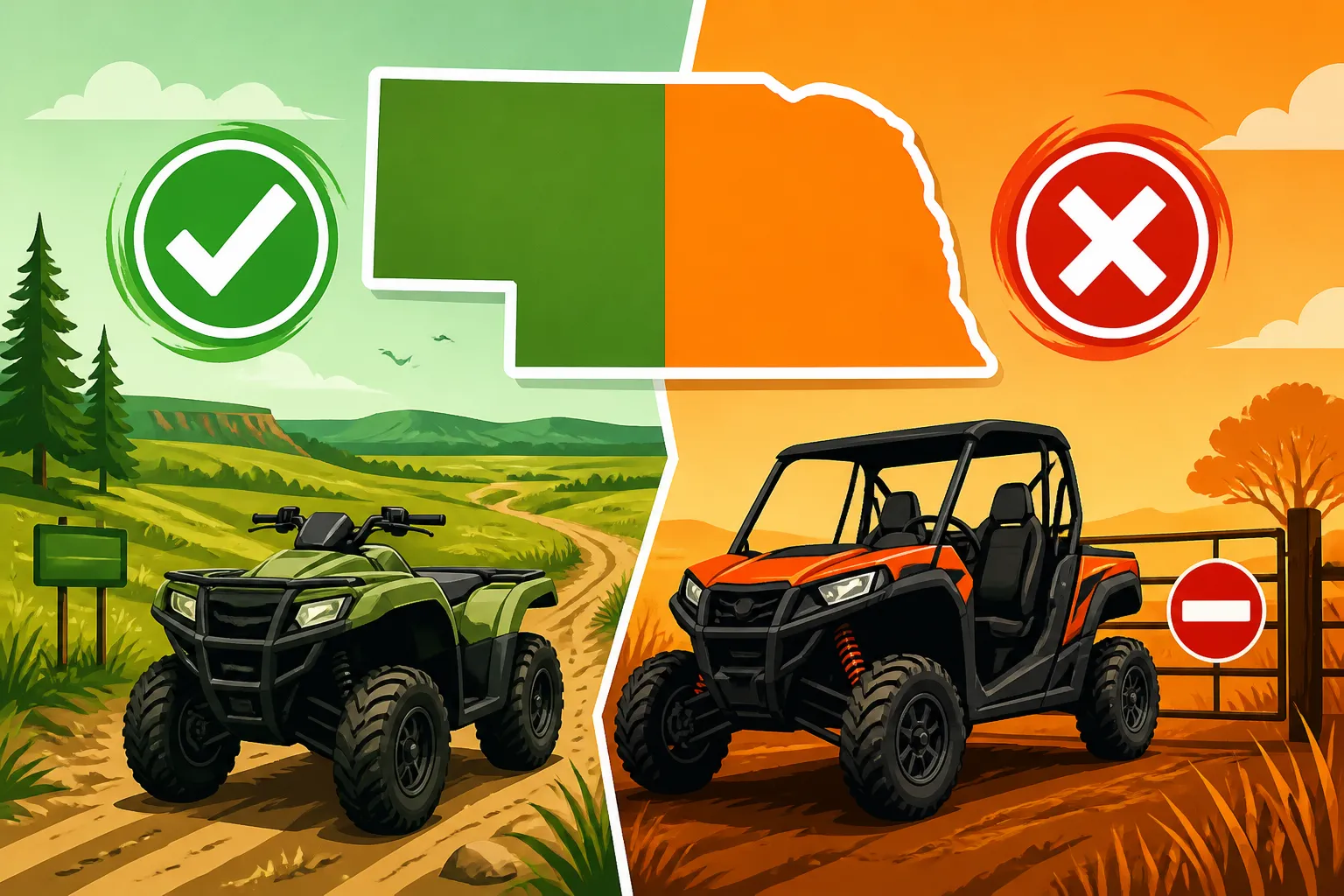
Nebraska riders can’t assume that an ATV allowed on one parcel is allowed on the next. Public land may be closed to ATVs or limited to marked routes, while private land access depends on the owner or riding park. The key is to identify who manages the riding area, what routes are open, and whether a permit covers the machine or only your vehicle.
The basic difference between public and private riding
On public land, the managing agency sets the rules. A road or trail that looks rideable is not automatically open to ATVs. Use may be limited to designated routes, specific trail areas, or particular conditions. Closures can also vary by season, weather, fire danger, or maintenance needs.
Private land works differently. A landowner can allow or prohibit riding and set conditions for access. A private riding park may establish its own rules for admission, age limits, equipment, helmets, passengers, noise, and trail use. Those rules apply alongside any laws that still govern the rider, vehicle, and surrounding area.
| Question | Public land | Private land |
|---|---|---|
| Who decides where you can ride? | The agency managing the property, through posted rules, maps, and designated routes | The landowner or private riding park |
| Does a general land or vehicle permit authorize ATV use? | Not necessarily. A permit may cover entry or parking without opening trails to ATVs | The owner or park determines what admission or permission covers |
| Can you ride anywhere that looks open? | No. Follow designated routes and closures | No. Stay within the area and trails the owner has authorized |
| What should you check before unloading? | Current agency rules, maps, signs, and any required permit | Permission, park rules, operating hours, and any required waiver or admission |
| Do out-of-state riders get an automatic statewide ATV permit? | Nebraska has no statewide OHV permit or sticker to rely on | Private facilities can set their own entry requirements |
Nebraska’s lack of a statewide OHV permit does not mean all public land is open to riding. It also does not replace a park permit that may be required for a vehicle entering a state park or recreation area. These are separate questions: whether a permit is needed to enter or park, and whether an ATV is allowed on that property at all.
For an overview of the state-level permit distinction, see Nebraska Has No OHV Permit or Sticker and Why a Park Permit Does Nothing for Your ATV. A permit for the truck or trailer does not turn a closed ATV area into an open one.
What to check on public land
Nebraska public land is not one uniform riding system. State parks, recreation areas, wildlife management areas, national forest land, and other public properties can have different rules and managers. Check the rules for the exact property and trail system you plan to visit rather than relying on a statewide assumption.
State parks and recreation areas
ATVs are generally not allowed to ride in Nebraska state parks, and recreation areas also restrict ATV use. A park entry permit may be required for the vehicle entering the property, but it does not grant permission to ride an ATV there. Do not confuse access to a campground, boat launch, or parking area with authorization to ride trails.
There is a limited exception involving frozen water in certain circumstances, but it should not be treated as a general winter riding allowance. The area must be open for that use, and signs or current restrictions can close it. Check Nebraska State Parks Ban ATVs and One Exception Lets ATVs Onto Frozen Water before planning an ice ride.
Wildlife management areas
Wildlife management areas have their own access limits. Where motorized use is allowed, it may be restricted to designated roadways or other specifically identified areas. A parking area is not automatically a riding area, and a route used by other vehicles is not necessarily open to ATVs.
Some WMAs have special rules for frozen lakes or other seasonal access. Those rules can depend on posted signs and the condition or status of the area. Review Nebraska WMA Roadway Rules and Nebraska WMA Ice Riding Rules for the kinds of distinctions to look for.
National forest and designated trail systems
Some public areas do offer riding opportunities, but access is tied to specific routes and facilities. The Bessey Recreation Complex near Halsey, for example, has designated OHV riding areas. That does not mean all nearby forest roads or land are open to off-highway vehicles. Follow the trail map and posted restrictions, and confirm current conditions with the managing office before towing out.
Other riding areas may involve more than one agency or land manager. Cedar Run ATV Trail is a designated riding destination, but nearby public land should not be assumed to share its access rules. Read Nebraska ATV Trails: Where to Ride and check Nebraska Trail Conditions Before You Tow when choosing a destination.
Public-land rules can change because a trail is closed, damaged, or subject to a temporary restriction. Make the managing agency’s current map and notices part of your trip planning. A map saved from an old visit or a route posted by another rider may not reflect a closure.
What changes on private land
Private land access begins with permission. A machine owner, landowner, tenant, or other person with authority over the property may allow riding, but permission for one field or trail does not automatically extend to adjoining land. Get clear approval for the parcel, route, and dates you intend to use.
If the property is a commercial riding park, admission or a waiver may be required. The park can set rules that are stricter than the general law, including limits on vehicle type, age, passenger use, riding hours, and protective equipment. Read those rules before unloading. A park’s permission to ride also does not authorize riding on public roads or crossing a neighboring property.
A private road or trail can look like a public route, especially where parcels meet. Don’t use appearance, an open gate, or tire tracks as proof of access. If you are riding on ranch or farm property, ask where you may travel and whether there are active work areas, livestock, gates, or restricted sections to avoid.
Permission is also not a substitute for safe, responsible conduct. Follow the landowner’s instructions, avoid disturbing livestock and wildlife, leave gates as directed, and take out trash. If the owner limits speed, group size, or certain equipment, those conditions are part of the permission.
Private parks can have their own policies for out-of-state riders and machines. Nebraska does not have a statewide ATV sticker that visitors must obtain, but a private park may require admission, a signed waiver, proof of age, or other information. For a broader look at privately operated facilities, see Nebraska Private Park Waivers and Rules and Minimum Riding Ages a Private Park Sets Itself.
Before traveling to a private site, ask:
- Which machines and trail types are allowed?
- Are there age, passenger, helmet, or sound rules?
- Is advance booking or a waiver required?
- Are trails open after rain or during special events?
- Where should trucks and trailers park?
- Are there separate rules for camping, pets, or alcohol?
These questions can prevent a wasted trip. They are especially useful when a park’s online information is brief or when you are bringing a machine that may be too wide, loud, or powerful for some trails.
Permits, out-of-state machines, and a pre-ride check
Nebraska has no statewide OHV permit or sticker system for ATVs and UTVs. That matters for visitors: an out-of-state rider generally does not need a Nebraska state ATV sticker simply to ride, but that does not create access where riding is prohibited. The destination’s rules still control.
Nebraska also does not have another state’s ATV registration to reciprocate. Do not treat an out-of-state registration, decal, or plate as permission to ride on Nebraska public land. Carry useful ownership information and follow the local site’s requirements, especially if you are visiting a designated trail system or private park. See Nebraska Has No Registration to Reciprocate and Nebraska Visitors Need No State Sticker.
Road use is a separate issue from off-road access. A machine that is allowed on a designated trail is not automatically legal on a public road, and having a title does not grant road access. Nebraska road rules, local ordinances, insurance requirements, and equipment requirements may apply when a route includes a public road. Check Can You Drive an ATV on the Road in Nebraska? before planning a route that connects riding areas by road.
Use this checklist before each trip:
- Identify the land manager. Confirm whether the destination is state, federal, county, private, or managed through a partnership. If you are unsure, contact the office responsible for the property.
- Confirm that ATVs or UTVs are allowed. Check the rules for the specific area, not just the broader park, forest, or county.
- Find the authorized routes. Use a current map and stay on marked trails or roadways. Do not extend your ride onto nearby land because it appears connected.
- Check closures and conditions. Look for temporary closures, seasonal limits, weather-related restrictions, fire notices, and trail updates.
- Sort out permits and permission. Verify whether a permit is for vehicle entry, parking, or trail use. On private property, get permission from someone authorized to grant it.
- Review local rules. A city ordinance, county rule, private park policy, or land manager’s restriction may add requirements.
- Carry practical records. Bring the contact details or written permission you need, along with ownership information and any required permit documentation. Don’t assume a photo of a map or permit proves that a closed route is open.
A route planner should also distinguish between riding access and transportation to the riding area. A park permit may help you enter a property with a truck, while an ATV remains prohibited there. Conversely, a designated public trail may allow ATV use but have separate parking or camping requirements. Work out both parts before leaving home.
If you need a map case or other gear for keeping a paper route map readable, a retailer such as Amazon may be one option; check that the map itself is current and specific to the trail system. A phone map is useful, but it is not a substitute for posted signs or official closure information.
The safest rule is simple: public land requires confirmation from the managing agency, while private land requires permission from the person or facility controlling access. Neither a Nebraska title, an out-of-state registration, nor a general park permit should be treated as a blanket license to ride.
Disclaimer
This article is for general informational purposes only and does not constitute professional advice. Laws, prices and regulations vary by location and change over time. Consult a qualified professional for guidance on your specific situation.