Nebraska WMA Frozen Lake Exception
Nebraska’s frozen-lake exception can make riding on a Wildlife Management Area possible, but it is not permission to drive anywhere on the property. The key is to separate riding on qualifying frozen water from travel across land, then check the particular area’s rules and signs before unloading.
What the frozen-lake exception allows
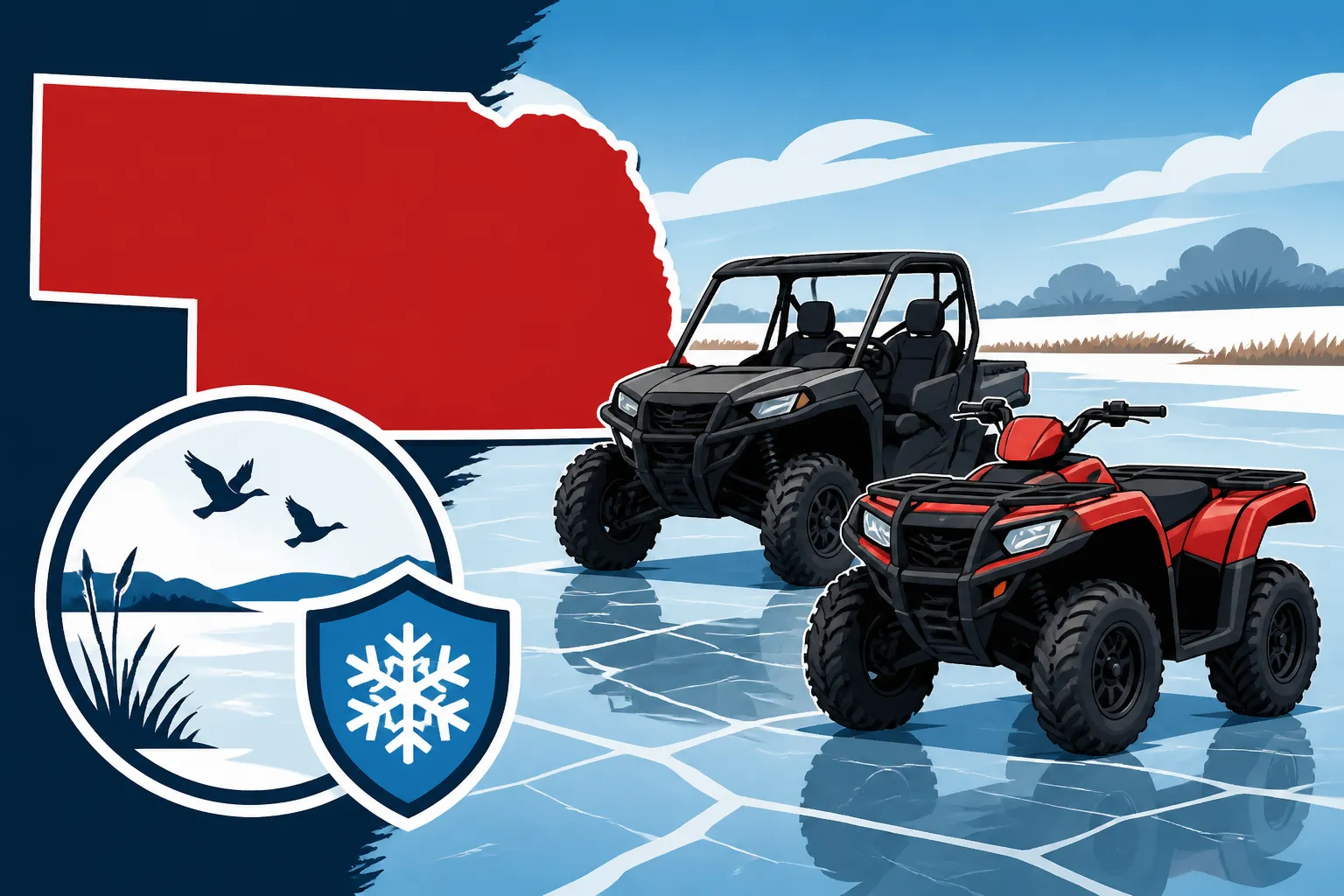
Nebraska Wildlife Management Areas, or WMAs, are public lands managed for wildlife and outdoor recreation. They are not open riding parks. The general rule is that motor vehicles must stay on designated roads or other routes specifically open to them. A narrow exception may allow motorized riding on the frozen surface of a lake at a WMA.
That exception is limited by both place and conditions. It applies to the frozen water surface, not to the surrounding shoreline, parking areas, fields, trails, or other parts of the WMA. It also does not override a closure or restriction posted for a particular site. If signs say the lake or an area is closed to motor vehicles, follow them even if the ice appears solid.
This distinction matters because a rider can be on a WMA where some motorized use is allowed and still be in a prohibited area. A route across a parking lot, access lane, or strip of shoreline does not become legal just because the intended destination is a frozen lake. Use the area’s designated access point and route, and do not assume that a track made by another rider marks an approved path.
The exception should also not be read as permission to ride every frozen lake in Nebraska. It concerns the applicable WMA rules and the particular area. A lake on a WMA, a lake in a state recreation area, and a lake on private land may each have different restrictions. For broader background on property rules, see Nebraska WMA Riding Rules and Nebraska WMA Access for a Quad.
| Place or situation | What to check before riding |
|---|---|
| Frozen lake at a WMA | Whether motorized use is allowed there, whether the lake is open, and what signs or restrictions apply |
| WMA land around the lake | Whether the route is a designated roadway or another specifically authorized access route |
| State park or recreation area | Separate rules; do not assume the WMA exception applies |
| Private lake or land | The owner’s permission and any local restrictions |
| Out-of-state ATV or UTV | Nebraska land rules still apply; home-state registration does not grant access |
When a rule depends on the particular property, signs and current area information are important parts of the answer. If the signs are missing, unclear, or appear to conflict, do not treat uncertainty as permission. Check with the managing agency before riding.
Why a WMA is different from a park or trail area
A WMA’s primary purpose is wildlife management. Public access can include activities such as hunting, fishing, and wildlife viewing, but that does not make every route open to motorized recreation. Vehicle restrictions help limit disturbance to habitat, wildlife, and other visitors.
That is why the frozen-water allowance should be treated as a narrow exception rather than a general invitation to use a WMA as an ATV trail system. Riding across a frozen lake does not authorize cutting across a field to reach another part of the property, making a new trail along the shore, or driving through an area closed to vehicles. Stay within the permission that applies to that site.
State parks and state recreation areas are a separate category. Rules that apply to a WMA do not automatically apply to those properties; Nebraska state parks generally prohibit ATVs. See Nebraska State Parks Ban ATVs for that separate issue. A nearby road or a common agency name does not make two properties interchangeable.
A useful way to think about the exception is:
- Confirm the land type. Make sure the lake is part of a WMA, rather than a state park, recreation area, private property, or another type of public land.
- Confirm that the specific area is open. Check current signs and property information for closures or restrictions.
- Limit riding to the allowed surface and access route. Permission to ride on frozen water is not permission to drive around the WMA.
- Stop if conditions or instructions are unclear. Ask the managing agency instead of relying on assumptions or another rider’s tracks.
The practical details can differ between properties. A WMA may have a designated parking location, a closed access road, seasonal limits, or signs that prohibit riding in a particular portion. For parking-specific questions, [Nebraska WMA Parking Rules] offers related context. For the ice-specific rules, consult [Nebraska WMA Ice Riding Rules] as well as the signs at the site.
How to check a WMA before you haul your machine
A quick check before leaving home can prevent a wasted trip and help avoid an unsafe or unlawful ride. Do not rely only on a map pin, an old social-media post, or the fact that a lake appears frozen in a photograph. Confirm the land manager, current access, and route to the lake.
Use this process:
- Identify the exact property. Write down the WMA name and the lake or access point you plan to use. Nearby properties can have different rules.
- Check the managing agency’s current information. Look for alerts, closures, access details, and vehicle restrictions. If the page or map does not make the frozen-lake rule clear, contact the manager.
- Read signs at the entrance and along the route. Posted restrictions at the property matter. A general description of an exception does not cancel a site-specific closure.
- Confirm where you may park and unload. Use an authorized parking area. Do not drive across grass, a field, or an unmarked track to get closer to the water.
- Check the access route, not just the destination. The route from the road to the lake may cross land where motorized use is limited.
- Recheck conditions before departure. Ice, weather, access, and closures can change. A report from an earlier visit may no longer be useful.
- Keep a backup plan. If the lake is closed, the access route is blocked, or the ice is unsafe, be prepared to leave without riding.
A WMA map can help identify property boundaries and roads, but a map does not necessarily show every current restriction. Treat it as one planning tool, not as proof that a route is open. If an entrance sign says a road is closed, do not use a map line or a prior track to justify entering.
If you cannot confirm that the lake and route are open to your machine, ask the land manager before you go. That is especially important when a property has multiple access points or when a sign’s wording is difficult to interpret. A direct answer about the exact lake and access route is more useful than a broad answer about WMAs in general.
Ice safety and responsible riding
Legal access does not mean safe ice. A lake can have changing thickness, weak spots, pressure cracks, springs, moving water, or snow cover that hides hazards. Ice may vary across a single lake, and a route that held a machine on one visit may not be safe later. Never assume that tracks from another ATV or UTV prove the ice can support yours.
Before riding, consider whether you can avoid the risk altogether. If you cannot verify conditions or do not have a reliable way to assess the ice, do not take the machine onto it. A vehicle can become trapped or break through quickly, leaving little time to respond. Ice conditions can also change during the day as temperatures and weather shift.
If you choose to ride where it is allowed, use conservative judgment:
- Keep well away from open water, cracks, pressure ridges, and areas where water appears to be moving.
- Do not follow another machine closely. Its weight and path do not establish that the route is safe for you.
- Avoid carrying unnecessary passengers or cargo that adds weight.
- Wear suitable cold-weather and protective gear, and keep communication equipment accessible.
- Tell someone where you are going and when you expect to return.
- Keep the machine under control and leave room to stop or turn without crossing into a restricted area.
- Do not ride if visibility, weather, or surface conditions make it hard to see hazards or stay oriented.
A UTV’s greater size or enclosed cab does not make uncertain ice safe. A heavy machine can increase the consequences of a failure, and a cab may make it harder to get out quickly if the vehicle goes through. Do not let engine power, wide tires, or another rider’s confidence substitute for a sound safety decision.
Responsible riding also means respecting other WMA users. Anglers, hunters, walkers, and wildlife may be present. Reduce speed near people, avoid disturbing wildlife, and do not create new tracks along the shore or through vegetation. If the area is crowded or the available route would bring you too close to other visitors, choose a different day or location.
A legal exception does not remove the need to follow posted closures, protect habitat, and leave the property as you found it. If the ice is not safe, the access route is not clearly authorized, or conditions have changed, turning around is the right choice.
Permits, out-of-state machines, and common misunderstandings
The frozen-lake exception is about where a machine may be operated; it is not a statewide ATV registration program. Nebraska does not have a general state OHV permit or sticker for ordinary off-highway riding, but that does not mean every public property is open to machines. The land manager’s rules still control access. See Nebraska Has No OHV Permit or Sticker for more on the difference between a state sticker and property-specific rules.
A state park entry permit is also a separate matter from WMA access. Do not buy or display a park permit as if it authorizes ATV riding on a WMA, and do not assume a WMA exception allows riding in a state park or recreation area. The property type determines which rules to check. For the permit question specifically, Does a Frozen WMA Lake Need a Park Permit? explains the distinction.
Visitors from another state should make the same checks as Nebraska riders. An out-of-state registration, plate, permit, or trail sticker may help identify the machine or satisfy another jurisdiction’s rules, but it does not grant permission to ride on a Nebraska WMA. Nebraska’s property rules apply to the land being used. Related details are covered in Nebraska Visitors Need No State Sticker and Nebraska Has No Registration to Reciprocate.
Do not confuse a WMA riding question with other permit or access questions:
- A hunting or fishing permit relates to those activities, not automatically to ATV access.
- A state park permit relates to entry to covered park properties, not general permission to ride a WMA.
- A machine’s title or registration does not override a posted land restriction.
- Permission to ride on frozen water does not authorize use of closed land or roads.
- A private landowner can set access rules that differ from public-land rules.
If your trip involves more than riding—such as hunting, fishing, camping, or using a nearby park—check the requirements for each activity and each property separately. One permit or permission should not be assumed to cover everything on an itinerary.
Frequently Asked Questions
Can I ride an ATV anywhere on a Nebraska WMA if the lake is frozen?
No. The frozen-lake allowance is limited to eligible frozen water where riding is allowed. It does not open the surrounding land, closed roads, or other parts of the WMA to motorized use. Follow the site’s signs and current rules.
Does the exception apply to every frozen lake in Nebraska?
No. Do not assume a frozen lake is open because it is on public land or because riding is allowed somewhere else. Confirm the rules for the specific property and lake.
Does an out-of-state registration let me ride on a Nebraska WMA?
No. A registration or sticker from another state does not replace Nebraska property rules. Check that the WMA, lake, and access route are open to your machine.
Does a state park permit authorize ATV riding on a WMA?
A state park permit is not permission to ride a WMA. Check the access rules for the property you plan to use, and do not assume that a park permit or a WMA riding exception applies to other types of land.
Disclaimer
This article is for general informational purposes only and does not constitute professional advice. Laws, prices and regulations vary by location and change over time. Consult a qualified professional for guidance on your specific situation.