Nebraska Has No Registration to Reciprocate
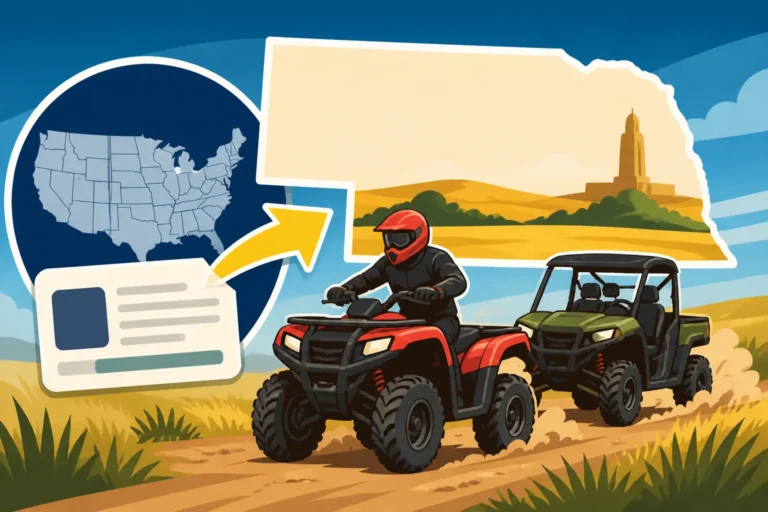
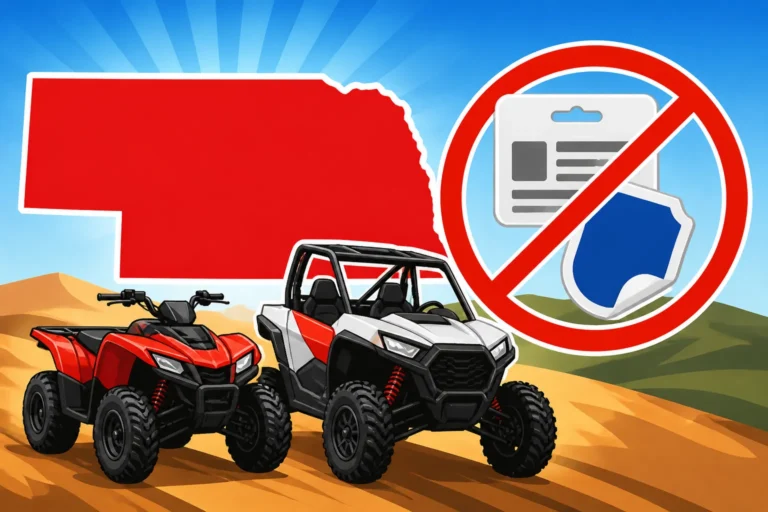
Nebraska has no statewide ATV registration system, so it has no Nebraska registration to exchange or reciprocate with another state’s. If you are visiting with a machine registered at home, that sticker does not decide where you may ride in Nebraska. The practical questions are whether the land is open to your machine and what local, park, trail, or road rules apply.
The short answer: Nebraska has no registration to reciprocate
Some states require off-highway vehicles to be registered or carry a state-issued sticker. Nebraska’s system is different: the state titles ATVs and UTVs but does not issue a general state registration for off-road use. That means there is no Nebraska OHV registration program for another state’s registration to match.
For a visitor, the important distinction is that having an out-of-state registration is not the same as having permission to ride. A sticker from your home state may show that you completed its requirements, but it does not automatically open Nebraska land, trails, parks, or roads to your machine. Nebraska access rules still control within Nebraska.
Nor does the lack of a Nebraska registration mean there are no paperwork or access requirements. A machine may need a Nebraska title in situations covered by the state’s title rules, and public or private riding areas may have their own requirements. A title establishes ownership; it is not a trail permit or a road-use authorization. See Nebraska Titles ATVs but Does Not Register Them and Nebraska Has No OHV Permit or Sticker for the difference between those systems.
For visitors, the useful takeaway is simple:
- Do not rely on your home-state registration as permission to ride a particular Nebraska trail or property.
- Check the rules for the exact place you plan to visit.
- Treat road riding as a separate question from off-road riding.
- Carry sensible proof of ownership and any documents required by the riding area or your home state.
- Confirm current requirements with the land manager, park, city, or county before you travel.
That approach avoids a common misunderstanding: Nebraska’s lack of statewide registration is not a blanket invitation to ride wherever an ATV or UTV can physically go.
Registration, title, permit, and reciprocity are different things
The word “registration” can mean different things depending on where you live. In some states, registering an ATV produces a decal, plate, or other state credential for off-highway use. Nebraska does not have a comparable statewide ATV registration credential. As a result, asking whether Nebraska “honors” another state’s registration can be misleading: Nebraska has no equivalent state registration to grant or deny.
What a title does
A title is a document tied to ownership. Nebraska has title requirements for ATVs, but a title does not by itself give you a right to ride on public land or a road. A title also is not the same as an off-road permit or a city registration.
If you are moving to Nebraska, buying a machine there, or bringing a machine into the state permanently, do not assume the absence of registration removes title obligations. The details can depend on the machine and how you acquired it. Start with Nebraska Title for a New Resident or Nebraska Rules for an Out-of-State Machine, and verify your situation with the appropriate county office.
What a permit does
A permit usually grants a defined kind of access or use. It may apply to a particular park, a vehicle entering a recreation area, a private riding facility, or a specific public-land activity. It does not necessarily register the ATV itself.
For example, a park entry permit and an ATV registration are not interchangeable. A vehicle permit may be required to bring your truck or trailer into a state park even though the state does not register your ATV for off-road riding. Conversely, having the required park permit does not make every trail or area open to ATVs. Review Nebraska State Park Entry Permits and the relevant Nebraska Park Rules for ATVs before planning a ride.
What reciprocity means in practice
Reciprocity generally means one jurisdiction recognizes a credential issued by another jurisdiction for a particular purpose. Where Nebraska has no statewide ATV registration program, there is no Nebraska registration credential that can reciprocally recognize an out-of-state ATV registration.
That does not mean your home-state paperwork becomes meaningless. It may remain relevant to your ownership, the laws where you live, insurance, or requirements set by a particular riding facility. It simply should not be treated as a substitute for Nebraska’s land-access or road-use rules.
| Item | What it generally establishes | What it does not automatically establish in Nebraska |
|---|---|---|
| Home-state ATV registration or decal | Compliance with a registration system in the issuing state | Permission to ride every Nebraska trail, park, road, or parcel |
| Title | Ownership record | Statewide off-road access or road authorization |
| Park or area permit | Access subject to that place’s rules | General ATV registration or access to other properties |
| City registration or local permit | Compliance with a local ordinance, where one applies | Statewide registration or permission outside that jurisdiction |
| Insurance | Coverage under the policy’s terms | Permission to ride where machines are prohibited |
Keep those categories separate when you read a sign, fill out a form, or ask an official about “registration.” A useful follow-up is: “Is this an ownership document, an area permit, or authorization for a specific road?” That question helps identify what the requirement actually covers.
Where an out-of-state ATV or UTV may ride
Because no statewide reciprocity shortcut applies, the land manager’s rules matter. A machine that is legal to own and registered in another state may still be prohibited from a particular Nebraska property. Before hauling, confirm that the specific property is open to your type of machine and that the route or trail you intend to use is allowed.
Public land rules are not all the same
Nebraska public land includes places managed for different purposes. State parks, recreation areas, wildlife management areas, and national forest lands can have different vehicle rules. Do not assume that a path visible on a map is an ATV trail, or that a rule for one public-land category carries over to another.
Nebraska state parks and recreation areas generally are not places to assume you can ride an ATV. Wildlife management areas may restrict motorized travel to designated roadways or other specifically authorized locations. National forest riding is limited to routes and areas open to motorized use, with local notices and closures taking priority. Rules can vary by property and can change with conditions or management decisions.
Start with the specific location rather than a general search for “Nebraska ATV trails.” The related pages Nebraska State Parks Ban ATVs, Nebraska WMA Vehicle Rules, and Nebraska National Forest Riding explain why the land category matters.
If your planned trip is to a named riding area, check its current operating information directly. Confirm the permitted machine types, trail boundaries, seasonal closures, staging arrangements, and any access or parking requirements. A trail that allows one kind of ATV may not necessarily allow a wide side-by-side, and a trail shown as open in an older map may have changed.
Private riding areas set their own conditions
A private park or riding facility may have rules that go beyond state law. It might require proof of ownership, a waiver, a day-use payment, a reservation, a specific safety item, or compliance with machine-size and rider-age limits. These are the facility’s entry conditions, not Nebraska state registration.
Ask the operator what documents and equipment it expects before leaving home. If the operator says it accepts out-of-state registration, clarify what that acceptance means. It may be asking for proof that your machine is identified or legally operated at home, rather than claiming that Nebraska grants registration reciprocity.
Also ask whether the park has different rules for ATVs and UTVs, whether passengers are allowed, and what happens if a route closes because of weather. A machine that can enter the property may still be barred from particular trails. Nebraska Private Park Waivers and Rules covers the kinds of facility-level requirements worth checking.
Carry documents that answer likely questions
No single document is a universal riding pass, but organized paperwork can make a trip easier. Consider having access to:
- Proof of ownership, such as a title or other document appropriate to your situation.
- Your home-state registration paperwork, if your state issues it or requires you to carry it.
- Any reservation, waiver confirmation, or permit information required by the destination.
- Insurance details, especially if your planned route could involve a road or a facility that requests proof.
- Contact details for the land manager or riding facility.
Do not assume a phone screenshot will satisfy every agency or facility. Ask in advance whether a digital copy is acceptable and whether the original document must be available. Avoid leaving an original title unsecured on the machine; carry documents in a way that protects them from weather and loss.
For public land, posted signs and official route information are especially important. If signage conflicts with an old map, do not treat the map as permission to proceed. When the status is unclear, contact the land manager before riding rather than trying the route and hoping the out-of-state decal resolves the question.
Road riding is a separate legal question
Out-of-state registration does not make an ATV or UTV street legal in Nebraska. The rules for using a machine on a public road are separate from whether it may be ridden off-road, whether it has a title, or whether it carries a registration from another state.
Nebraska has limited circumstances in which ATVs may use roads, and applicable requirements can depend on the type of trip, location, and local authorization. Do not interpret an out-of-state plate or sticker as a substitute for Nebraska’s road-use conditions. A machine permitted on one local street may not be allowed on the next road, and permission to cross a road is not permission to travel along it.
Before a road trip, check the relevant state law and local rules. The references Can You Drive an ATV on the Road in Nebraska? and Nebraska UTV Street Legal Rules by City are useful starting points. Confirm conditions with the city, county, or law enforcement authority responsible for the route.
Pay particular attention to the difference between:
- Riding on private land: Permission from the landowner is central, and public-road rules may not apply in the same way.
- Riding on a designated trail: The trail manager’s machine and route rules control.
- Crossing a public road: Crossing rules may apply even when you are riding on land on either side.
- Traveling along a public road: This is a separate use that may be limited to specific situations and subject to equipment, operator, insurance, or local requirements.
An out-of-state registration may matter to your home jurisdiction, but it does not answer these Nebraska questions. Verify road access and conditions route by route. A route that appears to be a convenient connection between two riding areas can include a county road, a city street, a highway, or private property, each with its own restrictions.
If you are using a machine for farm or other work, do not assume that describing the trip as agricultural automatically makes it legal on a road. The purpose of the trip, the road, and the statutory conditions matter. Review Nebraska’s Agricultural Road Exception and confirm how it applies before relying on it.
Insurance deserves its own check. A policy may distinguish off-road use from public-road use, and coverage can depend on the machine, rider, location, and activity. Nebraska road rules may require liability coverage for certain road use, but a registration decal from another state does not prove that you have the right coverage. Check your policy and ask your insurer about the precise route and use. For more detail, see When Nebraska Riders Are Required to Carry Insurance.
A practical checklist for visiting riders
A little planning prevents the most common reciprocity mistake: assuming that a home-state credential answers every Nebraska access question. Use this sequence before the trip.
- Identify the exact destination. Write down the trail, public property, private park, or address where you plan to ride. “Somewhere in the national forest” or “near the lake” is not precise enough to establish access.
- Find the land manager or facility operator. Use the official contact or current information for the property. Ask whether ATVs or UTVs are allowed on the particular routes you want to use.
- Ask what paperwork is required. Explain that the machine is from out of state and ask whether the property needs proof of ownership, a home-state registration document, a permit, a waiver, or something else.
- Check machine-specific restrictions. Confirm that the route allows your machine’s type and dimensions. Ask about passengers, age restrictions, sound requirements, equipment, and seasonal closures where applicable.
- Map every public-road connection. Do not treat short road segments as harmless links between trails. Verify whether riding along the road is permitted, whether only a crossing is allowed, or whether you need another route.
- Check permits for the tow vehicle and destination. A park entry permit or parking requirement may apply to the truck or trailer even though Nebraska does not issue statewide ATV registration.
- Review insurance and ownership documents. Confirm that coverage fits the planned use, and carry documents in the form accepted by the relevant authority or facility.
- Recheck conditions close to departure. Closures, weather restrictions, and operating details may change. Use current information rather than relying only on a saved map or an old trip report.
When you call, keep the question specific. Instead of asking, “Does Nebraska honor my registration?” ask: “I have an ATV registered in another state. Is this property open to this type of machine, what documents do you require, and which routes may I use?” That makes it easier for the person answering to distinguish registration from access.
If someone tells you that you need a “registration,” ask who issues it, what area it covers, and whether it is a state requirement or a local or facility rule. It may turn out to be a city credential, a private-park check-in requirement, or a permit for a different vehicle. Getting the exact name and purpose prevents you from buying or applying for the wrong thing.
For a move or a permanent purchase, handle ownership paperwork separately from a weekend ride. A visitor using a machine temporarily and a new Nebraska resident establishing ownership may face different title questions. The absence of an off-road registration system does not settle those questions. Check the appropriate county treasurer’s office and the relevant title guidance before completing a sale or relying on out-of-state paperwork.
Frequently Asked Questions
Does Nebraska recognize my state’s ATV registration?
Nebraska has no statewide ATV registration system to reciprocate with another state’s. Your home-state registration does not automatically grant Nebraska trail, land, park, or road access.
Do I need a Nebraska sticker to ride off-road?
Nebraska does not issue a general statewide OHV registration sticker for off-road riding. A specific property, private facility, city, or event may have separate access or documentation requirements, so check the place you plan to use.
Does an out-of-state registration make my ATV street legal in Nebraska?
No. Road use is governed by Nebraska law and any applicable local rules. Check whether the particular road use is allowed and whether your machine, operator, and insurance meet the requirements.
Is a Nebraska title the same as a riding permit?
No. A title concerns ownership. A riding permit or facility authorization concerns access, and it may only apply to a specific area or activity.
What should I check before bringing a UTV to a Nebraska trail?
Confirm that the trail allows UTVs of your machine’s type and size, then check route status, local requirements, parking or entry permits, and any paperwork the land manager or operator requests. Do not rely on your home-state registration alone.
Disclaimer
This article is for general informational purposes only and does not constitute professional advice. Laws, prices and regulations vary by location and change over time. Consult a qualified professional for guidance on your specific situation.