Reading the Signs That Close a Frozen Lake
A frozen lake can look like an open riding area, but ice does not automatically make ATV or UTV access legal in Nebraska. The sign at the approach, the land manager’s rules and the lake’s current conditions all matter. Here’s how to read a closure, what to check when signs are unclear, and how to avoid mistaking a frozen-water exception for permission to ride anywhere.
What a frozen-lake closure sign means
Start with the posted message, not with what other riders are doing or what the ice looks like. A sign saying “Closed,” “No Motorized Vehicles” or “No Vehicles on Ice” is a clear reason not to ride into that area. Wording and sign placement can vary, so read all signs along the approach and at the access point—not just the one closest to the water.
A closure may apply to the ice, the shoreline, a parking area, an access road or a larger portion of the property. For example, a sign at a boat ramp might prohibit vehicles on the ramp without necessarily explaining whether motorized travel is allowed elsewhere. That is not a reason to test the boundary. Look for additional signs and ask the agency or land manager responsible for the site if the restriction is uncertain.
Pay attention to arrows, boundary markers, maps and dates as well as the main wording. A sign can limit access to a specific area, or it can indicate that a route is closed while another designated route remains open. Seasonal notices may also be temporary. Do not treat a faded, damaged or partly obscured sign as permission to pass; if you cannot tell what the notice says or where it applies, stop and confirm before unloading.
In Nebraska, rules differ by land type. State parks, recreation areas, wildlife management areas and private riding sites do not all follow the same access rules. The state’s general approach to ATVs on public land is not a blanket permission to ride on any frozen lake. Start by identifying who manages the property, then check that manager’s current rules. Nebraska Frozen Lake Riding Rules explains the broader issue of riding on frozen water.
A practical way to read a closure is to ask three questions:
- What is closed? The ice, the access point, a route, or the whole area?
- Who posted the sign? The land manager, a local authority or a private owner?
- What is the boundary? Does the sign apply to a marked section, or is the boundary unclear?
If the answer to any of these is uncertain, do not ride past the sign while trying to work it out. Stay out of the disputed area and get clarification first.
Do not confuse an exception with open access
Some Nebraska rules and land-management policies may allow motorized travel on frozen water under specific conditions. That does not mean every frozen lake is open to ATVs or UTVs. An exception only helps when it applies to that place and the current circumstances; a posted closure or a different property rule can still bar access.
A frequent source of confusion is the difference between permission to travel on frozen water and permission to use the surrounding land. A lake may be frozen while its shoreline, parking lot or approach road remains closed to motor vehicles. A route may also be open only to certain users or under conditions set by the property manager. Do not assume that reaching the ice by vehicle is allowed just because riding on the ice may be allowed.
The distinction matters especially on wildlife management areas. Access rules can be limited to designated roads or other specified locations, and a frozen-water exception should not be read as general permission to ride across the property. Check the specific area’s rules and signs before you unload. Nebraska WMA Ice Riding Rules and Nebraska WMA Roadway Rules cover the separate questions of ice access and travel on a management area.
State parks are another important distinction. A rule that may apply to a frozen lake elsewhere does not automatically open a state park to ATVs. Nebraska State Parks generally do not allow ATVs, and riders should not treat an apparent frozen-water exception as overriding a park’s restrictions. Check Nebraska Parks Closed to ATVs if the lake is within or near a state park.
A state park entry permit is also different from permission to ride. A permit may cover entry to a park, but it does not turn a closed road, shoreline or lake into an authorized ATV route. Likewise, Nebraska does not have a general statewide OHV permit or sticker that grants riders access to every public property. Nebraska Has No OHV Permit or Sticker explains why a lack of a state sticker does not settle the question of where you can ride.
| What you see or know | What it tells you | What to do |
|---|---|---|
| A sign says the lake or ice is closed to motor vehicles | The posted restriction applies, even if the ice looks solid | Do not ride onto the ice |
| A sign closes a road, ramp or parking area | That access point is restricted; it does not establish that another route is open | Do not bypass the closure; ask the land manager about authorized access |
| No sign is visible at the launch | You do not yet know whether riding is allowed | Check the property’s rules and contact the manager if needed |
| Another rider is already on the ice | Their presence does not prove that access is legal or safe | Verify the rules independently |
| The property allows frozen-water travel in some circumstances | The permission may be limited by location, season or other conditions | Confirm it applies to this lake and does not conflict with a closure |
How to handle unclear, missing or conflicting signs
A missing sign is not the same as an open invitation. Signs can be placed at another entrance, damaged by weather or temporarily unavailable. If the area’s rules are not clear at the point where you plan to enter, check the managing agency’s current information or contact its office. Ask a specific question: whether ATVs or UTVs may be operated on the lake, which access point is allowed, and whether any temporary closure is in effect.
If two signs seem to conflict, do not choose the one that gives you the answer you prefer. One may apply to the road and another to the lake; one may be a current temporary notice; or the signs may mark different parts of the property. Keep your machine out of the restricted area while you clarify which notice governs the route you intended to use.
You can make that conversation more useful by noting:
- The lake or property name and the nearest access point
- The exact sign wording, including any arrows or dates
- Whether you are asking about travel on the ice, the shoreline or the access road
- The kind of machine you plan to use, such as an ATV or UTV
- The day you intend to ride, since temporary conditions can change
A photo of the sign can help you explain the situation, but it does not replace permission. Take photos from a safe, lawful place without driving past a closure to get closer. If the manager cannot confirm that access is allowed, choose another legal riding area rather than relying on guesswork.
The same caution applies when rules are posted online but the signs at the property say something different. Online information can be useful for planning, but on-site notices may reflect a temporary closure, changing conditions or a specific boundary. Confirm with the responsible office before riding, particularly if the notice is new, unclear or appears to conflict with a general rule.
For broader context on public-property access, Nebraska Public Land Rules Compared to Private explains why the owner or manager matters. A private lake or riding park may set its own access rules, while public properties may have agency-specific restrictions. Permission from a nearby landowner does not necessarily authorize travel across land managed by someone else.
Safety checks before riding on ice
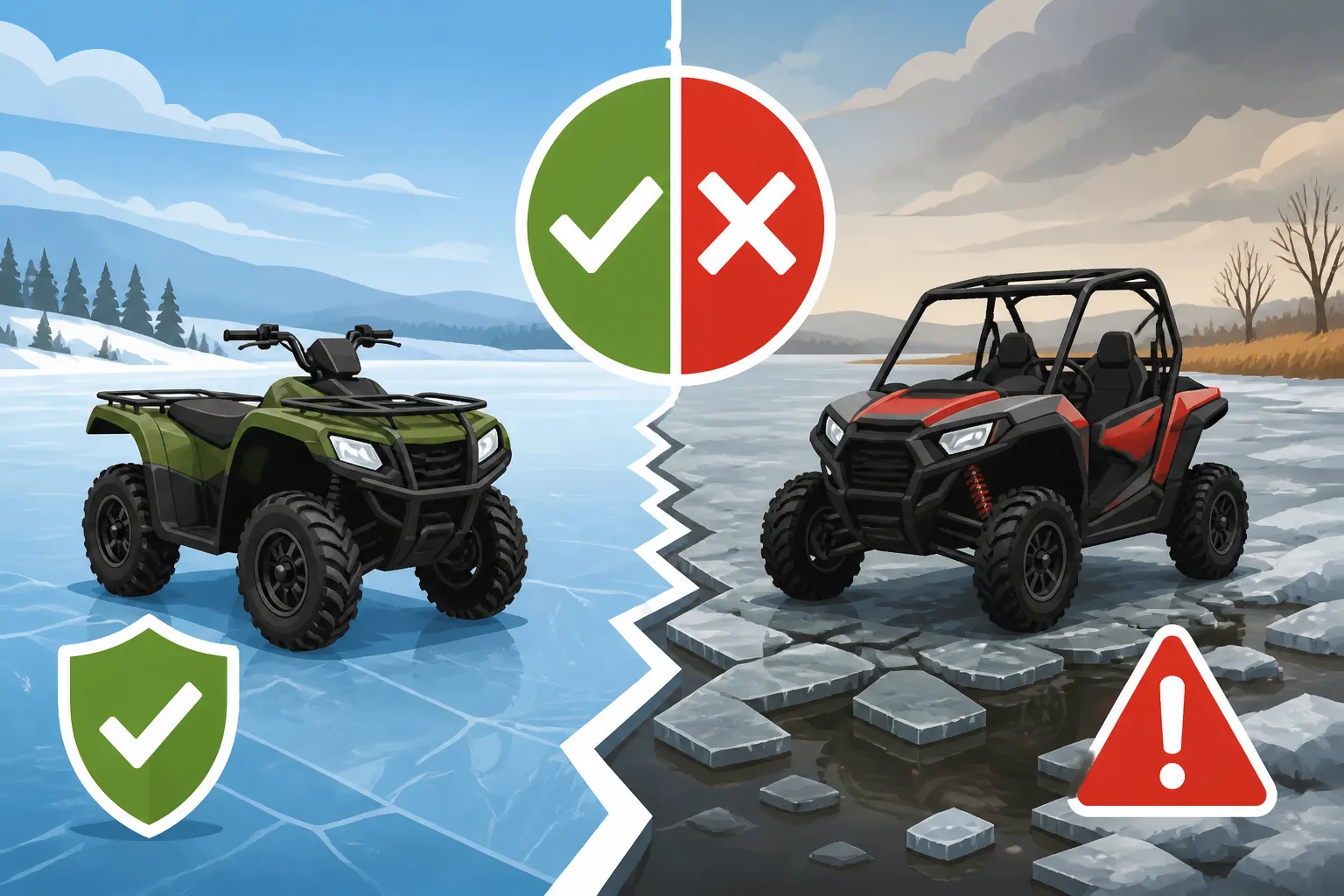
Legal access and safe ice are separate questions. A sign that permits riding does not certify the ice as safe, and a lake that looks frozen may have thin spots, open water or changing conditions. Ice thickness can vary across a single body of water, especially near moving water, inlets, outlets, vegetation, structures and areas affected by changing weather. A vehicle’s weight and movement also create risks that a person walking on shore may not encounter.
Do not use another rider’s tracks as proof that the ice can support your machine. Tracks show where someone traveled, not whether the ice remains sound, whether conditions have changed or whether the route is safe for your vehicle. If you cannot assess conditions reliably, do not ride onto the ice. Local land managers may know of hazards or closures, but a general statement that a lake is open is not a guarantee of ice safety.
Before setting out, make sure your plan does not depend on entering a closed area or crossing an unverified route. Keep a way to contact your group, agree on a turnaround point and avoid separating from other riders. If the route is blocked by a closure sign, turn around rather than looking for an informal way around it. Never use an ATV or UTV to push through barriers or to reach the ice from an unapproved shoreline.
For a public wildlife management area, review both the ice guidance and the rules for where vehicles may travel and park. Nebraska WMA Parking Rules can help clarify the parking question, but the local signs and current directions still control your decision at the site. If you plan to ride elsewhere in Nebraska, remember that rules at one lake do not establish access at another.
The simplest decision rule is: ride only when the land manager’s rules clearly allow it, no closure sign prohibits the route, and you have a separate reason to believe conditions are safe. If any part of that test is missing, do not take the machine onto the ice. A short call or a change of destination is better than treating silence on a sign as permission.
Disclaimer
This article is for general informational purposes only and does not constitute professional advice. Laws, prices and regulations vary by location and change over time. Consult a qualified professional for guidance on your specific situation.