Mobility Permits for Riders Who Cannot Walk Far
If walking from a parking area to a trail or hunting spot is difficult, a mobility permit may seem like a way to reach it by machine. In Nebraska, though, a permit’s value depends on the land, route, and vehicle involved. Here’s how to check what access it may allow—and why it does not automatically make an ATV or UTV legal on every public trail.
What a Nebraska mobility permit may allow
A mobility permit is an access accommodation to ask about when a mobility disability makes ordinary access difficult. Depending on the program and location, it may allow a person to use a motorized vehicle on a route or in an area where motorized access is otherwise restricted. It is not a general ATV registration, a statewide riding permit, or blanket permission to drive wherever walking is hard.
The key detail is the specific permission the agency grants. A permit may be limited to a particular property, route, vehicle type, or purpose. It may also come with conditions about where to travel and how to protect natural resources. Do not assume that a permit issued for one property applies at another.
The permit also may not cover the machine you have in mind. “Motorized vehicle” can mean different things under different land rules. An agency may distinguish between a mobility device designed to assist a person with a disability and a recreational ATV or UTV. A regular quad does not necessarily become an approved mobility device because its rider has difficulty walking.
Before planning around a machine, ask the land manager to confirm in plain terms whether the permit can be used with that exact vehicle. Give the make and type of machine, explain how you intend to use it, and ask which routes are allowed. If a staff member says a permit is available, ask whether it covers an ATV or UTV specifically—not just a wheelchair, scooter, or other mobility device.
| Question | Why it matters |
|---|---|
| Which property does the permit cover? | Permission for one site may not apply elsewhere. |
| What type of vehicle is allowed? | A mobility device and a recreational ATV may be treated differently. |
| Which roads or trails are open? | A permit may authorize travel only on specified routes. |
| What activity is allowed? | Access for one purpose may not authorize general trail riding. |
| Is the area open on your planned date? | Seasonal closures, conditions, or other restrictions may still apply. |
| What paperwork or identification must you carry? | The agency can tell you what to have available if questioned. |
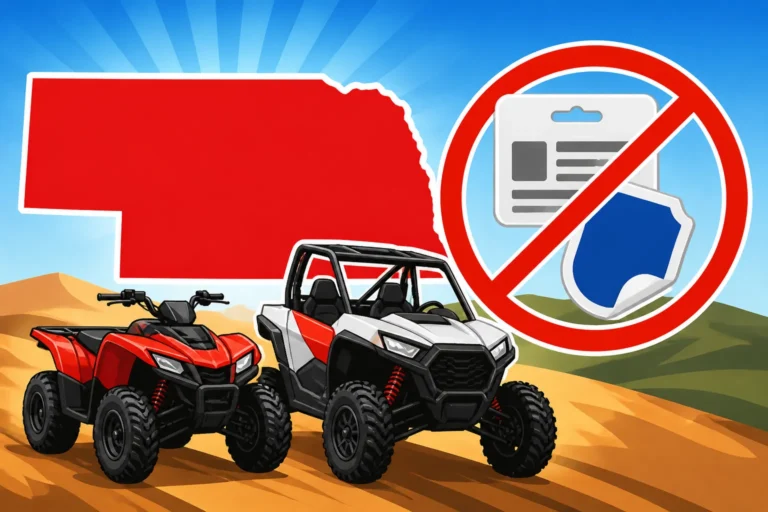
Nebraska has no general state OHV sticker that opens public land to ATV riding. A mobility permit is separate from the state’s vehicle title process and from any local or site-specific rules. For a broader explanation of the state permit picture, see Nebraska Has No OHV Permit or Sticker. For details about applying for an accommodation, Nebraska Mobility Permit Applications is a useful related topic.
Check the land rules and vehicle rules separately
A common source of confusion is treating “permission to access the land” as the same as “permission to operate this ATV here.” These are separate questions. A mobility permit may address an individual’s access needs, while the property’s rules still determine which vehicles may use which routes.
That distinction matters across Nebraska’s public lands. Wildlife management areas, state parks, recreation areas, national forest land, and private riding parks do not all follow the same rules. Even within one property, a road open to some vehicles may not be open to ATVs. Start with the managing agency’s rules for the exact site, then ask how a mobility permit affects those rules, if at all.
For wildlife management areas, check whether travel is limited to designated roadways and whether the route you need is open to your vehicle. The overview at Nebraska WMA Vehicle Rules and the specific explanation in Nebraska WMA Designated Roadways Only can help you identify the right questions. Do not take a machine onto a closed road or across undeveloped ground just because the distance on foot would be difficult.
State parks are another important distinction. Nebraska’s state parks are not general ATV riding areas. An accommodation should not be treated as automatic permission to ride park roads or trails. If you need access to a particular facility or destination, contact the park staff and explain both your mobility needs and the vehicle you propose to use. Ask whether another accessible route, parking location, or accommodation is available. See Nebraska State Parks Ban ATVs for the broader ATV restriction.
Private riding parks make their own access and operating rules within applicable law. A private park may have terrain, age, helmet, waiver, passenger, or machine-width requirements that differ from public land. A mobility permit from a public agency generally does not bind a private operator. Call the park before traveling and describe the access you need; Nebraska Private Park Waivers and Rules covers some of the separate rules riders may encounter there.
A permit also does not usually remove unrelated requirements. You may still need the machine’s title paperwork, landowner permission, a park or parking permit, insurance for road use, or compliance with posted closures. Check the property rules and the machine rules independently. Nebraska Permit Questions Riders Ask offers a useful starting point for separating permits that serve different purposes.
How to verify eligibility and apply
Do not rely on a general description or a friend’s experience as proof that a particular machine will be allowed. Contact the agency responsible for the land you want to visit. If you are unsure who manages it, begin with the property’s official contact information or ask a local office to direct you to the right land manager.
Use this process before you make travel plans:
- Name the property and destination. Give the agency the specific management area, trailhead, road, facility, or other place you need to reach. “A wildlife area near town” may not be enough to identify the rules.
- Explain the access problem. Describe the practical difficulty, such as being unable to walk a long distance from parking. You do not need to assume that this explanation guarantees approval; it helps staff understand what accommodation you are asking about.
- Identify the vehicle precisely. Say whether you want to use a wheelchair, mobility scooter, ATV, side-by-side, or another vehicle. If relevant, include dimensions and whether the machine is used only to reach a destination or for trail riding.
- Ask which routes are authorized. Request the name or description of any route, road, or area where use is permitted. Ask whether travel off the route is prohibited, even if it would shorten the distance.
- Ask about eligibility and documentation. The issuing agency can tell you what application, medical information, or other documentation it requires. Confirm whether approval must be obtained before visiting and whether the permit needs to be displayed or carried.
- Confirm limits and timing. Ask how long approval lasts, whether it applies to a companion or operator, and whether weather, seasonal closures, fire restrictions, or site conditions can suspend access.
- Get the instructions in writing when possible. Save the approval and the route information. Written details reduce the chance of misunderstanding at a gate or during a contact with staff.
Eligibility and paperwork should come from the agency administering the permit. Avoid sending medical records or personal details to an unofficial contact. If an application is unclear, ask the issuing office what each requested item is for and how to submit it securely.
It can help to prepare a short, specific question before calling: “I have a mobility disability and need to reach this location without walking the full distance. I plan to use this type of vehicle. Is there a permit or accessible route for this property, and exactly where may I travel?” That gives staff the information needed to distinguish between an accommodation request and a request to ride recreationally.
If you receive an answer that seems to conflict with a posted sign or online rule, ask the agency to clarify before you go. A general statement that a permit exists does not necessarily mean the route you want is included. Likewise, an accessible parking space or facility does not automatically authorize ATV travel beyond the designated access route.
Plan the trip around the approved access
Once you have an answer, make a plan that follows the permission exactly. Keep the permit information with you, along with any vehicle or ownership paperwork the land manager says to carry. Do not rely on a verbal summary from a different property or assume that another rider’s permit covers your situation.
Check conditions shortly before departure. A route may be unavailable because of maintenance, weather, fire danger, wildlife management, or a temporary closure. Confirm the trailhead, gate, parking arrangement, and any permitted route. If the route is closed, do not substitute a nearby road or trail unless the land manager confirms that it is allowed.
Think through the entire access chain, not just the ride itself. Consider how you will load and unload the machine, move from the vehicle to the approved route, manage gates, and reach the destination. Ask whether a companion may assist and whether the accommodation allows that person to travel with you. If you need help with a transfer or loading, arrange it before leaving rather than assuming the site has staff available.
A mobility permit should not be confused with a disability parking placard or a park entry permit. Those documents serve different purposes and may be issued by different authorities. A parking placard does not give an ATV access to a closed trail, and a park entry permit does not establish that a motorized machine is allowed on that property. The land manager can tell you what additional documents, if any, are needed.
If your aim is simply to reduce the distance between parking and a destination, ask about accessible parking, an established accessible route, or another accommodation before requesting ATV access. An agency may have an option better suited to the site and the activity. If a mobility permit is appropriate, the written approval and clear route boundaries will help you use it without unintentionally violating a separate vehicle restriction.
The practical rule is simple: get confirmation for the person, property, vehicle, purpose, and route—not just confirmation that “mobility permits” exist. That small amount of checking can prevent a frustrating trip and help keep access available for others.
Disclaimer
This article is for general informational purposes only and does not constitute professional advice. Laws, prices and regulations vary by location and change over time. Consult a qualified professional for guidance on your specific situation.