Camping at Whitetail in Nebraska
Camping at Whitetail can make a Nebraska ATV weekend easier: you wake near the Bessey riding area instead of starting each day with another long tow. The tricky part is knowing what the campground provides, which routes allow machines, and what to confirm before you leave home. This guide walks through planning, camping, riding, and the details worth checking before arrival.
What to know about camping at Whitetail
Where Whitetail fits into a Bessey riding trip
Whitetail is associated with the Bessey Recreation Complex near Halsey, in the Nebraska National Forest. For riders, its appeal is the chance to set up camp close to the Bessey area and spend more of the trip riding than shuttling a trailer back and forth. The landscape is a mix of forest, open spaces, and Sandhills terrain, so a weekend here can feel quite different from riding a paved or densely wooded trail system.
That proximity is useful, but it does not mean every road, campground lane, or nearby piece of land is open to ATVs and UTVs. Riding access depends on designated routes and current rules. Think of your campsite as a base, not as permission to ride anywhere you can reach from it. Before unloading, make sure you understand where machines may be driven and how to get from camp to an authorized riding area.
If you are comparing places to ride before choosing where to stay, start with [Bessey OHV Trails at Halsey in Nebraska]. It helps put the camping question in context: the trip is not only about finding a place to sleep, but also about matching your machine, group, and plans to the riding area. For an overview of the trail system, [Bessey's 36 Miles in Nebraska] is another useful planning topic.
What to verify before you book or head out
Campground details can change, and it is easy to plan around an amenity that turns out not to be available during your visit. Before leaving, verify whether Whitetail is open for your dates, how sites are assigned, what services are operating, and whether reservations or payment arrangements apply. Do not assume that water, electrical hookups, showers, a dump station, or a staffed check-in are available just because you have camped at another forest campground.
It is also worth asking whether the campground has rules about trailers, generators, fires, quiet hours, pets, or parking extra vehicles. These details can affect a group more than expected. For example, a family arriving with two trucks and a machine trailer may need to know whether the entire setup fits at one site, while a group using a generator should confirm where and when it may be run.
Use this checklist when confirming your plans:
| Planning detail | What to confirm |
|---|---|
| Dates and access | Whether the campground is open and accessible during your trip |
| Site setup | Space for your tent or RV, tow vehicle, trailer, and machines |
| Services | Which facilities are operating and whether potable water is available |
| Payment and reservations | How to secure a site and what payment methods are accepted |
| Camp rules | Fire, generator, pet, noise, and parking requirements |
| Riding access | Which designated routes are open to your machine type |
| Conditions | Road, trail, weather, and fire-related restrictions |
A call to the relevant forest office or campground contact can save a frustrating drive, especially if your group is arriving late or towing a large trailer. For broader campsite questions, [Camping at a Main Campground in Nebraska] offers a useful comparison point without assuming every campground has the same layout or services.
Getting your group and machines ready
Plan the drive, trailer, and unloading routine
The trip starts well before you reach the campground. Check your tow vehicle, trailer tires, lights, hitch, safety chains, and tie-downs while you are still at home, when a missing part is easier to replace. Then work out how many machines you are hauling and where each one will sit once you arrive. A crowded campsite can become awkward if the trailer blocks the space everyone needs to unload, cook, or walk around safely.
Consider the full sequence from arrival to first ride. One person may need to handle check-in or locate the site while another looks for a safe place to park the trailer. If you are traveling with children or several riders, agree on where everyone should stand during unloading and who is responsible for keys, helmets, and machine checks. This is a small bit of coordination that prevents people from walking behind a reversing trailer or starting machines while someone is still securing gear.
For longer drives, build in time for fuel, food, and a final strap check. Avoid treating arrival as an afterthought: tired drivers are more likely to miss a turn, rush the unloading process, or leave something important in the truck. [Planning a Long Trailer Haul to the Bessey Trails] can help you think through the road-trip side of the outing. If your route depends on forest roads or changing conditions, also check [Nebraska Trail Conditions Before You Tow] before setting out.
Pack for changing weather and a self-sufficient stay
Nebraska weather can make a campsite feel comfortable one hour and exposed the next. Pack layers, rain protection, sun protection, and enough drinking water for both the ride and time back at camp. Dust and wind can be tiring even when temperatures seem manageable. A spare set of riding glasses or goggles, a neck covering, and a way to keep food and water protected from dust can make a noticeable difference.
Bring a basic repair and recovery kit suited to your machines and the terrain. Depending on your group and route, that might include tire-repair supplies, a tool roll, a small first-aid kit, a flashlight, and a way to contact help. Do not load so much gear that the trailer becomes unsafe or the campsite impossible to use. Pack essentials where you can reach them without unloading everything else.
A practical packing list includes:
- Drinking water and refill containers.
- Clothing layers, rain gear, sun protection, and sturdy footwear.
- Helmet, eye protection, gloves, and any required safety equipment.
- Basic tools and machine-specific repair items.
- First-aid supplies and a flashlight or headlamp.
- Food storage that keeps supplies secure and clean.
- Paper directions and a charged phone with offline information where possible.
For an especially hot or dusty outing, [What to Pack for a Hot Dry Riding Day] adds useful detail. A mapping app such as onX Offroad can help you review routes before the trip, but do not rely on a phone alone: service may be inconsistent, batteries run down, and an app does not override posted closures or local rules.
Riding from camp responsibly
Confirm your route and machine access
Before riding away from camp, identify which routes are open and suitable for your machine. A route that appears on a map may have restrictions, seasonal closures, or conditions that make it unsuitable for a wide UTV or an inexperienced rider. Check posted signs at the trailhead and follow any directions from land managers. If a route is closed, do not treat the closure as a suggestion or assume that a nearby track is an acceptable substitute.
Route planning is especially important when the group includes different machines or experience levels. A narrow or rough section that feels manageable on one ATV may be uncomfortable for a wider side-by-side or a new rider. Agree on a turnaround point, regrouping locations, and what everyone should do if the group becomes separated. Apps such as onX Offroad can be useful for reviewing a route and keeping track of your general position, but cross-check mapped information with current signs and official guidance.
Give yourself a realistic riding plan rather than trying to cover every trail in a single day. Stops for water, machine checks, and slower riders add up, and a route that looks short on a screen can take longer over uneven ground. For trail mileage and area context, review [Bessey's 36 Miles of Forest Trail at Halsey] alongside current route information. Keep [Nebraska Trail Conditions Before You Tow] in mind if rain, wind, or other weather may have changed access since you made your plan.
Treat the campground as a shared space
Riding responsibly includes the time when you are not on the trail. Start machines only where permitted, avoid unnecessary revving, and keep speeds low around camp. Other visitors may be resting, putting children to bed, or trying to enjoy a quiet evening. A short, considerate routine—moving machines carefully, limiting late-night noise, and keeping gear within your site—makes the campground more pleasant for everyone.
Be mindful of dust, fires, and food storage as well. Wind can carry dust toward neighboring campsites, so avoid spinning tires or driving faster than needed on campground surfaces. Follow current fire instructions and do not assume a fire is allowed simply because you brought a fire ring or saw one at another site. Secure food and rubbish so they do not attract wildlife or become scattered when the wind picks up.
Trail manners matter just as much. Slow down near other users, yield appropriately on narrow routes, and do not widen trails by riding around muddy or blocked sections. Pack out what you bring in, including small items such as broken zip ties, food wrappers, and worn-out parts. If your group is unsure about a rule, stop and check rather than guessing. A good ride is one that leaves the campsite, trail, and surrounding forest in good shape for the next visitors.
Making a comfortable camping routine
Set up camp for easy mornings and safe evenings
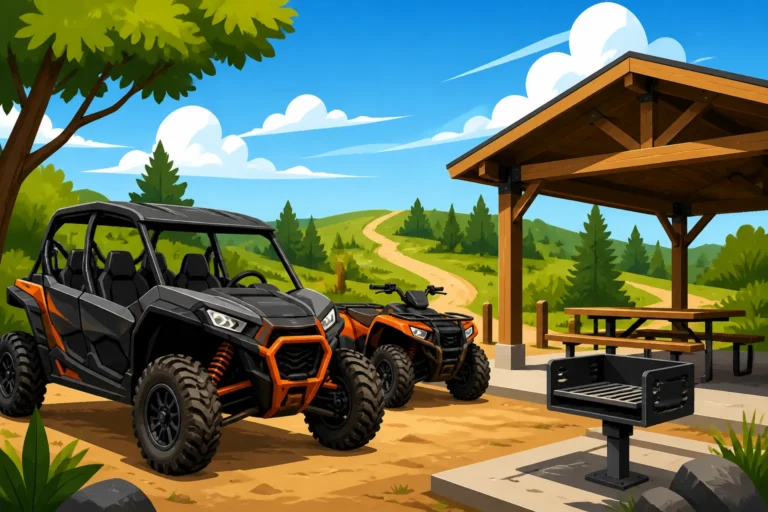
A thoughtful campsite layout saves time throughout the weekend. Keep the cooking area separate from machine parking and maintenance, and avoid placing tents where vehicles will need to maneuver. Leave a clear walking path between sleeping areas, the truck, and any shared gathering space. If you arrive after dark, use lights carefully so people can see without shining bright beams into neighboring tents or RVs.
At the end of each ride, make a short routine of checking machines and organizing gear. Look for loose straps, obvious damage, low tires, or anything that should be dealt with before the next outing. Put helmets, gloves, and keys in a predictable place instead of leaving them scattered across tables and tailgates. That habit is especially helpful when several people share equipment or when the next morning begins early.
Keep food, water, and waste organized from the start. A cooler that stays closed and a dedicated rubbish container are easier to manage than loose packaging left on picnic tables. Bring extra bags for wet clothing, muddy gear, or trash that needs to travel home with you. If campground services are limited, plan to carry out waste rather than assuming there will be a convenient place to dispose of everything.
Prepare for limited connectivity and changing conditions
Do not assume you will have reliable cell service at every campsite or along every route. Save directions, campground details, and emergency contacts before leaving a town with dependable coverage. Tell someone outside your riding group where you are going and when you expect to return. Within the group, agree on a simple plan for regrouping if riders lose sight of one another.
Offline map access can be helpful, and onX Offroad may support route review and location awareness where the app’s features and downloaded information are available. Still, a phone is not a complete safety plan. Keep it charged, consider carrying a backup battery, and bring a paper map or written route notes when practical. [Planning for No Cell Service on a Forest Ride] explains why a backup matters, especially when a trip includes remote sections.
Conditions can change after you arrive. Heavy rain may affect roads and trails, wind may make open riding uncomfortable, and dry conditions can bring additional fire restrictions. Check for current notices before the ride and again if the weather changes. Leave room in the itinerary for a shorter loop, a rest day, or a change of plans. Flexibility is not wasted planning; it is how you keep a weekend enjoyable when the original plan no longer makes sense.
Common questions before a Whitetail camping weekend
Does camping at Whitetail automatically allow ATV or UTV riding?
No. Staying at or near a riding area does not automatically authorize riding on every nearby road or trail. Use only routes open to your machine type, follow signs and posted directions, and confirm access rules before departing camp. Keep in mind that a campground may have separate rules for driving within the site itself.
Nebraska does not have a general statewide OHV permit or sticker that serves as blanket permission to ride anywhere. That does not remove the need to follow land-manager requirements, campground rules, or any applicable local restrictions. For more on that distinction, see [Nebraska Has No OHV Permit or Sticker]. A permit or pass for another kind of recreation also should not be assumed to authorize ATV use on a closed or restricted route.
What should I do if a service or route is unavailable?
Have a backup plan before you leave home. If a facility you expected is closed, your group may need to adjust food, water, waste, or charging arrangements. If a route is closed or unsuitable, choose an authorized alternative rather than riding around a closure. Checking official notices and asking a local contact before traveling can help you make those changes while you still have options.
It also helps to set expectations with everyone in the group. Explain that riding plans may change with weather, trail conditions, or access restrictions. A flexible group is less likely to turn a closure into an argument or an unsafe decision. If you are traveling with first-time riders, tell them that the route plan is a guide, not a promise; the leader may decide to turn around when conditions warrant it.
Is Whitetail a good choice for every kind of camping trip?
It can suit riders who want a base near the Bessey area, but the right fit depends on your group’s needs and expectations. Someone looking for a full-service campground may need to confirm facilities carefully before committing. A group bringing several vehicles should make sure the site arrangement can accommodate the whole setup, and families should check the rules and amenities that matter to them.
The best approach is to confirm the basics directly, arrive with a backup for essential supplies, and plan riding around designated access rather than assumptions. With that preparation, Whitetail can be a practical starting point for a Nebraska riding weekend. Before departure, review campground availability, road and trail conditions, current restrictions, and your group’s equipment one last time.
Disclaimer
This article is for general informational purposes only and does not constitute professional advice. Laws, prices and regulations vary by location and change over time. Consult a qualified professional for guidance on your specific situation.