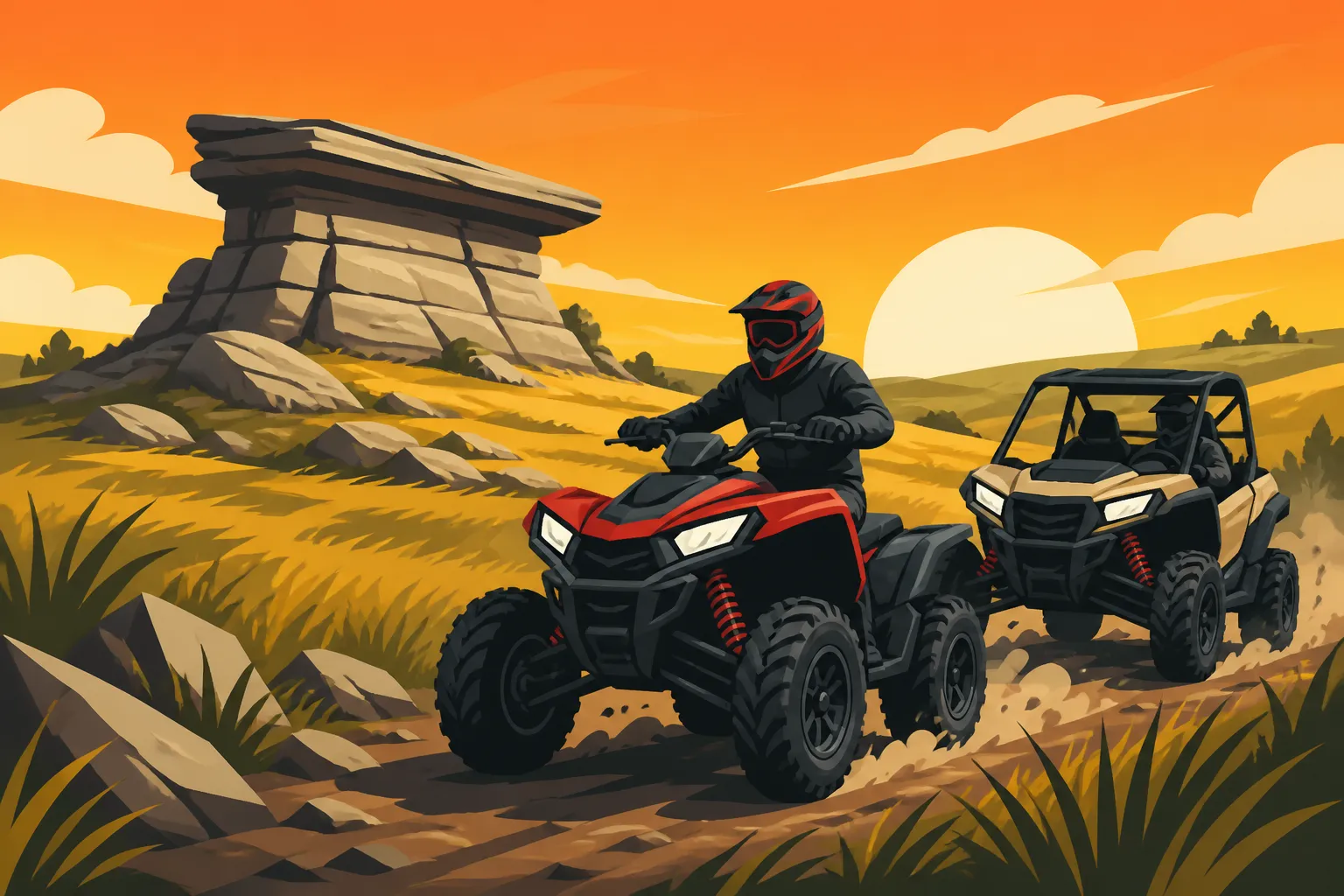
Flat Rock’s 15 Acres in Nebraska
A 15-acre riding area can be a fun place to spend a few hours, but it is not the same kind of trip as a large trail network. This guide explains what to expect at Flat Rock Riders OHV Park, how to plan for its compact footprint and separate riding features, and what to confirm before you load up your ATV, dirt bike or side-by-side.
What to expect at Flat Rock Riders OHV Park
A compact riding area calls for realistic expectations
Flat Rock Riders OHV Park is described as a 15-acre riding area with two tracks. That small scale is important when you are deciding whether it fits your group. It may work well for a shorter outing, practice, or a change of pace from riding open country, but it is not a place to expect dozens of miles of connected trails.
A compact park can still offer a satisfying ride. Riders can focus on handling, cornering, and reading the terrain without spending the day navigating a large network. For families or newer riders, a smaller setting may also feel less intimidating than an expansive trail system, provided the riding areas are appropriate for their experience and the park’s rules.
The tradeoff is that a small footprint may feel repetitive during a long visit, especially for experienced riders or a group looking for a full-day adventure. If you are planning around a long haul, compare the ride time you expect with the park’s size and layout. The overview in [Flat Rock's 15 Acres in Nebraska] can help set that scale before you plan the drive.
Understand the two-track setup before you arrive
The park is associated with two tracks, including separate motocross and quad riding areas. That distinction can shape your day. A motocross track is generally intended for a different style of riding than a casual quad trail, and the two areas may have different surfaces, turns, and riding demands.
Do not assume that every machine can ride every section. A trail or track that works for a dirt bike may not be suitable for a wide side-by-side, while a quad area may have its own restrictions. The park’s current rules and posted signs should guide where each machine can go. The title [Separate Motocross and Quad Trails] points to the key planning question: which part of the site fits your machine and riding style?
It is also worth checking whether the features are open and usable when you plan to visit. Weather, maintenance, events, or local operating decisions can affect access. Rather than treating an online map or old trip report as a guarantee, contact the park or check its official visitor information before leaving home.
| Planning question | Why it matters | What to confirm |
|---|---|---|
| Is the park open on your planned day? | Access and operating arrangements can change | Current opening information and any closures |
| Which area suits your machine? | Tracks may not be open to every vehicle type | ATV, dirt bike, and side-by-side rules |
| Is the riding appropriate for your group? | A track’s character can exceed a beginner’s comfort level | Difficulty, surface, and supervision expectations |
| What should you bring? | A small facility may have limited services | Water, fuel, tools, protective gear, and payment options |
| Are there event or noise restrictions? | Organized use can affect a casual visit | Calendar, visitor rules, and quiet-hour policies |
Choose the right machine and riding plan
ATVs and dirt bikes need different expectations
A quad and a dirt bike do not handle the same way, even when they are using nearby riding areas. A quad has a wider footprint and turns differently; a dirt bike depends on balance and body position. A layout that feels straightforward on one machine can feel awkward or demanding on another.
Before unloading, make sure you understand where your vehicle is permitted and whether any areas are reserved for particular types of riding. The park’s posted instructions matter more than assumptions based on what another rider has done. If you are traveling with mixed machines, agree on boundaries and regrouping points before anyone heads out.
If you have young or inexperienced riders in the group, keep the plan simple. Start with the most suitable area, let each rider warm up at a comfortable pace, and avoid treating a track like a racecourse. For more ideas on selecting an appropriate riding environment, see [Nebraska Kids' Riding Areas] and [Nebraska Trail Difficulty Ratings].
Side-by-sides require an extra fit check
A side-by-side can be too wide for some trail systems, gates, or turns. Even where a park permits UTVs, that does not automatically mean every track is a good fit for every UTV. Machine width, turning radius, ground clearance, and the layout of the riding area all matter.
Before towing a side-by-side to a compact park, ask specifically whether that vehicle class is allowed and which areas it may use. If there are size limits, clarify how the park measures width, particularly if your machine has aftermarket wheels, tires, mirrors, or other additions. A quick call is much easier than discovering at the entrance that your machine cannot use the area you came to ride.
When researching access, look for an answer that applies to the exact kind of machine you own, not just a general reference to “off-highway vehicles.” [Nebraska Trails That Allow Side-by-Sides] offers useful context for thinking about UTV access around the state, while [Nebraska Rules for an Out-of-State Machine] may be relevant if you are visiting from outside Nebraska. Still, the park’s own current policy is the final word for its property.
Plan the visit before you tow
Confirm access, rules, and practical details
A smooth trip often depends on small details that are easy to overlook: the entrance location, opening arrangements, whether advance planning is needed, and what facilities are available. These are especially important for a compact riding area, where you may not have nearby alternatives if you arrive and find the site closed or your machine is not permitted.
Check the park’s own information shortly before you leave. Confirm the address or directions, access conditions, machine restrictions, and any special rules for the day. If a club, event organizer, or local group manages the riding area, look for visitor guidance from that organization rather than relying only on a third-party map listing.
It can also help to ask what support is available on site. Do not assume there is fuel, water, repair help, restrooms, or a place to buy supplies. Pack what your group needs for the ride and the drive home. [Nebraska Trail Conditions Before You Tow] is a helpful reminder to check trip conditions before committing to a trailer haul.
Use maps as planning aids, not permission
A digital map can help you plan the route to a riding area and understand the surrounding roads, but it cannot establish that a route or parcel is open for riding. Property lines, local access arrangements, closures, and posted restrictions may not be obvious from a map view. Treat maps as one planning tool, then confirm access with the park itself.
Some riders use onX Offroad to review routes and organize trip planning. It can be useful to compare the route you intend to drive with the park’s directions, especially when coordinating multiple vehicles. But a mapped line should never be treated as permission to ride on nearby land or as proof that a gate or track is open.
For a small site, the more useful planning questions may be practical rather than navigational: where to unload, whether trailers can be staged without blocking access, and how riders should enter or leave the designated areas. Use onX Offroad alongside official park information, signs, and direct confirmation—not instead of them.
Ride considerately and protect the site
Keep your riding within the designated areas
A small riding property has little room to absorb mistakes. Cutting across vegetation, widening a turn, or riding beyond a marked boundary can damage the site and affect access for everyone. Stay on designated tracks, obey closures, and give other riders space, particularly where the riding areas connect or visibility is limited.
Follow the direction of travel and any instructions posted by the park. If no direction is apparent, do not assume that a track is one-way or open in both directions. Ask before riding, and slow down near entrances, staging areas, and places where people are unloading machines.
Good trail manners matter even when the park is not crowded. Avoid roosting soil toward other riders or parked vehicles, leave gates as instructed, and take all rubbish with you. [Nebraska Trail Etiquette Locals Expect] covers habits that help keep riding areas welcoming and usable.
Ride within your ability and look after your group
A motocross-style section can demand more speed, balance, and control than a casual trail. If you are unsure whether a feature is appropriate, watch a pass from a safe location before attempting it. Give yourself permission to skip jumps, steep turns, or rough sections. A good ride does not require proving anything to the group.
Set expectations before starting, especially when riders have different experience levels. Agree on a meeting point, keep track of younger riders, and make sure everyone knows how to stop safely if someone needs help. Riders should use appropriate protective equipment and inspect their machines before riding. A loose control, low tire, or faulty brake can turn a short outing into a serious problem.
The description [Riding at Your Own Risk] is a useful prompt to think through personal responsibility, but it should not be read as a substitute for the park’s actual safety rules. Follow posted instructions, use common sense, and do not ride beyond your comfort level or the capability of your machine.
Decide whether Flat Rock fits your trip
Match the park to the kind of day you want
Flat Rock’s compact size may be a good match if you want a short, focused outing rather than a long-distance trail day. It may suit riders who want to spend time on a track, practice basic handling, or introduce a new rider to off-highway riding in a defined setting. The best fit depends on your group’s skill, the machine you bring, and the features open during your visit.
It may be less satisfying for a group expecting extensive mileage, a full day of varied terrain, or room for several kinds of machines to roam freely. In that case, compare it with larger Nebraska riding options before making a long drive. Keep travel time, fuel, trailer logistics, and the likelihood of repeating sections in mind—not just the appeal of having a designated place to ride.
A useful way to make the call is to describe your ideal day plainly. If you want a few hours of focused riding and your machine is allowed, a 15-acre park may be enough. If you want a broad trail network and changing scenery, look at other options such as [Nebraska ATV Trails: Where to Ride] and [Nebraska Trail Map Downloads].
Make a simple pre-trip checklist
Before loading, verify that the park is open, your machine is allowed, and the riding area you intend to use is accessible. Ask whether there are requirements for visitors, any event-related changes, and any restrictions on trailers or staging. Save the park’s directions and contact information so you are not relying on a single map app at the last minute.
Check your machine at home: tires, brakes, controls, fuel, and any basic tools you may need. Pack water, food, protective gear, and a way to secure equipment. For a group, decide who is carrying a first-aid kit and how everyone will communicate if riders get separated.
Finally, leave room in the plan for the ride to be shorter or different than expected. If a section is closed or the park is busier than you anticipated, do not improvise by riding beyond marked areas. A little flexibility keeps the day safer and helps protect the property. For a broader overview of the site’s footprint, [15 Acres With Two Tracks] is a useful reference point as you decide what kind of outing to plan.
Disclaimer
This article is for general informational purposes only and does not constitute professional advice. Laws, prices and regulations vary by location and change over time. Consult a qualified professional for guidance on your specific situation.