Nebraska Fire Restrictions in Dry Months
Nebraska’s dry months can bring changing fire restrictions that affect where you stop, camp, and use equipment while riding an ATV or UTV. The difficult part is that conditions and rules may differ between public land, private parks, and private property. Check the active order for your destination before leaving, then plan your ride so a small spark or hot machine does not start a grass or forest fire.
Why Nebraska fire restrictions change
Fire restrictions respond to conditions, not just the calendar. Dry grass, low moisture, wind, and recent weather can increase the chance that a campfire, cigarette, or hot equipment will start a fire. A restriction may apply to one area while another nearby remains open, and an order can change as conditions improve or worsen.
That makes a general statement like “fires are allowed in Nebraska” or “fires are banned in the summer” unreliable. The rules depend on who manages the land and what restrictions are active there. A county, federal land manager, state agency, private riding park, or individual landowner may have different requirements.
Restrictions can also cover more than campfires. Depending on the order, they may limit or prohibit activities such as:
- Building wood or charcoal fires outside designated places
- Using certain stoves or other open-flame devices
- Smoking outside enclosed vehicles or designated areas
- Operating equipment that can throw sparks
- Welding or grinding
- Parking hot equipment in dry grass
- Fireworks or other ignition sources
These are examples of possible restrictions, not a list of rules that applies everywhere. Read the actual order for your destination. It should explain the affected area, what activities are limited, and whether any exceptions apply.
For riders, it is useful to separate three questions: Is the riding area open? Is a fire allowed at the campsite or trailhead? Are there equipment-related restrictions that affect the ride? A trail can remain open even when campfires are prohibited, but a closure or additional equipment rule may also be in effect. Confirm each part rather than assuming one answer covers all of them.
If you are heading to a national forest trail, start with the local land manager’s notices and the current Nebraska National Forest Riding information. If you are considering an overnight trip, check both the riding rules and the campground’s fire instructions through Nebraska OHV Camping With Trail Access. A parking or recreation permit does not replace a fire restriction or authorize an activity that an active order prohibits.
What restrictions mean for an ATV or UTV trip
Fire rules can affect a ride even if you do not plan to have a campfire. A machine has hot parts, and equipment used around a campsite or work area can create ignition risks. The practical response is to remove avoidable hazards and follow the instructions for the specific site.
At the trailhead and on the trail
Park on gravel, pavement, or another designated surface when possible. Avoid leaving a hot exhaust or engine area over dry grass, leaves, or brush. Do not idle in tall vegetation, and do not pull over where a hot machine could contact combustible material. If a site has signs or designated parking areas, use them.
Check the machine before the trip. A loose or damaged exhaust component, dragging metal, or debris caught near a hot part can create a problem. Clear dry grass and other material from the machine after riding, particularly around hot components. If the land manager has equipment rules, follow those rules even if the machine seems well maintained.
Use established trails and roads. Cutting across dry vegetation can damage the land and may put the machine in contact with material that can ignite. Do not ride around a gate or closure to reach a trailhead or campsite. A closure notice may address fire danger, public safety, or both.
At camp
A campsite may have a designated fire ring, but that does not automatically mean a fire is permitted during a restriction. The current order and posted instructions take priority. If fires are prohibited, do not use a fire ring, make a small fire elsewhere, or assume a cooking fire is exempt. Check the wording for any specific allowance before using a stove or other device.
If fires are allowed, follow the site’s instructions and keep the fire attended. Have water and a way to put the fire out nearby, and make sure it is fully extinguished before leaving. Wind can carry embers beyond a ring, so a fire that looks small can still pose a risk in dry conditions.
A small extinguisher can be useful for vehicle or equipment emergencies, but it does not make a prohibited fire legal or replace required fire precautions. If you are comparing compact extinguishers, Amazon is one place to review options; check that the model is appropriate for your intended use and can be secured safely in your vehicle.
On private land and at private riding parks
Do not assume that a private riding park follows the same fire rules as nearby public land. The park operator may impose its own restrictions, and a public agency order may also apply to the area. Ask the operator what is allowed at the trails, campsites, and staging areas before you arrive. The broader differences are covered in Nebraska Public Land Rules Compared to Private.
On private ranch or farm ground, get the landowner’s instructions directly. Permission to ride is not automatically permission to build a fire, camp, or use equipment in a particular area. If the owner asks you to avoid a location or activity during dry conditions, follow that direction.
| Trip situation | What to check | Safer approach |
|---|---|---|
| Forest or other public-land ride | Current land-manager alerts, closures, and fire order | Confirm the specific trailhead and area before towing out |
| Overnight camping | Campground rules and active fire restrictions | Do not assume a fire ring means fires are currently allowed |
| Private riding park | Operator rules and any applicable public orders | Contact the park before departure |
| Ranch or farm ride | Landowner permission and site-specific directions | Ask before camping, cooking, or using equipment near dry vegetation |
| Ride with no planned fire | Equipment restrictions and parking instructions | Keep hot components away from grass and brush |
How to check restrictions before you leave
Use information that applies to the exact place and date of your ride. An old social media post, a general trail description, or a sign you saw on a previous visit may not reflect current conditions. Fire notices can change quickly, so check close to departure and again if the trip is several days long.
- Identify who manages the destination. A national forest, wildlife management area, private park, and private ranch may have different contacts and rules. Confirm the land manager rather than relying on a nearby town’s general information.
- Look for current fire notices and closures. Check the manager’s official alerts, posted notices, and recorded updates if available. Read the boundary and activity details, not just the headline.
- Confirm campsite rules separately. If you are staying overnight, ask whether campfires, charcoal, or portable stoves are allowed under current conditions.
- Ask about equipment-related limits. If the notice is unclear about a machine, tool, or cooking device you plan to use, contact the managing office or park operator before the trip.
- Recheck before unloading. Look for signs at the entrance and trailhead. A notice on site may provide an update or identify a closure that was not apparent during trip planning.
For national forest questions, the Questions Worth Asking a Ranger District Office article can help you prepare a focused call. For a broader pre-trip check, use Nebraska Trail Conditions Before You Tow. Ask directly whether restrictions apply to your intended trail, camping area, and equipment. If the answer is unclear, choose the more cautious option until you can confirm.
Do not treat an out-of-state permit, a Nebraska park permit, or an ATV title as proof that fires are permitted. These documents address different issues. A riding permit may give access to an area under its terms, but it does not override a closure or a separate fire order.
A dry-month riding checklist
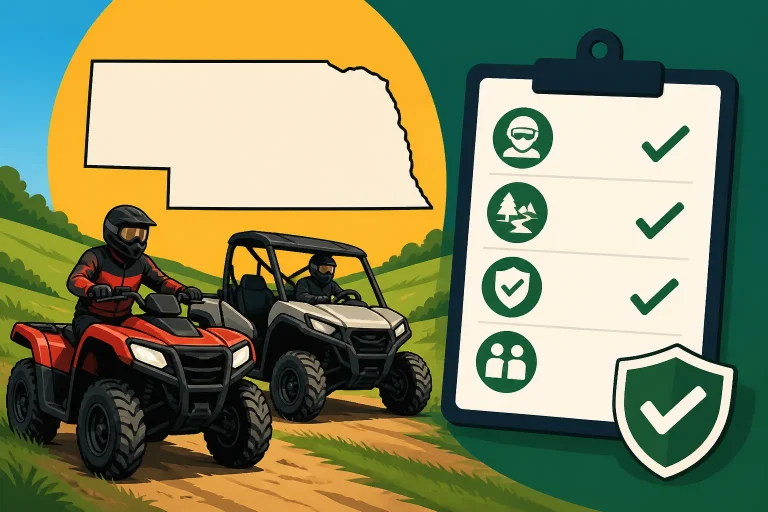
A short checklist helps avoid a wasted trip and reduces the chance of causing a fire. Use it for day rides as well as camping trips.
- Check the current restriction for the exact destination and land manager.
- Confirm the trail and campground are open.
- Read any posted instructions at the entrance and staging area.
- Ask whether cooking devices are covered by the restriction.
- Park on designated hard surfaces and away from dry vegetation.
- Inspect the machine for debris, loose parts, or damage near hot components.
- Carry water and suitable emergency equipment, but do not rely on them as permission to start a fire.
- Keep cigarettes, matches, and other ignition sources controlled and dispose of them properly.
- Avoid sparks from tools or repair work unless the activity is allowed and precautions are in place.
- Have a plan to leave if conditions change or officials close the area.
If you see smoke or a fire, do not ride toward it to investigate. Move away from the area, alert the appropriate emergency service or land manager, and give a clear location if you can do so safely. Do not attempt to fight a fire that is spreading or beyond your ability to handle. Wind and dry fuel can make conditions dangerous very quickly.
Restrictions are not a reason to abandon every ride. They are a reason to plan around current conditions, avoid unnecessary ignition risks, and choose another activity if the rules close your destination. If a notice is unclear, verify it before traveling rather than guessing at the trailhead. That simple step helps protect the riding area and keeps a day out from becoming an emergency.
Disclaimer
This article is for general informational purposes only and does not constitute professional advice. Laws, prices and regulations vary by location and change over time. Consult a qualified professional for guidance on your specific situation.