Nebraska Riding Areas With RV Sites
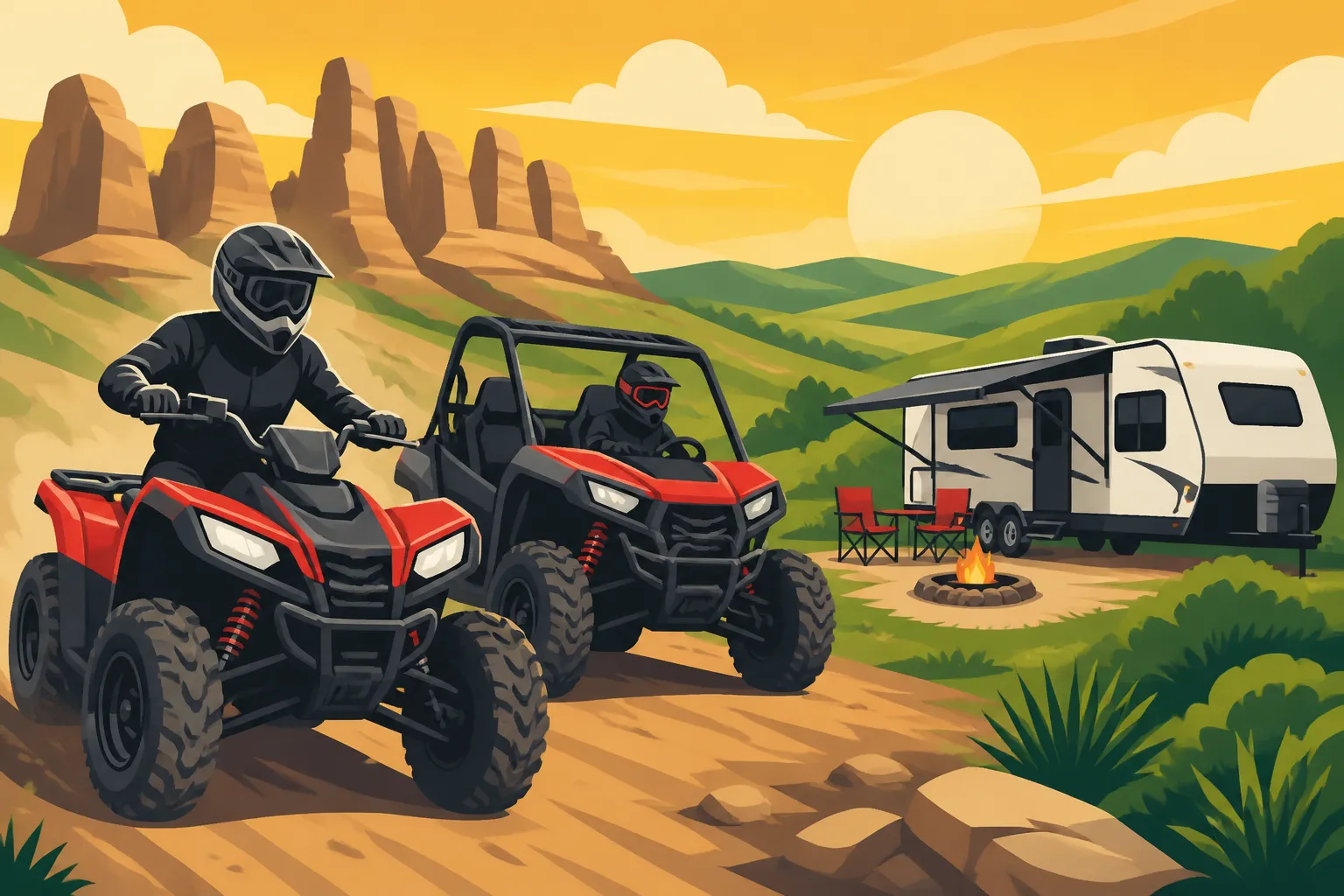
Finding an RV site near an ATV or UTV trail can take more planning than the ride itself. A campground may be close to a riding area without offering direct trail access, and a site that fits your RV may not have room for a trailer. This guide covers Nebraska riding-area options to investigate, what to confirm before towing, and how to plan a less stressful trip.
How to choose a Nebraska riding area with RV camping
Separate camping from riding access
“RV camping near trails” can mean several different things: a campground inside a riding complex, a campground nearby that requires you to trailer to the trailhead, or a place to camp that is convenient for riding but has no legal ATV access of its own. That distinction matters. A nearby campsite does not automatically mean you can ride from your site to the trail, campground roads, or surrounding public land.
Before reserving, ask the campground and riding-area manager separately whether machines may be unloaded at the campsite, where they can be parked, and how riders are expected to get from camp to the trail. If you need to use a public road between the two, check whether that route is legal for your machine and situation. Nebraska’s rules for public-road riding are separate from campground rules; [Can You Drive an ATV on the Road in Nebraska?](Can You Drive an ATV on the Road in Nebraska?) is a useful place to start.
For a trip with children, several machines, or an RV and trailer, the difference between “nearby” and “connected” is especially important. A site can look close on a map yet require a long haul on roads where an ATV cannot legally travel. Plan on transporting machines unless the riding area or campground confirms a lawful connection.
Compare the kind of RV stay you need
Not every RV trip requires the same facilities. A self-contained camper may be comfortable with a basic campsite, while a larger rig might need a level site, dependable access, and enough room to maneuver with a machine trailer attached. Hookups, dump access, water, restrooms, and reservation requirements can vary by campground and season.
Make a short list of essentials before you call. For example, one family may need a roomy pull-through site and restrooms close by; a group of experienced riders may be more concerned with early trail access and secure trailer parking. Ask about the exact site dimensions rather than relying on a general statement that “RVs are welcome.”
Use a map to estimate driving distance from the campground to the trailhead, then confirm the route with the operator. onX Offroad can help with advance route planning and map review, but it should not replace posted signs, local instructions, or direct confirmation that a road or trail is open to your vehicle. For more ideas, see [Nebraska OHV Camping With Trail Access](Nebraska OHV Camping With Trail Access) and [Nebraska Trails With Camping](Nebraska Trails With Camping).
Nebraska riding areas to consider for an RV trip
Bessey OHV trails at Halsey
Bessey Recreation Complex, near Halsey in the Nebraska National Forest, is one of the state’s established places to research for an OHV outing. Its riding opportunities make it a natural candidate for riders looking to pair a forest trip with an RV stay. Start with [Bessey OHV Trails at Halsey in Nebraska](Bessey OHV Trails at Halsey in Nebraska) and confirm which trail areas are open to your machine type before you tow.
The key question is whether the camping arrangement you want is at the same recreation complex as the riding access, and whether it accommodates your RV and trailer. Ask about site length, vehicle and trailer parking, access to water or restrooms, and any camping rules that could affect unloading or storing machines. Do not assume that a campsite has power or other hookups just because it is part of a developed recreation area.
Bessey is also a place where a little map work can save a frustrating arrival. Check the route from your chosen campsite to the appropriate staging area, and make sure your trailer can handle the access road. If the group is large, ask whether there is room to unload without blocking other visitors. The related guides [Bessey's 36 Miles of Forest Trail at Halsey](Bessey's 36 Miles of Forest Trail at Halsey) and [Nebraska National Forest Riding](Nebraska National Forest Riding) can help you think through the riding portion of the trip.
Cedar Run ATV Trail near Harlan County Lake
Cedar Run is another area to investigate if you want to combine an ATV ride with camping near Harlan County Lake. The trail is associated with the lake area, but don’t treat every nearby campground as a trail campground. Confirm whether the campsite you book is convenient for your intended trailhead, and ask whether machines can be transported or moved between camp and staging.
Start with [Cedar Run ATV Trail in Nebraska](Cedar Run ATV Trail in Nebraska), then check campground options and their specific RV arrangements. Ask about site size, trailer parking, seasonal access, and whether reservations are needed. If the campsite is managed separately from the trail, get directions and rules from both operators. You can also review [Camping at Whitetail in Nebraska](Camping at Whitetail in Nebraska) and [Camping at a Main Campground in Nebraska](Camping at a Main Campground in Nebraska) as you compare possibilities around the area.
For a group that wants to ride more than one day, the logistics are worth checking before choosing a site. Ask how far the trailhead is from camp by road, whether there is a designated staging area, and whether a truck and trailer can stay at the trailhead while you ride. onX Offroad may help you inspect the general layout before leaving home, but rely on local directions and signs for access decisions.
Flat Rock Riders OHV Park
Flat Rock Riders OHV Park in the Sutherland area may suit riders looking for a focused OHV destination. Its smaller footprint means it is particularly useful to ask about parking and group logistics in advance rather than assuming a large campground-style setup. Begin with [Flat Rock Riders OHV Park in Nebraska](Flat Rock Riders OHV Park in Nebraska), then contact the park about current access, machine rules, and nearby RV options.
Ask whether the park itself has camping or whether you will need to book somewhere else. If you’ll be staying off-site, confirm the drive time with the park, whether the route is trailer-friendly, and where you can leave the RV while riding. A small riding area can be a good fit for a short weekend, but the experience depends on whether the nearby camping and parking arrangements match your group.
If there is no convenient RV site at the riding area, consider whether a nearby campground still makes sense for your trip. Look for an easy towing route, reliable check-in arrangements, and a place to park both the camper and machine trailer. The broader listing [Nebraska Riding Areas With RV Sites](Nebraska Riding Areas With RV Sites) can help you compare this kind of setup with other camping-and-riding options.
| Area to research | What to confirm before booking | Best planning question |
|---|---|---|
| Bessey near Halsey | RV and trailer space, campground facilities, trail access | Is the campsite connected to the riding area, or will I need to tow to the trailhead? |
| Cedar Run near Harlan County Lake | Nearby campground location, machine transport, staging access | Which campground is most practical for the trail I plan to ride? |
| Flat Rock near Sutherland | Whether camping is available at the park, nearby RV choices, parking | Where can my RV and trailer stay while I ride? |
Questions to ask before reserving an RV site
Check site fit and campground rules
A reservation description may not tell you whether a long RV and a separate machine trailer will fit comfortably. Give the campground the full picture: RV length, trailer length, number of vehicles, and whether you need room to maneuver. Ask whether the site is back-in or pull-through, whether the access road has tight turns, and whether the trailer can remain at the site during your stay.
Then ask about machine-specific rules. Some campgrounds may restrict unloading, riding on internal roads, washing machines, or storing fuel. These details can make a big difference after a dusty day on the trail. A designated wash area is helpful, but if none is available, ask what cleanup practices are allowed so you don’t create a problem for the campground or neighboring campers.
Check the cancellation and arrival details, too. If trail access or weather changes your plan, you’ll want to know the campground’s procedures before you are already on the road. Find out when check-in begins, whether late arrival is possible, and who to contact if you arrive with a trailer and cannot maneuver into the assigned site.
Verify the trailhead, machine rules, and current access
Before departure, confirm that the trail or riding area is open and that your ATV or UTV is allowed. Machine size, trail designation, noise requirements, and seasonal closures can affect whether a particular route suits your vehicle. Ask whether a side-by-side can use the same trail system as an ATV, and whether the park has any additional rules that are not obvious from a general campground listing.
Also find out where you are allowed to unload and park. The closest lot may have limited trailer space or different rules from the riding area itself. [Nebraska Trailheads With Trailer Parking](Nebraska Trailheads With Trailer Parking) offers another planning angle, while [Nebraska Trail Conditions Before You Tow](Nebraska Trail Conditions Before You Tow) is a reminder to check access before loading up.
Keep public-land and campground rules distinct. Nebraska state parks are not ATV riding areas; [Nebraska State Parks Ban ATVs](Nebraska State Parks Ban ATVs) explains why a state park campsite should not be mistaken for machine access. For any location, follow current signs and directions from the managing agency. onX Offroad can be useful as a planning aid, but mapped lines alone do not establish that a route is open or legal.
Plan for the ride back to camp
The end of a riding day is when small logistical oversights become irritating. Have a plan for muddy or dusty machines, fuel storage, helmets and riding gear, and where everyone will park after returning. If you’ll be hauling machines back to camp, secure tie-downs and straps before the trip and make sure the trailer is easy to access at the site.
If your party includes new riders, agree on a meeting point and a simple communication plan before setting out. Cell reception can vary, particularly in forested or rural areas, so don’t assume everyone can call for help. Carry water, basic repair supplies, and a paper map or downloaded map information for the ride. A route-planning app such as onX Offroad may help organize the day, but tell the group not to ride beyond posted boundaries or rely on a phone as the only navigation tool.
Finally, leave time to load safely. Packing up in a hurry after a long ride makes it easier to miss a loose strap, leave gear behind, or block a busy staging area. A relaxed departure plan is part of choosing a good RV-and-riding destination—not an afterthought.
A practical booking checklist for Nebraska RV and ATV trips
Confirm the details with both operators
A campground and an OHV area may have different owners, contact points, and operating rules. Speak with both before paying for a site. The campground can answer questions about RV access and overnight parking; the riding-area manager can clarify machine access, trail status, staging, and any restrictions.
Use a checklist so important details don’t get lost in a friendly phone conversation:
- Confirm that the riding area is open for your planned dates.
- Ask whether your specific ATV or UTV type is permitted.
- Confirm the campground location and the distance to the legal staging area.
- Verify that your RV, trailer, and extra vehicle will fit.
- Ask whether machines may be unloaded or stored at camp.
- Check facilities, reservation conditions, arrival procedures, and cancellation rules.
- Save directions, contact information, and any posted access instructions.
If you are unsure whether a road between camp and the trail is legal for your machine, plan to haul it rather than ride it. Nebraska’s rules for riding on roads, trails, and private land are not interchangeable. The safest approach is to confirm the route with the relevant local authority or land manager before you use it.
Build a backup plan
A backup campsite or riding option can be useful when the first choice is full, access is limited, or weather affects the trail. Don’t assume another campground nearby will allow the same machine-related activities. Check its rules separately, especially if you need to park a trailer, unload at the site, or store equipment overnight.
Look at the trip as three connected pieces: the RV site, the route to the riding area, and the trail system itself. If any one of those pieces is uncertain, pause before towing. A little advance calling is less exciting than a ride, but it beats arriving after a long drive and discovering that the campground is miles from the trailhead or that your trailer cannot fit.
For location research, compare [Nebraska Trailheads With Trailer Parking](Nebraska Trailheads With Trailer Parking) with the specific camping and trail information for your chosen destination. Use onX Offroad to help visualize routes and distances, then confirm access with the people who manage the campground and riding area. That combination of map planning and direct local confirmation makes it much easier to choose an RV stay that truly works for your Nebraska ride.
Disclaimer
This article is for general informational purposes only and does not constitute professional advice. Laws, prices and regulations vary by location and change over time. Consult a qualified professional for guidance on your specific situation.