Nebraska Trails Near Grand Island
Grand Island is a handy starting point for central Nebraska, but that doesn’t mean there’s a public ATV trail just outside town. The closest worthwhile rides take some planning, and access rules can differ from one area to another. This guide compares nearby riding destinations, explains what to check before towing, and helps you avoid arriving at a place where your machine can’t ride.
ATV and UTV riding options near Grand Island
There are no obvious public OHV trail networks right in Grand Island, so think of “near” as a day-trip radius rather than a quick ride after work. Two destinations worth investigating are Bessey OHV Trails near Halsey and Cedar Run ATV Trail near Republican City. They offer different settings, and the better choice depends on the kind of ride you want and how far you’re willing to travel.
Before settling on either one, check the current rules and access details for the specific trailhead or riding area. A place being open to recreation doesn’t automatically mean ATVs or UTVs are allowed on every road, path, or nearby piece of public land.
Bessey OHV Trails near Halsey
Bessey is a strong option if you’re looking for a forest setting and a larger trail network. The area is associated with the Bessey Ranger District near Halsey, in Nebraska’s Sandhills region. It’s far enough from Grand Island that the trip deserves a little preparation, especially if you’re hauling a trailer or bringing several machines.
The trail system is often described as having about 36 miles of forest trail, with additional open riding areas associated with the recreation complex. That can make Bessey appealing to riders who want to spend a good part of the day exploring rather than completing one short loop and heading home. For an overview of the riding area, see [Bessey OHV Trails at Halsey in Nebraska](Bessey OHV Trails at Halsey in Nebraska). Check trail restrictions, closures, and access information before you go; available routes and conditions can change.
Bessey may suit a mixed group, but don’t assume every trail is appropriate for every machine or rider. Trail width, surface, hills, and your group’s experience all matter. Review [Nebraska Trails That Allow Side-by-Sides](Nebraska Trails That Allow Side-by-Sides) before bringing a wider UTV, and look into [Nebraska Kids' Riding Areas](Nebraska Kids' Riding Areas) if children are part of the trip. A family-friendly destination still calls for adult supervision, appropriate protective gear, and a realistic plan for the youngest or least experienced rider.
Cedar Run ATV Trail near Republican City
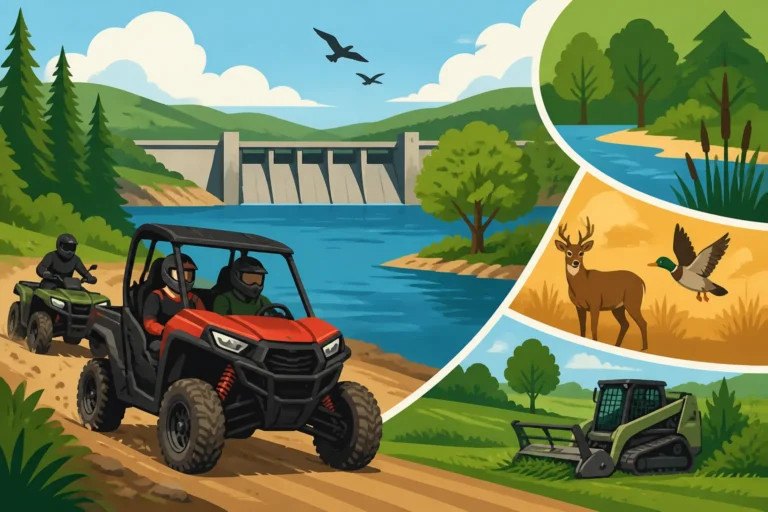
Cedar Run ATV Trail is another destination to consider from Grand Island, near Harlan County Lake and Republican City. Its lakeside setting gives the trip a different feel from a ride in the forest. The trail is commonly described as having about nine miles of riding, so it may be a better fit for a shorter outing or for a group that prefers a defined trail experience over a full day of exploring.
Cedar Run is a more compact option than Bessey, but a shorter trail doesn’t mean you can skip planning. Confirm that the area is open to your type of machine, check what the staging area provides, and plan for the ride you’ll actually get rather than assuming there will be additional routes nearby. You can find more context in [Cedar Run ATV Trail in Nebraska](Cedar Run ATV Trail in Nebraska) and [Nebraska Riding Near Republican City](Nebraska Riding Near Republican City).
For either destination, treat nearby roads and recreation lands as separate from the designated riding trail. A machine permitted on one trail is not automatically permitted on a neighboring road, beach, campground, or wildlife area. If you’re hoping to add public land riding to the trip, review [Nebraska WMA Designated Roadways Only](Nebraska WMA Designated Roadways Only) and verify the rules for the specific area before unloading.
| Riding area | General setting | What may make it a fit | What to verify |
|---|---|---|---|
| Bessey OHV Trails near Halsey | Forest and Sandhills region | A longer trail day and varied terrain | Trail access, machine restrictions, closures, parking, and fees |
| Cedar Run ATV Trail near Republican City | Lakeside riding area | A more compact trail outing | Current access, staging details, machine restrictions, and any nearby-area rules |
Choosing the right ride for your group
The closest destination isn’t always the best one. A group with young riders may care more about manageable trail conditions and a simple staging setup than about the number of miles available. A group bringing side-by-sides may need to prioritize width restrictions. And if your main goal is a long day in the saddle, the size and layout of the riding area may matter more than the drive.
Match the destination to your machines and experience
Start with the machine, not the map. Check whether the trail system permits your particular vehicle type, including a side-by-side, dirt bike, youth quad, or three-wheeler. A trail described generally as an ATV area may still have restrictions that affect specific machines. Width and trail design can be especially important for UTV owners, so confirm the rules rather than relying on assumptions or a map label.
Then be honest about your group’s experience. A confident adult rider may be comfortable with uneven ground or a longer route, while a new rider may need easier terrain, shorter loops, and frequent breaks. If the group has a wide range of ability, agree in advance on how you’ll keep everyone together. Decide who will lead, who will ride at the back, and what you’ll do if someone needs to stop.
A trail map can help with the planning, but it cannot tell you everything about a ride on the day you arrive. Consider using onX Offroad to help orient yourself and plan a route before leaving Grand Island. Use it as one planning aid, not as proof that every mapped line is open or legal to ride. Confirm access with the area manager or the official trail information before you commit.
Compare distance, trail length, and day-trip logistics
For Grand Island riders, both Bessey and Cedar Run involve enough travel that the trip can feel rushed if you set out late or underestimate loading time. Add the time needed to secure machines, stop for fuel, check straps, and unload at the trailhead. If you’re going with a group, coordinate arrival plans so one delayed truck doesn’t leave everyone else waiting with machines ready to ride.
Trail mileage is useful, but it’s only one part of the decision. A shorter trail can still make a satisfying outing if the terrain and setting suit your group. Conversely, a longer network doesn’t guarantee that every section is open or appropriate for the day’s riders. Look for current information on route access, staging, and any restrictions before you choose. [Nebraska Trail Conditions Before You Tow](Nebraska Trail Conditions Before You Tow) is a helpful companion topic for building that pre-trip check into your routine.
If you’re planning to camp, compare overnight options separately from trail access. A campground close to a riding area does not necessarily allow you to ride from your campsite to the trails. Check whether you’ll need to trailer the machines between the two, and whether the campground has room for your truck and trailer. You can also explore [Nebraska Trails With Camping](Nebraska Trails With Camping) for more options to investigate.
Plan the trip before you leave Grand Island
A good ride starts before you reach the trailhead. For a family outing, that might mean confirming that the route fits a young rider and packing snacks, water, and protective gear. For a group of adults, it might mean deciding who carries tools and what happens if a machine breaks down. Those practical details can keep a fun trip from turning into a frustrating one.
Check access, rules, and trail conditions
Confirm that the area is open to the machine you plan to bring, and check for temporary closures or conditions that could affect access. Weather can change the experience quickly: rain may make a trail difficult, while dry, dusty conditions can reduce visibility and make a long ride more tiring. Don’t assume that information from a past visit still applies.
Also check what is and isn’t required. Nebraska does not have a statewide OHV permit or sticker for general ATV trail riding, but that does not mean every riding area is free or that all other rules disappear. A parking fee, land-manager requirement, or private-area policy may still apply. Read [Nebraska Has No OHV Permit or Sticker](Nebraska Has No OHV Permit or Sticker) alongside the specific destination’s information, and review [Nebraska Park Rules for ATVs](Nebraska Park Rules for ATVs) if your trip includes state recreation areas or other park land.
Mapping tools can be useful when you’re trying to understand where a trail lies in relation to roads, land boundaries, and your starting point. onX Offroad may help you organize a route and prepare for a long trailer haul, but don’t treat any app as a substitute for posted signs or current land-manager guidance. Before you unload, make sure you’re at the correct staging location and that your machines are permitted there.
Pack for the trailer, trailhead, and ride home
Before leaving, inspect the trailer, check that the machines are secured properly, and make sure you have the equipment needed for a basic trail-side problem. A small toolkit, tire repair supplies, gloves, and a first-aid kit can be useful, but pack according to your machines and your group’s needs. If you’re unfamiliar with the route or expect limited cell service, tell someone where you’re going and when you expect to return.
Bring enough water for the time you’ll be outside, even when the weather feels mild. Riders often underestimate how tiring a day can be when they’re dealing with sun, wind, dust, vibration, and repeated stops. Pack eye protection and clothing suited to the forecast, and keep a spare layer or dry clothing in the truck for the trip home.
Plan the end of the day, too. Leave enough time to load safely before dark, check that nothing has shifted on the trailer, and secure loose gear. If the machines are muddy or dusty, think ahead about where you can clean them without washing debris into an inappropriate area. For a more detailed haul checklist, see [Planning a Long Trailer Haul to the Bessey Trails](Planning a Long Trailer Haul to the Bessey Trails) and [Nebraska Trailheads With Trailer Parking](Nebraska Trailheads With Trailer Parking).
Make your Grand Island ride a good one
The best choice depends on what you want from the day. Bessey can be appealing for riders looking for a longer forest ride, while Cedar Run may work well if you’d rather explore a more compact lakeside trail. Neither should be treated as a casual stop without checking access, current conditions, and machine rules first.
Use maps as a planning tool, not permission
Before the trip, map your route from Grand Island to the riding area and identify where you’ll park, unload, and refuel. onX Offroad can be useful for organizing the route and giving your group a shared planning reference. Still, a line shown on a map is not automatically an authorized ATV trail. Use official information and posted signs to confirm where you may ride.
Once you arrive, take a few minutes to read the trailhead signs and orient the group. Confirm the direction of travel, any marked closures, and where you’re allowed to park. If the information on site differs from what you expected, follow the current posted guidance and ask the responsible office or staff member rather than guessing.
For a wider list of possible destinations and planning ideas, start with [Nebraska ATV Trails: Where to Ride](Nebraska ATV Trails: Where to Ride). You can narrow your options further with [Nebraska Riding Near Halsey](Nebraska Riding Near Halsey), then compare the destination details with your group’s needs. A little checking at home is much easier than discovering at the trailhead that your machine, trailer, or planned route doesn’t fit the rules.
Leave room for a change of plan
Even a carefully planned trip can change. A trail may be closed, weather may make conditions unpleasant, or a rider may decide they’ve had enough for the day. Build flexibility into your schedule instead of treating every mile as a commitment. For a long drive, that can mean having a second activity in mind or being willing to call the ride early.
Keep the group together and respect other visitors, land managers, and posted boundaries. Stay on permitted routes, avoid disturbing wildlife or nearby property, and don’t assume that an open gate means you have permission to ride beyond it. Responsible riding helps protect access for everyone who hopes to return.
When the ride is over, check your machines and trailer before leaving the area. Look for loose straps, debris caught around moving parts, and anything that could shift on the road. A final check may feel like one more chore after a full day, but it’s far easier than discovering a problem halfway back to Grand Island.
Disclaimer
This article is for general informational purposes only and does not constitute professional advice. Laws, prices and regulations vary by location and change over time. Consult a qualified professional for guidance on your specific situation.