Scooters and Minibikes Barred Too
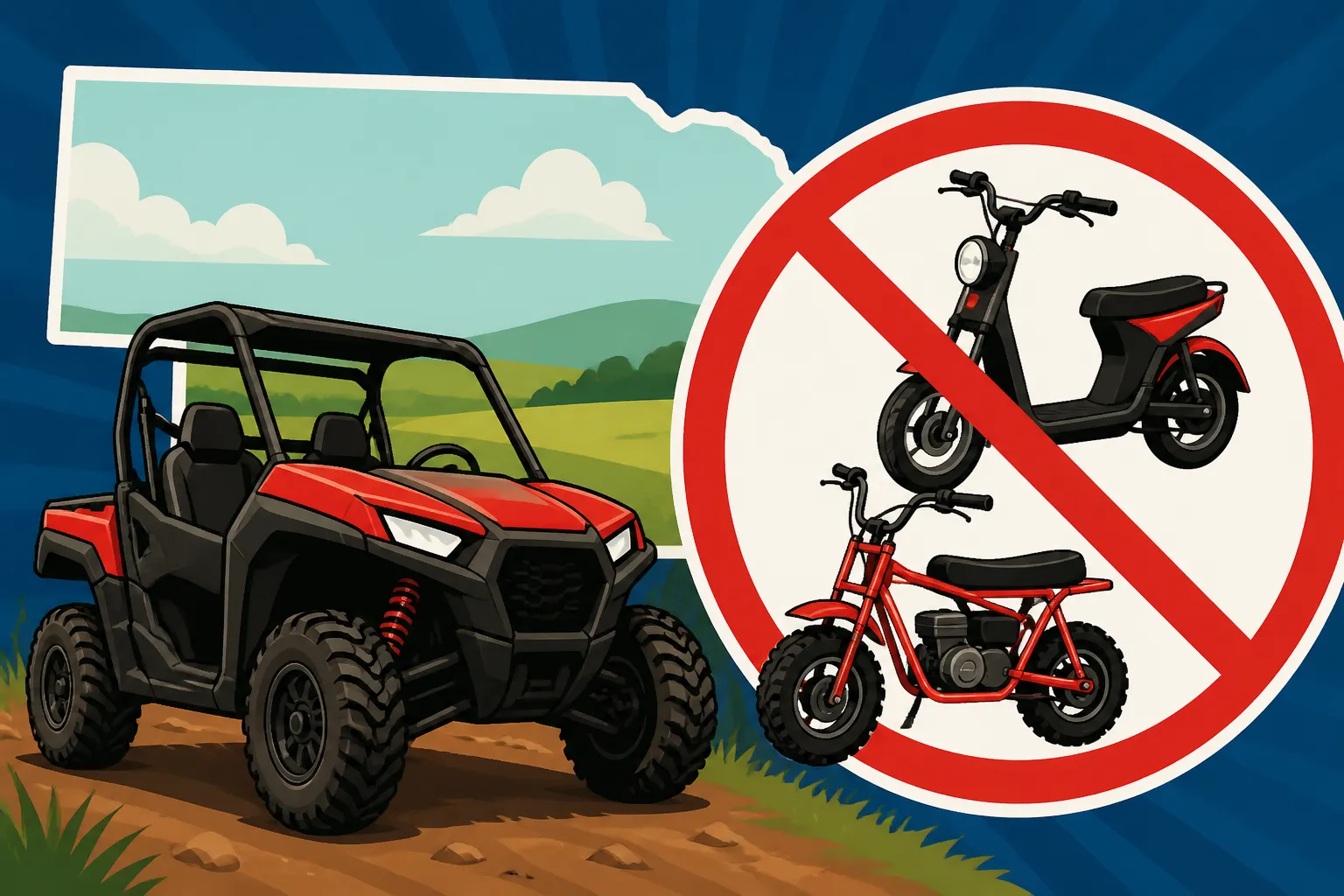
A scooter or minibike can look small enough to bring along for a quick ride, but size does not automatically make it welcome on Nebraska park roads or trails. Riders can arrive with a machine, a park permit, and good intentions only to learn that the area does not allow it. This guide explains the restriction and how to check where you can ride instead.
Why scooters and minibikes may be barred
Small machines can still count as motorized off-road vehicles
It is easy to assume that rules aimed at ATVs do not apply to a small minibike or scooter. In practice, park rules may cover multiple types of motorized recreational vehicles, not just full-size four-wheelers. A machine’s compact size, low speed, or ability to fit in a pickup does not by itself establish that it is allowed on a park trail.
That distinction matters because Nebraska state parks and recreation areas are not automatically open riding areas. If an area bars ATVs and similar off-road machines, scooters and minibikes may be prohibited there too. Check the rules for the specific property and vehicle rather than relying on what another park allows. [Nebraska State Parks Ban ATVs] and [Scooters and Minibikes Barred Too] are useful starting points for understanding the restriction.
There can also be a difference between riding a machine and transporting or storing it. A scooter secured in a vehicle is not the same as riding it on a park path, but that does not guarantee that every facility has identical rules about where you can unload or park it. If the signs or online rules are unclear, ask the park office before you unload.
A park permit is not permission to ride every vehicle
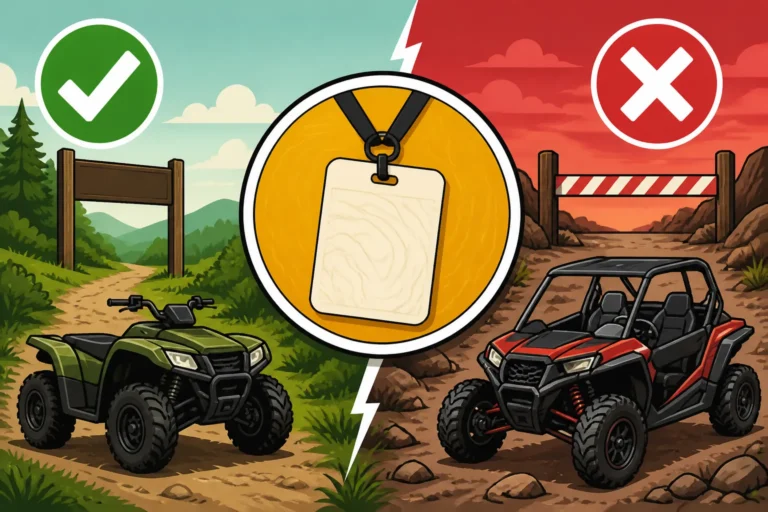
A Nebraska park entry permit addresses access to the park or recreation area. It should not be treated as an off-highway vehicle permit or as approval to ride a scooter, minibike, ATV, or UTV wherever you see a road or open space. [Why a Park Permit Does Nothing for Your ATV] explains this important distinction.
This is a common source of frustration. Someone buys the right park permit, drives a long way, and then finds out that the vehicle itself cannot be ridden there. The permit and the vehicle-use rules answer different questions: one concerns park entry, while the other concerns where a particular machine may operate.
It is also worth separating park rules from rules for other public or private riding locations. A vehicle prohibited in a state recreation area might be permitted at a designated trail system or private riding park, subject to that location’s own requirements. Always check the land manager’s rules for the exact place you plan to visit. [Nebraska Recreation Area Rules for ATVs] covers the recreation-area side of that distinction.
Check the exact property before you load up
Confirm the vehicle category and the activity
Before a trip, identify the machine as accurately as you can. “Scooter” can refer to different types of vehicles, and a minibike may be treated differently from a mobility device or a street-legal motorcycle. If a rule uses broad language such as motorized vehicles, off-road vehicles, or similar machines, do not assume your vehicle is exempt just because the rule does not name its brand or model.
Then confirm what you want to do. Riding on a designated route, crossing a property, unloading at a trailhead, and parking a machine can be covered by different directions. A park may allow a vehicle to be transported through an entrance while still prohibiting it from being operated on trails. Ask specifically whether the machine may be ridden, not merely whether it may be brought onto the property.
When you contact an office, have the make and model handy and describe how it is powered and used. Ask whether the answer applies to the whole property, a named trail, or a particular kind of access road. That short conversation can prevent a disappointing drive from Omaha, Lincoln, Grand Island, or a rural community farther from your intended riding area.
Use maps as a planning aid, not as the final authority
Mapping tools can help you spot candidate riding areas and plan a route, but a map is not a substitute for current land-manager rules. onX Offroad can be useful for exploring routes and getting a sense of the surrounding area before you travel. Treat any map as a planning layer: confirm the vehicle rules, access status, closures, and parking instructions with the responsible agency or property.
This is especially important near boundaries. A route may appear to continue from a forest road into a park, private property, or a wildlife management area, even though vehicle access changes at the line. A trail shown on a map does not necessarily mean that scooters or minibikes can legally use it.
A practical routine is to check the map, identify the land manager, and then verify the rules directly. onX Offroad may help you organize that first step, but signs at the property and the manager’s directions should guide your decisions. If access is uncertain, choose a confirmed riding location rather than testing the boundary on arrival.
| Before the trip | What to confirm | Why it matters |
|---|---|---|
| Identify the property | State park, recreation area, forest, WMA, or private park | Different land managers set different vehicle rules |
| Identify your machine | Scooter, minibike, ATV, UTV, or mobility device | A rule may cover vehicle types differently |
| Check the permitted activity | Riding, crossing, unloading, or parking | Permission for one activity does not guarantee permission for another |
| Verify access details | Open routes, closures, hours, and posted signs | Conditions and restrictions can vary by location |
| Ask the land manager | Whether your specific machine is allowed on your planned route | A direct answer can prevent a wasted trip |
Find a suitable place to ride instead
Look for designated riding areas
If a state park or recreation area does not allow your machine, look for a location specifically intended for motorized riding. Nebraska has several kinds of places to investigate, including designated OHV trail areas, national forest riding opportunities, and private parks. Their rules are not interchangeable, so verify whether scooters or minibikes are allowed rather than assuming that a place open to ATVs accepts every small motorized vehicle.
For example, [Nebraska National Forest Riding] can help you explore a different category of public-land riding. The national forest is not the same as a state park, and access rules can depend on the route, season, and posted conditions. Check with the responsible ranger district before setting off.
Private riding areas may have their own age limits, equipment requirements, waivers, fees, and operating rules. A location that accepts ATVs might still limit minibikes or scooters, so confirm the exact vehicle category. [Nebraska Private Park Waivers and Rules] is a helpful companion when you are considering a privately operated riding park.
Be careful with wildlife management areas and other public land
A public property is not automatically an open riding area. Wildlife management areas, for example, may restrict vehicles to designated roadways or allow access only under specific conditions. [Nebraska WMA Vehicle Rules] is a useful reminder to check the rules for the particular management area rather than treating it like a trail park.
This is another point where a map can mislead. A dirt track may be visible, but it could be a service road, a boundary route, or a road that is not open to recreational riding. If signs identify a roadway as closed or limit vehicle travel, follow those directions even if the route looks rideable.
If you are planning around sand, hills, or a particular region, narrow your search to places that explicitly identify motorized riding opportunities and then confirm machine eligibility. [Where You Can Legally Ride Nebraska Sand] can help with the location search, but it does not replace checking the current rules of the area you choose.
Avoid the most common planning mistakes
Do not rely on another rider’s experience
A friend may have ridden a minibike somewhere before, but that does not prove that the same vehicle is allowed today or that the same rules apply to your destination. The friend may have been on private land, a designated trail, or a route with different access conditions. Even within one general area, a boundary or closure can change what is permitted.
Likewise, do not infer permission from the presence of tire tracks. Tracks can be old, unauthorized, or left by a vehicle that has different access rights. Follow the posted rules and get an answer from the property manager when the category of your machine is unclear.
If another rider’s advice conflicts with a sign or direct instruction from the land manager, follow the sign or instruction. A polite call before the trip is far easier than arguing about a rule at the trailhead after the machine is unloaded.
Ask clear questions before you leave home
When rules are ambiguous, keep the questions specific. Ask whether your make and model may be ridden on the intended route, whether the answer changes for a scooter versus a minibike, and whether there are separate restrictions for unloading or parking. If you are traveling with more than one type of machine, ask about each one.
It can also help to ask where the rules are posted and whether there are temporary closures or seasonal limitations. Write down the name of the location and the route you were told to use. That does not replace posted directions, but it gives you a clear plan and makes it easier to confirm that you are heading to the right place.
Finally, keep the categories straight: park entry does not automatically authorize riding; public ownership does not mean open access; and a small machine is not necessarily exempt from off-road vehicle restrictions. [Nebraska Has No OHV Permit or Sticker] provides additional context on Nebraska’s lack of a general state OHV sticker, while [Nebraska Park Rules for ATVs] can help you keep park-specific restrictions in view.
Disclaimer
This article is for general informational purposes only and does not constitute professional advice. Laws, prices and regulations vary by location and change over time. Consult a qualified professional for guidance on your specific situation.