Rules for Guiding ATV Riders for Pay
Guiding ATV or UTV riders for pay in Nebraska is more than choosing a route and collecting a fee. The key questions are who controls the land, whether commercial use is allowed, and what protection your business needs. Here’s how to check those issues before advertising a ride, taking bookings, or leading a group onto a trail.
Start With Land Access and Commercial Permission
A paid ride does not get the same access as a personal outing. Permission to ride somewhere recreationally may not include permission to bring paying customers, advertise guided trips, or operate a business there. Before you set a route, identify who manages the land and get clear confirmation that your specific activity is allowed.
Nebraska does not have a general state OHV sticker that serves as a commercial guiding permit. That does not mean a guide can ride anywhere or that a public-land manager has approved a paid operation. The title, any local road permissions, and the rules for a particular trail or property are separate questions. Nebraska Has No OHV Permit or Sticker
Public land needs a location-specific check
Public land is not one uniform category. A trail may be managed by a federal agency, a local authority, a private operator, or another land manager, and each can set its own access and use conditions. A route that is open to individual riders may still have restrictions on commercial activity, group size, staging, advertising, or the use of facilities.
For a proposed trip on National Forest land, contact the relevant ranger district before offering the ride for sale. Ask whether a paid, guided activity needs written authorization, a special-use approval, or other arrangements. Get the answer for the exact location and activity rather than relying on what another operator does elsewhere. Nebraska National Forest Riding and Questions Worth Asking a Ranger District Office can help you frame a location-specific inquiry.
Do the same for other public properties. Confirm that the proposed trail is open to the machines you plan to use, that commercial guiding is permitted, and that you may use the intended meeting and parking area. A road, trail, or staging lot being accessible to the public does not automatically make it available as a commercial base.
Private land requires more than a casual yes
On private land, speak with the owner or the person who has authority to approve the activity. Explain that customers will pay you, how often trips may run, the types of machines involved, your expected group size, and where riders will park. Ask whether the permission covers the route, staging, customer access, and any planned amenities.
Put the terms in writing. An agreement can spell out which areas are open, when trips may occur, who maintains the route, how gates and livestock are handled, and what happens if weather or land conditions require a closure. Clear terms reduce the risk of a misunderstanding between the guide, the owner, and a customer. Nebraska Landowner Permission Rules
A private riding park may have its own operator rules for commercial trips. Do not assume that a customer’s admission or a general waiver lets an outside guide run paid tours there. Ask park management directly whether it permits outside guides, whether it requires approval or insurance documents, and how it handles participant check-in and waivers. Nebraska Private Park Waivers and Rules
Separate riding access from road access
A permission to ride off-road does not make the trip legal on public roads. If a route uses a road, crossing, or town street, check the rules for that specific location and vehicle. Nebraska’s limited road-use rules and local ordinances are a separate layer from trail access. A guide should not describe a route as road-legal unless the planned movements comply with applicable state and local requirements. See Can You Drive an ATV on the Road in Nebraska? for the broader road-use issue.
Set Up the Business Before Taking Bookings
Once you have a plausible route and land permission, make the business side concrete. Customers need to know what the fee covers, what they must bring, what equipment is provided, and what can cause a trip to be delayed or canceled. The guide also needs a plan for injuries, damage, breakdowns, and changing trail conditions.
Check insurance with the activity described accurately
Do not assume a personal ATV policy, a machine policy, or a landowner’s insurance covers a paid guided ride. Tell an insurance agent that customers will pay for guided off-road trips, and explain who owns the machines, who operates them, and where the activity takes place. Ask whether the policy covers the guide’s business liability and the specific vehicles and operations involved.
If you rent or provide machines, describe that too. Renting equipment and guiding customers can present different risks from leading riders who bring their own machines. Confirm how coverage applies to customer injuries, property damage, machine damage, and staff activity. Ask whether the landowner, trail operator, or public-land manager needs to be named or provided with proof of coverage. Requirements vary, so get the answer from the relevant insurer and land manager rather than relying on a generic policy description. What Insurance an Organized Trail Ride Needs
Waivers and participant acknowledgments can be part of a risk-management process, but they are not a substitute for permission, safe operations, or suitable insurance. Have forms reviewed for the business and location, and make sure customers understand what they are signing before the ride begins.
Explain the offer without overpromising
A booking page or customer message should state the practical details: ride duration, meeting location, machine requirements, age or passenger limits, what is included, and what happens if a route closes. Make clear whether riders need to bring their own machine or whether you provide one. If machines are supplied, explain how riders are assessed and briefed before operating them.
Avoid promises such as “all skill levels welcome” unless the route and operating plan truly accommodate a range of abilities. A beginner ride needs a route, pace, and group size that suit beginners. A challenging route should be described accurately, including terrain that may be difficult for a novice or a machine that is not suited to it.
Set a cancellation and refund policy that accounts for unsafe weather, land-manager closures, mechanical problems, and a customer who arrives without required gear or skills. Tell customers about the policy before taking payment. If you use an online marketplace or take payment through a third party, check how its terms handle cancellations and disputes; those arrangements do not replace your land-use approval or insurance.
Treat equipment and transportation as separate issues
A guide may need machines, helmets, eye protection, communication equipment, first-aid supplies, tools, and a way to transport disabled vehicles. Decide what is essential for the route and whether customers or the business provide it. If sourcing routine supplies online, Amazon may be one place to compare availability, but check that any safety equipment is appropriate for the activity and fits the rider; a listing alone is not proof of suitability.
Also plan for trailers and support vehicles. A trailer has its own transport and paperwork considerations, separate from the ATV or UTV. If a customer brings a trailer or you tow one to the meeting point, confirm that the tow vehicle, trailer, load, and parking arrangement are suitable. Do not let an informal staging plan obstruct a trailhead or other users.
Build a Safe, Manageable Ride
A paid guide is responsible for more than knowing the route. The group needs clear expectations, a way to respond when something goes wrong, and a plan for riders whose experience or equipment does not match the trip.
Screen riders before the ride
Ask about experience, machine type, passenger plans, and any relevant limitations before accepting a booking. The point is not to exclude riders unnecessarily; it is to match the route and pace to the people who will be there. If a machine is too large for a trail, a rider is unfamiliar with its controls, or a passenger setup is unsuitable, resolve that before departure.
Provide written pre-ride information. Include the meeting time and location, route conditions if known, clothing and protective equipment, food and water expectations, and instructions for arriving with a properly maintained machine. Explain that riders must follow the guide’s instructions and the land manager’s rules. Do not imply that a guide can authorize access to a closed area or override posted restrictions.
Brief the group and manage the route
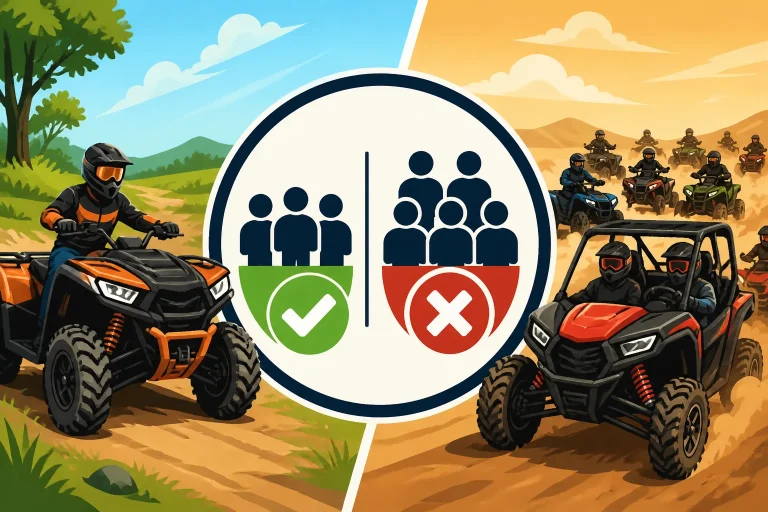
Before starting, explain hand signals or other communication methods, spacing, speed expectations, passing rules, and what riders should do if they lose sight of the group. Identify the lead and sweep positions if the trip uses them. Keep the group size manageable for the route, visibility, and available support. A group that works on a wide, open trail may be difficult to control on narrow or uneven terrain. Nebraska Group Size at a Trailhead
Use a route plan that accounts for turnaround points, weather, fuel, water, and the abilities of the least experienced rider. Check conditions before departure and be prepared to change or cancel the trip. Do not treat a planned route as fixed when a closure, storm, washout, fire restriction, or unsafe surface changes the situation.
Plan for a breakdown or injury. Decide how the group will stop, who contacts emergency services, how the location can be described, and how the rest of the riders will be kept together. Do not promise cell service where you have not confirmed it. For remote rides, consider what communication and recovery options are realistic for the area.
Keep road riding out of a trail tour unless it is clearly lawful
Some guides may be tempted to connect two trail sections by using a public road. That can create legal and safety issues that do not arise on a closed off-road route. Check the state rules, local ordinances, required equipment, and insurance conditions for every road segment. Do not assume a road exception applies simply because the group is traveling between riding areas or a customer is familiar with local farm roads.
If a route relies on local permission or an ordinance, verify that it applies to the specific road and vehicles. Confirm any required equipment and operating limits with the appropriate authority. A customer’s signature on a waiver does not make an otherwise prohibited road movement lawful.
A Practical Pre-Trip Checklist
Before advertising a paid ride, work through the following steps. Keep copies of approvals and operating documents where they can be accessed when needed.
- Map the entire trip. Identify every trail, property, staging area, road segment, and meeting point.
- Contact each land manager or owner. Describe the paid activity, frequency, group size, machines, and facilities you plan to use.
- Get permission in writing. Record any limits on route, dates, group size, parking, advertising, or customer access.
- Check commercial-use requirements. Ask public-land managers and private operators whether a separate authorization or agreement is required.
- Confirm insurance. Describe the business accurately to an agent and request written clarification about the activity and machines covered.
- Set customer terms. Explain equipment, skill expectations, route difficulty, cancellations, and what happens if a rider is not prepared.
- Create a ride plan. Include a briefing, group-control method, route alternatives, emergency response, and breakdown procedure.
- Verify local rules. Recheck closures, road permissions, posted restrictions, and conditions before each trip.
- Keep records. Save approvals, customer communications, maintenance records, incident reports, and insurance documents.
- Stop when access or safety is uncertain. A paid booking is not a reason to enter closed land or continue in unsafe conditions.
| Question | What to confirm | Why it matters |
|---|---|---|
| Who manages the route? | The owner or agency responsible for each segment | Permission from one party may not cover adjoining land |
| Is paid guiding allowed? | Whether commercial use needs written approval or other authorization | General recreational access may not include business activity |
| Where can customers stage? | Parking, unloading, check-in, and support-vehicle locations | A trail being open does not automatically allow commercial staging |
| What insurance applies? | Coverage for guiding, supplied machines, customers, and property | Personal or vehicle coverage may not address business risks |
| Can the route use roads? | State and local rules for each road segment | Off-road access does not grant public-road privileges |
| What happens if plans change? | Closure, weather, breakdown, injury, and cancellation procedures | A clear plan protects customers and keeps the guide from improvising |
The central rule is straightforward: secure access for the paid activity itself, not just for riding. A state title or the absence of a state OHV sticker does not authorize a guiding business. Confirm land-manager requirements, get permission in writing, and make sure the route, insurance, and customer procedures all match the trip you are actually selling.
Disclaimer
This article is for general informational purposes only and does not constitute professional advice. Laws, prices and regulations vary by location and change over time. Consult a qualified professional for guidance on your specific situation.