Sunrise to Sunset and a Snow Exception
Trying to figure out when and how you can actually ride your ATV or UTV on Nebraska's public roads can feel like navigating a maze blindfolded. Many of us just want to get from one field to another, or maybe take a quick trip down a gravel road, but the rules are notoriously tricky, leaving riders confused and often worried about getting a ticket. This guide is here to untangle the complexities of Nebraska's ATV and UTV road laws, breaking down the specific times you can ride, the equipment you'll need, and the exceptions that apply, so you can ride with confidence and stay on the right side of the law.
The Core Rules of Road Riding: When You Can and Can't
Nebraska's stance on ATVs and UTVs on public roads is, for the most part, quite restrictive. Unlike some states that might embrace off-road vehicles as alternative transportation, Nebraska has very specific and limited circumstances under which you can legally operate them on paved or gravel roads. It’s not about convenience or leisure for most riders; it's about necessity, particularly for agricultural purposes, and adherence to strict safety standards. Understanding these core limitations is the first step to staying compliant, and the biggest one often comes down to the clock.
The Daylight Riding Mandate
One of the most fundamental rules governing ATV and UTV use on Nebraska roads is the "sunrise to sunset" mandate. This isn't just a suggestion; it's a hard and fast legal requirement. You simply cannot operate your off-road machine on a public road before the sun comes up or after it sets, period. This rule is rooted in safety, aiming to ensure maximum visibility for both the ATV/UTV rider and other motorists. When you're out there, even if your machine has amazing headlights, the law states that the natural light of day is what's required. This means if you're planning a trip, whether it's for farm work or simply getting to a trail, you need to factor in the daylight hours. For many, this is a major frustration, especially when chores or hunting trips extend into the twilight hours, but deviating from this rule can lead to significant penalties. [Sunrise to Sunset Only] is a concept woven into the fabric of these laws, emphasizing the state's cautious approach to mixing off-road vehicles with regular traffic.
This daylight restriction applies across the board, whether you're on a small county gravel road or briefly crossing a state highway. There's no gray area for "just a little bit after sunset" or "just before sunrise." Law enforcement officers are well aware of this statute, and they enforce it diligently. So, while your machine might be equipped with powerful LED light bars, often from brands like SuperATV, that make it feel like daytime even in the dark, the legal requirement transcends your vehicle's capabilities. It's about when the sun itself is visible. Always check your local sunrise and sunset times to plan your rides accordingly, especially as the seasons change and daylight hours fluctuate dramatically.
The Snow Removal Exception
Now, every rule seems to have an exception, and for the daylight riding mandate, that exception comes draped in white: snow removal. Nebraska law carves out a specific allowance for ATVs and UTVs to be operated on public roads after sunset or before sunrise when engaged in snow removal operations. This is a practical recognition of the role these machines play, especially in rural areas, in keeping roads and driveways clear during winter storms. It would be entirely impractical to require someone clearing snow from a public right-of-way to stop working simply because the sun went down.
This exception isn't a free pass for joyriding in the dark; it's strictly limited to the act of plowing or clearing snow. If you're using your UTV to plow your driveway and it requires a short trip down a public road to get to the next section or neighbor's property, you're covered. However, after the snow is cleared, and you're just heading home, the daylight rule kicks back in. This specific exemption highlights the state's understanding of the utility of these machines in specific, essential tasks, even when general restrictions are quite tight. It’s also a good reminder that while [Clearing Snow After Dark] is allowed, it comes with the implicit responsibility of operating safely and only for the duration of the task.
Speed Limits and Safety Flags
Beyond the time-of-day restrictions, operating an ATV or UTV on a Nebraska public road comes with specific speed and visibility requirements. You are generally restricted to a speed limit of [30 mph at Most] when operating on public roads, even if the posted speed limit for other vehicles is higher. This isn't just about safety; it's a recognition that ATVs and UTVs are designed for off-road environments and often lack the same stability, braking, and general road-worthiness of conventional automobiles. Exceeding this limit not only puts you at risk but also makes you immediately non-compliant with the law.
Visibility is also paramount, and Nebraska law mandates the use of a safety flag. This isn't optional; it's a non-negotiable requirement for legal road use. The safety flag must be at least five feet above the ground, and it needs to be "day-glow" orange, measuring at least 30 square inches. This bright, elevated flag helps other motorists spot your lower-profile machine, especially over hills, around curves, or in areas with tall crops. Many riders opt for sturdy flags and mounts, often finding robust options from accessory providers like SuperATV, ensuring their flag can withstand the wind and elements while maintaining its required height and visibility. Understanding [Why Road-Legal ATVs Need a 5-Foot Safety Flag] is crucial, as it’s a simple yet effective way to increase your presence on shared roadways.
Specific Vehicle Requirements for Street Legal Use
Before you even think about hitting a public road with your ATV or UTV in Nebraska, you need to make sure your machine is properly equipped. It's not enough to simply have a powerful engine or rugged tires; the state has laid out specific requirements that mirror, in some ways, those for conventional vehicles, but are tailored to the unique nature of off-road machines. Ignoring these requirements isn't just risky; it's a surefire way to encounter legal trouble and compromise your safety.
Lighting Up for the Road
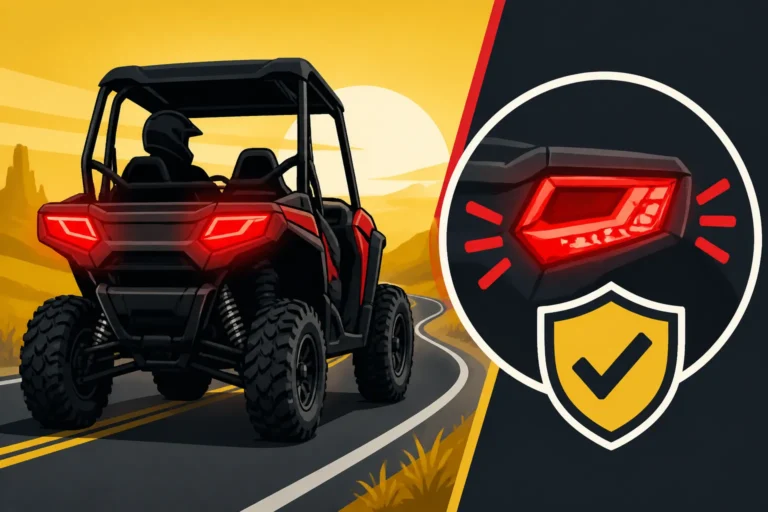
Even though the primary rule is to ride from sunrise to sunset, your ATV or UTV must still be equipped with proper lighting if you're venturing onto a public road. This includes a headlight, a taillight, and a brake light. The headlight must be on at all times, even during daylight hours, for increased visibility. Think of it like a motorcycle—always on. The taillight needs to be visible from a certain distance, typically 500 feet, and the brake light must activate when you apply the brakes. These lights are critical not only for the snow removal exception we discussed earlier but also for simply being seen by other drivers during the day.
Many factory ATVs and UTVs come with basic lighting, but some riders choose to upgrade for better performance and visibility. Aftermarket lighting solutions, including those from companies like SuperATV, can provide brighter, more robust options that meet or exceed legal requirements, making your machine more conspicuous. It’s about ensuring that your machine is impossible to miss for other drivers, reducing the risk of accidents. [Nebraska Lighting Statute 60-6,357] outlines these specifics in detail, so it's wise to review it carefully to confirm your machine meets all criteria.
Safety Flags: Visibility is Key
We touched on this briefly, but it bears repeating: the safety flag is a non-negotiable item for road-legal ATV and UTV use in Nebraska. It's not just about having a flag; it's about having the right flag, properly positioned. The law specifies a "day-glow" orange, triangular flag, at least 30 square inches in size, mounted at least five feet above the ground on the machine. This specific combination of color, size, and height is designed to maximize your visibility to other drivers, especially those in larger vehicles who might not easily see a low-slung ATV or UTV.
Imagine you're cresting a hill on a gravel road, or navigating a blind curve near a cornfield. That tall, bright flag can be the first indication to an oncoming motorist that an off-road vehicle is present, giving them precious extra seconds to react. Without it, you're significantly increasing your risk of being overlooked. While some might view it as an aesthetic nuisance, it is a critical safety component mandated by law. When considering options, look for flags made from durable materials that won't fray or tear easily, as they need to withstand consistent exposure to wind and weather.
Insurance and Licensing Prerequisites
Operating any motorized vehicle on public roads in Nebraska means you need to be properly licensed and insured, and ATVs and UTVs are no exception when they are granted these limited road privileges. First, you must possess a valid Class O driver's license, which is the standard driver's license in Nebraska. A farm permit can also suffice if your operation falls under the specific agricultural exemptions. [Nebraska Requires a Class O License or Farm Permit] for anyone driving these machines on public roadways. This ensures that operators have at least a basic understanding of traffic laws and safe driving practices.
Second, liability insurance is absolutely mandatory. Just like with a car or truck, if you're involved in an accident on a public road, you need to be able to cover damages or injuries. Nebraska law specifies minimum liability coverage limits, which are currently set at $25,000 for bodily injury or death of one person, $50,000 for bodily injury or death of two or more people, and $25,000 for property damage (often expressed as 25/50/25). It's important to note that these minimums are set to increase in 2027, so staying informed about [Nebraska Insurance Minimums From 2027] is crucial. Always carry proof of insurance with you, as law enforcement can and will ask to see it. Operating without the required license and insurance is a serious offense that can lead to fines, impoundment of your machine, and other legal repercussions.
Understanding Nebraska's Agricultural Exceptions
While Nebraska generally keeps ATVs and UTVs off public roads, there's a significant and often utilized exception for agricultural purposes. This isn't a loophole; it's a recognition of the essential role these machines play in modern farming and ranching operations. For many rural Nebraskans, an ATV or UTV is a workhorse, not just a recreational toy, and the law reflects this utility by providing specific allowances. However, these exceptions are not boundless and come with their own set of conditions and interpretations.
Defining "Farm Use" on Public Roads
The agricultural exception allows for ATVs and UTVs to be operated on public roads when being used "for agricultural purposes." But what exactly constitutes "agricultural purposes"? The law generally defines this broad term to include activities directly related to farming, ranching, and other agricultural production. This could mean transporting tools or supplies between fields, moving livestock, checking fences, or accessing different parts of a farm or ranch that are bisected by a public road. [Nebraska's Agricultural Road Exception] is a cornerstone of how many rural residents use their machines.
It's vital to understand that "farm use" doesn't extend to recreational riding, even if you happen to live on a farm. Taking your kids for a joyride down the county road, even if it's on your own property, typically would not qualify under this exception. The key is the purpose of the trip. Is it directly and inherently tied to the operation of a farm or ranch? If a deputy pulls you over, they will likely inquire about the nature of your trip. Having a clear, concise explanation of how your journey contributes to your agricultural work is important. For example, [Is Checking Cattle an Agricultural Trip Under the Law?] – yes, absolutely, as it's a fundamental part of livestock management.
The Nuances of Ranch and Feedlot Operations
Ranching and feedlot operations present unique scenarios for ATV and UTV use on public roads that fall squarely within the agricultural exception. In these settings, vast tracts of land are often involved, and roads frequently cut through property boundaries. An ATV or UTV is indispensable for managing livestock, inspecting infrastructure, or even just getting feed to specific areas. The law recognizes that a rancher needs to cross or travel short distances on a public road to move from one pasture to another, or a feedlot operator needs to get to a distant lot.
Consider a rancher needing to mend a fence line that runs alongside a county road, or quickly move a small herd of cattle across the road to a fresh pasture. These are legitimate "agricultural purposes." Similarly, in a large feedlot, a UTV might be the most efficient way to transport personnel or small equipment between different pens, even if it means momentarily using a public access road. The important thing is that these trips are typically short, direct, and essential to the daily operation of the enterprise. Carrying [Your Title Copy on a Ranch Road] is always a good practice, as it provides proof of ownership, which can be helpful if questioned by authorities.
Crossing Public Roads for Farm Business
Beyond simply driving on a public road for farm use, the agricultural exception also covers crossing public roads. This is especially relevant for farms with land on both sides of a county road or state highway. It's often the most direct, and sometimes the only, way to move equipment, livestock, or personnel between fields. While crossing, all the usual road rules still apply: observing speed limits, displaying your safety flag, using appropriate lighting, and having your license and insurance.
When crossing, the law requires you to do so at a ninety-degree angle to the road and to yield to all other traffic. This minimizes your time in the travel lane and reduces the risk of collision. It's not about convenience but necessity. You can't just drive for miles on the road to get to another field if there's an alternative, albeit longer, route on private land. The exception is specifically for "crossing" when that's the most practical way to continue agricultural work. [When Farm Work Lets You Cross a Four-Lane] provides further insights, clarifying that even major thoroughfares can be crossed under strict conditions for agricultural necessity.
Local Ordinances: The City and County Landscape
Even with statewide rules, the local level plays a significant role in determining where and when you can legally ride your ATV or UTV on public roads in Nebraska. While the state law is generally restrictive, it grants authority to local municipalities and county boards to create their own ordinances that can open up certain roads or areas to off-road vehicles. This creates a patchwork of rules across the state, making it essential for riders to do their homework before venturing into any town or unincorporated village.
How Cities Open Their Streets
Some Nebraska cities have recognized the utility and recreational appeal of ATVs and UTVs and have chosen to adopt ordinances that allow their operation on certain city streets. These ordinances are typically very specific, outlining which streets are open (often only designated streets, not state highways that pass through town), during what hours, and under what additional conditions. Common requirements include a special city registration permit, specific age restrictions for operators, and mandatory safety equipment beyond state minimums, such as helmets (even though the state doesn't require them for ATVs generally).
For example, a city might charge a yearly registration fee, like [Nebraska City's $100 Yearly ATV Registration Fee], and require you to display a city-issued sticker. They might also limit speeds even further than the state's 30 mph rule, or impose stricter passenger restrictions. It's never safe to assume that just because one city allows ATV/UTV street use, another nearby city will too. Every city ordinance is unique. The best course of action is always to contact the city hall or police department directly, or check their official website, to get the most accurate and current information on [How a Town Ordinance Opens Its Streets to ATVs].
Village and County Board Resolutions
Beyond incorporated cities, unincorporated villages and rural areas under county jurisdiction can also see their roads opened to ATV and UTV traffic, but this requires action from the county board. A county board resolution is essentially the county's way of saying, "Yes, we approve of these machines on certain roads within our jurisdiction." This is often done in response to requests from local residents or to facilitate agricultural activities within an unincorporated community.
Similar to city ordinances, county board resolutions will detail the specific roads or areas where ATV/UTV use is permitted, as well as any additional rules or requirements that apply. These might include similar provisions for licensing, insurance, and safety equipment. Again, this isn't a blanket permission for all county roads; it applies only to those explicitly designated by the resolution. [How a County Board Opens a Village to ATVs] illustrates the process for this localized decision-making. If you're planning to ride in an unincorporated area, a call to the County Clerk's office would be invaluable to confirm if any such resolutions are in place for your intended riding area.
Registration, Fees, and Age Minimums in Local Jurisdictions
When a city or county opens its roads to ATVs/UTVs, it almost invariably comes with a set of local regulations regarding registration, fees, and age minimums that are in addition to any state requirements. These local registration processes are distinct from state titling requirements. For instance, while Nebraska titles ATVs but does not register them statewide, a city might require its own local registration and decal to signify compliance with its ordinance.
The fees associated with these local registrations can vary widely, from nominal amounts to more substantial annual charges. These fees often go towards covering administrative costs or local infrastructure. Age minimums are also common, with some cities requiring operators to be 16 or 18 years old, regardless of whether a younger rider holds a farm permit or has completed a safety course. It's also not uncommon for cities to have specific helmet rules, even if the state doesn't, especially for younger riders. Therefore, always investigate the specific requirements of the town or county you plan to ride in. [Nebraska City Age Requirements] can often be found within the city's specific ATV ordinance, which you can usually find on their municipal website or by calling city hall.
Navigating Intersections and Highway Crossings
Even when you're legally operating your ATV or UTV on a public road in Nebraska, special care and adherence to specific rules are required when you encounter intersections, especially those involving state highways or divided roadways. These are points of increased traffic volume and speed, demanding heightened caution and precise execution of maneuvers to ensure safety for everyone on the road.
The Ninety-Degree Rule
One of the most crucial rules for crossing any public roadway with an ATV or UTV in Nebraska is the "ninety-degree rule." This means that when you cross a road, you must do so as directly as possible, at an angle as close to 90 degrees as you can safely manage. The intent behind this rule is to minimize the amount of time your machine is exposed to the flow of traffic in the travel lanes. You're not meant to merge into traffic and drive down the road before turning; you're meant to cross straight across and exit the public road quickly.
This applies whether you're crossing a small gravel county road to get to another field, or a busier two-lane highway. Imagine yourself driving up to the edge of the road, looking both ways, and then proceeding directly across to the other side without veering down the road. This direct approach reduces the risk of being hit from behind or by oncoming traffic, as you're not moving with the flow of vehicles for an extended period. Understanding [What a Ninety-Degree Crossing Looks Like in Practice] is key to executing this maneuver safely and legally.
Yielding and Stopping Requirements
When approaching any intersection or point where you intend to cross a public road, your ATV or UTV is always required to yield to all other traffic. This isn't a suggestion; it's a legal mandate. You must ensure that the path is completely clear before you attempt to cross. This often means coming to a complete stop, even if there isn't a stop sign, to thoroughly check for oncoming vehicles from all directions.
The principle here is simple: ATVs and UTVs are granted limited access to public roads for specific purposes, and when they are on those roads, they must operate with extreme caution and defer to other vehicles. This means taking your time, being patient, and never assuming that another driver sees you or will yield to you. Your bright safety flag and always-on headlight will help, but ultimately, the responsibility to yield and ensure a safe crossing falls squarely on the ATV/UTV operator. [Do You Have to Stop Before Crossing a Highway?] The answer is almost always yes, and then some, to ensure complete safety.
Divided Highways and Controlled Access Crossings
Crossing divided highways or controlled-access highways (like interstates or major expressways) presents an even greater challenge and comes with stricter limitations. While agricultural exceptions might allow for crossing certain state highways, you are generally prohibited from crossing a controlled-access highway. The high speeds and limited access points of these roads make ATV/UTV crossings extremely dangerous and are typically banned by statute.
For divided highways that can be crossed (typically not controlled-access, but major state routes with a median), the crossing must occur at an intersection. You cannot simply cut across the median at an arbitrary point. This is because intersections are designed for vehicle crossings, often with clearer sightlines and sometimes with traffic control devices. Again, the ninety-degree rule and yielding to all traffic remain paramount. It's a complex area of law, and misinterpreting it can have severe consequences. Always remember that [Nebraska Bans Crossing a Controlled-Access Highway] for good reason, prioritizing the safety of all motorists on these high-speed roadways.
Penalties, Enforcement, and What to Expect
Operating an ATV or UTV on Nebraska's public roads carries significant responsibility, and failing to adhere to the numerous state and local regulations can lead to a range of penalties. Law enforcement officers are vigilant about enforcing these laws, not just to issue tickets, but primarily to ensure the safety of everyone on the roads. Understanding the potential consequences and how to interact with authorities is crucial for any rider.
Common Violations and Their Consequences
The most common violations for ATV/UTV road use in Nebraska include riding outside of daylight hours (without the snow exception), failing to have the mandatory safety flag, not having proper lighting, exceeding the 30 mph speed limit, and operating without a valid driver's license or liability insurance. Each of these can lead to fines, which can quickly add up, along with court costs. For example, [Nebraska Ticket Costs for Road Riding] can vary significantly depending on the specific infraction and whether it's a first offense or a repeat.
Beyond monetary penalties, serious or repeated violations can result in the impoundment of your machine. This means your ATV or UTV could be towed away and stored at your expense, adding substantial fees to your woes. In some cases, especially if reckless driving is involved or if you cause an accident while non-compliant, you could face misdemeanor charges, potential points on your driving record, and even suspension of your driver's license. The legal system takes public road safety very seriously, and off-road vehicles are held to the same, if not stricter, standards when they enter this domain.
What a Deputy Can Ask to See
If you are stopped by a law enforcement officer while operating your ATV or UTV on a public road, they have the authority to ask for specific documentation and verify your compliance with the law. Typically, a deputy will ask to see your valid driver's license, proof of liability insurance, and the title for your ATV or UTV. They may also inspect your machine to ensure it has the required lighting, a properly displayed safety flag, and that its VIN (Vehicle Identification Number) matches the title.
It's important to be polite, cooperative, and provide the requested information promptly. Carrying a copy of your [Nebraska Titles ATVs but Does Not Register Them] is helpful for proof of ownership. If you're riding under an agricultural exception, be prepared to briefly and clearly explain the nature of your farm work. If you're in a city with an ordinance, you might also need to show your city-issued registration or permit. Having all your paperwork in order and easily accessible can make a traffic stop much smoother and quicker, often de-escalating potential issues.
Contesting a Citation
If you receive a citation for an ATV/UTV road use violation, you have the right to contest it in court. This means you would appear before a judge and present your case, explaining why you believe the ticket was issued in error or why you should not be found guilty. Common reasons for contesting a ticket might include a misunderstanding of a specific local ordinance, a factual error on the citation, or belief that your operation fell within an agricultural exception that was not recognized by the issuing officer.
Before deciding to contest, it's wise to fully understand the charges, review the relevant statutes, and consider the evidence you have (like photos, written permission, or eyewitnesses). The legal process can be complex, and you might want to consult with an attorney specializing in traffic law. Remember, the burden of proof is usually on the state, but you'll need to present a compelling argument. Showing up prepared and respectful is crucial, as is understanding the potential [Nebraska Court Costs for a Citation] if you are ultimately found guilty.
Disclaimer
This article is for general informational purposes only and does not constitute professional advice. Laws, prices and regulations vary by location and change over time. Consult a qualified professional for guidance on your specific situation.