Crossing a Highway at a Ninety-Degree Angle
There’s nothing quite like the feeling of hitting the trails or heading out to the back forty on your ATV or UTV in Nebraska. But for many riders, the moment you need to get from one section of land to another, or simply access a county road that requires crossing a highway, a wave of confusion and anxiety can hit. You know you can’t just cruise down the highway, but what about those quick dashes across? This guide is here to clear up the common frustrations and walk you through the very specific, and often misunderstood, rules for legally crossing a highway in Nebraska, focusing intently on that "ninety-degree angle" requirement.
The Nebraska Law on Highway Crossings: Understanding the Rules
Navigating Nebraska's ATV and UTV laws can feel like threading a needle, especially when it comes to public roads. It's a common misconception that all highways are completely off-limits, no matter what. While it's true that [Nebraska Bans ATVs on State Highways] for general travel, there's a very specific, narrow exception for crossing certain types of highways. This isn't just a suggestion; it's a hard-and-fast rule designed with your safety, and the safety of other motorists, in mind.
Understanding the "Ninety-Degree Angle" Mandate
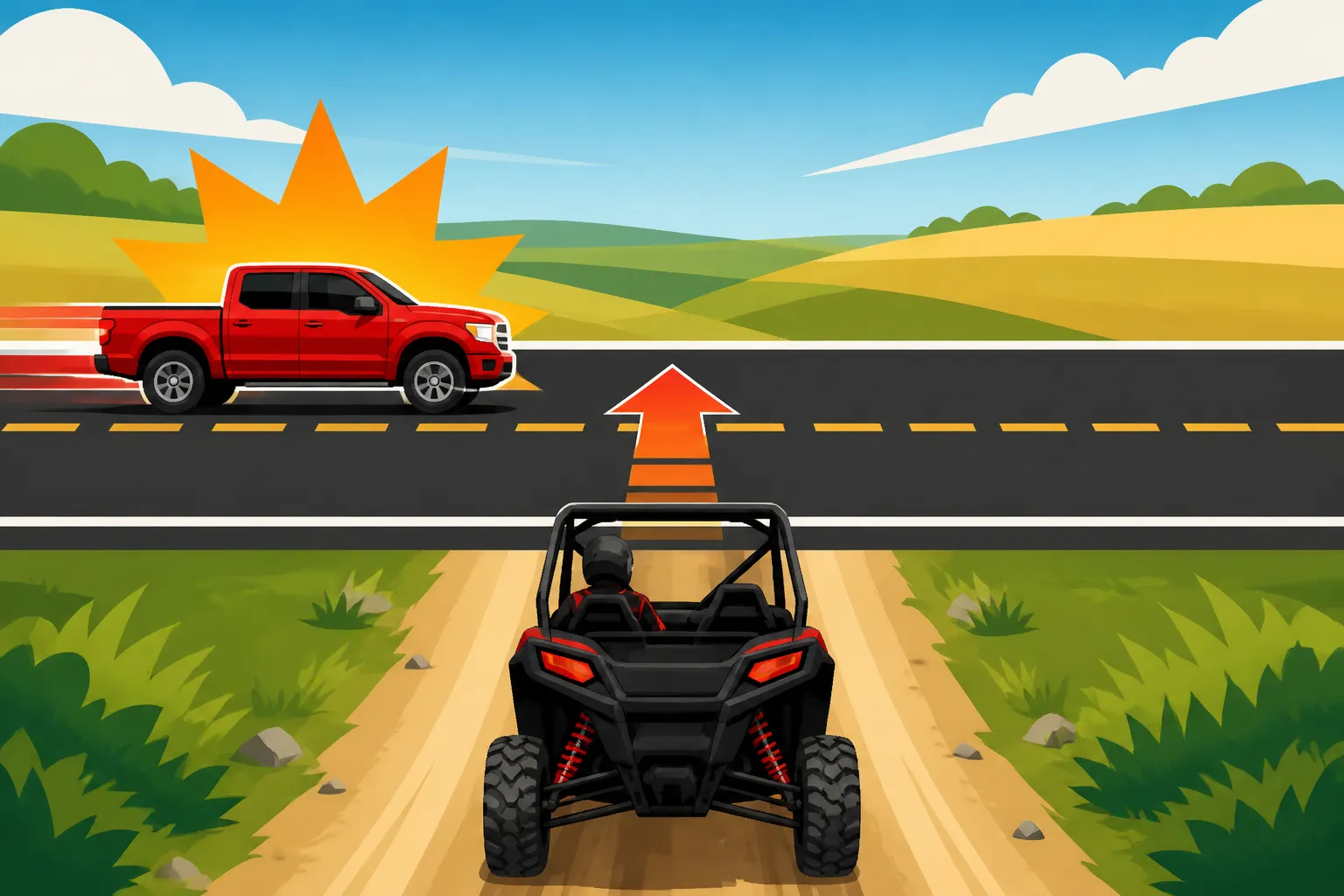
So, what exactly does "crossing at a ninety-degree angle" mean? It means you must approach the highway, make a direct, perpendicular crossing to the other side, and then immediately exit the highway surface. You cannot ride along the shoulder, drift diagonally, or take a scenic route across. Imagine drawing a perfectly straight line from where you enter the pavement to where you leave it, forming a "T" with the highway. That's your ninety-degree angle.
This rule exists for a very good reason: visibility and predictability. When an ATV or UTV crosses perpendicularly, it presents the smallest possible profile to oncoming traffic for the shortest duration. Drivers on the highway can more easily see you and predict your path. If you were to angle across, you'd be exposed to traffic for a longer time, and your movement would be harder for high-speed traffic to judge, dramatically increasing the risk of a collision. It's a quick, decisive maneuver, not a leisurely traverse. Any deviation from this direct path is not only illegal but incredibly dangerous.
Identifying "Controlled-Access" vs. Other Highways
Before you even think about crossing, you need to understand the type of highway you're dealing with, because not all highways are created equal in the eyes of Nebraska law. Some highways are absolutely, unequivocally off-limits, even for crossing. These are known as "controlled-access" highways.
Controlled-access highways are typically our Interstate systems and some major state highways that have limited entry and exit points, often via ramps and interchanges. You won't find direct driveway access or intersecting roads every quarter mile. The idea is to keep traffic flowing at high speeds with minimal interruption. Think I-80, or major sections of US-6 or US-30 outside of towns. Crossing these highways, even at a ninety-degree angle, is strictly forbidden. There's no legal exception for it. Attempting to do so would not only result in a significant penalty but could easily lead to a catastrophic accident.
However, many other state highways and larger county roads are not controlled-access. These are the ones where you might have direct farm entrances, smaller cross roads, or businesses lining them outside of city limits. It’s these types of highways where the ninety-degree crossing rule might apply, assuming you meet all other legal requirements (which we’ll get into). Always err on the side of caution. If you're unsure whether a highway is controlled-access, assume it is and find an alternate route. A quick check with your local county sheriff's office or Nebraska Department of Transportation map can sometimes clarify specific sections, but generally, if it looks like an Interstate, it probably functions like one in terms of ATV access.
Practical Steps for a Safe 90-Degree Crossing
Once you've determined that the highway you intend to cross is not a controlled-access highway and that your specific activity (like agricultural use) allows for such a crossing, the actual execution needs to be precise and deliberate. This isn't a time for casual riding; it's a serious maneuver that demands your full attention and adherence to safety protocols.
Pre-Crossing Checks and Situational Awareness
Before your wheels even touch the paved surface, you need to conduct a thorough mental and physical check. First and foremost, you must always be ready to yield to all traffic on the highway, no exceptions. [Nebraska Yielding at Every Crossing] isn't just a courtesy; it's the law. Your machine, even if it's a powerful UTV from a brand like SuperATV, is no match for a semi-truck or even a passenger car at highway speeds.
Here's a checklist of things to consider:
- Visibility: Can you clearly see both directions for a significant distance? Are there blind hills, curves, or large vehicles blocking your view? If not, do not proceed. Wait until you have an unobstructed view. This also means ensuring your ATV or UTV is itself highly visible.
- Traffic Assessment: How fast is the traffic moving? How much time do you have to cross safely? Remember, you need enough time to cross, plus a substantial buffer. Don't try to "beat" traffic. A gap that looks sufficient for a car might be too tight for your ATV or UTV to accelerate and clear safely.
- Machine Readiness: Is your engine running smoothly? Are your tires properly inflated? Do your brakes work perfectly? A stall or mechanical issue mid-crossing could be catastrophic.
- Driver Intent: Anticipate what other drivers might do. Are they slowing down, or speeding up? Are there any turn signals indicating they might be turning onto your road? Always assume the worst and prepare for it.
Beyond these points, ensure your machine is equipped with all legally required safety gear for road use. This includes having a [Nebraska's 5-Foot Safety Flag Rule] properly displayed, as well as operational [Nebraska Requires Head and Tail Lights], which should be on even in daylight.
Executing the Turn: From Shoulder to Shoulder
The physical act of crossing needs to be swift and unwavering. Once you have a clear, safe window, make your move.
- Approach the Edge: Slowly and carefully approach the edge of the highway on the shoulder. Don't crowd the lane. Stop if necessary to re-evaluate traffic.
- Look, Look, Look: Perform a final, thorough check in both directions. Your head should be on a swivel. Look twice, even three times.
- Accelerate Decisively: When the path is clear, accelerate smoothly and firmly directly across the highway. Maintain a steady, controllable speed. You want to get across quickly, but not so fast that you lose control. Avoid sudden jerks or swerving.
- Stay Straight: Maintain that strict ninety-degree angle. Do not drift with the flow of traffic or angle down the road. Go straight across, from one shoulder to the other.
- Exit Promptly: Once your wheels clear the paved surface and are safely on the opposite shoulder or into your intended access point, decelerate and continue on your way. Do not linger on the shoulder.
Remember, this is a maneuver for crossing, not for traveling any distance along the highway itself. Your goal is to minimize your time on the highway pavement to the absolute bare minimum required to get from one side to the other safely and legally. This is explicitly stated in the law as part of the conditions under which an ATV can operate on certain roads in Nebraska.
Equipment and Visibility for Highway Crossings
While Nebraska has specific laws regarding what an ATV or UTV needs to be "street legal" for certain types of road use (like within city limits that have an ordinance), the requirements for a highway crossing are often tied back to basic visibility and safety equipment. You're trying to stand out to drivers traveling at potentially 60-70 miles per hour, which is no small feat.
The Critical Role of Lights and Safety Flags
When you’re sharing a space, however briefly, with vehicles traveling at highway speeds, being seen is paramount. [Nebraska Requires Head and Tail Lights] to be operational whenever you are operating on a public road, and that includes crossing. Your headlight should be on, even in bright daylight, and your taillight should be shining bright. These aren't just for seeing where you're going; they're primarily for making sure others see you.
Beyond your standard lights, Nebraska has a specific rule for ATVs and UTVs on public roads: the safety flag. [Nebraska's 5-Foot Safety Flag Rule] mandates that you must have a triangular flag, at least 30 square inches in size and day-glow orange in color, mounted at least five feet above the ground. This flag is incredibly important for visibility, especially on roads with dips, rises, or tall crops along the edges. It helps make your machine visible to drivers of larger vehicles who might not immediately see your lower-profile ATV or UTV. When considering accessories for your machine, particularly if you know you’ll be doing legal highway crossings, investing in a robust flag mount and a high-quality flag is a smart move. Companies like SuperATV offer a range of visibility products, from flags to enhanced lighting, that can contribute significantly to your safety when operating near or on public roads. Think of it as your mobile billboard, screaming "I'm here!" to everyone around.
Rider Gear and Personal Responsibility
While Nebraska’s helmet statute specifically covers motorcycles and not ATVs, wearing a helmet is always a smart choice, especially when performing a high-risk maneuver like crossing a highway. Your brain is worth protecting, regardless of what the law says. Beyond a helmet, consider your clothing choices. Bright, contrasting colors will make you more noticeable than dark, drab attire. High-visibility vests or jackets are not just for construction workers; they're excellent for anyone operating machinery near traffic.
Ultimately, your greatest safety gear is your own personal responsibility and attention. There are no do-overs in a collision with a highway-speed vehicle.
Here’s a quick overview of essential gear and practices for highway crossings:
| Category | Requirement/Recommendation |
|---|---|
| Machine Lights | Headlight and taillight MUST be on (day or night) |
| Safety Flag | Day-glow orange, at least 30 sq. in., 5 ft. above ground |
| Personal Gear | Helmet (recommended), bright clothing, eye protection |
| Attitude | Hyper-focused, patient, prepared to yield |
| Machine Prep | Fuel, brakes, tires, and engine checked |
This table isn't just a list; it's a commitment to safety every time you approach a public road.
Common Misconceptions and Legal Pitfalls
The Nebraska laws around ATV and UTV road use are nuanced, and it’s easy to misunderstand them. Many riders, with the best intentions, can accidentally put themselves at risk or break the law due to these misunderstandings. It’s critical to distinguish between what’s allowed and what’s absolutely forbidden.
The Difference Between Crossing and Riding On a Highway
This is perhaps the most crucial distinction to grasp. Nebraska law provides for a very specific, limited exception for crossing certain highways, under stringent conditions. It absolutely does not provide an exception for riding on a highway for any sustained period or distance. You cannot ride down the shoulder, even for a short stretch, to reach a crossing point that's a bit further down the road. You cannot ride along the highway to the next section line. That's illegal road use, pure and simple.
The crossing must be direct and immediate from one side to the other. If your destination is 100 yards down the highway on the other side, you cannot make your ninety-degree crossing, turn, and then ride those 100 yards on the shoulder or even parallel to it. You must cross and immediately exit the highway surface. This rule is a major reason why [Nebraska Bans ATVs on State Highways] in general. The state's intent is to allow necessary movement across major arteries for purposes like farming, but not to integrate ATVs and UTVs into general highway traffic flow. Trying to stretch the definition of a "crossing" into "short-distance travel" is a recipe for trouble.
Penalties for Non-Compliance and Enforcement
Ignoring the rules for highway crossings can lead to serious legal and financial consequences, not to mention the immense safety risks. Law enforcement in Nebraska takes road safety very seriously, and deputies are well aware of the state's ATV and UTV laws. If you're caught violating the ninety-degree crossing rule, or riding on a highway where you shouldn't be, you could face:
- Fines: Significant monetary penalties are common for illegal road use.
- Court Costs: Beyond the fine, you'll likely incur court costs.
- Impoundment: In some cases, your ATV or UTV could be impounded, leading to additional towing and storage fees.
- Points on Your Driving Record: Depending on the nature of the violation, it could even affect your driver's license.
- Insurance Issues: Your insurance might not cover an accident that occurs while you were illegally operating your machine on a public road.
Deputies are within their rights to stop you and ask to see [What Paperwork a Deputy Can Ask to See], including proof of ownership and possibly even a driver's license if you're operating on a road. They're looking for compliance with the law, which includes understanding and following these specific crossing rules. Ignorance of the law is never a valid defense. Therefore, familiarize yourself with all the nuances of [Nebraska Penalties for Illegal Road Riding] and the specific statutes to avoid an unpleasant encounter. It's far better to find an alternative route, even if it adds a few extra miles, than to risk a ticket, a damaged machine, or worse, an injury.
Contextualizing Highway Crossings Within Nebraska's ATV Road Laws
To fully appreciate the ninety-degree crossing rule, it helps to understand it within the broader framework of Nebraska's ATV and UTV road laws. These rules aren't arbitrary; they are carved out with specific uses and safety considerations in mind, primarily revolving around the state's strong agricultural roots.
Farm Use and Agricultural Exemptions
One of the primary reasons ATVs and UTVs are granted any road access in Nebraska is for agricultural purposes. This is codified in [Nebraska's Agricultural Road Exception]. If you're using your machine for tasks directly related to farming, ranching, or other agricultural operations, the law provides for specific allowances, including the ability to cross certain highways. This could mean moving between fields, checking cattle, or transporting equipment related to a farm operation.
However, "farm use" is not a blanket exemption for joyriding. The activity must be directly connected to agricultural work. For instance, taking your quad from the farm to the local convenience store for a soda, even if you’re technically crossing a highway to do it, likely wouldn't fall under the agricultural exemption. The spirit of the law, as highlighted in [Why the ATV Road Law Was Written Around Farming], is to enable farmers and ranchers to conduct their essential work efficiently, not to make ATVs recreational street-legal vehicles. If your purpose isn't agricultural, then the highway crossing rules, strict as they are, might not even apply to you – meaning you shouldn't be crossing at all. Always be ready to explain the agricultural purpose if stopped by law enforcement.
The "Why" Behind Nebraska's Strict Rules
Nebraska has a relatively conservative approach to ATV and UTV road use compared to some other states. This isn't an oversight; it's a deliberate choice rooted in safety and the specific infrastructure of the state. Our highways are designed for high-speed vehicular traffic, and the inherent differences in size, speed, and safety features of ATVs and UTVs make them a poor match for sustained highway travel.
The ninety-degree crossing rule is a direct reflection of this concern. It minimizes the interaction time and predictability issues. While other states might allow ATVs on shoulders or even specific road types, Nebraska has generally opted for a more restrictive stance to protect both ATV riders and the general motoring public. This approach also helps avoid situations that could lead to widespread calls for [Nebraska Penalties for Illegal Road Riding] if accidents became commonplace.
It's also worth noting that while county roads often have more lenient rules – for example, [Nebraska Rules for Riding a County Road] are generally less restrictive than state highways – and some [Nebraska City Ordinances That Open Streets] or [How a County Board Opens a Village to ATVs] can allow limited street use within their jurisdictions, these local allowances do not override or change the state's highway crossing rules. A city ordinance allowing you to ride within city limits does not give you permission to ride a state highway, even if that highway passes through the city. Each level of government has its own jurisdiction, and the highway crossing rules apply specifically to state and larger county thoroughfares that aren't under controlled-access designation.
Understanding these underlying reasons can help riders not just follow the rules, but appreciate their purpose, contributing to a safer riding environment for everyone in the Cornhusker State.
Disclaimer
This article is for general informational purposes only and does not constitute professional advice. Laws, prices and regulations vary by location and change over time. Consult a qualified professional for guidance on your specific situation.