Nebraska Rules for Riding a County Road
It's a question that plagues almost every ATV and UTV owner in our great state: can you actually ride your machine on a county road in Nebraska? The confusion is real, and the frustration of knowing you have a perfectly capable vehicle but being unsure of its legal status on public thoroughfares is completely understandable. This guide is here to cut through the noise, clarify the specific Nebraska rules for riding county roads, and help you understand when, where, and how you might legally operate your ATV or UTV beyond your private property.
The Core Question: Can You Even Ride a County Road in Nebraska?
Let's get straight to the heart of the matter because this is where a lot of misunderstandings happen. The short answer, by default, is often "no," but there are crucial exceptions that can make county road riding perfectly legal under specific circumstances. It's not a blanket ban, but it's also not a free-for-all. Many riders get ticketed because they assume "county road" means "open to anything," and that's just not the case here in Nebraska.
The General Rule: Why Roads Are Often Off-Limits
The primary reason you can't just hop on your quad and cruise down a county road is rooted in how ATVs and UTVs are classified in Nebraska. Unlike cars or motorcycles, these machines are generally considered "off-road vehicles." They are designed for fields, trails, and private land, not public paved or gravel roads. In fact, when you title your ATV or UTV in Nebraska, the title often carries a specific notation: [Nebraska's Not To Be Registered Notation]. This notation is a big clue, signaling that the state doesn't intend for these machines to be registered for general highway use.
This can be incredibly frustrating for owners, especially those who live on rural properties or have land scattered across a county. You might need to go just a mile down the road to check on a pivot, visit a neighbor, or access another field, and suddenly you're faced with a legal gray area. Many folks buy an ATV or UTV specifically for utility and travel around their property and nearby areas, only to find the public roads in between are a legal minefield. It feels like you're stuck in limbo, with a machine perfect for the job but confined to a limited space.
The Agricultural Exception: When Farm Work Paves the Way
Now, for the good news – or at least, the big exception that many rural Nebraskans rely on. Nebraska law does provide a specific "agricultural exception" that allows ATVs and UTVs to operate on public roads, including county roads, for agricultural purposes. This isn't a loophole for joyriding; it's a recognition of the vital role these machines play in our state's agricultural backbone.
So, what exactly counts as "agricultural purposes"? Think about the daily realities of farm and ranch life. This includes things like checking livestock, moving between fields for planting or harvest, inspecting irrigation equipment, hauling small tools or supplies from one part of the farm to another, or doing maintenance on fence lines. Imagine a rancher using their side-by-side to cross a county road to get from the main barn to a distant pasture where a new calf might be struggling. Or a farmer needing to drive a short distance on a gravel road to get to the next section of pivot for inspection. These are classic examples of the agricultural exception in action.
However, even with this exception, there are critical rules you absolutely must follow. First, you need to be properly licensed. This means having a valid Class O operator's license (a standard driver's license) or a farm permit if you're a qualified minor. [Nebraska Requires a Class O License or Farm Permit]. Second, and this is a big one, you need to carry liability insurance. Just like driving a car, if you're operating on a public road, you're required to have coverage. [Nebraska Requires Liability Insurance on Roads] to protect yourself and others in case of an accident. Ignoring these basic requirements can quickly turn a legal agricultural trip into a costly legal headache, even if your purpose was legitimate.
Local Control: How County Boards Open Up Roads
While the statewide agricultural exception is a huge relief for many, it doesn't cover every situation. What if you live in a small, unincorporated village and want to use your UTV to go to the local store or visit a neighbor across town? That's where the power of local control comes into play. Nebraska law allows local governmental bodies, such as county boards, to pass specific resolutions or ordinances that can open certain county roads to ATV and UTV traffic within their jurisdiction.
The Power of Local Ordinances: Unincorporated Villages
It's important to understand the distinction between cities and unincorporated villages. Cities have their own municipal ordinances, which we'll save for another discussion. For county roads, specifically those winding through or connecting unincorporated villages, a county board can take action. [How a County Board Opens a Village to ATVs] explains that this means the local elected officials for your county can vote to allow ATV and UTV use on designated county roads within a specified area, often tied to these smaller, non-incorporated communities.
This process usually involves local residents or groups advocating for the change. It’s not uncommon for a county board to hold public hearings, gathering input from the community, law enforcement, and other stakeholders before making such a decision. If you live in an unincorporated area and believe opening certain county roads would be beneficial and safe, reaching out to your county commissioner or attending board meetings to express your views can be a powerful way to initiate change. Always remember, though, that if such an ordinance is passed, it will come with its own set of rules and limitations that you must strictly adhere to. It's not a free pass for unrestricted riding, but rather a carefully carved out opportunity.
Specific Requirements for Road-Legal Machines
When county roads are opened up, either through an agricultural exception or a local ordinance, your machine needs to be equipped to handle the road environment safely and legally. These aren't just suggestions; they're legal requirements designed to protect you and other motorists.
Here’s a breakdown of what your machine needs:
| Requirement | Details |
|---|---|
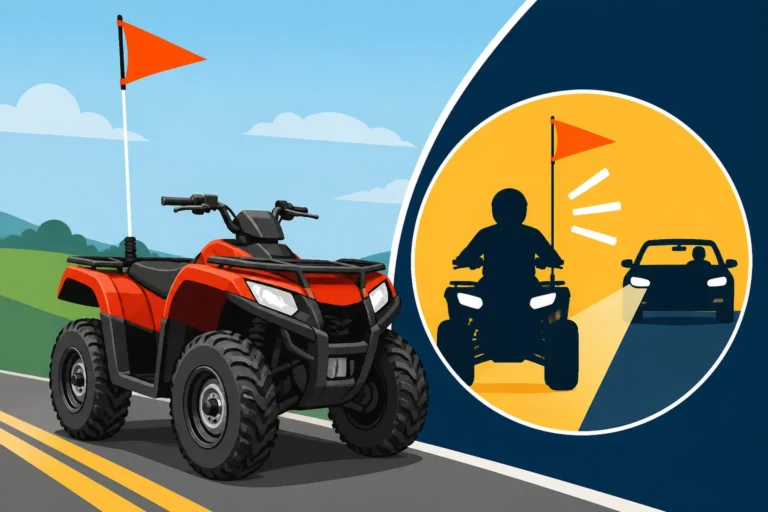
| Safety Flag | Must be a day-glow orange or red triangular flag, at least 30 square inches, mounted on a pole at least 5 feet above the ground. This is crucial for visibility on roads where you might be lower than other vehicles. [Nebraska Safety Flag Dimensions] |
| Head and Tail Lights | Your ATV/UTV must have working headlights and taillights. While daylight riding is the norm, these lights are often required to be on even during the day for increased visibility. [Nebraska Requires Head and Tail Lights] |
| Brakes | Fully functional brakes on all wheels. |
| Muffler | An adequate muffler to prevent excessive or unusual noise. |
| Rearview Mirror | At least one rearview mirror. |
| Speed Limit | Even if permitted, you generally cannot exceed 30 mph on a public road. This is a critical safety rule for slower-moving off-road vehicles. [Nebraska's 30 mph Road Limit] |
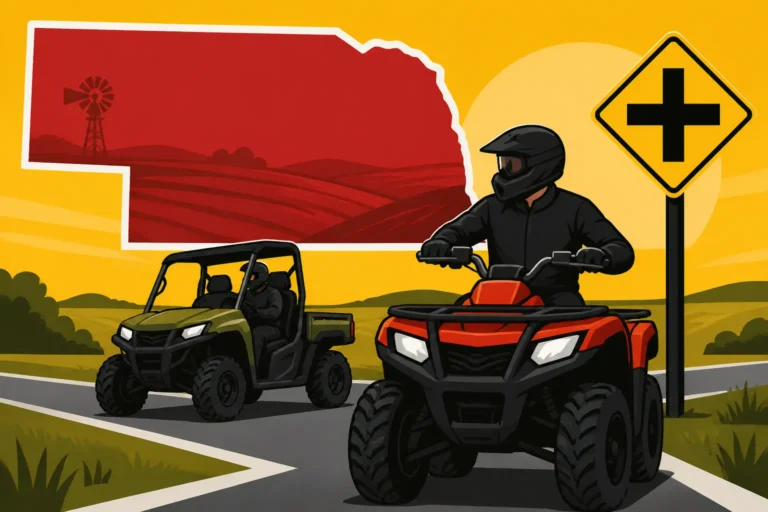
| Crossing Highways | When crossing a state highway or controlled-access highway, you must do so at a 90-degree angle, after coming to a complete stop and yielding to all traffic. [Nebraska Crossing Rules at Ninety Degrees] |
| Insurance | As mentioned, liability insurance is non-negotiable for road use. Be aware that minimums can change, so stay informed on [Nebraska Insurance Minimums Today] and future changes like [Nebraska Insurance Minimums From 2027]. |
| Driver's License | A valid Class O driver's license or a farm permit is required for the operator. |
Beyond these legal requirements, consider some practical safety enhancements. While the state doesn't mandate helmets for ATVs, wearing one is always a wise choice for your safety. Good tires are also essential. If you're spending any time on gravel or paved county roads, ensure your tires are in good condition and suitable for mixed terrain. Companies like SuperATV offer a range of tires and accessories designed for durability and performance across various conditions, which can make your ride safer and more comfortable. Having high-quality components, like robust control arms or heavy-duty axles from SuperATV, can also add a layer of reliability when navigating county roads that might not be as smooth as a typical paved street.
Practicalities and Pitfalls of County Road Riding
So, you've checked the boxes: your purpose is agricultural, or your county has an ordinance, and your machine is equipped. You're ready to roll, right? Not quite. There are still practical considerations and potential pitfalls to navigate when using county roads. Assuming you're good to go without verifying specifics can land you in hot water.
Verifying Legality: Don't Assume
This is perhaps the most crucial piece of advice: never assume a county road is open to ATV or UTV traffic. Laws and local ordinances can be complex and vary from one county to another, and even within different parts of the same county. A conversation with your local Sheriff's office or County Clerk is invaluable. Don't be afraid to [Ask the Sheriff Whether a County Road Is Open]. They are the ones who enforce these rules, and they can provide the most accurate and up-to-date information for your specific area.
Riding illegally can lead to significant consequences. [Nebraska Penalties for Illegal Road Riding] can include fines, court costs, and potentially even impoundment of your machine. Imagine getting pulled over for a quick, seemingly innocent trip down a county road, only to be hit with a hefty [Nebraska Ticket Costs for Road Riding] and having your weekend plans (or even your work plans) completely derailed. It's simply not worth the risk. Always do your homework before you head out.
Safety and Sharing the Road
When you do ride legally on a county road, safety becomes paramount. You're sharing the road with cars, trucks, and sometimes even large agricultural equipment like combines and grain trucks. These vehicles are bigger, faster, and often don't expect to see an ATV or UTV.
- Visibility is Key: Your 5-foot safety flag helps, but you can do more. Wear bright, high-visibility clothing. Consider adding reflective tape to your machine, especially if you might be out near dusk or dawn. [Adding Reflective Tape to an ATV for Road Use] can make a huge difference in how quickly other drivers see you.
- Road Conditions: Many county roads are gravel. This means dust, loose surfaces, and potential washboards. [Riding in Dust on a Gravel County Road] can severely reduce your visibility and that of others. Slow down, keep a safe distance from other vehicles, and be aware of how gravel affects your handling. And speaking of other vehicles, those [Sharing a Gravel Road With Grain Trucks at Harvest] need to be particularly cautious, as those trucks are heavy, fast, and kick up a lot of dust.
- Yield to Others: Always remember that as an ATV or UTV on a county road, you are typically the slower and less prominent vehicle. Be prepared to yield to larger and faster traffic. Pull over safely to let vehicles pass, and always signal your intentions clearly.
Maintaining Your Machine for Road Use
While ATVs and UTVs are rugged, consistent road use, particularly on gravel, can put different stresses on your machine than trail riding. Tires designed for off-road grip might wear down much faster on hard surfaces. Dust from gravel roads can clog air filters quickly, leading to performance issues if not addressed.
Regular maintenance becomes even more critical. Check your tire pressure frequently, as proper inflation helps with handling and tire longevity. Keep your air filter clean, especially in dusty conditions. Inspect your brakes, lights, and steering components often. Investing in durable aftermarket parts, perhaps from a brand like SuperATV, can sometimes provide added resilience for machines that see regular county road duty. A well-maintained machine is not only safer but also less likely to break down when you're miles from home.
This article is for general informational purposes only and does not constitute professional advice. Laws, prices and regulations vary by location and change over time. Consult a qualified professional for guidance on your specific situation.