One Exception Lets ATVs Onto Frozen Water
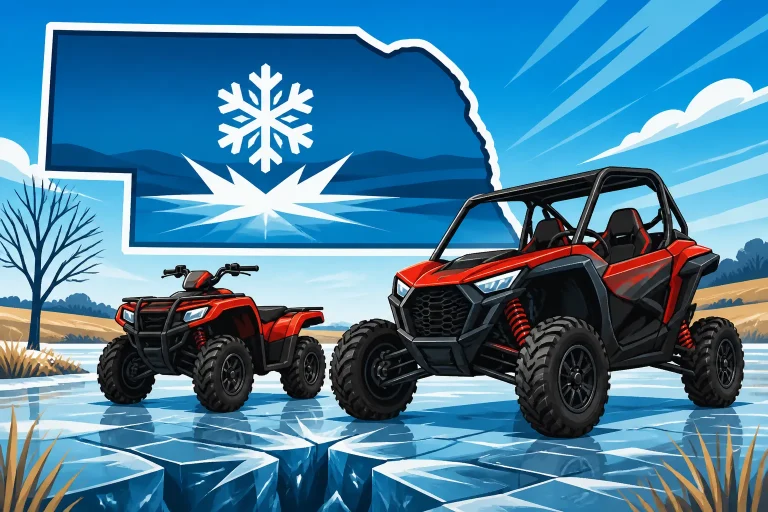
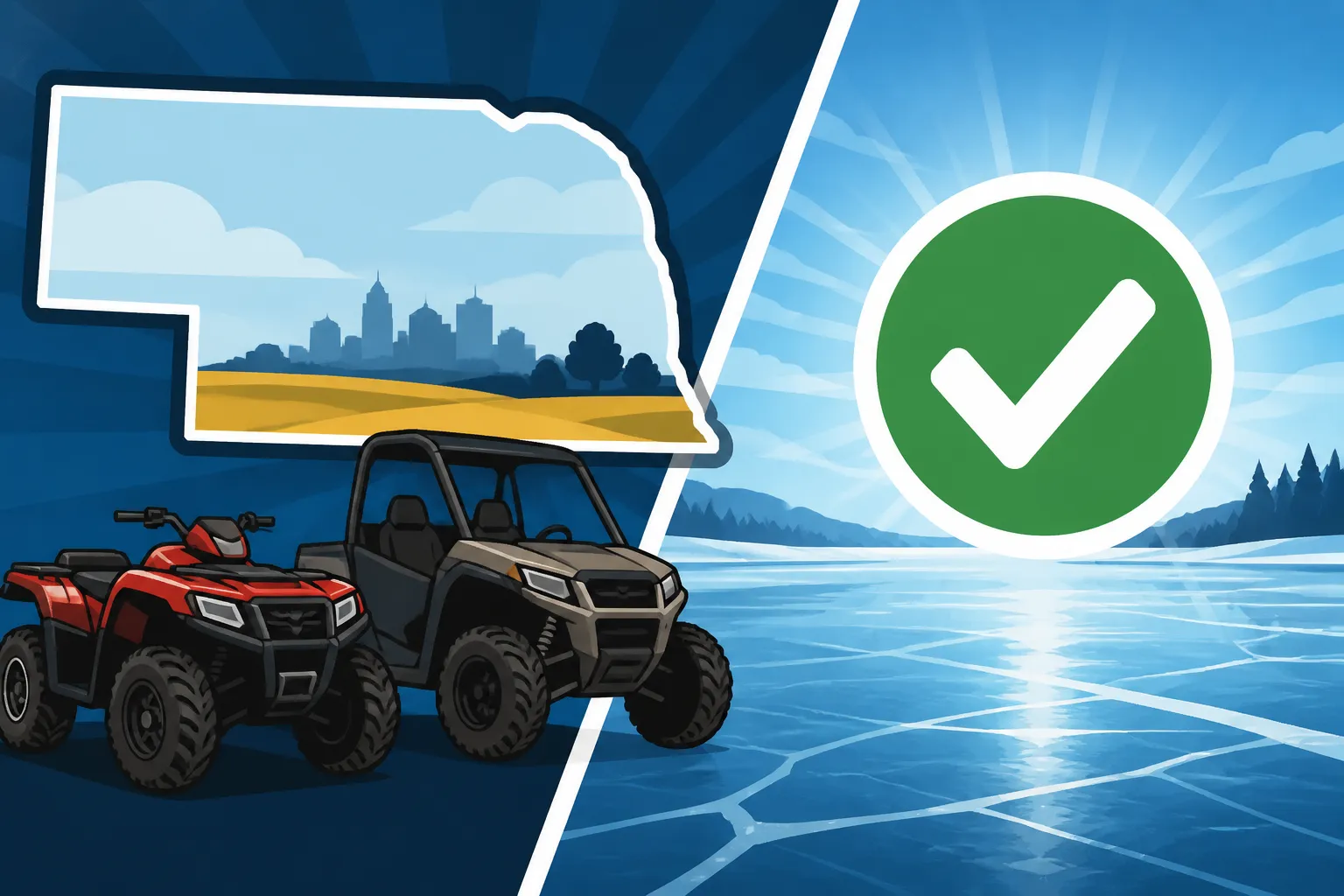
A frozen lake can look like a wide-open riding area, but ice does not erase the rules that apply to the land and water around it. Nebraska has a narrow exception that may allow ATV use on certain frozen waters. The practical key is to confirm where it applies, check for closures and keep the exception separate from general trail access.
What the frozen-water exception means
Nebraska’s restrictions on motorized vehicles in public recreation areas and wildlife management areas do not automatically make every frozen surface off-limits. A limited exception can allow riding on the ice-covered surface of a lake in the places where that rule applies. It is an exception for the frozen water itself, not a general opening of the surrounding public land.
That distinction matters because an ATV may be prohibited on the shoreline, access road, parking area, or trails even when riding on the ice is allowed. A lake being frozen is not, by itself, proof that it is open to motorized use. The property’s rules and signs still control.
For a rider, the safest interpretation is narrow: confirm that the specific lake and public property allow the activity, stay on the permitted frozen surface, and follow any posted restrictions. Do not assume a rule for a wildlife management area also applies at a state park or recreation area. These are separate property categories with their own rules.
| Situation | What to check |
|---|---|
| Riding on a frozen lake at a wildlife management area | Whether the area allows ice riding and whether the lake or access is posted closed |
| Riding across land to reach the ice | Whether the route is an open, designated roadway or otherwise allowed |
| Riding at a state park or recreation area | Whether ATVs are prohibited there, regardless of the frozen-water exception |
| Visiting from another state | Whether you need a park entry permit for the property you plan to enter |
| Finding no sign at the access point | Confirm the applicable property rules before riding; lack of a sign is not permission |
The exception is not the same as a statewide ATV registration, off-highway vehicle sticker, or general public-land riding permit. Nebraska does not issue a statewide OHV sticker that opens public land to ATV use. Likewise, permission to ride on a particular frozen surface does not turn the shoreline or nearby trails into ATV routes. For the broader distinction between state permits and vehicle documents, see Nebraska Has No OHV Permit or Sticker.
Where the exception may apply and where it does not
Wildlife management areas
Wildlife management areas, often shortened to WMAs, are managed for wildlife and public use. Vehicle access is generally limited, so riding on a WMA should not be treated like riding at an off-road park. A narrow allowance for a frozen lake, when it applies, does not authorize free travel around the management area.
Before heading out, identify the exact WMA and lake. Then check its current access information and posted signs. A property may have designated roads, parking areas, or other limits that affect how you get to the water. The rules for a quad on a WMA are covered in Nebraska WMA Access for a Quad, while [Nebraska WMA Roadway Rules] explains why a route across land should not be assumed open simply because it leads to a frozen lake.
Pay attention to boundaries, too. The ice may border a public management area, private land, or another kind of public property. Permission to ride on one parcel does not transfer to the next. If reaching the ice requires crossing private land, obtain the landowner’s permission before entering.
State parks and recreation areas
Do not assume the frozen-water allowance applies at a Nebraska state park or state recreation area. ATVs are generally not allowed in Nebraska state parks, and recreation areas have their own restrictions. Check the rules for the specific property rather than using a WMA rule as a substitute. Nebraska State Parks Ban ATVs and Nebraska Park Rules for ATVs cover those separate restrictions.
This is an easy distinction to miss because a lake and its shoreline may appear to be one continuous place. In practice, management boundaries and rules matter. A frozen lake adjoining a park does not become an ATV riding area just because the ice is firm, and a nearby WMA rule does not create access through park land.
Other frozen water
The exception should not be read as permission to ride on any frozen pond, river, reservoir, or private lake in Nebraska. The land manager’s rules, access rights, local restrictions, and posted closures still matter. A frozen surface may be physically reachable but legally closed to vehicles.
If you cannot establish who manages the property or what rules apply, choose another riding location or contact the relevant land manager before unloading. A lack of a gate or closure sign does not necessarily mean motorized use is allowed.
How to check whether a particular frozen lake is open
Use a property-specific check instead of relying on a general description of the exception. Conditions and closures can vary from one area to another, and a posted restriction may apply even where ice riding is otherwise permitted.
- Identify the exact property. Find the name of the WMA, park, or recreation area and determine who manages it. A lake’s common name may not tell you which property rules apply.
- Check the applicable riding rules. Look for the land manager’s current vehicle and ice-access rules. [Nebraska WMA Ice Riding Rules] is a useful starting point for understanding the WMA context, but check the specific area as well.
- Look for closures and signs. A closure can apply to the lake, a portion of the shoreline, an access route, or the entire property. Read signs at entrances, parking areas, and the edge of the ice. Signs That Close an Ice Area and Reading the Signs That Close a Frozen Lake explain why a sign should be treated as a rule, not a suggestion.
- Confirm how you may reach the ice. A permitted destination does not automatically make every route to it legal. Check whether the road or staging area is open to your machine and whether the vehicle must stay on designated routes.
- Ask the managing office if anything is unclear. Describe the specific lake, access point, machine, and planned route. A clear question is more useful than asking generally whether “ATVs are allowed on ice.”
If a sign prohibits motorized use, follow it even if you have heard that the lake is usually open. If signs conflict or are difficult to interpret, pause and ask the land manager rather than treating the less restrictive sign as permission. Closures may also be temporary, so an old report or a previous visit is not enough to establish current access.
A park entry permit is a separate question. State park and recreation-area permits relate to entry to those properties; they do not make a prohibited ATV activity legal. For a WMA, do not assume a park permit is required or that buying one grants vehicle access. Does a Frozen WMA Lake Need a Park Permit? addresses the difference between property entry requirements and permission to ride.
Ice safety and responsible riding
Legal access and safe ice are separate issues. Permission to ride on a frozen surface does not certify that the ice is thick enough to support a machine, and a trail or road opening does not guarantee safe conditions across the lake. Ice can vary over short distances because of currents, springs, inflows, changing temperatures, snow cover, and other local conditions.
Before traveling, check current local information and make a conservative decision. Do not rely on a frozen-looking surface, tracks left by another rider, or a single measurement taken somewhere else on the lake. Conditions can change, and the load and movement of a machine differ from those of a person on foot.
Keep these points in mind:
- Do not ride alone in an isolated area. Tell someone where you are going and when you expect to return. Carry a way to contact help, while recognizing that cell service may be limited.
- Stay away from uncertain ice. Avoid inlets, outlets, visible cracks, open water, and places where water is moving. If conditions are unclear, turn back.
- Use appropriate cold-weather safety gear. A helmet and protective clothing help reduce injury risk, but they do not make weak ice safe. Consider carrying equipment suited to cold-water emergencies and know how to use it.
- Keep speed and spacing under control. Sudden turns, hard acceleration, and close-following can create avoidable hazards. Give other riders plenty of room.
- Avoid fragile shorelines and vegetation. Do not widen an access route or cut across sensitive habitat to reach the water.
- Leave the area as you found it. Pack out litter, avoid disturbing wildlife, and do not block gates, roads, or emergency access.
The most important decision may be choosing not to ride. If the ice condition is uncertain, if the route is unclear, or if the area’s rules cannot be confirmed, the exception is not a reason to take a chance.
Common mistakes that can turn the exception into a problem
Treating “frozen lake” as a blanket permission
The exception is limited by the place and its rules. One WMA’s conditions do not establish the rules for a different WMA, private lake, park, or recreation area. Confirm the property rather than relying on a general statement about Nebraska.
Riding across land that is not open to ATVs
Even when riding on ice is allowed, crossing the shoreline or nearby land may not be. Stay on routes that are open to your machine. If the only way to reach the ice appears to cross a closed area or private property, do not use that route without clear authorization.
Confusing a park entry permit with riding permission
A permit can satisfy a property-entry requirement, but it does not override a vehicle ban, a seasonal closure, or a posted restriction. Conversely, a rider should not assume that a park permit is needed for every WMA. Check the specific land category and its current requirements.
Assuming an out-of-state registration provides access
A vehicle document from another state does not create permission to ride on Nebraska public land. Nebraska does not have a statewide ATV trail sticker that serves as general access authorization. Visitors still need to follow the Nebraska property rules and any applicable entry requirements. For broader visitor questions, see Nebraska Visitors Need No State Sticker.
Trusting old information or tracks on the ice
A previous season’s access information may no longer apply, and tracks are not proof that riding is currently legal or safe. Closures can change, and another rider may have entered unlawfully. Check current signs and property guidance before unloading.
When the answer is uncertain, make the check before towing to the site. Confirm the exact property, the route, any entry permit, and whether the lake is open to motorized use. A short call to the land manager can prevent a long trip to a closed access point or an avoidable violation.
Frequently Asked Questions
Does the frozen-water exception let me ride anywhere on a WMA?
No. It is a narrow allowance for frozen water where the applicable rules permit it. It does not make all WMA roads, shorelines, trails, or other land open to ATV use.
Can I ride on a frozen lake inside a Nebraska state park?
Do not assume so. State parks have separate restrictions, and ATVs are generally prohibited there. Check the specific property’s rules and signs before bringing a machine.
Does a park permit let me ride my ATV on the ice?
No. A park entry permit does not override a vehicle restriction or closure. Check both the property’s entry requirements and its rules for motorized vehicles.
Is a frozen lake automatically safe for an ATV?
No. Legal access does not guarantee safe ice. Conditions can vary across a lake and change over time, so avoid riding where ice strength is uncertain.
Disclaimer
This article is for general informational purposes only and does not constitute professional advice. Laws, prices and regulations vary by location and change over time. Consult a qualified professional for guidance on your specific situation.