Nebraska Hunting License and Land Access
A Nebraska hunting license may let you hunt during an eligible season, but it does not automatically let you drive an ATV or UTV wherever you can hunt. The key is to check two separate permissions: whether you may hunt on the land and whether you may take a motorized vehicle onto it.
What a Nebraska hunting license does and does not allow
A hunting license is permission to hunt when you meet the requirements for the species, season, and location. It is not a general land-access pass, an ATV registration, or permission to ride on roads and trails. Those are separate questions, and each can have its own rules.
Think of a hunting trip as involving at least three distinct permissions:
- Permission to hunt: Do you have the right license, permit, and season authorization for the species?
- Permission to enter the land: Is the property open to hunting, and are you allowed to enter it?
- Permission to use a machine: Are ATVs or UTVs allowed on the particular route or area you want to ride?
A yes to one does not mean yes to the others. For example, a hunting license does not give you permission to cross a private field to reach public land. Likewise, access to hunt on a property does not necessarily include permission to drive across it.
| Situation | What the hunting license establishes | What you still need to check |
|---|---|---|
| Hunting on private land | Your hunting eligibility for the applicable season and species | Landowner permission and whether machine use is allowed |
| Hunting on public land | Your hunting eligibility | The property’s access, vehicle, parking, and seasonal rules |
| Hunting on enrolled walk-in land | Your hunting eligibility | The enrollment terms, posted limits, and whether any vehicle access is allowed |
| Riding on a public road to reach a hunting area | Nothing about road access | Road-use laws, local rules, required equipment, and insurance |
| Retrieving game with an ATV or UTV | Nothing about vehicle use | Landowner or land-manager authorization and any applicable retrieval rules |
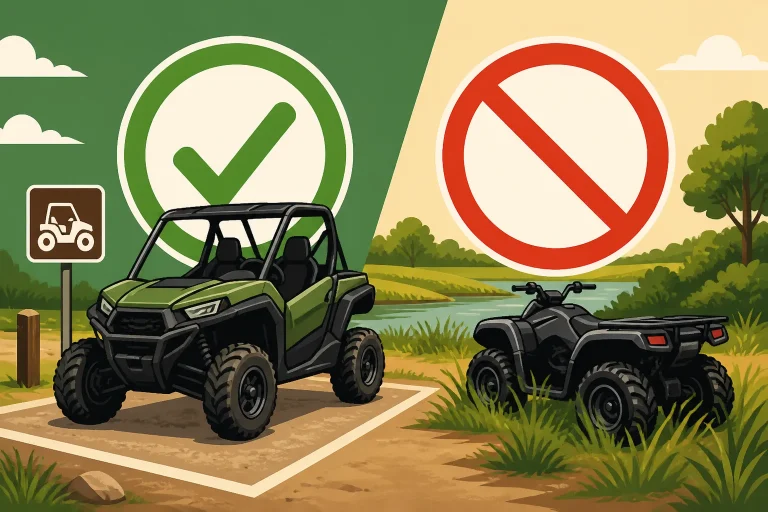
This separation matters because it is easy to mistake permission to hunt for permission to drive. A landowner might allow you to walk in and hunt but ask that vehicles stay at the entrance. A public property might allow hunting while restricting motorized travel to designated roads. A trail or road open to other users may still be closed to ATVs.
The same is true of state permits. Nebraska does not have a general state OHV permit or sticker that turns a hunting area into a riding area. And a park permit, when one is required for a separate activity, does not grant ATV access where machines are prohibited. For details about public-land permits and vehicle rules, see Nebraska Hunting Land Access by Machine and Why a Park Permit Does Nothing for Your ATV.
Before you leave, identify the exact parcel, access point, and route. “I have a hunting license” is not enough information to determine whether you may cross a particular property or ride a particular road. If the property is managed by an agency, check the current property-specific rules and posted signs. If it is private, ask the owner directly.
Land access is separate from license eligibility
Private land and landowner permission
A hunting license does not give you permission to hunt on private property. Get permission from the landowner or the person authorized to control access before entering. Do not assume that a gate left open, a field road, or a previous invitation means you have permission for a new trip.
Ask about the route as well as the hunt. Permission to hunt may cover walking access but not driving an ATV or UTV. Clarify whether you may:
- Drive from the road to a parking or unloading area
- Use a particular farm lane or field road
- Cross a field to reach a hunting location
- Park or leave a trailer on the property
- Use a machine to retrieve game
- Bring another rider, passenger, or hunting companion
- Return at a different time or during a different season
It helps to be specific. Rather than asking, “Can I hunt your place?” ask which part of the property you may enter, how you should reach it, where to park, and whether motorized travel is allowed. A landowner may set conditions even when the hunt itself is permitted. Follow those conditions and close gates as directed.
For a practical reminder about written permission, see Carrying a Landowner’s Written Permission in Your Pocket. A written note does not replace any required license or legal access permission, but it can help avoid confusion about what the owner agreed to.
Public land and enrolled access
Public ownership does not mean every parcel is open to every activity. Different properties can have different rules for hunting, camping, parking, and motorized vehicles. A boundary may also separate public land from private land, so check the map and access point rather than assuming a nearby road provides an entrance.
Wildlife management areas often have specific rules for where vehicles may travel and park. Do not treat a two-track, maintenance road, or visible path as an ATV trail unless the property’s rules or signs say it is open to your machine. Some roads may be available for access while off-road travel is restricted. Conditions can also change with weather, habitat work, seasonal closures, or management needs. Check the signs at the property and the current information from the managing agency.
Walk-In Access properties are another case where the distinction is important. Enrollment generally concerns access for the activities and conditions stated for that property; it should not be read as permission to drive an ATV across the land. Check the current property listing and signs for the permitted activity and access method. If the rules do not clearly authorize motorized travel, do not ride onto the property.
Hunting access and vehicle access can also differ on land managed by federal agencies, local governments, or other public entities. A machine might be allowed on a designated road but not on surrounding trails or ground. Rules for one public property do not automatically apply to another.
Use Nebraska WMA Access for a Quad and Nebraska WMA Roadway Rules when checking wildlife management areas. For access to hunting ground generally, Your Hunting License Does Not Open Any Trails explains the central distinction: hunting permission does not make a route legal for riding.
When an ATV or UTV can be part of a hunting trip
The safest approach is to plan motorized travel as its own part of the trip. Start with the place you intend to hunt, then identify where you will unload, park, and ride. Confirm that each part of the route is allowed, including any stretch on a public road.
Stay on routes that are actually open
On a public property, follow the posted vehicle rules and stay on routes expressly open to the kind of machine you are using. Do not assume a route is open because it is wide enough, has tire marks, or appears on an old map. A road used by agency staff may not be open for public ATV travel.
If a route is closed, do not ride around the barrier or use the edge of the road to get past it. A short detour across grass, crops, or a field can create a trespass or resource-damage problem, even if the intended destination is public land. When signs are unclear, ask the property manager before riding.
Where a public road is part of the trip, road-use rules apply separately from hunting and property rules. Nebraska has limited circumstances in which ATVs may use certain roads; an eligible hunting trip does not create an exception by itself. City ordinances, county decisions, road type, required equipment, and other conditions can affect whether a particular road is open. Review Can You Drive an ATV on the Road in Nebraska? and Nebraska Rules for Riding a County Road before planning a road connection.
Do not assume that an ATV can use a ditch, section line, farm lane, or shoulder as an alternative route. Each has its own access and safety issues. A route across private land still requires permission, and a public road may be closed to ATVs even when it appears to be a convenient way to reach a hunting area.
Game retrieval needs separate planning
If you hope to use a machine to retrieve harvested game, ask about that use before the hunt. Permission to hunt does not automatically include permission to bring an ATV or UTV to the animal. On private land, obtain the landowner’s approval for the route and the retrieval method. On public land, check the managing agency’s rules for the specific area and season.
Do not assume a machine can leave an approved road to reach a location. Restrictions may apply even when the purpose is retrieving game. If motorized access is not allowed, arrange a legal alternative, such as carrying the animal out or using an authorized route. Local conditions and property rules matter, so get a clear answer before relying on a machine.
Also consider whether the vehicle can safely reach the location without damaging crops, vegetation, fences, wetlands, or other property. A route that is passable does not necessarily mean it is permitted. If you cannot confirm that riding is allowed, leave the machine in an approved parking area and proceed on foot.
A hunting license does not make a machine road-legal
If your route uses public streets or roads, the machine must meet the rules that apply to that road and rider. A hunting license does not replace a driver’s license or any required farm permit, insurance, equipment, or local authorization. Road access is narrow and conditional, so verify the route instead of relying on the idea that a hunting-related trip is automatically allowed.
Nebraska’s road-use rules can involve requirements such as rider qualifications, liability insurance, lighting, a safety flag, travel times, speed limits, and restrictions on which roads may be used. These requirements are separate from the rules for hunting on the land. See Nebraska Rules for Riding a Ditch and Nebraska Rules for Riding a Section Line before using either as part of a route.
An ATV that has a Nebraska title is not automatically permitted on public roads. A title proves ownership; it does not provide a plate or general road-registration permission. The distinction is explained in Why a Titled ATV Still Has No Plate. Likewise, an out-of-state registration does not automatically make every Nebraska route available to a visiting rider. Check the rules for the machine and the road you plan to use.
Plan the trip before loading the machine
A quick check before departure can prevent a wasted trip, a trespass problem, or an avoidable citation. The goal is to confirm the hunt, the property, and the vehicle route separately.
- Identify the exact hunting property. Use a current map or property information, and verify the boundary and authorized entrance. Do not rely only on a general label such as “public land” or “walk-in ground.”
- Confirm your hunting authorization. Check that your license and any other required authorization fit the species, location, and season.
- Ask whether you may enter. For private property, contact the owner or authorized person. For public or enrolled land, read the property-specific rules and posted signs.
- Ask separately about the machine. Confirm whether an ATV or UTV may enter, which routes are open, where you may park, and whether game retrieval by machine is allowed.
- Check every road in the route. Do not assume the road to the property is open to ATVs just because the property is open to hunting. Review Nebraska Rules for Crossing a Highway if a crossing is part of the trip.
- Confirm access conditions on the day you go. Closures, weather, field conditions, and posted restrictions can affect access. If a sign or barrier conflicts with an older map or plan, follow the current restriction and ask the manager if needed.
- Bring useful documentation. Carry your hunting credentials and any permission or property instructions you have been given. For a machine used on a road where documentation may be requested, review What Paperwork a Deputy Can Ask to See.
If you cannot get a clear answer about motorized access, use a different route or leave the machine at a permitted staging area. Do not treat uncertainty as permission. A few minutes spent contacting the landowner or land manager is usually easier than sorting out a disagreement after riding onto land or a route that was closed.
The key takeaway is simple: a Nebraska hunting license addresses hunting eligibility, not land access or ATV and UTV use. Confirm permission to hunt, permission to enter, and permission to ride as three separate parts of the same plan.
Disclaimer
This article is for general informational purposes only and does not constitute professional advice. Laws, prices and regulations vary by location and change over time. Consult a qualified professional for guidance on your specific situation.