Nebraska Game Retrieval by Machine
Retrieving legally harvested game with an ATV or UTV can save time and effort, but the machine does not give you permission to cross land or drive wherever you choose. In Nebraska, the key questions are where the animal lies, what access rules apply there, and whether your route is allowed. Plan the recovery before riding in.
Separate game retrieval from hunting
An ATV or UTV may help carry a harvested animal, but using a machine to pursue, locate, or take wildlife raises different legal issues. Do not assume that permission to retrieve game also permits hunting from a vehicle or driving through closed habitat. Before the season, review the current rules for the species you are pursuing and the land where you expect to hunt.
The distinction matters in practice. A machine used only after a lawful harvest is not a pass to follow an animal across property lines, leave an approved route, or keep riding until you find it. If the animal is wounded or has moved, follow the applicable hunting rules and land-access conditions rather than treating the situation as ordinary recovery.
A hunting license also does not create access rights. Public land may have its own vehicle restrictions, while private land requires the landowner’s permission. The broader rules in Nebraska Hunting License and Land Access and Nebraska Hunting Land Access by Machine can help clarify these separate questions.
Before moving game, check the requirements for your species and permit. Tagging, validation, reporting, and transport rules can differ by species and may change. Follow the instructions that apply to the permit you hold, and do not rely on a general assumption about when a tag must be attached or a harvest reported. If the rules are unclear, ask Nebraska Game and Parks or the land manager before the hunt.
A useful way to think about the process is:
- Confirm that the harvest and permit requirements are satisfied.
- Identify the property where the animal is located and the route you would need to take.
- Confirm that you have permission to access that property and use a machine there.
- Check any public-land, road, trail, or seasonal restrictions that apply.
- Retrieve the animal without pursuing other wildlife or continuing beyond the authorized route.
| Situation | What to confirm before riding |
|---|---|
| Animal on private land | Landowner permission for entry and machine use |
| Animal on a wildlife management area | Whether the route and vehicle use are allowed there |
| Animal near a property boundary | Which parcel the route crosses and who controls access |
| Animal on or beside a public road | Road rules, safe loading, and any restrictions on stopping or parking |
| Animal in difficult terrain | Whether recovery can be done without leaving an allowed route |
When a recovery plan depends on a narrow exception, a verbal guess from another hunter is not enough. Check the current rule or contact the relevant land manager. Conditions may also differ between public properties, so a route that is legal at one site may not be legal at another.
Check land access and vehicle rules before the hunt
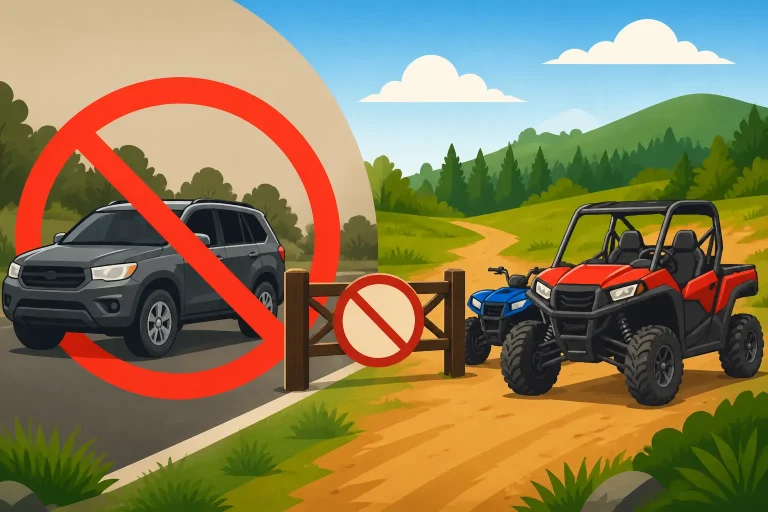
The biggest mistake is treating an open hunting area as if every part of it is open to motorized travel. A public property can allow hunting while limiting ATVs to particular roads or access points. A private parcel can allow foot access but prohibit motorized vehicles. A trail that appears usable may be closed, restricted, or on land you do not have permission to enter.
On Nebraska wildlife management areas, check the property’s posted rules and current access information before bringing a machine. Do not assume you can drive cross-country to reach a downed animal. The guidance in Nebraska WMA Access for a Quad and Nebraska WMA Roadway Rules is relevant: confirm where vehicles may travel and where they may be parked. If a designated route does not reach the animal, that does not automatically authorize leaving it.
For private land, ask the landowner specifically about recovery by ATV or UTV. Permission to hunt does not necessarily mean permission to drive. Clarify the route, the machine you plan to use, any gate or pasture instructions, and whether you may cross a neighboring parcel if the animal moves beyond the original boundary. Carrying a Landowner’s Written Permission in Your Pocket covers why written permission can help prevent confusion, especially when multiple people manage or use the property.
Ask these questions before the season or before entering unfamiliar land:
- May I use an ATV or UTV to retrieve a legally harvested animal?
- Which roads, lanes, or trails can I use?
- May I cross a field, pasture, or another parcel to reach the animal?
- Are there gates, livestock areas, crops, or sensitive ground I must avoid?
- Who should I contact if the animal crosses a boundary?
- Are there seasonal closures or other access limits?
Written permission is useful, but it does not override a public-land restriction or a separate rule that applies to the area. Similarly, a landowner’s approval to cross private ground does not make an otherwise prohibited road route lawful. Keep the permissions and the vehicle rules distinct.
For a farm or ranch hunt, route planning should account for livestock, irrigation equipment, fences, crops, and muddy ground. Ask where to enter and where to leave the machine. Close gates as instructed, avoid driving through standing crops unless permission clearly covers it, and do not use a recovery trip as an excuse to explore additional ground. See Nebraska Rules for Riding Farm Ground for related access considerations.
If you are hunting public land, contact the managing office when the posted information does not answer your question. A staff member can help you identify the permitted access route, but do not treat an informal answer as permission to ignore posted signs or current closures. When in doubt, retrieve the animal by a route you know is allowed or use a non-motorized method.
Plan a recovery that protects the animal, land, and riders
A good recovery plan starts before the shot. Think about how far you may need to carry the animal, what terrain separates the hunting area from your vehicle, and whether a machine can reach the location legally. If the only possible route crosses a closed area or someone else’s property without permission, choose another retrieval method rather than assuming the situation will work out later.
Where vehicle access is allowed, keep the machine on the authorized route and park without blocking gates, roads, trails, or emergency access. Do not drive over a planted field or through a pasture simply because it is the shortest line. Even on property where you have permission, wet ground can rut easily, and damage may affect the landowner’s willingness to allow future access.
Use a suitable recovery method for the animal and the terrain. A winch, ramp, cargo rack, or small game cart may make the work safer, but equipment does not change access rules. Secure the load so it cannot shift into the rider, wheels, exhaust, or controls. Avoid exceeding the machine’s capacity, and do not carry a load that blocks the driver’s view or makes steering unstable. If the animal is too heavy or the slope is unsafe, stop and arrange help instead of risking a rollover or injury.
For remote areas, tell someone where you will be and when you expect to return. Bring a charged phone or another communication option suited to the area, and know how to describe your location. A machine can become stuck, run out of fuel, or develop a mechanical problem during recovery. A simple backup plan is more useful than assuming the ATV will handle every condition.
Keep the recovery separate from transportation and road use. A machine’s ability to travel on private property or a designated trail does not mean it may be driven on any public road. If you need to move the animal to a truck, plan a lawful route and load it at an appropriate access point. For road questions, consult Nebraska Rules for Riding a County Road and the rules that apply to the specific road or local jurisdiction.
If the animal is near a boundary, stop before crossing it. Confirm where the property line is and obtain permission from the person who controls the adjoining land. A wounded animal can create urgency, but urgency does not erase trespass rules or vehicle restrictions. Using an ATV to Retrieve a Deer on Pasture offers related considerations for recovery on private ground.
Keep the following practical checks in mind:
- Carry the permit and any required harvest documentation.
- Follow the species-specific tagging and reporting instructions before transport.
- Use only a route you are authorized to travel.
- Leave gates, fences, signs, and property as you found them.
- Secure the animal and keep the machine within its safe load limits.
- Stop if the route is unclear, the ground is unsafe, or permission is uncertain.
If a recovery crosses a public boundary, involves a closed area, or requires access you did not arrange, call the land manager or appropriate authority for direction. Do not assume that a deputy, conservation officer, or landowner will view an unauthorized machine trip as acceptable just because the animal was already harvested.
The safest approach is to make access part of the hunt plan, not a decision made after the animal is down. Confirm the route, permission, and vehicle restrictions in advance. That preparation can prevent a difficult recovery from turning into a trespass, property-damage, or safety problem.
Disclaimer
This article is for general informational purposes only and does not constitute professional advice. Laws, prices and regulations vary by location and change over time. Consult a qualified professional for guidance on your specific situation.