Nebraska Online Rider Courses
Nebraska Online Rider Courses
If you ride an ATV or UTV in Nebraska, an online safety course can help you prepare—but it can also be mistaken for a permit, registration, or legal requirement. The key is knowing what a course teaches, what proof of completion means, and what it does not change about where you may ride. Here’s how to choose a useful course and apply it responsibly.
What an Online Rider Course Does in Nebraska
An online rider course is a way to study basic operating and safety topics before riding. Depending on the course, lessons may cover controls, protective equipment, terrain, riding with others, loading and unloading, and what to do if a machine becomes stuck or breaks down. A course may be useful for a first-time rider, a parent helping a young rider prepare, or an experienced operator who wants a refresher.
Nebraska does not require every ATV or UTV rider to complete a safety course as a general statewide condition of riding. A voluntary course can still be worthwhile, but it is not the same as a state permit or authorization to use a particular trail, road, park, or private riding area. For the broader rules, see Nebraska Has No Mandatory Safety Course and Nebraska Safety Course Options.
| Question | What an online course may do | What it does not automatically do |
|---|---|---|
| Does it teach safety information? | Yes, if its lessons cover relevant topics and are current | It cannot replace supervised practice or sound judgment |
| Does it satisfy a Nebraska statewide course requirement? | Nebraska does not require every rider to take a course statewide | A certificate does not create a requirement that otherwise does not apply |
| Does it give permission to ride on public land? | It may help you understand rules | It does not open closed land or replace a required park permit |
| Does it register or title a machine? | No | It does not replace title paperwork or local registration |
| Does it qualify a rider at a private park? | Possibly, if that facility accepts the course | Acceptance is up to the facility’s rules |
| Does it guarantee safe operation? | No, though it can build knowledge | It cannot account for every machine, rider, or trail condition |
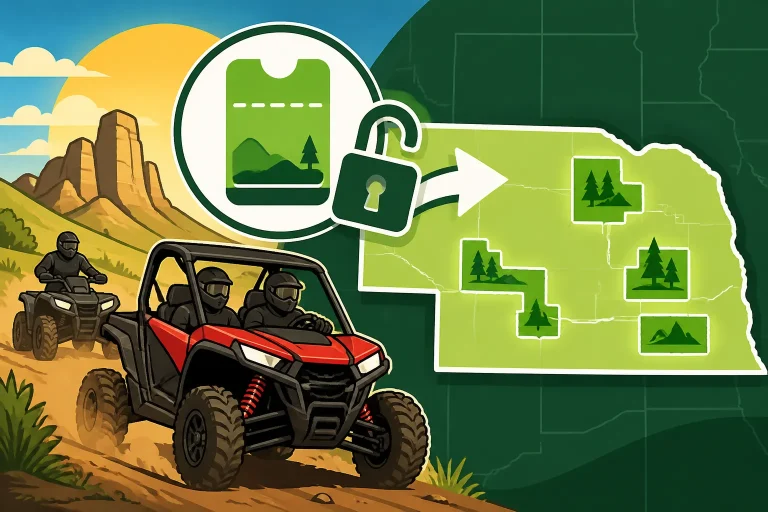
The most important distinction is between learning and authorization. A course can help a rider recognize hazards, but it does not itself grant access. Nebraska has no statewide ATV permit or sticker of the kind some riders expect from other states; that does not mean every place is open to riding. Public areas, private parks, local roads, and private land can all have separate rules. See Nebraska Has No OHV Permit or Sticker and Nebraska Permit Questions Riders Ask before treating course completion as an access credential.
A certificate can also be confused with proof of ownership. Carrying course paperwork does not establish that you own the machine or have permission to use it. When ownership or permission may be questioned, keep the relevant documents separate from course records. Nebraska Proof of Ownership on the Trail explains that distinction.
How to Choose a Useful Online Course
Course quality matters more than the fact that it is online. Look for material that clearly applies to ATVs or UTVs, explains safe operating practices in understandable terms, and states what completion proves. A course that is vague about its subject, intended audience, or certificate may not meet a park’s or organization’s expectations—even if it contains some useful information.
Start with the reason you want the course
Before enrolling, decide what you need from it. You may want a structured introduction, a refresher before a riding trip, material to discuss with a child, or a certificate a private riding facility has asked you to provide. Those are different goals.
If the goal is general education, a clear course with relevant safety lessons may be enough. If a specific park, event, employer, or organized ride has requested training, ask that organization which courses it accepts before paying or setting aside time. A course can be educational without satisfying a particular organization’s rule.
If you are taking a course because someone else requires proof, confirm the details directly:
- Does the organization require a course at all, or merely recommend one?
- Does it accept online-only training?
- Must the course cover ATVs, UTVs, or both?
- Does it require a certificate, a particular provider, or a minimum age?
- Does the certificate need to be presented at check-in?
- Is hands-on instruction expected in addition to online lessons?
The answers can prevent a common problem: completing a course that is useful but not accepted for the specific purpose you had in mind. Private parks set their own participation rules, so check the facility’s current requirements rather than assuming a statewide rule applies. See Nebraska Private Park Rules for ATVs and Who Signs the Waiver for a Rider Under 18.
Check the course content, not just its title
A useful course should address how a rider behaves on a machine and around other people. Depending on its intended audience, look for discussion of:
- Basic controls and safe starting and stopping
- Choosing a machine that fits the rider
- Protective clothing and helmet use
- Riding within the machine’s and rider’s abilities
- Maintaining space from other machines
- Scanning ahead for terrain changes and obstacles
- Safe speed on unfamiliar or changing surfaces
- Riding on slopes and uneven ground
- Avoiding alcohol and other impairment
- Passenger and cargo limits specified by the manufacturer
- Pre-ride checks and routine maintenance
- What to do after a breakdown, rollover, or injury
A course may not cover every topic in equal depth. That is one reason to read its outline before enrolling. A video series focused on basic controls, for example, may not give much detail about riding in sand, managing a group, or planning for an area with limited cell service.
The machine matters too. ATVs and UTVs have different controls, seating arrangements, handling characteristics, and passenger considerations. Some general safety advice applies to both, but a course designed for one type may not address the other well. Check the course description for the machine type, and use the owner’s manual for model-specific operating instructions.
Confirm what the certificate represents
A certificate usually records that a participant completed a course or its required activities. It does not necessarily mean that the rider passed a practical skills test, demonstrated safe handling, or received approval from the State of Nebraska. Read the course’s description and completion terms rather than relying on the word “certified” alone.
Keep a digital copy of the certificate and, if convenient, a printed copy. If you are taking it for a private facility or event, follow that organization’s instructions for submitting or showing the proof. Do not assume a certificate is stored in a state database or can be retrieved later.
The course should be transparent about any quiz, final assessment, renewal expectation, or record-keeping process. If the website does not explain how completion is recorded, who issues the certificate, or what the certificate says, ask before enrolling.
What Online Training Cannot Replace
Online learning is useful for concepts and preparation, but riding is a physical skill. A screen cannot show whether a rider can operate the controls smoothly, judge a slope, keep appropriate spacing, or respond calmly when traction changes. Those abilities develop through practice in a controlled setting, with a capable adult or instructor supervising when appropriate.
A good plan combines instruction with gradual experience. Start somewhere legal, open, and appropriate for the machine and rider. Review the owner’s manual. Practice basic controls at low speed before attempting difficult terrain. Add new challenges one at a time rather than treating course completion as proof that a rider is ready for every trail.
Match the machine to the rider
A rider needs to reach and use the controls comfortably, understand the machine’s response, and maintain control without being overwhelmed. A course can explain why machine fit matters, but it cannot evaluate a rider’s reach, strength, coordination, or confidence in person.
Parents and guardians should consider the individual rider, not just age or enthusiasm. A young rider may need a smaller, simpler machine and close supervision; an adult beginner may need the same patient approach. A larger or more powerful machine is not automatically a better choice. For age-related questions, see Nebraska ATV Age Requirements and Nebraska Rules for a Teen Rider.
Learn through practice, not just a quiz
After a lesson, take time to practice basic tasks where riding is permitted. A careful progression might include starting and stopping, turning, riding at a controlled speed, and learning how the machine responds on a mild change in terrain. Increase difficulty only when the rider is comfortable and conditions are suitable.
Do not use public roads as a practice area unless riding there is specifically legal under the applicable rules. Road use is a separate legal question from off-road training. Nebraska’s road rules include specific limits and conditions, and a safety course does not make an otherwise prohibited road trip lawful. See Can You Drive an ATV on the Road in Nebraska? and Nebraska Rules for Riding a County Road.
Nor does a course override land restrictions. A rider still needs lawful access to the property and must follow posted closures and local rules. Private land requires the landowner’s permission; public land may limit motorized use to designated routes or areas. Check the specific site before unloading. Nebraska Landowner Permission Rules and Nebraska WMA Access for a Quad cover two different kinds of access questions.
Use the owner’s manual and inspect the machine
An online course provides general safety principles. The owner’s manual explains the controls, warnings, passenger limits, loading guidance, maintenance schedule, and other details for a particular model. Read the manual for the machine you will ride, even if you have used a similar ATV or UTV before.
A basic pre-ride check can help catch obvious issues before they become problems. Inspect tires, brakes, lights, controls, visible leaks, and the condition of straps or other gear you plan to carry. Follow the manufacturer’s instructions for maintenance and operation. A course cannot identify a damaged part on your machine or confirm that it is safe to ride.
Protective equipment also deserves practical attention. Choose gear that fits and is suitable for the riding conditions. If you shop on Amazon or another marketplace, verify the product’s specifications, sizing, and safety claims rather than relying on a listing title or customer photos alone. A course may explain why protective gear matters, but fit and condition still need to be checked before riding.
Taking a Course With a Child or New Rider
Online lessons can give a family a shared vocabulary for talking about safety. They work best when an adult is available to pause, explain, and connect a lesson to the machine the rider will actually use. A child may complete an online module, but completion alone does not show readiness to ride independently.
Before starting, set expectations: the course is one part of preparation, not a promise of access or permission to ride. Talk through what to do if the rider feels uncomfortable, sees an obstacle, loses sight of the group, or needs to stop. Make clear that choosing not to ride is always acceptable.
Make the lessons active
Instead of letting the course play in the background, invite the rider to explain key ideas in their own words. Ask what they would do before starting, how they would signal a problem to the group, and why a rider should leave space between machines. Discuss the answer without turning the conversation into a test.
Then connect the lesson to the machine while it is parked and turned off. Point out the controls, explain how to stop it safely, and review any warnings in the owner’s manual. Keep this practical session calm and brief enough that the rider can stay focused.
Supervise the first rides
An adult’s role is not just to be nearby. The supervising person should be able to help the rider, understand the machine, and choose a practice area that does not expose the novice to unnecessary traffic, steep terrain, or unfamiliar hazards. Keep the first sessions short and uncomplicated.
A helmet and other suitable protective equipment should be part of the plan from the start. Check the fit and condition before each ride, and follow the equipment maker’s instructions. Do not treat course completion as a reason to relax supervision or move a new rider onto more demanding terrain.
Private riding facilities may set their own minimum ages, helmet rules, supervision requirements, or waiver procedures. These vary by facility and can differ from what applies on other property. Ask the facility before traveling, especially if a child is riding or the group includes both ATVs and UTVs. See Nebraska Private Park Minimum Ages and Helmet Rules a Private Riding Park Enforces.
Keep access and paperwork separate
A child’s course certificate does not replace the documents or permissions needed for a ride. Before a trip, check the riding area’s rules, confirm who is responsible for the machine, and make sure the adult has the information needed to manage the outing.
If the ride is on public land, check whether the area allows ATVs or UTVs at all and whether there are restrictions on routes, parking, or permits. For example, a park permit may apply to the vehicle used to enter a state recreation area, while the ATV itself may still be barred. A rider course does not change that. Why the Park Permit Belongs on Your Truck explains why different permissions should not be confused.
Plan the Ride After Completing the Course
The next step is to put the course in context: decide where you may ride, what the trip requires, and whether the rider and machine are prepared. A certificate is not a trail map. It cannot confirm that a route is open, that a road is available to ATVs, or that conditions are suitable on the day you arrive.
Use a simple pre-trip sequence:
- Choose the location. Confirm that the land is open to the type of machine you plan to bring. Check current rules with the land manager or facility.
- Confirm permission and permits. Determine whether the location requires a permit, reservation, fee, landowner approval, or other paperwork. Do not assume course completion satisfies any of these.
- Check machine requirements. Review the owner’s manual and inspect the machine. Make sure the machine’s dimensions and equipment are suitable for the intended route.
- Plan for the rider. Consider skill, comfort, weather, terrain, group size, and how long the rider can reasonably stay focused.
- Prepare for problems. Bring appropriate protective gear, water, basic supplies, and a way to communicate or regroup if the group gets separated.
- Keep proof organized. Save course records separately from title, ownership, permit, and access documents. Bring only the paperwork that the facility or land manager asks you to carry.
If you are traveling to a designated riding area, check its specific rules rather than relying on a general online course. Trail conditions, closures, machine restrictions, and facility procedures can change. The course may help you ride more thoughtfully, but the land manager’s current instructions determine what is allowed there.
For Nebraska riding, that distinction is especially useful because riders can encounter very different settings: a private park, a national forest trail, a wildlife management area, or a locally permitted road. The same machine and rider may be allowed in one place and prohibited in another. See Nebraska Public Land Rules Compared to Private and Nebraska Trail Conditions Before You Tow when planning a destination.
An online course can also make group trips safer by encouraging a conversation before the engines start. Agree on the route, stopping points, signals, and what to do if someone falls behind. Set a pace the least experienced rider can handle. Avoid pressure to follow a faster group or attempt terrain beyond a rider’s ability. These practical decisions matter whether or not anyone in the group has a certificate.
Frequently Asked Questions
Does Nebraska require an online ATV safety course?
Nebraska does not require every ATV or UTV rider to complete a safety course as a general statewide condition of riding. A private park, event, or other organization may set its own training or proof requirements, so check directly with the place you plan to ride.
Does an online course give me permission to ride on Nebraska trails?
No. A course can teach safety practices, but it does not open trails, provide landowner permission, replace a required permit, or override closures. Confirm the rules for the specific location.
Is an online certificate the same as a practical skills test?
Not necessarily. Course formats differ. Read the course description to see whether it includes a hands-on assessment or only online lessons and a knowledge check. Do not assume that a completion certificate proves practical ability.
Should a new rider take a course even if it is voluntary?
It can be a useful starting point, especially for someone new to ATVs or UTVs. Pair it with the owner’s manual, appropriate protective equipment, supervised practice, and a riding location suited to the person’s experience.
Disclaimer
This article is for general informational purposes only and does not constitute professional advice. Laws, prices and regulations vary by location and change over time. Consult a qualified professional for guidance on your specific situation.