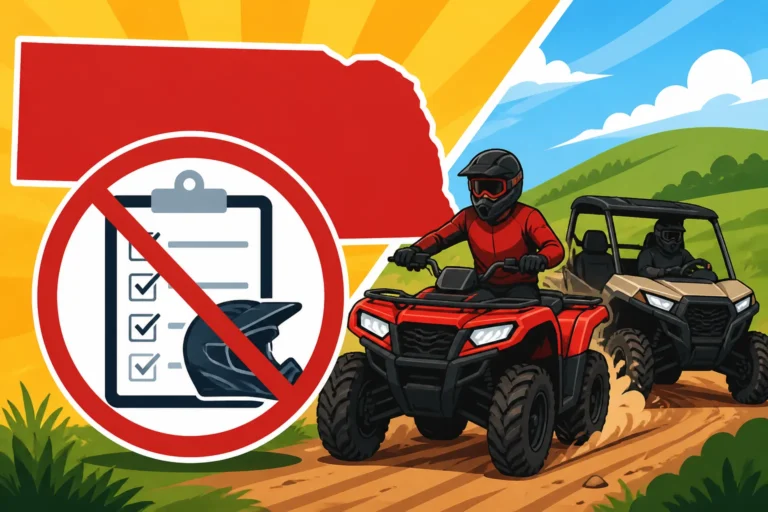
Nebraska Voluntary Safety Courses
Nebraska Voluntary Safety Courses
Nebraska riders may wonder whether an ATV or UTV safety course is required before they ride, whether an online course counts, or if a certificate gets them a permit. The short answer: a course can be useful, but it does not replace land-access rules, local requirements, or a riding area’s own policies. Here’s how to choose training and understand what it does—and does not—authorize.
Are ATV safety courses required in Nebraska?
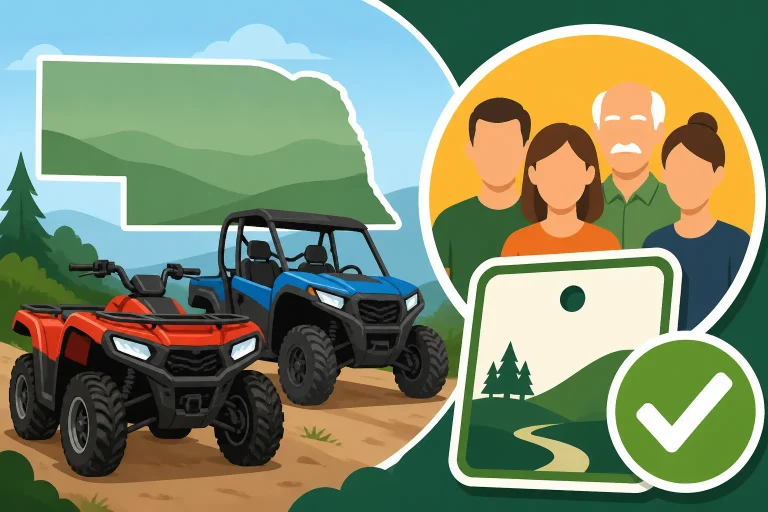
Nebraska does not require every ATV or UTV rider to complete a statewide safety course simply to own or ride an off-highway machine. That makes a course voluntary for many riders, but “voluntary” does not mean pointless. Training can help a new rider build basic skills, recognize common hazards, and make safer decisions around passengers, slopes, traffic, and other machines.
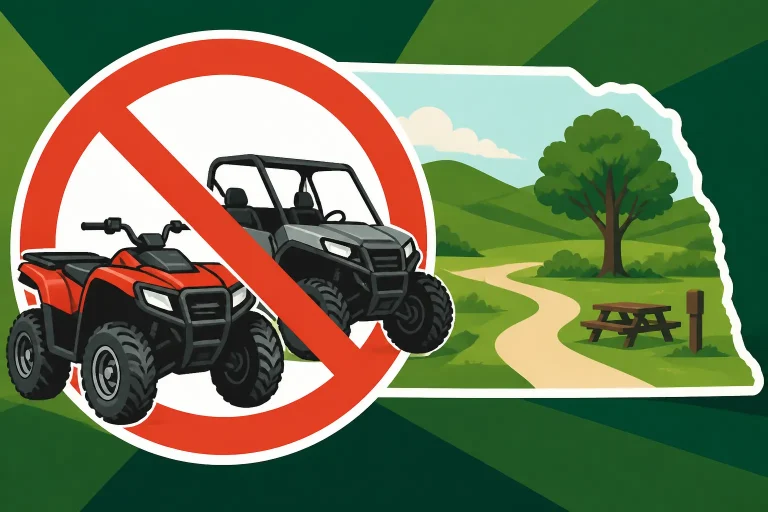
The state-level course question is only one part of the picture. Rules can differ depending on where you ride. A private riding park may set its own age, helmet, supervision, waiver, or training policies. A public riding area may have rules about where machines can go, what equipment is allowed, and which permits or fees apply. A town may also have local requirements for riding on streets. A course certificate does not override any of those rules.
It is also important to separate a safety course from a permit. A course teaches riding and risk-management skills. A permit or pass, when required for a particular area or activity, provides permission under that area’s rules. Neither document automatically substitutes for the other. Nebraska does not have a general statewide OHV permit or sticker, but specific locations may still require their own permits, access fees, or permissions. For the broader distinction, see Nebraska Has No OHV Permit or Sticker.
| Question | Practical answer |
|---|---|
| Does every Nebraska ATV or UTV rider need a safety-course certificate? | No statewide course requirement applies to every rider. Check the rules for the place where you plan to ride. |
| Can a course certificate act as an ATV permit? | No. Training is not land-access permission or a permit. |
| Does an online course guarantee entry to a private park? | No. The park sets its own admission and rider requirements. |
| Is a course useful if it is optional? | It can be, especially for new riders, young riders, and anyone unfamiliar with a machine or terrain. |
| Should a rider carry proof of course completion? | It may be useful if a park, organized event, insurer, or other authority asks for it, but confirm what form of proof they accept. |
A course may still be required by a particular program, event, employer, landowner, or riding facility. Those requirements are not the same as a statewide rule. Before registering, ask who requires the training, which course they accept, whether an online format counts, and whether a certificate must be current or presented in a particular form.
The distinction matters for families, too. A parent might choose training for a young rider even when state law does not require it. A private park may have its own age rules or require an adult to supervise a minor. Taking a course does not automatically satisfy those policies. See [Nebraska Rules for a Ten-Year-Old Rider] and Nebraska Supervision at a Private Park for related questions about youth riding.
What voluntary training can teach
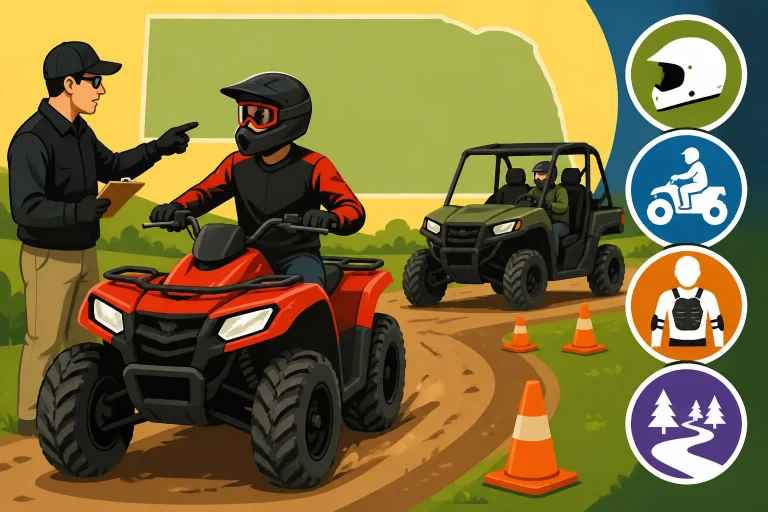
A useful course should go beyond a list of rules. It should help a rider recognize what can go wrong and how to reduce the chance of a crash or injury. The exact curriculum varies by provider, so check the course outline rather than assuming every program covers the same topics.
Common subjects include:
- Pre-ride inspection: Checking controls, tires, brakes, lights, steering, fuel or battery condition, and visible damage before setting out.
- Rider fit and controls: Understanding how to sit, reach the controls, use the throttle and brakes, and position the body for the machine.
- Starting, stopping, and turning: Practicing controlled starts, smooth stops, and turns without abrupt inputs that can upset the machine.
- Speed and terrain: Adjusting speed for visibility, surface conditions, turns, hills, ruts, loose sand, mud, and changing traction.
- Rollover awareness: Recognizing how steep slopes, sharp turns, side hills, loads, and high speed can increase rollover risk.
- Passengers and cargo: Understanding that a machine’s passenger capacity and carrying limits matter. A passenger should never be added merely because there is room on the seat or cargo rack.
- Protective equipment: Learning why a properly fitted helmet and other protective gear can reduce injury risk. A course can explain protective practices, but it does not change any separate rule set by a park or event.
- Road and trail awareness: Watching for other riders, vehicles, pedestrians, livestock, gates, and obstacles, and using appropriate signals or communication when riding with a group.
- Environmental and land-use responsibility: Staying on routes that are open to riding, respecting closures, avoiding damage to wet ground, and leaving gates as instructed.
- Emergency planning: Carrying appropriate supplies, telling someone the route and expected return time, and planning for a breakdown or injury.
A good course should also make clear that an ATV and a side-by-side do not handle exactly like a car. Their weight, center of gravity, tires, braking, and steering response are different. A rider may need to shift body position on a quad; a side-by-side has a steering wheel and seat belt system but can still roll or lose control. Familiarity with one machine does not mean a rider is automatically prepared for every other type.
Training is most useful when it leads to practice in a controlled setting. Reading about braking or hill travel is not the same as performing those skills. If an in-person course or supervised practice session is available, a new rider may benefit from instructor feedback. An online course can still provide a foundation, particularly for rules, risk awareness, and planning, but it cannot observe how a person handles a specific machine.
The learning value also depends on the rider. A first-time operator may need a careful introduction to controls and basic handling. An experienced rider may get more from a course that addresses passenger safety, group rides, trail etiquette, or a new machine type. A parent may want to take the course alongside a young rider so that both understand the same safety expectations.
For a fuller overview of likely course subjects and why they matter, see What an ATV Safety Course Actually Teaches You. Course content is not identical from one provider to another, so use that overview as a checklist when comparing options rather than as a promise about any particular class.
Choosing an online or in-person course
Nebraska riders may find online courses, in-person instruction, or a combination of both. The right format depends on what the rider needs and whether a specific park, event, or organization will accept the course.
Online courses
An online course can be convenient for learning at home and reviewing material at a comfortable pace. It may cover rules, risk awareness, equipment, passenger safety, and decisions riders face before and during a ride. Some programs may include quizzes or a completion record; the format and proof of completion depend on the provider.
Online training has limits. It cannot evaluate the rider’s posture, braking technique, turning, or control of a machine. It also may not reflect every local rule or every private park’s policy. If a rider plans to use an online certificate to meet a specific requirement, confirm acceptance with the organization imposing that requirement before paying or enrolling.
A course completion record is not automatically a state-issued license, registration, or permit. Do not assume that a certificate from a provider will be treated as an official qualification for a different purpose. Ask whether the course is recognized, what documentation is accepted, and whether the requirement applies to the rider’s age, machine type, or activity.
In-person instruction
In-person instruction can offer practical demonstrations and feedback. A class may let a rider ask questions, see safety practices in context, and practice under supervision if hands-on instruction is part of the program. Confirm the course’s format before signing up: some in-person sessions may focus mainly on classroom material, while others include riding practice.
A hands-on class is especially worth considering for a rider who has never operated an ATV or UTV, is moving from one machine type to another, or feels uncertain about hills, turns, braking, or carrying a passenger. Instruction should not be treated as a substitute for gradual practice. A rider still needs to become familiar with the specific machine and avoid terrain beyond their ability.
Compare courses by purpose, not just format
Start by writing down why the rider wants training. Is the goal general safety knowledge, supervised practice, a park’s admission requirement, or a condition of an organized ride? Then compare options against that goal.
| Course feature | What to check | Why it matters |
|---|---|---|
| Acceptance | Ask the park, event, or organization whether it accepts the course. | A certificate is useful for a requirement only if the organization recognizes it. |
| Format | Confirm whether the course is online, classroom-based, hands-on, or blended. | The format affects how much practical feedback the rider receives. |
| Machine coverage | Check whether lessons apply to ATVs, UTVs, or both. | A rider should not assume training for one machine fully covers another. |
| Age suitability | Review the provider’s age guidance and any facility rules for minors. | A course’s age policy and a park’s rider policy may differ. |
| Proof of completion | Ask what record or certificate is issued and how it can be retrieved. | A digital record may be convenient, but a facility may ask for a specific form of proof. |
| Course scope | Read the outline for riding skills, protective gear, passenger safety, and land-use topics. | A course title alone does not show what the rider will learn. |
| Practice opportunities | Find out whether riding practice is included or whether it is classroom-only. | Practical skills cannot be assessed through reading alone. |
| Updates and local rules | Check whether the content addresses the area where the rider expects to ride. | General training may not cover local ordinances or site-specific rules. |
Look for clear information about the provider, course content, instructor qualifications where relevant, and the certificate or record offered. Be wary of wording that suggests a course grants a statewide ATV license or gives access to public land unless the responsible authority confirms that claim.
Nebraska riders can begin with Nebraska Safety Course Options and Nebraska Online Safety Courses when comparing formats. Before relying on a particular program, confirm current details with the course provider and the organization that may require it. Course offerings and acceptance policies can change.
Courses, permits, and where you ride
A course answers a safety-training question. It does not answer every question about whether a machine may be ridden in a particular place. Before a trip, identify the land manager or property owner and check the rules that apply there. A rider can complete training and still be prohibited from entering an area, using a closed route, or riding a machine that does not meet the site’s conditions.
Public areas and land access
Public lands can have different rules from one type of area to another. Some places restrict or prohibit ATVs, while others allow riding only on designated routes or under specified conditions. A state park permit, for example, should not be treated as permission to ride an ATV where ATVs are not allowed. Check the particular area’s motorized-use rules, permitted routes, access requirements, and current closures.
Nebraska’s public-land rules are separate from a voluntary safety course. For an overview of area-specific issues, see Nebraska Park Rules for ATVs and Nebraska WMA Access for a Quad. For national forest or other public-land riding, check the responsible land manager’s current information before hauling a machine. A trail that appears on an old map or in an online discussion may be closed, restricted, or unsuitable for the machine being brought.
If a course suggests that a rider should carry proof of training, that does not mean every public area requires it. The practical approach is to check the rules for the destination and carry any documentation that the destination specifically asks for. Also keep ownership and access documents separate from course records. For related preparation, see Nebraska Proof of Ownership on the Trail.
Private parks and organized rides
Private riding parks can create their own conditions of entry. These may include a waiver, age limits, required equipment, supervision rules, restrictions on passengers, or specific training expectations. A park may accept a particular certificate, require its own orientation, or have no course requirement at all. The operator is the right place to confirm.
An organized ride may have requirements that do not apply to ordinary riding elsewhere. Event organizers can set conditions for participants, such as gear, insurance documentation, a safety briefing, or proof of training. Ask before travelling, especially if the event involves minors, a large group, or multiple machine types.
A rider should not interpret completion of an online course as permission to ride on someone else’s land. Landowner permission and any conditions attached to it remain separate. Courses can teach riders to respect boundaries, but they do not grant access. The same goes for a waiver: signing one does not necessarily establish that a rider has completed training or meets every park rule. See Nebraska Private Park Waivers and Rules for more on how private facilities set their own policies.
Visitors from another state
Visitors should not assume that an out-of-state registration, training card, or trail document gives them access to Nebraska riding areas. Nebraska does not issue a general statewide OHV sticker that every visitor must obtain, but local access rules, park permits, private facility requirements, and landowner permission still matter. A rider’s course certificate may be useful background, but it is not a substitute for checking the destination’s rules.
For visitor questions, see Nebraska Visitors Need No State Sticker and Nebraska Rules for a Visiting Iowa Rider. Similar checks are important for riders coming from other neighboring states. Before setting off, confirm which documents are relevant to the specific trail or facility, whether the machine is allowed, and whether the rider needs to meet a local age or supervision rule.
A simple pre-trip routine helps keep the categories straight:
- Identify the exact property, trail system, park, or event.
- Check whether the machine type is permitted and whether routes are open.
- Look for permits, fees, waivers, age limits, equipment rules, and training conditions.
- Contact the operator or land manager if a rule is unclear.
- Keep course proof only if the destination or event asks for it, and carry other requested documents separately.
Getting practical value from voluntary training
The best reason to take a course is not to collect a certificate; it is to change how the rider prepares and behaves. A short checklist can turn general lessons into habits that are useful every time the machine comes out.
Before riding, match the machine to the operator. Review the controls and owner’s manual, especially when borrowing or renting. Check the machine’s condition and safety equipment, and make sure the rider understands how to stop it and what to do if it behaves unexpectedly. A course can provide a framework, but each model may have different controls and operating instructions.
Choose terrain with the rider’s current skill in mind. A new operator should start in a legal, open area with manageable ground and low risk. Avoid putting a beginner straight into steep slopes, deep sand, mud, tight trails, or a crowded group ride. Build skills gradually, and stop when fatigue, weather, visibility, or machine condition makes riding less safe.
Passengers deserve particular attention. The machine must be designed for the number of people aboard, and the passenger must be able to sit and hold on as intended. A child’s size, maturity, and ability to follow instructions matter. Never treat a course certificate as evidence that a rider is ready to carry someone. For related rules and safety questions, see Nebraska Rules for Passengers on a Quad.
Group riding requires planning, not just staying in a line. Riders should agree on a route, pace, stopping points, and what to do if someone becomes separated. Keep enough distance to react to dust, braking, or an obstacle. A beginner should not be pressured to keep up with a faster group or attempt a route they are not comfortable riding.
Finally, update the plan when conditions change. Rain can alter traction and trail access. Dust can reduce visibility. Wind, cold, heat, and long distances can affect judgment and endurance. A course may help riders recognize these risks, but the decision to turn back, take a break, or change routes remains part of responsible riding.
For parents, a course can also be a way to set shared expectations. Discuss where the young rider may go, whether an adult must be present, what protective gear is required, and how the rider should respond to a breakdown or a change in weather. These family rules are useful even when no state course requirement applies. They should be consistent with the machine’s owner’s instructions and any rules at the riding location.
A careful rider treats training as one layer of preparation, alongside legal access, machine condition, protective equipment, and good judgment. A certificate cannot make an unsafe route safe or turn an unauthorized location into an open trail. Its value is in helping the rider make better choices before and during a ride.
Frequently Asked Questions
Does Nebraska require an ATV safety course?
Nebraska does not require every ATV or UTV rider to complete a statewide safety course simply to ride. A private park, event, or other organization may set its own training requirements, so check with the place or program involved.
Does an online course give me a Nebraska ATV permit?
No. A safety course is not a permit or land-access authorization. Check the specific area’s rules for permits, fees, route access, and other conditions.
Will a course certificate let my child ride at a private park?
Not automatically. Private parks set their own age, supervision, training, equipment, and waiver policies. Ask the park which courses, if any, it accepts and what rules apply to minors.
Should out-of-state visitors take a Nebraska safety course?
There is no universal statewide course requirement for every visitor. A visitor may still choose training, and a particular park or event may require it. Confirm the destination’s current policies before travelling.
Disclaimer
This article is for general informational purposes only and does not constitute professional advice. Laws, prices and regulations vary by location and change over time. Consult a qualified professional for guidance on your specific situation.