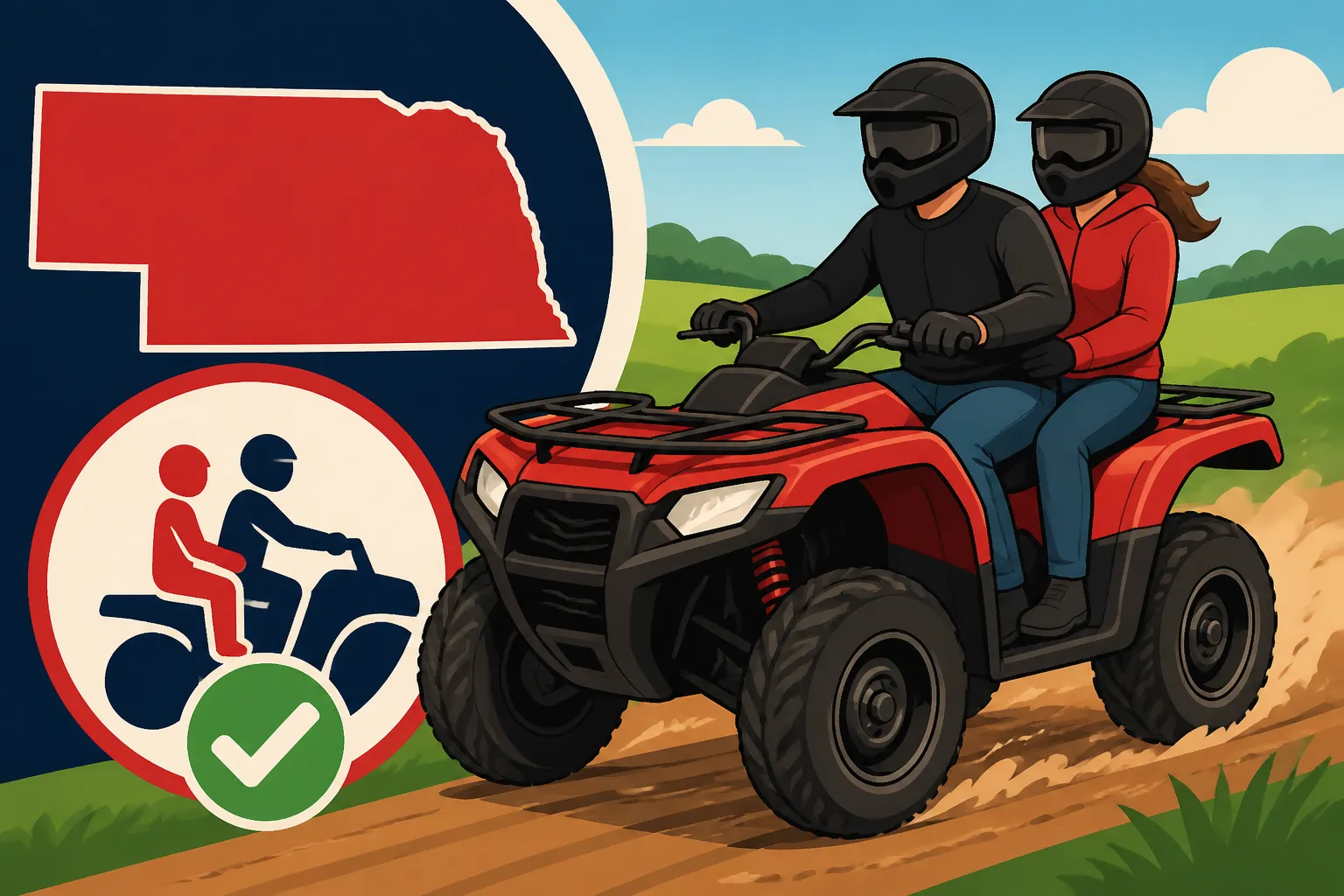
Nebraska Rules for Passengers on a Quad
The wide-open spaces of Nebraska are a dream for ATV and UTV enthusiasts, but a common question that pops up when you're planning a ride with family or friends is: "Can I bring a passenger along on my quad?" It's a valid concern, because while it might seem simple enough to just hop on, Nebraska law has specific requirements, and more importantly, there are some serious safety implications involved. This guide is here to clear up the confusion, lay out the rules, and help you make safe, informed decisions about carrying passengers on your ATV or UTV in the Cornhusker State.
Understanding Nebraska's Baseline Rules for ATV Passengers
When it comes to carrying passengers on an all-terrain vehicle in Nebraska, the law really zeros in on one crucial detail: how the machine was originally designed. This isn't just a suggestion; it's a foundational principle that impacts everything from safety to legality. Many riders assume that if there's enough room, or if they can just squeeze someone on, it's fine. However, that assumption can lead to dangerous situations and legal trouble.
The "Manufacturer-Designed" Requirement
Nebraska state law is quite clear that an ATV (which typically refers to a traditional sit-astride quad) is generally intended for one operator only, unless the machine was specifically engineered and designated by the manufacturer for more than one person. This distinction is absolutely critical. It means that if your quad rolled off the assembly line with a single-rider seat, it's meant for you and you alone. No matter how much you wish you could share the ride, the law looks at the original design. This often comes as a surprise to many, especially those new to the ATV world who might have seen people doubling up elsewhere or in movies. But here in Nebraska, the focus is squarely on the manufacturer's intent and safety engineering.
What does "manufacturer-designed" truly mean in practice? It's not just about a slightly longer seat. A legitimate two-up ATV or UTV will have specific features built in. For a two-up ATV, think a noticeably elongated seat that provides ample space for both the operator and a passenger, often with a raised section for the passenger to see over the driver. You'll also typically find dedicated handholds for the passenger, often integrated into the rear rack or seat, and separate, sturdy footrests positioned to accommodate a second rider comfortably and securely. These features are not just for comfort; they are integral to maintaining the machine's balance and control with two occupants, which is especially important on varied terrain. Without these design elements, adding a passenger fundamentally alters how the ATV handles, often in unpredictable and dangerous ways.
Single-Rider Quads vs. Tandem-Ready Machines
Let's break down the physical differences between machines designed for one versus two riders. Most traditional sport ATVs, with their narrow, flat seats and aggressive styling, are unequivocally single-rider machines. The same goes for many utility ATVs that have a standard-length seat and rear rack. The suspension, frame, and braking systems on these machines are all calibrated for the weight and dynamics of a single operator. Trying to add a second person to such a machine overloads its design limits and can lead to a host of problems. The center of gravity shifts dramatically, making the ATV far more prone to tipping, especially in turns or on uneven ground. Braking distances increase, and the steering can feel sluggish or unpredictable because the front end is effectively "unweighted."
In contrast, tandem-ready ATVs, often marketed as "2-Up" models, are built from the ground up to accommodate two people. Brands like Polaris, Can-Am, and Arctic Cat have specific models in their lineups designed for this purpose. These machines feature a longer wheelbase, a robust suspension system capable of handling the increased weight, and indeed, that extended seat, integrated handholds, and separate footrests we talked about. They are specifically engineered to maintain stability and control with two riders, ensuring a much safer experience. Think of it like a regular pickup truck versus an extended cab; both are trucks, but one is clearly designed to carry more passengers safely and legally. For anyone considering carrying a passenger, understanding this distinction is the first and most important step. You can often find this information clearly stated in your ATV's owner's manual or on the manufacturer's website.
UTVs and Their Passenger Capacity
When we shift our focus to UTVs, or side-by-sides, the conversation around passengers changes significantly. UTVs are inherently designed for multiple passengers, making them a popular choice for group rides, farm work, or simply exploring together. Unlike ATVs, which are straddle-style, UTVs feature bucket or bench seats, seatbelts, and a steering wheel, much like a small car. This design intrinsically allows for multiple occupants, usually two, three, four, or even six people, depending on the model. This makes them a fantastic option if you know you'll be consistently riding with others.
The safety features built into UTVs further underscore their suitability for carrying passengers. Most UTVs come equipped with factory-installed seatbelts for every seating position, a robust roll cage for occupant protection in the event of a rollover, and often doors or side nets. These features significantly enhance passenger safety compared to a traditional ATV. The stability of a UTV, with its wider stance and lower center of gravity, also makes it much more forgiving with multiple occupants on board, even on challenging terrain. If your primary goal is to share the riding experience with others, a UTV is almost always the safer and legally compliant choice in Nebraska. You'll find many models, from utility workhorses to sport-oriented recreational vehicles, that comfortably and safely accommodate passengers right out of the box. [Titling a Side-by-Side in Nebraska] has slightly different requirements than an ATV, reflecting these design differences.
Safety Implications and Risks of Carrying Passengers
Beyond the legalities, carrying a passenger on an ATV that isn't designed for it introduces a host of serious safety risks. We're talking about more than just a bumpy ride; it can fundamentally compromise the machine's performance and significantly increase the likelihood and severity of an accident. Even on private land, where legal enforcement might be less direct, the laws of physics still apply, and they are unforgiving.
Impact on Handling and Stability
Adding the weight of a passenger, especially to a single-rider ATV, drastically alters the machine's center of gravity and overall dynamics. Imagine trying to ride a unicycle with someone on your shoulders; it's just not what it was designed for. An ATV's suspension system is tuned for a specific load, typically the weight of one adult rider. With an additional person, the suspension can bottom out more easily, leading to a harsh ride and reduced control. The steering can become heavier or less responsive, making it harder to maneuver, especially in tight turns or over obstacles. Braking distances will increase significantly because the ATV has more momentum to shed. What might be a routine stop for one person can become an emergency stop with two, potentially leading to a skid or loss of control.
Consider riding scenarios: ascending a steep hill becomes more precarious as the front wheels might lift more easily, making it harder to steer. Descending a hill, the added weight can push the ATV forward, making it harder to control speed. In a sharp turn, the combined weight can make the ATV much more prone to tipping or rolling over, especially if the passenger shifts their weight unexpectedly or doesn't lean correctly with the driver. Experienced riders understand their machine's limits, but those limits are drastically reduced with an extra person on board. This is true whether you're navigating technical trails at [Bessey OHV Trails at Halsey in Nebraska] or simply cruising a gravel road.
The Importance of Proper Gear and Training
Even if you're on a machine explicitly designed for two riders (like a two-up ATV or a UTV), safety gear and proper training for both the operator and the passenger are non-negotiable. This isn't just a suggestion; it's common sense that can prevent serious injury. Both riders should always wear an approved helmet, eye protection (goggles or a face shield), sturdy over-the-ankle boots, long pants, and a long-sleeved shirt. These items provide crucial protection against impacts, flying debris, and abrasions in the event of a fall or collision. While Nebraska has no mandatory safety course for ATVs [Nebraska Has No Mandatory Safety Course], taking one is highly recommended for all riders, especially if you plan to carry passengers.
For the passenger, understanding how to ride along is just as important as the operator's skill. A passenger should never interfere with the operator's control. They need to know where to hold on securely (using those integrated handholds we discussed), and how to lean with the operator through turns and over obstacles. They should keep their feet firmly on the designated footrests at all times and avoid sudden movements that could upset the machine's balance. Communication between the operator and passenger is key, especially when approaching challenging terrain. A quick discussion before embarking can make a world of difference in ensuring a safe and enjoyable ride for everyone. And when considering [Nebraska Rules for a Child Passenger] or [Nebraska Rules for a Teen Rider], these safety precautions become even more critical due to their smaller size and potentially less developed riding instincts.
Increased Risk of Injury in an Accident
It's a grim reality, but carrying a passenger significantly escalates the risk and potential severity of injuries in the event of an ATV accident. When a single-rider ATV, already prone to instability with an extra person, goes down, there are two individuals who can be seriously hurt instead of one. The lack of proper seating and restraints means a passenger can be easily ejected, potentially hitting the ground or obstacles at speed. There's also the horrifying possibility of the ATV rolling over onto one or both occupants. Unlike the enclosed safety of a UTV with its roll cage and seatbelts, a traditional ATV offers very little structural protection.
Even seemingly minor tumbles can result in more severe outcomes for a passenger who isn't properly seated or secured. Fractures, head injuries, and internal trauma are all possibilities. Beyond the physical injuries, there's the emotional and financial toll. Medical bills can quickly mount, and there's the potential for long-term recovery. This is why personal liability is such a significant concern. If you're operating an ATV and an unapproved passenger gets injured, you could be held responsible. This underscores the importance of adhering to the manufacturer's design and Nebraska's laws regarding passenger capacity. Always prioritize safety over convenience.
Legal Nuances and Exceptions in Nebraska
While the general rule in Nebraska is quite clear about single-rider ATVs, it's worth exploring if there are any specific contexts or exceptions that might alter these rules. Understanding these nuances is crucial, especially when considering different types of terrain or specific uses for your machine. The legal landscape isn't always black and white, but the core principle of "manufacturer-designed" still holds immense weight.
Road Use Regulations and Passengers
Nebraska has specific, albeit limited, regulations for when and how ATVs can be used on public roads. Generally, ATVs are restricted from state highways and controlled-access roads. However, county roads and some city streets can be opened to ATV use under specific conditions, often involving local ordinances or agricultural exemptions. But here's the critical point: even if a road is legally open to ATVs, the rules regarding passengers on a single-rider machine do not magically disappear. [Nebraska ATV Road Rules Under 60-6,356] still require the machine to be designed for the number of occupants present.
This means that if your ATV is a single-rider model, it's still illegal to carry a passenger on a public road, regardless of whether that road itself is open to ATVs. The inherent dangers of altered handling and increased risk of injury are only amplified when sharing the road with other vehicles. Deputies and law enforcement officers are trained to look for these safety violations. Fines and penalties can be significant, not to mention the potential liability if an accident occurs. If you plan to operate your ATV on approved public roads, it's imperative that your machine meets all passenger requirements, which for most two-up riding, points strongly toward a UTV or a specially designed two-up ATV. For example, [Nebraska UTV Street Legal Rules by City] will outline specific requirements for UTVs, which naturally include their designed passenger capacity.
Private Land vs. Public Land Rules
The distinction between riding on private land and public land often leads to questions about passenger rules. On private property, with the landowner's permission, you might feel you have more leeway, and indeed, direct enforcement of passenger laws might be less common. However, the safety implications of carrying a passenger on a single-rider ATV remain the same, if not heightened, on uncontrolled private terrain. While you might not face a state trooper's citation on a private pasture, you absolutely still face the risk of serious injury. Furthermore, if an accident occurs and an unapproved passenger is injured, you could still be held personally liable in a civil lawsuit, regardless of where the incident took place.
On public lands, like state-managed trails or national forests, the rules are typically much more strictly enforced. Land management agencies have a duty to ensure public safety and will generally adhere to state laws regarding ATV passenger capacity. This means if your ATV is not manufacturer-designed for two, you will likely be prohibited from carrying a passenger on public trails. Examples of public riding areas, such as the [Bessey OHV Trails at Halsey in Nebraska], will often have clear signage or regulations stipulating these rules. Always check with the specific land management authority before you ride if you have any doubts. The bottom line is that safety and legal compliance should always be your top priorities, whether you're on your own back forty or exploring public trails.
Specific Circumstances: Youth and Farm Use
Are there any special considerations for youth passengers or ATVs used exclusively for agricultural purposes? When it comes to youth, Nebraska's general rules regarding manufacturer-designed capacity still apply. [Nebraska ATV Age Requirements] focus on the operator's age, not the passenger's. So, while a child might be small, putting them on a single-rider ATV still violates the machine's design intent and the law. This is particularly dangerous for children, as their smaller stature and lighter weight make it even harder for the operator to maintain control, and they are more vulnerable to injury. Specific guidelines on [Nebraska Rules for a Child Passenger] and [Nebraska Rules for a Teen Rider] would reiterate that the machine must be suitable for the number of occupants.
For farm use, Nebraska does have certain exceptions that allow ATVs to operate on public roads for agricultural purposes. This often includes traveling between fields, checking livestock, or transporting equipment. However, these exceptions typically focus on the type of use and the operator's qualifications, not on overriding the manufacturer's passenger capacity. A single-rider ATV used on a farm is still, by design, a single-rider machine. If you need to transport someone else on the farm, a UTV is a far more appropriate and safer choice, as it's designed for multiple occupants and can often carry tools or supplies simultaneously. The goal of farm exceptions is to facilitate agricultural work, not to bypass fundamental safety regulations regarding vehicle design.
Making Informed Decisions About Passenger Safety
Navigating the world of ATV and UTV ownership can be complex, especially with rules and safety concerns surrounding passengers. Ultimately, making informed decisions is about understanding your machine, knowing the law, and prioritizing the well-being of everyone involved. It's not just about what you can do, but what you should do.
Checking Your ATV's Specifications
Before you even think about putting a passenger on your ATV, the absolute first step is to consult your machine's owner's manual. This document is a treasure trove of information, including the manufacturer's stated occupant capacity. Look for sections on "specifications," "safety," or "operating instructions." The manual will explicitly state whether the ATV is designed for one person, or if it's a "two-up" model. You might also find a sticker on the ATV itself, often near the fuel tank or on the frame, indicating passenger capacity. If you've lost your manual, most manufacturers provide digital copies on their websites.
Beyond the manual, look for those physical characteristics we discussed: an extended, often stepped seat, dedicated passenger handholds, and separate footrests for the passenger. If your quad lacks these features, it's a strong indicator that it's a single-rider machine. Don't guess, and don't assume. Getting this right is fundamental to both legal compliance and safety. This due diligence can prevent an uncomfortable conversation with a sheriff or, worse, a preventable accident.
Accessories and Modifications for Passenger Comfort
It's natural to want to make your machine more versatile, and the aftermarket is full of innovative accessories. You might see extended seats, passenger grab bars, or even cargo boxes that double as rudimentary passenger seats. Companies like SuperATV offer a wide range of accessories for ATVs and UTVs, from winches to lift kits and indeed, storage solutions. While these products can be fantastic for enhancing your riding experience, it is crucial to understand that no aftermarket modification can legally or safely convert a single-rider ATV into a manufacturer-designed multi-passenger vehicle under Nebraska law.
Adding an aftermarket seat or footrests to a quad designed for one person does not change its fundamental engineering, suspension tuning, or frame integrity. It doesn't magically make it safe for two. Such modifications might offer a perception of comfort or space, but they do not address the critical issues of shifted center of gravity, increased braking distances, and compromised handling. In fact, relying on such modifications to carry a passenger can create a false sense of security, potentially leading to even greater risks. Always remember: accessories are for enhancing a machine's existing capabilities, not for creating new ones that contradict its original design intent.
Alternatives for Group Riding
If your ATV isn't designed for a passenger, or if you're frequently riding with others, it's wise to consider safer, legal alternatives rather than risking an accident or a citation. The most obvious and often best solution is a UTV (side-by-side). As we've discussed, UTVs are purpose-built for multiple passengers, coming standard with features like seatbelts, roll cages, and stable seating. They offer a comfortable, secure, and legally compliant way to share the trail or work on the farm with family and friends. [Nebraska Title for a Side-by-Side] is specifically for these machines, recognizing their distinct design and use.
Another option, if your budget allows, is to invest in a specific "2-Up" ATV model. These machines are designed with a longer chassis, a properly proportioned seat, and all the necessary safety features for a second rider. While they retain the straddle-style riding position of a traditional ATV, their engineering ensures a much safer experience for two. Finally, for casual rides with friends, simply having everyone ride their own appropriately sized and designed machine is always the safest bet. Group rides can still be a blast, even if everyone has their own set of handlebars. Prioritizing safety through the right equipment ensures that everyone can enjoy the adventure without unnecessary risks.
| Feature / Machine Type | Single-Rider ATV | 2-Up ATV (Tandem ATV) | UTV (Side-by-Side) |
|---|---|---|---|
| Manufacturer Designed Passenger Capacity | 1 | 2 | 2-6+ (varies by model) |
| Seat Design | Short, narrow, straddle-style | Extended, often stepped, straddle-style | Bench or bucket seats, car-like |
| Passenger Handholds | None (unless aftermarket) | Integrated, sturdy | Dash-mounted, grab bars, steering wheel |
| Passenger Footrests | None (unless aftermarket) | Dedicated, secure | Floorboards |
| Roll-Over Protection | None | None | Factory roll cage |
| Seatbelts | No | No | Yes, for all occupants |
| Impact on Handling (with passenger) | Significantly negative | Minimal (designed for it) | Minimal (designed for it) |
| Legal to Carry Passenger in NE (on roads) | No | Yes | Yes |
| Recommended Use | Solo riding, sport, utility | Two-person recreational | Multi-person utility, recreation, sport |
Disclaimer
This article is for general informational purposes only and does not constitute professional advice. Laws, prices and regulations vary by location and change over time. Consult a qualified professional for guidance on your specific situation.