Nebraska’s Agricultural Road Exception
Navigating the winding roads, gravel tracks, and even city streets on your ATV or UTV in Nebraska can feel like a minefield of rules and regulations. Many riders are rightfully frustrated by the common misconception that their machine is outright banned from any public thoroughfare, leaving them wondering how farmers and ranchers seem to use their quads and side-by-sides with impunity. This guide will meticulously break down Nebraska's crucial agricultural road exception, diving deep into what it means for working machines, how to comply, and what pitfalls to avoid so you can use your ATV or UTV legally and confidently for its intended purpose.
Understanding Nebraska's General Road Rules for ATVs and UTVs
For most ATV and UTV owners in Nebraska, the default rule is pretty straightforward, if a bit disheartening: your machine isn't designed, equipped, or typically allowed for general road use. This isn't just an arbitrary ban; it stems from fundamental differences in how these vehicles are manufactured and regulated compared to cars or trucks.
The Baseline – Why ATVs Are Generally Banned
When you think about the features of a traditional car or truck, things like turn signals, rearview mirrors, windshields, crumple zones, and specific lighting configurations immediately come to mind. These aren't just conveniences; they're safety features mandated by federal and state law for vehicles operating on public roads. ATVs and UTVs, by their very nature, are off-road machines. They're built for stability on uneven terrain, for power delivery in dirt and mud, and often for maneuverability in tight spaces, not for the high speeds and shared infrastructure of paved highways. Their tires are aggressive, their suspensions are designed for bumps, not smooth asphalt, and their braking systems often lack the sophistication of road vehicles. Because they lack these critical safety and operational features, and because they aren't subjected to the same rigorous road-worthiness inspections, the state generally deems them unsafe for mixing with regular traffic. It's a blanket rule meant to protect everyone, even if it feels restrictive to an owner who just wants to cross a county road.
This blanket ban often catches new owners off guard, especially those moving from states with different regulations or those who grew up seeing ATVs on gravel roads without understanding the context. The frustration is palpable when you've invested in a powerful, versatile machine only to find its use severely curtailed on anything but private land. It forces a careful re-evaluation of how, when, and where you can truly enjoy your ATV or UTV without running afoul of the law.
The "Not To Be Registered" Notation on Your Title
If you've ever looked closely at your Nebraska ATV or UTV title, you might have noticed a rather stark phrase stamped on it: "Not To Be Registered." This isn't just a suggestion; it's a legal declaration reflecting the state's stance on these vehicles. This notation is a direct result of the legislative framework in Nebraska that differentiates off-road vehicles from on-road vehicles. While your ATV or UTV absolutely requires a title – a legal document proving ownership, much like a car title – it explicitly states that this title does not confer the right to register the machine for road use. Registration, in this context, implies getting a license plate and the privileges that come with it, such as driving on public streets.
The "Not To Be Registered" notation reinforces the idea that your ATV or UTV, even with a valid title, is not meant for the highway. [Why an ATV Title Says Not To Be Registered] It's a clear signal from the state that these machines are primarily for off-highway recreation, agricultural work, or other specific exceptions. This distinction is crucial because it highlights the difference between proving ownership (titling) and gaining permission for public road use (registration). Many new owners mistakenly believe that because they have a title, they automatically have some form of road-legal status. The title, in this case, serves to track ownership for sales tax, theft prevention, and transfer of property, not to grant street legality.
Diving Deep into the Agricultural Exception (60-6,356)
Now, here's where things get interesting for many rural Nebraskans. While the general rule is "no public roads," Nebraska Revised Statute 60-6,356 carves out a very specific and critically important exception for ATVs and UTVs used for agricultural purposes. This isn't a loophole; it's a deliberate recognition of the vital role these machines play in farming and ranching operations across the state. This exception allows ATVs and UTVs to be operated on public roads only for activities directly related to agriculture, provided certain conditions are met.
What Constitutes "Agricultural Purpose"?
Defining "agricultural purpose" is key to understanding this exception, and thankfully, the law is fairly broad in its interpretation to accommodate the diverse needs of Nebraska's agricultural community. Essentially, if you are using your ATV or UTV to perform tasks that are integral to the operation of a farm, ranch, feedlot, or any other agricultural enterprise, you are likely falling under this umbrella.
Think about the daily life on a working farm or ranch: checking fences, moving irrigation equipment, hauling feed to livestock in a remote pasture, transporting tools for field repairs, monitoring crop health, or even retrieving a downed animal during hunting season if that hunting is part of a wildlife management plan tied to agricultural productivity. All of these are prime examples of activities that would typically fall under the agricultural exception. It's about efficiency and necessity. If using your side-by-side saves you a long walk or allows you to carry essential supplies across varied terrain more quickly and safely, then it's probably an agricultural purpose. The law understands that these machines are indispensable workhorses in rural settings. [When Farm Use Makes a Nebraska ATV Road Trip Legal] However, it's important to differentiate this from purely recreational use, even if that recreation happens on farm land. Cruising around for fun, even if on a field you own, is not an agricultural purpose.
Who Qualifies for This Exception?
This agricultural exception primarily applies to individuals and entities directly engaged in farming, ranching, or other agricultural operations. This most commonly includes:
- Farmers and Ranchers: The owners and operators of the agricultural land themselves are the primary beneficiaries of this exception. They are using their machines for the direct benefit and maintenance of their livelihood.
- Employees: Hired hands, farm managers, and other employees whose job duties require the use of an ATV or UTV for agricultural tasks are also covered. For example, a ranch hand moving cattle between pastures or a farm worker transporting parts to a broken combine in the field.
- Family Members: Immediate family members assisting in the agricultural operation are generally included, provided their use of the ATV or UTV is for a legitimate agricultural purpose. A teenager driving a side-by-side to deliver lunch to workers in the field, for instance, would typically qualify.
It's not about who owns the land, but who is doing the work and for what purpose. A neighbor borrowing your ATV to help with their harvest, if they are legitimately engaged in agriculture, would likely be covered. However, if you let a city cousin borrow your quad to go joyriding on the county roads, even if it's "on the way to the farm," that falls outside the exception. The core principle remains: the machine's use must be directly and demonstrably tied to the agricultural operation at that specific moment. Carrying written permission from the landowner or employer, especially if you're an employee, can be incredibly helpful if you're ever stopped by law enforcement. [Getting Written Permission From a Ranch Landowner] This provides immediate clarity about your purpose and connection to the agricultural activity.
Specific Conditions and Limitations of the Agricultural Exception
While the agricultural exception opens up road access, it's not a free-for-all. The statute comes with very specific conditions and limitations designed to ensure safety when these off-road machines interact with public roadways. Ignoring these can quickly turn a legal agricultural trip into an illegal joyride with consequences.
Navigating Roadways – Speed Limits and Crossing Rules
One of the most critical limitations is the speed limit. When operating an ATV or UTV on a public road for agricultural purposes, you absolutely cannot exceed 30 miles per hour. [30 mph at Most] This is a hard limit, reflecting the design limitations of these machines for road travel. Going faster not only increases the risk of an accident but also clearly indicates you're likely not performing a slow, deliberate agricultural task. Law enforcement is very aware of this restriction, and exceeding it is an easy way to draw unwanted attention and a potential citation.
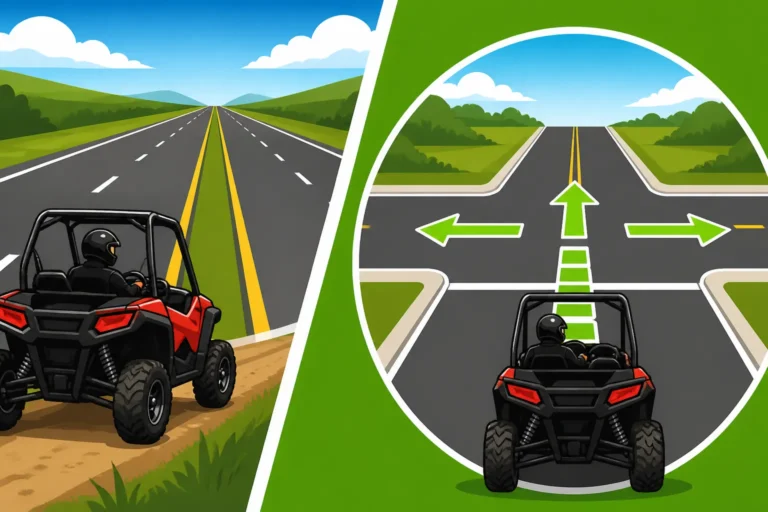
Another crucial rule involves crossing highways. You are permitted to cross a highway, but it must be done at a ninety-degree angle. [Crossing a Highway at a Ninety-Degree Angle] This means you approach the highway, come to a complete stop, look for traffic, and then proceed directly across, perpendicular to the flow of traffic. You cannot drive along the highway, nor can you make a sweeping turn. This "ninety-degree" rule is designed to minimize your time in active traffic lanes and make your intentions clear to other drivers. Furthermore, you must yield to all traffic on the highway and make a complete stop before entering or crossing. [Do You Have to Stop Before Crossing a Highway?] This isn't just common courtesy; it's a legal requirement that puts the onus on the ATV/UTV operator to ensure the crossing is safe. For divided highways, the same rules apply: you can only cross at an intersection and must proceed straight across.
Equipment Requirements for Agricultural Road Use
To enhance visibility and safety for all road users, ATVs and UTVs operating under the agricultural exception must meet specific equipment requirements. These are non-negotiable and are often the first thing law enforcement checks.
- Lights: Your ATV or UTV must be equipped with headlights and taillights. [Nebraska Requires Head and Tail Lights] While the statute typically allows daylight operation without headlights, for agricultural road use, especially when snow removal is involved after dark, lights are essential. It's always a good practice to use your lights, even during the day, to increase your visibility to other motorists. Ensuring your lights are clean, functional, and properly aimed is crucial. Many riders upgrade their factory lights to brighter LED units for better visibility, and reputable brands like SuperATV offer excellent lighting solutions that can make a huge difference, particularly in dusty conditions or at dawn and dusk.
- Safety Flag: This is perhaps the most distinctive and often overlooked requirement. Your machine must display a red or orange fluorescent flag that is at least five feet above the ground. [Why Road-Legal ATVs Need a 5-Foot Safety Flag] This flag must be a minimum of 30 square inches in size. The purpose of this flag is to make your low-profile ATV or UTV more visible to drivers of larger vehicles, especially on hilly or curvy roads where your machine might otherwise be obscured. Think of it as an extension of your machine's visibility, crucial for preventing accidents. Ensure your flag is securely mounted and not obscured by cargo or modifications.
- Reflective Tape/Markings: While not explicitly mandated by statute, adding reflective tape to the front, sides, and rear of your ATV or UTV is a smart move, especially if you operate near dawn, dusk, or in less-than-ideal weather conditions. Any way you can increase your machine's profile and visibility to other drivers is an advantage.
Licensing, Insurance, and Age Requirements
Just because you're on a farm doesn't mean basic road rules disappear. When you take your ATV or UTV onto a public road, even for agricultural purposes, you are subject to standard licensing and insurance requirements.
- Driver's License or Farm Permit: The operator of the ATV or UTV must possess a Class O operator's license (the standard driver's license) or a farm permit. [What a Class O License Means for Nebraska Riders] A farm permit is a special license for individuals engaged in farming operations, often allowing younger drivers to operate farm vehicles. This means you can't just hand the keys to anyone without a valid form of driving authorization. This is a critical point that sometimes gets overlooked, leading to significant legal trouble.
- Liability Insurance: When operating on a public road, liability insurance is required. [Nebraska Requires Liability Insurance on Roads] This isn't an option; it's a must. The minimum coverage limits are the same as for any other motor vehicle. This insurance protects you financially in case you are found at fault in an accident involving property damage or injury to another party. Operating without it can lead to severe penalties, including fines, license suspension, and personal financial ruin if an accident occurs. Your standard ATV insurance policy will typically cover this, but it's always wise to confirm with your insurance provider that your policy covers agricultural road use.
- Age Requirements: Nebraska has specific age requirements for ATV operators. Generally, no one under the age of 12 can operate an ATV. For road use under the agricultural exception, the operator must be of an age to hold a Class O license or a farm permit, meaning they generally need to be at least 16 (for a Class O) or a specific age for a farm permit as defined by state law. [Nebraska ATV Age Requirements] This ensures a certain level of maturity and driving experience for those operating on public roads. It’s imperative that these age restrictions are respected, not just for legal compliance but for the safety of the young operator and others.
Common Scenarios and Misconceptions Around Farm Use
The agricultural exception, while essential, can sometimes lead to confusion. It's vital to distinguish between what the law intends and what might be convenient or assumed. Understanding common scenarios and clearing up misconceptions can help avoid unintended legal issues.
Beyond the Farm Gate – When Does Farm Use End?
One of the trickiest aspects of the agricultural exception is knowing where the line is drawn. It's not just about what you're doing, but why and where you're doing it. The key question to ask yourself is: Is this trip necessary for the agricultural operation, or is it merely convenient or recreational?
For example, driving your UTV down a county road to check on a pivot irrigation system in a distant field is clearly an agricultural purpose. Transporting a load of hay from one pasture to another, or moving equipment for fence repair, also falls squarely within the exception. However, if you decide to take the same UTV into the nearest town to pick up a six-pack of soda at the convenience store, that is not an agricultural purpose, even if you just came from the field. Similarly, if you're taking your kids for a joyride down a gravel road that happens to be on your farm's periphery, that also doesn't count. The "agricultural purpose" must be the primary and immediate reason for the road travel. If you need a part from the co-op in town for a piece of farm machinery, that trip might be justified. If you're going to the co-op for groceries, it likely isn't. It's a subtle but critical distinction that officers will look for if you are stopped.
Carrying Tools, Feed, or Even Dogs
The actual cargo you're transporting can often support your claim of agricultural purpose. If your ATV or UTV is loaded with fencing supplies, livestock feed, vet medicines, or specific tools for crop maintenance, it clearly indicates a work-related trip. This also extends to animals. A rancher moving their working dog from one pasture to another, especially if the dog is an integral part of the cattle management process, is performing an agricultural task. Many modern UTVs, like those from SuperATV, come with or can be easily outfitted with extensive cargo systems, beds, and racks precisely because they are designed for this kind of utility.
These modifications, whether factory-installed or aftermarket, not only enhance the machine's utility but also visually reinforce its working role. If you have a spray rig mounted in the back, or a toolbox securely strapped down, it adds credibility to your assertion of agricultural use. However, simply having these items on board doesn't automatically grant you carte blanche. The purpose of the trip still needs to align with agricultural activities. For instance, hauling empty fuel cans to get fuel for a tractor could be agricultural, but hauling empty cans away from a recreational outing would not.
What About Hunting and Recreation on Farm Land?
This is a common point of confusion. Many hunters use ATVs and UTVs to access hunting blinds, retrieve game, or scout land, often on private farm or ranch properties. While this activity might take place on agricultural land, it generally does not fall under the agricultural road exception. The statute is specific about agricultural purposes, which are distinct from recreational pursuits like hunting, fishing, or simply enjoying the outdoors.
If you are driving your ATV down a county road to access a hunting lease, even if that lease is on agricultural land, you are likely outside the bounds of the agricultural exception. The purpose of the trip is recreational hunting, not farming or ranching. There might be specific local ordinances in some towns or counties that allow limited recreational use of ATVs on certain roads, but that's a separate exception and should not be confused with the agricultural one. Retrieving game after a hunt, while convenient, is still generally considered part of the recreational hunting activity, not an agricultural one. The only potential gray area might be if the hunting is part of a managed wildlife program directly linked to the agricultural productivity of the land, which is a very specific and less common scenario. When in doubt, assume recreational activities do not qualify for the agricultural road exception.
The Role of Local Ordinances and Other Exceptions
While the statewide agricultural exception is a big one for rural Nebraska, it's not the only way an ATV or UTV might find itself legally on a public road. It’s important to understand that beyond the state statute, some local jurisdictions have their own rules. These local ordinances create separate, distinct exceptions from the agricultural one, and they come with their own set of requirements.
City Ordinances That Open Streets for ATVs
Believe it or not, some towns and cities in Nebraska have passed their own local ordinances that allow ATVs and UTVs on certain municipal streets. These are typically smaller communities where the machines are more common and often used by residents for short-distance travel within city limits. These ordinances are entirely separate from the state's agricultural exception. They are specific to that particular city and often come with strict rules regarding:
- Designated Streets: Usually, only specific, lower-traffic streets are opened, not major thoroughfares or state highways running through town.
- Permits and Fees: Many cities require an annual permit or registration sticker and charge a fee to operate your ATV or UTV on their streets. This is distinct from state titling.
- Equipment: Beyond state requirements, cities might mandate additional equipment like turn signals, mirrors, or even specific insurance levels.
- Age and Time Restrictions: There might be age minimums, and often, operation is restricted to daylight hours or specific times.
- Residency: Often, these permits are only available to residents of that particular city.
[How a Town Ordinance Opens Its Streets to ATVs] It's absolutely critical to research and understand the specific ordinance of any city you plan to ride in. What's legal in one small town might be illegal in the next. Never assume; always check with city hall or their official website. These local ordinances are a patchwork, not a unified system.
County Board Resolutions for Unincorporated Villages
Similar to city ordinances, a county board can pass a resolution to allow ATV and UTV use on public roads within specific unincorporated villages or designated areas within the county. An unincorporated village is a community that hasn't officially organized itself as a city and therefore falls under county governance.
The rationale is similar to city ordinances: recognizing the practical needs of residents in smaller communities. These county resolutions will also come with their own set of rules and limitations, which could include:
- Specific Geographic Boundaries: The resolution will clearly define the area where ATV/UTV use is permitted.
- Conditions of Use: Expect rules on speed, time of day, required equipment, and perhaps even noise restrictions.
- Enforcement: Local sheriff's deputies would enforce these county-level rules.
[How a County Board Opens a Village to ATVs] Just like with city ordinances, you cannot assume that because one county has such a resolution, another does. If you live in or plan to operate an ATV/UTV in an unincorporated village, your first step should be to contact your county clerk or sheriff's office to inquire about any such resolutions and their specific terms. Again, these are separate from the agricultural exception and apply to a different purpose (general community travel) and often to a different geographic scope.
Navigating Enforcement and Staying Compliant
No one wants a run-in with law enforcement, especially when you're just trying to get work done. Understanding how officers might approach the agricultural exception, and taking proactive steps to ensure compliance, can make all the difference between a smooth interaction and a frustrating citation.
What a Deputy Can Ask For
If a deputy pulls you over while you're operating your ATV or UTV on a public road, they're typically looking to verify two main things: your identity and that you're operating legally. Here’s a breakdown of what they might ask for and what you should be prepared to provide:
- Driver's License or Farm Permit: This is usually the first thing they'll request. Ensure you have your valid [What a Class O License Means for Nebraska Riders] or farm permit readily available.
- Proof of Insurance: You must have proof of liability insurance. This could be an insurance card or declaration page specific to your ATV/UTV, or a comprehensive policy that covers it. [Nebraska Requires Liability Insurance on Roads]
- ATV/UTV Title: While it doesn't grant road registration, it proves ownership, which is important for stolen vehicle checks. While you might not carry the original on your person, having a copy, or at least being able to verify ownership quickly, is helpful. [What Paperwork a Deputy Can Ask to See]
- Proof of Agricultural Purpose: This is where the "why" of your trip comes in. The deputy might ask what you are doing, where you are going, and why you are using the ATV/UTV. Being able to clearly articulate that you are engaged in an agricultural task, especially if you have cargo (feed, tools, parts) or are moving between fields, will support your case. If you're an employee, [Getting Written Permission From a Ranch Landowner] on company letterhead can be very persuasive.
- Equipment Check: They will likely observe your machine for the required safety flag, headlights, and taillights. Ensure these are all in good working order.
Being polite, cooperative, and clear about your purpose goes a long way. Have your documents organized and easily accessible.
Avoiding Penalties and Understanding the Risks
Operating an ATV or UTV on a public road outside of the specific exceptions can lead to significant penalties. These aren't minor infractions and can have lasting impacts:
- Fines: The most immediate consequence is a ticket and a fine, which can be substantial.
- Impoundment: In some cases, your ATV or UTV could be impounded, leading to towing fees, storage fees, and the hassle of retrieving your machine.
- License Points/Suspension: Depending on the severity of the violation (e.g., reckless operation, no insurance), points could be added to your driver's license, potentially leading to suspension.
- Insurance Ramifications: Violations can lead to increased insurance premiums or even policy cancellation.
- Accident Liability: If you're in an accident while operating illegally, your insurance company might deny coverage, leaving you personally liable for damages and injuries. This can be financially devastating.
[Nebraska Penalties for Illegal Road Riding] The old adage "ignorance of the law is no excuse" absolutely applies here. It's your responsibility as the operator to know and abide by the rules. The risks of non-compliance far outweigh the convenience of cutting corners.
Making Smart Modifications for Road Safety
While the law dictates minimum equipment for agricultural road use, smart riders often go above and beyond to enhance safety, especially when they know they'll be sharing roads with other vehicles. These aren't necessarily legal mandates for agricultural use but are highly recommended best practices:
- Enhanced Lighting: Beyond basic headlights and taillights, consider adding extra LED light bars or cube lights, particularly on the front and rear. These dramatically improve your visibility to others, especially at dawn, dusk, or in adverse weather. SuperATV offers a wide range of durable and bright LED lighting solutions that can be easily integrated into most ATVs and UTVs, making your machine much more noticeable.
- Turn Signals: While not typically required for agricultural use on roads, turn signals make your intentions clear to other drivers, significantly reducing confusion and collision risk. Many aftermarket kits are available to add street-legal turn signals to your machine.
- Mirrors: A good set of rearview mirrors (side mirrors and/or a center rearview mirror) can drastically improve your situational awareness. Being able to see traffic approaching from behind without constantly turning your head is a major safety advantage, especially with the limited visibility often found on UTVs.
- Horn: A loud, functional horn is a simple but effective safety device for alerting other drivers or pedestrians to your presence.
- Reflective Tape: As mentioned before, strategic application of reflective tape to areas like the fenders, rear, and even helmet can significantly increase nighttime visibility.
While these extra modifications might seem like an added expense, consider them an investment in your safety and the safety of others on the road. For machines that are used frequently for agricultural tasks, especially on or near public roads, these enhancements offer peace of mind and can prevent accidents.
Planning Your Agricultural ATV Use in Nebraska
Thoughtful planning before you ever turn the key can make all the difference in ensuring your agricultural use of an ATV or UTV on public roads is both efficient and legal. It’s about being prepared, informed, and proactive.
Pre-Ride Checklist for Farm Road Travel
Before you even leave your driveway or field access point and enter a public road, take a moment to run through a quick checklist. This isn't just about avoiding a ticket; it's about ensuring your safety and the safety of others.
- Confirm Purpose: Is this trip genuinely for an agricultural purpose? Double-check your intentions. If you're heading to town for something non-agricultural, consider using a street-legal vehicle instead.
- Check Equipment:
- Are your headlights and taillights working? Are they clean?
- Is your red or orange fluorescent safety flag properly mounted and at least five feet above the ground? Is it clean and highly visible?
- Are your tires in good condition and properly inflated for the terrain you'll encounter (mix of off-road and road)?
- Verify Documentation:
- Do you have your valid driver's license (Class O) or farm permit with you?
- Do you have proof of liability insurance for your ATV/UTV?
- If you're an employee, do you have written permission from the landowner or employer on hand?
- Scan the Route: Mentally review your intended route. Are there any particularly blind corners, busy intersections, or areas where visibility might be an issue? Plan to be extra cautious in those spots.
- Weather Conditions: Is the weather suitable for safe ATV/UTV operation on roads? Rain, fog, or heavy dust can significantly reduce visibility and make road travel hazardous.
Taking these few minutes can prevent a major headache down the road. It ensures you're ready for any interaction with law enforcement and, more importantly, that you're operating as safely as possible.
Documentation and Communication
Being able to quickly and clearly communicate your legal standing can de-escalate potential issues with law enforcement. This means having the right paperwork and understanding the specific statute that grants you permission.
- Carry Essential Documents: Always carry your driver's license/farm permit and proof of insurance. A copy of your ATV/UTV title can also be helpful. Keep these documents in a waterproof bag or compartment on your machine.
- Written Permission for Employees: If you're operating an ATV or UTV for an employer, a simple, clear letter of permission on company letterhead can be incredibly valuable. This letter should state that you are authorized to operate the specific machine(s) for agricultural purposes on public roads as part of your job duties. [Getting Written Permission From a Ranch Landowner] This immediately clarifies your status and purpose.
- Know the Statute: Familiarize yourself with Nebraska Revised Statute 60-6,356. You don't need to memorize every word, but knowing the statute number and its general purpose (the agricultural road exception) allows you to confidently reference the law if questioned. This demonstrates that you understand the rules and are not just guessing.
- Be Respectful and Cooperative: If you are stopped, remain calm, respectful, and cooperative. Present your documents clearly and answer questions truthfully. Most deputies are familiar with the agricultural exception and, if you're compliant, will appreciate your forthrightness.
By being well-prepared with your documentation and knowledgeable about the regulations, you're not only protecting yourself but also contributing to the positive perception of ATV and UTV users in Nebraska. Operating responsibly under the agricultural exception ensures that this vital allowance continues to serve the needs of the state's farming and ranching communities.
Summary of Nebraska ATV/UTV Road Rules for Agricultural Use
To help quickly visualize the key rules and requirements for using your ATV or UTV on Nebraska roads for agricultural purposes, here's a brief table summarizing the main points:
| Aspect | Requirement | Notes |
|---|---|---|
| Purpose | Strictly for agricultural purposes (e.g., farming, ranching, feedlot operations). | Must be the primary and immediate reason for road travel. Recreational use is NOT covered. |
| Roads Permitted | Public roads and highways (county roads, state highways). | Must adhere to specific operating conditions. Does not include controlled-access highways (interstates). |
| Speed Limit | Maximum 30 mph. | Strictly enforced. Exceeding this speed can lead to citations. |
| Highway Crossings | Must cross at a ninety-degree angle after a complete stop. Yield to all traffic. | Minimize time in active traffic lanes. Always prioritize safety and right-of-way for other vehicles. |
| Lighting | Must have functional headlights and taillights. | Recommended to use lights even during daylight hours for enhanced visibility. Crucial for operating at dawn/dusk or during snow removal. |
| Safety Flag | Red or orange fluorescent flag, at least 30 square inches, mounted at least five feet above the ground. | Critical for visibility to other motorists, especially on uneven terrain or with larger vehicles. |
| Operator License | Valid Class O driver's license or a farm permit. | Must be carried by the operator. Age restrictions apply per license type. |
| Insurance | Proof of liability insurance required. | Minimum coverage limits apply. Confirm your policy covers agricultural road use. |
| Age Restrictions | Operator must be old enough to hold a Class O license or farm permit. (Generally 16 for Class O, specific age for farm permit). | No one under 12 can operate an ATV. Passenger rules may apply based on machine design. |
| Documentation | Carry license/permit, proof of insurance. Consider a copy of title and written permission (if an employee). | Helps in clear communication with law enforcement and verifies legal compliance. |
| Local Ordinances | City or county boards may have separate ordinances for general road use in specific areas. | These are separate from the agricultural exception and have their own specific rules (permits, fees, designated streets). Always check local regulations. |
Disclaimer
This article is for general informational purposes only and does not constitute professional advice. Laws, prices and regulations vary by location and change over time. Consult a qualified professional for guidance on your specific situation.