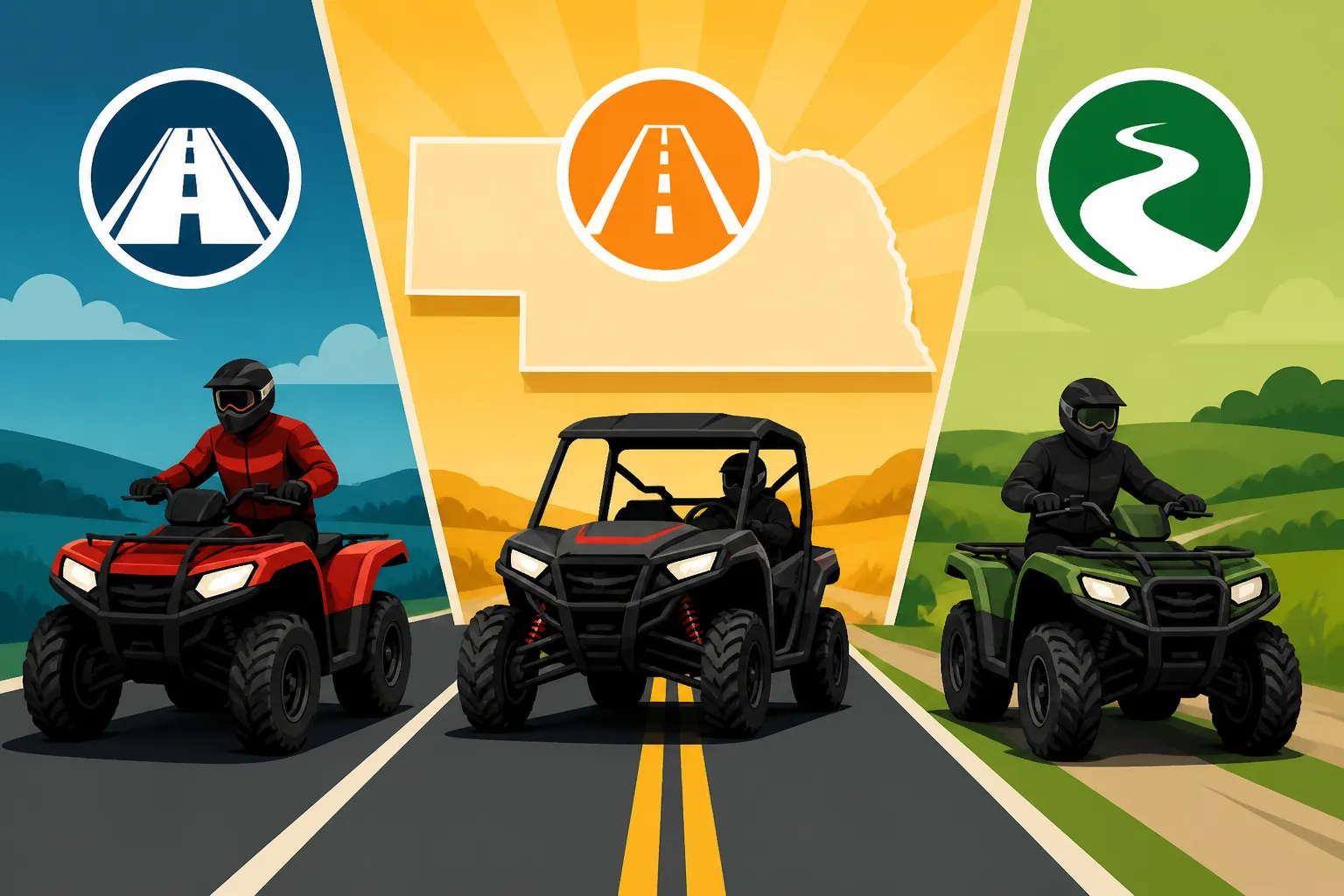
Three Ways ATVs Can Legally Use Nebraska Roads
Many ATV and UTV riders in Nebraska feel stuck between a rock and a hard place, often hearing that taking their machine onto any public road is strictly forbidden. This common belief can lead to frustration when you just need to get across a county road to the next field, or cruise down a village street to a friend's house. But here's the good news: Nebraska law actually provides three distinct pathways for legally using your ATV or UTV on public roads, and understanding these can unlock new possibilities for how you enjoy and utilize your machine. This guide will walk you through each of these legal avenues, offering clarity on the specific rules you need to follow to stay on the right side of the law.
The Agricultural Exception: When Farm Work Makes an ATV Road Trip Legal
Nebraska's heart and soul is agriculture, and it's no surprise that the state's laws reflect this heritage. For countless farmers, ranchers, and agricultural workers, an ATV or UTV isn't a toy; it's a vital piece of equipment, a workhorse essential for daily operations. Recognizing this reality, state law carves out a significant exception that allows these machines to traverse public roads for legitimate agricultural purposes. This isn't a loophole for joyriding, but a practical allowance for those whose livelihoods depend on their machines.
Defining "Agricultural Purpose" in Nebraska
So, what exactly counts as an "agricultural purpose" in the eyes of Nebraska law? Essentially, it boils down to activities directly related to farming, ranching, or other agricultural enterprises. This could involve driving your quad down a county road to check on cattle in another pasture, moving a side-by-side from one field to another for planting or harvesting, or even taking your UTV to an outbuilding on your property for maintenance. The key here is the intent behind the trip. If your purpose is genuinely connected to your farm or ranch, you're likely within this exception.
However, it's crucial to understand what this exception does not cover. It doesn't mean you can use your ATV to run into town for groceries, commute to an off-farm job, or simply go for a recreational cruise on public roads, even if you happen to live on a farm. The law is quite specific: the travel must be for bona fide agricultural tasks. A deputy pulling you over might ask about your destination and purpose, and if it doesn't align with agricultural work, you could find yourself facing a citation. Always be clear about why you're on the road if you're relying on this exception.
Specific Rules for Farm Use on Roads
Even when your ATV or UTV use falls squarely within the agricultural exception, you're not entirely free from rules. Nebraska law outlines several requirements to ensure safety on public roads. For starters, you're generally limited to a maximum speed of 30 mph. This isn't just a suggestion; it's a legal limit designed to account for the different handling characteristics of ATVs compared to traditional vehicles. You'll need to keep an eye on your speedometer and resist the urge to push past this limit, even if the road ahead is clear.
Beyond speed, there are strict rules for crossing highways. If you need to cross a paved state or federal highway, you must do so at a ninety-degree angle, making a complete stop and yielding to all traffic before proceeding. This emphasizes safety at what can be a very dangerous intersection. Furthermore, your ATV must have functioning head and taillights, which are generally required to be on during daylight hours when on the road, though there can be an exception for plowing snow after dark. Most importantly, you must display a highly visible five-foot safety flag, typically day-glow orange, to alert other motorists to your presence. [Nebraska's Agricultural Road Exception] offers more detail on these specific requirements for rural areas. For many ranch machines, this is the primary way they touch public roads, often for brief trips. [Nebraska Farm Trips Outside City Limits] further clarifies the boundaries.
The "Farm Permit" vs. Class O License
A common point of confusion for riders, especially younger ones, is the "farm permit." While Nebraska does offer a farm permit, which allows individuals under 18 to operate certain agricultural vehicles on public roads for farm-related work, it's not a special ATV license for road use. For anyone aged 16 and over, a standard Class O (operator's) driver's license is sufficient when operating an ATV for agricultural purposes on public roads. If you're 14 or 15 and operating an ATV on public roads for agricultural purposes, a valid farm permit would cover you, but again, only for that specific purpose.
It's vital to understand that neither a farm permit nor a Class O license makes your ATV street-legal for general recreational use. The permit simply addresses the licensing requirement for the driver when the purpose of the ride is agricultural. In essence, the Class O driver's license covers most adult riders, while the farm permit steps in for qualified younger operators. Remember, a deputy isn't going to distinguish between your machine being used for fun versus work simply by your age or license type; the critical factor is the actual activity you are engaged in. [Can a Farm Permit Replace a Driver's License?] dives deeper into this distinction.
Unincorporated Villages and City Ordinances: Local Control Over ATV Access
While state law provides the agricultural exception, it generally maintains a stance against ATVs and UTVs on public roads. However, Nebraska is a state that values local control, and this philosophy extends to how communities manage their streets. Many smaller cities and even unincorporated villages across the state have taken matters into their own hands, passing local ordinances or resolutions to permit ATVs and UTVs on certain public roadways within their boundaries. This local authority creates the second major avenue for legal road use, but it comes with its own set of unique rules and considerations.
How a Town Ordinance Opens Its Streets to ATVs
Imagine living in a small Nebraska town where the closest gas station or convenience store is just a few blocks away, but getting there requires loading your UTV onto a trailer because state law prohibits its road use. It's a real headache for many residents. This is precisely why many city councils have stepped up, recognizing the practical need and desire of their citizens to use their ATVs and UTVs for local transportation. These municipalities can pass specific ordinances that designate certain streets or even all city streets as open to ATV and UTV traffic.
When a city adopts such an ordinance, it often comes with a list of conditions. These might include specific operating hours (e.g., daylight only), designated streets where machines are allowed, age restrictions for operators, and mandatory equipment beyond what comes standard on many ATVs, such as turn signals, rearview mirrors, and horns. You'll typically be required to register your machine with the city hall and purchase a local permit or sticker, which often has an annual fee. [Nebraska City Ordinances That Open Streets] highlights how these local rules can dramatically change where you can ride. Always assume you need to check with the local authorities before you ride within city limits, as rules can vary drastically from one town to the next, even within the same county.
County Board Resolutions for Villages
What about those charming, unincorporated villages that dot the Nebraska landscape, places that don't have their own city council to pass ordinances? They, too, have a pathway to opening their streets for ATV and UTV use, albeit through a slightly different administrative channel. In these cases, residents or groups can petition their county board. The county board then has the authority to pass a resolution that allows ATVs and UTVs on the public roads within that specific unincorporated village.
This process is similar in spirit to a city ordinance but involves county-level governance. The resulting resolution will also outline specific rules that riders must follow, often mirroring the types of requirements seen in city ordinances: speed limits, equipment mandates, and potentially local registration. It’s a powerful tool for communities without formal municipal government to adapt state law to their local needs. If you live in or plan to ride through an unincorporated village, checking with the county clerk's office would be your first step to understanding what's allowed. [County Boards Can Open Unincorporated Villages to ATVs] provides more context on this avenue.
Local Registration and Insurance Requirements
If you're lucky enough to live in a city or village that permits ATV or UTV use on its streets, be prepared for additional requirements beyond what state law demands for agricultural use. Most cities will require you to register your machine annually with the city clerk's office. This typically involves paying a fee and obtaining a special decal or sticker that you must display on your machine. This local registration helps the city track who is riding on their streets and ensures compliance with their specific rules.
Crucially, you will almost certainly be required to carry liability insurance. This isn't just a good idea; it's a legal mandate in any city that has opened its streets to ATVs. The minimum coverage amounts will usually align with state motor vehicle insurance requirements, covering bodily injury and property damage. Before you even think about riding on city streets, confirm your insurance coverage. Your standard off-road ATV policy might not automatically cover road use, so a quick call to your insurance agent is essential. [Nebraska City ATV Registration Fees] and [Nebraska City Insurance Requirements] are excellent resources to consult for these local specificities. Ignoring these local requirements can quickly turn a fun ride into an expensive ticket, or worse, leave you financially vulnerable in case of an accident.
General Road Rules for Any Legal ATV Use in Nebraska
Regardless of whether you're taking your ATV on the road for agricultural purposes, or cruising legally through a village that has passed an ordinance, there's a foundational set of statewide rules that apply to all ATV and UTV road usage in Nebraska. These rules are designed to promote safety and ensure that ATVs, which are inherently different from cars and trucks, can share the road as responsibly as possible. Neglecting any of these general requirements can quickly invalidate your legal right to be on the road, leading to citations or worse.
Essential Equipment: Lights, Flags, and More
Visibility is paramount when an ATV is on a public road, and Nebraska law reflects this with specific equipment requirements. Every ATV or UTV operating on a public road must be equipped with functioning head and taillights. These lights must be turned on even during daylight hours, ensuring your machine is seen by other motorists. The only exception often cited is for snow removal operations at night, where specific lighting rules might allow for flexibility. Beyond the basic lighting, a 5-foot safety flag is a non-negotiable item. This flag, typically made of day-glow orange material, must be mounted so that its highest point is at least five feet above the ground. This elevates your machine's profile, making it much more visible over dips, hills, and through traffic. Many riders find that aftermarket light kits, sometimes from reputable brands like SuperATV, can significantly enhance their visibility and ensure compliance with these crucial lighting standards.
While not always explicitly required by state law for all road use, it's highly recommended to add turn signals and a horn if your machine doesn't have them, especially if you plan to operate under a city ordinance where such equipment is often mandatory. A rearview mirror is another common-sense addition that can greatly improve your situational awareness. Think about what a standard car or truck has, and consider how you can replicate those safety features on your ATV. [Nebraska Requires Head and Tail Lights] details the specifics, and [Why Road-Legal ATVs Need a 5-Foot Safety Flag] explains the logic behind this critical visibility measure. For specifics on flag dimensions, [Nebraska Safety Flag Dimensions] is your go-to.
Speed Limits and Crossing Procedures
The state of Nebraska has a clear mandate regarding the speed of ATVs on public roads: you cannot exceed 30 mph. This applies universally across all legal road uses, from agricultural trips on county roads to cruising village streets. This speed limit reflects the design and handling characteristics of ATVs, which are not built for sustained high speeds on paved surfaces. Exceeding this limit is not just dangerous; it's a direct violation of the law and can result in a traffic ticket.
Beyond speed, there are strict protocols for interacting with larger roadways. While ATVs are generally prohibited from state highways, the law does allow for crossing them. If you need to cross a highway, it must be done at a ninety-degree angle, meaning you go straight across, not diagonally or longitudinally. Before crossing, you must come to a complete stop and yield the right-of-way to all other traffic on the highway. This is a critical safety measure, as highways are designed for faster-moving vehicles, and an ATV presents a smaller, slower target. Trying to ride alongside traffic on a state highway, even for a short distance, is almost certainly illegal and incredibly risky.
Insurance and Licensing Requirements
One of the most critical, and often overlooked, aspects of legal ATV road use in Nebraska is the requirement for liability insurance. If your ATV or UTV touches a public road for any of the legal reasons described, you must carry liability insurance. This isn't optional; it's a legal obligation designed to protect you and others in the event of an accident. The minimum coverage amounts for bodily injury and property damage are typically set by state statute and align with what's required for other motor vehicles.
Just like driving a car, you also need to be a licensed operator. For most adults, this means possessing a valid Class O (operator's) driver's license. As discussed earlier, younger operators engaged in bona fide agricultural work may use a farm permit. It's imperative that the person behind the handlebars is legally authorized to drive a motor vehicle. Remember, the absence of a license or valid insurance can lead to severe penalties, regardless of whether your ATV use was otherwise legal. [Nebraska Requires Liability Insurance on Roads] outlines the insurance necessity, and [Do You Need a License for an ATV in Nebraska?] clarifies the operator requirements. Always confirm your insurance coverage before venturing onto any public road.
Understanding Penalties and Common Misconceptions
Despite the clear legal pathways, there's still a widespread belief that ATVs and UTVs are absolutely forbidden from all Nebraska roads. This misconception, coupled with a lack of understanding of the specific laws, often leads riders into situations where they inadvertently break the law. Understanding the penalties for illegal road riding and the historical context of Nebraska's ATV laws can help prevent costly mistakes and encourage safer, more compliant operation. It's not just about avoiding a ticket; it's about respecting the safety of yourself and others on shared public ways.
The Consequences of Illegal Road Riding
Riding your ATV or UTV on a public road when not engaged in agricultural work, not within an authorized city/village, or without the proper equipment and insurance, can lead to a host of unpleasant consequences. The most immediate impact is usually a traffic citation, which carries fines and court costs. These aren't trivial; a single ticket can quickly add up to hundreds of dollars. Beyond the financial hit, repeated offenses could lead to more serious legal action, potentially impacting your driving record. In some cases, deputies have the authority to impound your machine, leaving you not only with fines but also impound fees to retrieve your ATV.
Imagine being pulled over on a county road, thinking you're just cutting across to a friend's property, only to find yourself facing a hefty fine and a tow bill because you weren't on an agricultural mission and the county hadn't authorized recreational use. It's a frustrating, expensive lesson that many riders wish they hadn't learned the hard way. It’s important to remember that ignorance of the law is rarely an acceptable defense in court. [Nebraska Penalties for Illegal Road Riding] and [Nebraska Ticket Costs for Road Riding] detail some of the potential repercussions.
Why the ATV Road Law Was Written Around Farming
To truly understand why Nebraska's ATV road laws are structured the way they are, you have to look at the state's roots. Nebraska has always been an agricultural state, and its laws often reflect the practical needs of its farming and ranching communities. The original intent behind allowing ATVs on roads was not to facilitate recreational riding or commuting, but to provide essential mobility for agricultural workers. Lawmakers recognized that forcing a farmer to trailer a machine for a short hop between fields was inefficient and burdensome.
This agricultural focus is why the laws are so specific about "agricultural purposes" and why the general state stance remains restrictive for recreational road use. It wasn't about making ATVs street-legal in the same vein as motorcycles; it was about supporting a vital industry. This historical context helps explain why recreational riders often feel limited, while agricultural users have a clearer, though still regulated, path to road access. [Why the ATV Road Law Was Written Around Farming] delves into this legislative history.
Checking Local Rules Before You Ride
Given the variations in city and county ordinances, the most crucial piece of advice for any ATV or UTV rider in Nebraska is this: always check local rules before you ride on any public road. What's permissible in one village might be strictly forbidden just a few miles down the road in another. Don't rely on hearsay or what a friend's friend told you. The only reliable sources are the local authorities themselves.
Before planning any road-based ride, make a phone call or visit the website of the city hall or county clerk's office for the area you intend to ride in. Ask specific questions: Are ATVs allowed on public roads here? If so, which roads? What are the equipment requirements? Is there a local registration or permit needed? What are the age and licensing requirements? Being proactive can save you a lot of grief. [What to Ask City Hall Before Riding Streets] offers a good checklist of questions to pose. A little research upfront can make all the difference between a great ride and a costly encounter with law enforcement.
Equipping Your ATV for Nebraska Road Safety
So, you've confirmed that your intended road use falls under one of Nebraska's legal pathways – fantastic! But before you hit the pavement, it's crucial to ensure your machine is properly equipped not just to meet legal requirements, but also to maximize your safety. ATVs and UTVs are designed primarily for off-road environments, and making them road-ready involves more than just throwing on a safety flag. Investing in the right gear, from enhanced lighting to appropriate tires, can significantly reduce risks and make your road-going adventures much smoother.
Lights, Turn Signals, and Horns
While your ATV likely came with basic head and taillights, consider whether they're truly adequate for road use, especially if you're riding in a city or near heavier traffic. Bright, clear lights are crucial for being seen by others, day or night (if allowed). Many riders opt for aftermarket LED light bars or upgraded headlights to improve their visibility. If your machine doesn't have them, adding turn signals is highly recommended. Hand signals can be difficult for other drivers to interpret, especially at speed or in poor visibility. A dedicated turn signal kit, readily available from accessory providers, makes your intentions clear. SuperATV, for instance, offers a range of universal turn signal and horn kits that can easily be adapted to most ATV and UTV models, bringing your machine up to necessary safety standards for public roads.
A horn is another often-overlooked but essential safety device. While you might not use it often, being able to alert a distracted driver or pedestrian can prevent an accident. Most aftermarket turn signal kits will include a horn, or you can purchase one separately. Ensuring these components are clearly visible, properly installed, and fully functional isn't just about avoiding a ticket; it's about actively preventing collisions by making your presence and actions unmistakable to everyone else on the road.
Safety Flags and Reflective Gear
We've already touched on the importance of the 5-foot safety flag, but let's dive into the specifics. This flag must be a day-glow color, typically orange, and needs to be at least 30 square inches in size. It serves as a visual beacon, increasing your machine's profile and making it easier for drivers of larger vehicles to spot you, especially when cresting hills or navigating winding roads. Make sure the mounting is secure and durable; you don't want your flag flying off at 30 mph.
Beyond the mandatory flag, consider adding extra reflective tape to your machine – on the fenders, brush guards, or any other visible surface. This is particularly beneficial if you might be riding near dusk or dawn, or in dusty conditions where visibility is naturally reduced. Even wearing a high-visibility vest or jacket can dramatically improve how quickly other drivers see you. While not always legally required for every type of road use, these additional reflective measures are smart safety precautions that can literally save your life. [Day-Glow Orange and the 30-Square-Inch Flag Rule] provides specific dimensions and color requirements.
Tire and Suspension Considerations for Road Use
While not explicitly part of Nebraska's legal road-use requirements, the type of tires and condition of your suspension play a significant role in your safety and comfort on public roads. Most ATVs come with aggressive, knobby tires designed for maximum traction in dirt, mud, and sand. While these are excellent off-road, they wear down very quickly on pavement, offer reduced grip on hard surfaces (especially wet ones), and can make your machine feel unstable at speed. If you anticipate frequent road use, consider investing in a set of more road-friendly or "all-terrain" tires that offer a compromise between off-road grip and on-road durability and handling.
Similarly, your ATV's suspension is tuned for absorbing bumps and jumps off-road. On pavement, this can sometimes lead to a "floaty" feeling or excessive body roll in turns. While you probably won't be making major suspension changes just for occasional road use, being aware of how your machine handles differently on hard surfaces is key. Ensure your tires are properly inflated for road use (check your owner's manual for recommended pressures), and that your suspension components are in good working order. SuperATV, known for its extensive range of ATV and UTV parts, can be a great resource for exploring different tire options or even suspension upgrades that might improve your machine's performance and safety on mixed terrains.
| Feature | Agricultural Use | City/Village Ordinance | Crossing a Highway (General) |
|---|---|---|---|
| Primary Purpose | Farm/Ranch Work | Local Transportation | Connects Legal Riding Areas |
| Legal Authority | State Statute | Local Ordinance/County Resolution | State Statute (for crossing only, not riding) |
| Speed Limit | 30 mph | Varies (often 30 mph) | 30 mph |
| Required Flag | Yes (5-foot day-glow) | Yes (often required) | Yes (often required) |
| Head/Tail Lights | Yes (Daylight exception for snow removal) | Yes | Yes |
| Insurance | Yes (Liability) | Yes (Liability) | Yes (Liability) |
| Driver's License | Class O or Farm Permit | Class O | Class O or Farm Permit |
| Registration/Permit | No state registration | Often local registration | No state registration |
| Where Allowed | County roads, some city roads (for ag only) | Designated city/village streets | At intersections, 90-degree angle |
| Key Restriction | Only for bona fide ag use | Limited to specific areas | Not for continuous travel |
Disclaimer
This article is for general informational purposes only and does not constitute professional advice. Laws, prices and regulations vary by location and change over time. Consult a qualified professional for guidance on your specific situation.