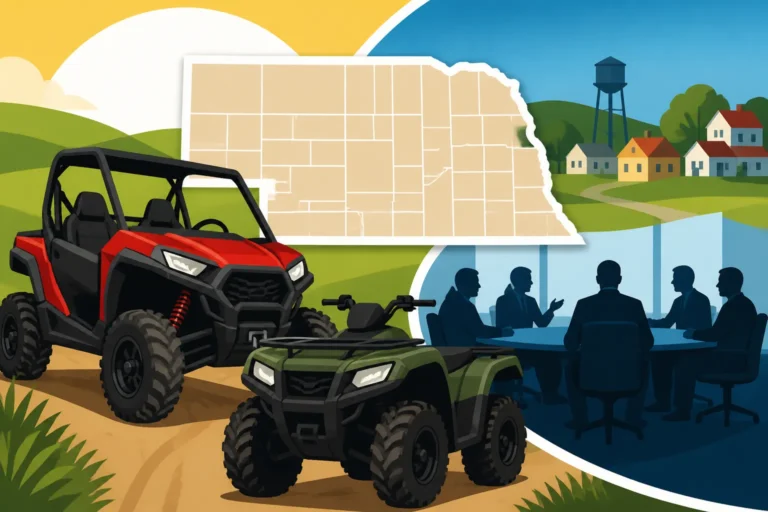
County Boards Can Open Unincorporated Villages to ATVs
It can be incredibly frustrating to feel like you're playing a constant guessing game when it comes to riding your ATV or UTV on public roads in Nebraska. Many riders assume all roads are off-limits, but that's not always the case, especially in smaller communities. This guide will help you understand how local county boards can open up the streets of unincorporated villages, shedding light on a specific pathway to legal road use that many might not even know exists.
The Patchwork of Nebraska ATV Road Rules
Navigating the rules for ATV and UTV use on Nebraska roads can feel like trying to assemble a puzzle with pieces from different boxes. You might hear general state laws, then city ordinances, and then, if you dig deeper, county resolutions for smaller communities. It's enough to make your head spin, leaving you wondering if it's even worth the effort to figure it all out.
Why State Law Isn't Always the Final Word
While Nebraska state law, specifically statute 60-6,356, lays down the baseline for ATV and UTV operation, it often doesn't tell the whole story, especially when it comes to local street access. The state sets the overarching framework, like requiring specific safety equipment or defining agricultural exemptions, but it also provides avenues for local entities – cities, towns, and even county boards – to create their own rules. This means that a road that's off-limits in one area might be perfectly legal to ride in another, even if they're just a few miles apart. It's not about ignoring state law, but understanding how local rules intersect with and, in some cases, expand upon it. For a deeper dive into the state's foundational rules, check out [Nebraska ATV Road Rules Under 60-6,356].
The state's approach recognizes the diverse needs and desires of Nebraska's communities. What works for a bustling city like Omaha might be completely impractical or undesirable for a tiny, unincorporated village out in the Sandhills. This flexibility, while sometimes confusing, allows communities to tailor regulations to their unique character and local culture. This is why you can't just rely on a single, statewide "yes" or "no" answer when planning a ride. Each local jurisdiction has the power to adapt these rules, which can be both a blessing and a curse for ATV and UTV enthusiasts.
The Local Control Over Small Communities
This local control becomes particularly evident when we talk about Nebraska's numerous unincorporated villages. These are communities that don't have their own municipal government, mayor, or city council. They exist, people live there, businesses operate, but they fall under the direct governance of the county board. In these situations, it's the county, not a city government, that has the authority to decide if ATVs and UTVs can legally use the local roads within that specific village.
This is a key distinction. If you live in a city, you'd approach the city council. But in an unincorporated village, your local governing body is the county board. They are the ones who can pass a resolution or ordinance to permit ATV and UTV use on streets, assuming certain conditions are met and public safety is considered. It's a way for residents of these smaller, often rural, communities to have a say in how their local roads are used, without having to form a full municipal government.
Understanding Unincorporated Villages and County Authority
Many people hear "village" and automatically think of an incorporated town with its own mayor and council. But Nebraska has a significant number of unincorporated communities, which are distinct in how they're governed. Knowing this difference is crucial if you're trying to figure out if you can legally ride your ATV through a small community.
What Defines an Unincorporated Village?
An unincorporated village is essentially a cluster of homes and businesses that is not formally incorporated as a city or town under state law. It doesn't have its own separate legal identity, its own local ordinances distinct from the county, or its own elected officials (like a city council or mayor) to manage its day-to-day affairs. Instead, these areas rely entirely on the county government for services like law enforcement, zoning, and, critically for us, road regulation.
Think of it this way: while people might call it "Elm Creek" or "Pleasant Dale," if it's not officially incorporated, it's just a geographical location within a specific county. The county board holds the legislative power for all areas within the county that aren't part of an incorporated municipality. This structure simplifies governance in rural areas but can make understanding specific rules feel a bit less intuitive. You won't find a separate "Elm Creek ATV Ordinance" but rather a "Buffalo County Resolution Pertaining to ATV Use in Unincorporated Villages." To learn more about this specific governmental arrangement, look up [Nebraska Unincorporated Villages and County Boards].
How County Boards Gain This Power
The authority for county boards to regulate ATVs and UTVs in unincorporated villages stems directly from state statutes. The state grants counties the power to manage their roads and regulate traffic within their jurisdiction, specifically in areas not covered by a city or village's own municipal code. This isn't a power they just decide to take; it's delegated to them by the state legislature.
When a county board considers opening village streets to ATVs, they are typically acting under these state-granted powers. They can pass a resolution or ordinance that outlines the specific conditions under which ATVs and UTVs can be operated on those village roads. This might include speed limits (often mirroring the state's [Nebraska's 30 mph Road Limit]), specific times of day, safety equipment requirements, and licensing mandates. The key is that this power allows for local flexibility, recognizing that a blanket state rule might not fit every community.
The Role of the County Board in Local Governance
The county board acts as the primary governing body for all unincorporated areas within its county. This means they are responsible for everything from setting property tax rates to maintaining county roads, and yes, even deciding on the legality of ATV use in unincorporated villages. When residents of an unincorporated village want to see ATVs allowed on their streets, it's the county board they must approach.
These boards typically hold regular public meetings where residents can voice concerns, present proposals, and engage in the decision-making process. The board members, usually elected by district or county-wide, are meant to represent the interests of all county residents, including those in unincorporated areas. Understanding their role is the first step in advocating for changes to ATV use rules in your local area.
The Process for Opening Village Roads to ATVs
So, you live in an unincorporated village and you'd love to legally ride your ATV or UTV on its streets. How do you actually make that happen? It's not as simple as just deciding to do it, but there's a clear process in place for residents to work with their county board.
Initiating the Request: Who Can Ask?
The process usually begins with community members or local ATV enthusiasts approaching their county board. It's helpful to gather support from other residents in the unincorporated village who also favor opening the streets to ATVs. A petition, letters of support, or even just a well-attended board meeting can demonstrate the community's interest. It's often more impactful when the request comes from the very residents who would be affected, showing that it's a community-driven initiative.
When you make your request, it's important to come prepared. Understand the existing [Nebraska Rules for Riding a County Road] and be ready to discuss how opening the village streets would fit within or deviate from those rules. You'll want to highlight the benefits – perhaps it offers a convenient way for farmers to get to their fields, or allows residents to access local businesses without trailering their machines. Consider also how any potential safety concerns might be addressed. A well-thought-out proposal has a much better chance of success.
The Public Hearing and Board Decision
Once a request is formally submitted, the county board will typically schedule a public hearing. This is a critical step where all sides can present their views. Residents can speak in favor of the proposal, explaining why they believe ATVs should be allowed on village streets. Likewise, residents who have concerns about safety, noise, or property values will have an opportunity to voice their objections.
The county board listens to all testimony, considers the potential impacts, and often seeks input from local law enforcement, the county attorney, and other relevant departments. After the hearing, the board will deliberate and then vote on whether to pass a resolution or ordinance to allow ATV and UTV use. This resolution will often specify the terms and conditions, such as the areas where riding is permitted, the hours of operation, and any additional safety requirements. For specific guidance on this, it's worth reviewing [How a County Board Opens a Village to ATVs].
What an Ordinance or Resolution Entails for Riders
If the county board approves the request, they will issue a formal resolution or ordinance. This document is what legally opens the streets of the unincorporated village to ATVs and UTVs. It will detail the specific rules that riders must follow within that designated area. These rules are usually in addition to, or in clarification of, state laws.
Common stipulations in such ordinances might include:
- Specific Roadways: Which streets or alleys are open, and which remain closed.
- Speed Limits: Often 30 mph or less, aligning with safety for residential areas.
- Time of Day: Restrictions on night riding, often sunrise to sunset, with exceptions for snow removal or agricultural use.
- Driver Licensing: Requirement for a valid driver's license, such as a [Nebraska Requires a Class O License or Farm Permit].
- Insurance: Mandatory [Nebraska Requires Liability Insurance on Roads] coverage.
- Safety Equipment: Requirements for headlights, taillights, mirrors, turn signals, and often a [Why Road-Legal ATVs Need a 5-Foot Safety Flag]. If your machine needs some upgrades to meet these standards, companies like SuperATV offer a wide range of accessories, from turn signal kits to mirrors, that can help you get compliant.
- Passenger Rules: Limitations on passengers, especially for youth riders.
It's absolutely essential for riders to obtain a copy of the specific county resolution or ordinance and understand every detail. Ignorance of the local law is no excuse for a citation.
What Changes for Riders When a Village Opens Its Streets
Once a county board formally opens an unincorporated village's streets to ATVs and UTVs, it's not a free-for-all. There are very specific changes and obligations that riders must adhere to, and understanding these is paramount to avoiding trouble.
Specific Rules for Road-Legal ATV Use
When a village's streets become accessible to ATVs and UTVs, it means you can operate your machine on those public roadways, but only under strict conditions. These conditions are designed to ensure the safety of riders, pedestrians, and other motorists. For example, while you might now be able to run to the corner store on your quad, you'll likely still need to obey all traffic laws, including stop signs, yield signs, and posted speed limits, which, in Nebraska, is typically capped at [Nebraska's 30 mph Road Limit] for ATVs on public roads, even if the road itself has a higher limit for cars.
You'll also need to ensure your machine is equipped for road use. This typically includes working headlights and taillights, brake lights, a horn, mirrors, and often a safety flag that is at least five feet above the ground. These are common requirements for any ATV or UTV being operated on public roads, regardless of whether it's under a specific local ordinance or the agricultural exemption. Making sure your machine is up to snuff with these requirements is essential – a quick visit to a site like SuperATV can help you find everything from mirrors to turn signal kits to get your machine legal. Remember, even in an unincorporated village, you're sharing the road with cars, trucks, and pedestrians, so visibility and signaling are key.
The Importance of Local Ordinance Details
Every county resolution or ordinance can be slightly different, and the devil is truly in the details. One county might open all village streets, while another might designate only certain ones. Some might have time-of-day restrictions, forbidding riding after dark, while others might allow it if your machine has proper lighting. It's not enough to know that ATVs are allowed; you need to know how and where.
Before you take your machine out, always obtain a copy of the specific resolution or ordinance from the county clerk's office or the county's website. Read it carefully, and if anything is unclear, don't hesitate to contact the county clerk or even the local sheriff's department for clarification. [Asking the Sheriff Whether a County Road Is Open] is always a good idea. Relying on hearsay or what a neighbor "thinks" the rules are can lead to costly [Nebraska Penalties for Illegal Road Riding].
Equipment and License Requirements That Still Apply
Even with a county ordinance allowing ATV use, several fundamental state requirements remain in force. These are non-negotiable and apply across the board for road use:
- Driver's License: The operator must possess a valid Class O operator's license (standard driver's license) or a farm permit if operating for agricultural purposes. [Nebraska Requires a Class O License or Farm Permit]. A learner's permit typically isn't sufficient for ATV road use.
- Liability Insurance: Any ATV or UTV operated on public roads, including those in unincorporated villages, must be covered by liability insurance that meets Nebraska's minimum requirements. [Nebraska Requires Liability Insurance on Roads] is not an option; it's a must.
- Safety Equipment: As mentioned, functional headlights, taillights, brake lights, turn signals (if required by the ordinance), mirrors, and often a safety flag are mandatory. Don't assume that just because the streets are open, your off-road machine is automatically road-legal without modifications. You might need to add items like a horn or DOT-approved tires. SuperATV has a range of products like windshields and full street-legal kits that can help ensure your machine complies with these critical equipment standards.
- Helmet Use: While Nebraska's helmet law specifically covers motorcycles, it's always wise to check if a local ordinance might include helmet requirements for ATVs, especially for youth riders. Even if not legally mandated, wearing a helmet is always a smart choice for safety.
Failing to meet these requirements can still result in fines or other penalties, even if you are riding on a street that is technically open to ATVs.
Navigating the Nuances: Challenges and Best Practices
Understanding that county boards can open unincorporated village roads is a great start, but the real challenge lies in staying compliant and being a responsible rider. It’s not just about what’s legal, but how you conduct yourself in these shared spaces.
Staying Informed About Local Rule Changes
County resolutions and ordinances aren't set in stone forever. While they might not change as frequently as city ordinances, they can be amended or even repealed. It's your responsibility as a rider to stay informed about the current rules in any area where you plan to ride. This means periodically checking the county clerk's website, attending local public meetings if changes are being discussed, or contacting the county office directly.
It's also important to remember that laws are interpreted and enforced by local law enforcement. Just because a rule exists on paper doesn't mean every deputy or officer is intimately familiar with every nuance of every county resolution. Carrying a copy of the relevant ordinance with you can sometimes help clarify a situation if you're questioned, though it's never a guarantee against a citation if you've genuinely violated a rule.
Potential Pitfalls and Enforcement Differences
One of the biggest pitfalls when navigating these local allowances is the assumption that all roads are open once a village is covered by an ordinance. This is rarely the case. There might be state highways running through the village that remain strictly off-limits, or certain residential streets that are specifically excluded. Always pay attention to signage and the exact wording of the ordinance.
Enforcement can also vary. A smaller county might have fewer deputies, and thus enforcement might feel less consistent, but that doesn't mean the rules aren't in effect. Conversely, a county with a very active sheriff's department might enforce every detail stringently. It’s better to err on the side of caution and assume that all rules will be enforced. Additionally, remember that county lines exist. A resolution from one county has no bearing on a neighboring county, even if the unincorporated villages are just miles apart.
Advocating for ATV Access in Your Community
If your unincorporated village doesn't currently allow ATV or UTV road use, and you'd like to see that change, becoming an advocate is the way to go. This involves more than just showing up at a meeting to complain. It requires thoughtful preparation and community engagement.
Here are some best practices:
- Form a Group: There's strength in numbers. Connect with other riders and residents who share your interest.
- Educate Yourself: Understand the state laws, the county's powers, and what other communities have done. Reviewing resources like [What to Ask City Hall Before Riding Streets] can offer general guidance applicable to county boards as well.
- Develop a Proposal: Outline why opening the streets is beneficial (e.g., convenience for residents, access to businesses, agricultural use), and how potential concerns (safety, noise) will be addressed.
- Highlight Safety: Emphasize responsible riding, proper equipment, and adherence to traffic laws. Perhaps suggest a safety flag requirement or speed limits.
- Engage with the Board: Attend meetings, schedule appointments with individual board members, and present your case respectfully and professionally. Be ready to answer questions and address objections.
- Be a Good Neighbor: Even if you get the rules changed, ongoing responsible behavior by riders is crucial to maintaining good relations and preventing the rules from being revoked later.
Beyond the Village Limits: Other Road-Legal Scenarios
While county board resolutions for unincorporated villages are a specific avenue for ATV and UTV road use, it's important to remember that they are just one piece of the larger puzzle of Nebraska's ATV laws. Other situations also permit road travel, each with its own set of conditions.
Nebraska's Agricultural Road Exception
One of the most common ways ATVs and UTVs are legally operated on Nebraska roads is through the agricultural exemption. This exception allows machines used for farming, ranching, or other agricultural purposes to travel on county and township roads. This is incredibly important for many rural Nebraskans who rely on their machines for work.
However, "agricultural use" has specific definitions. It generally means transporting tools, equipment, supplies, or workers in connection with agricultural operations, or crossing a road to get from one part of a farm to another. It does not mean joyriding after finishing your chores. Even under this exception, riders must typically adhere to speed limits, equip their machines with proper lighting, and carry liability insurance. For many farmers and ranchers, a heavy-duty UTV with SuperATV accessories like a cargo bed liner or a full cab enclosure is an essential tool, making this exception vital for their daily operations.
City Ordinances That Open Streets
Just as county boards can pass resolutions for unincorporated villages, incorporated cities and towns in Nebraska have the power to enact their own ordinances allowing ATVs and UTVs on their municipal streets. This is distinct from county control. These city ordinances are typically more common in smaller towns that want to offer residents more recreational or practical access to their machines.
If you're in an incorporated city, you'd approach the city council, not the county board, to inquire about or advocate for ATV access. These ordinances often come with their own specific rules regarding registration, fees, age restrictions, and the specific streets that are open. For example, some cities might require an annual city-specific permit or sticker. If you plan to ride within city limits, it's crucial to consult the city's specific ordinance. For more details on how this works, see [Nebraska City Ordinances That Open Streets].
Ultimately, understanding the different layers of government and their specific powers is the key to legally enjoying your ATV or UTV on public roads in Nebraska. Always do your homework, stay informed, and ride responsibly.
Comparison of Nebraska Local ATV Road Access Types
| Access Type | Governing Body | Typical Location | Key Feature | Common Requirements |
|---|---|---|---|---|
| Unincorporated Village | County Board | Rural, unorganized communities | County resolution opens specific village roads | State license, insurance, safety equipment, local limits |
| Incorporated City/Town | City Council | Densely populated municipalities | City ordinance opens specific municipal streets | State license, insurance, safety equipment, city-specific permits/fees |
| Agricultural Road Exemption | State Law (general) | Rural county/township roads | For direct agricultural work; not recreational | State license, insurance, safety equipment, strict use limits |
| General County Road Use | State Law / County Boards | All county roads outside cities | Limited for specific purposes (crossing, snow removal, ag) | State license, insurance, safety equipment, strict use limits |
Disclaimer
This article is for general informational purposes only and does not constitute professional advice. Laws, prices and regulations vary by location and change over time. Consult a qualified professional for guidance on your specific situation.