Nebraska Rules for Plowing Snow at Night
Plowing snow with your ATV or UTV in Nebraska can be a real lifesaver, especially when winter storms dump several inches overnight. But when the flakes are flying after sundown, you're not just fighting the elements; you're also navigating a complex web of state and local rules. This guide will walk you through the specific regulations and best practices for safely and legally clearing snow from driveways and public access points under the cover of darkness.
Why Plowing Snow at Night is Different (and Tricky) in Nebraska
Let's be honest, few things are as satisfying as firing up your quad or side-by-side after a fresh snowfall, strapping on the plow, and getting to work. But when that work happens at night, the game changes significantly. Nebraska has specific laws that govern ATV and UTV use on public roads, and nighttime operations introduce a whole new layer of scrutiny, mainly due to visibility and safety concerns. It’s not simply about having a bright headlight; it’s about adhering to specific statutes that prioritize safety for everyone on the road, including you.
The Agricultural Exception and Its Limits
Many Nebraska ATV and UTV riders are familiar with the "agricultural exception" that allows these machines to operate on public roads for farm-related tasks. This exception is incredibly useful for ranchers moving between pastures or farmers checking irrigation pivots. However, it's crucial to understand that merely clearing snow from your driveway, even if you live on a farm, doesn't automatically qualify under this exception if you venture onto public roadways.
The law [Nebraska ATV Road Rules Under 60-6,356] generally permits ATVs and UTVs on public roads only for agricultural purposes, for utility service, or where a specific local ordinance allows it. While some might argue that clearing a farm lane could be seen as agricultural, driving your machine down a county road to clear a neighbor's driveway or access a different part of your property might stretch this definition. When it comes to plowing snow at night, deputies are even more vigilant about machines on public roads, so relying solely on a broad interpretation of the agricultural exception for non-direct farm work could put you at risk of a citation. It's always best to be absolutely sure your activity falls squarely within the defined agricultural use or is explicitly permitted by a local ordinance.
Visibility Challenges After Dark
This one seems obvious, right? It's dark! But the reality of plowing snow at night goes beyond just "less light." Snow itself can reduce visibility dramatically, reflecting light in a way that creates glare and obscures details. Falling snow, blowing snow, and snow kicked up by your own machine can form a near white-out condition, even with good lighting. For this reason, Nebraska's general rule is [Sunrise to Sunset Only] for most ATV road use. However, there's a critical exception: [Clearing Snow After Dark].
This exception acknowledges the necessity of night plowing but doesn't remove the burden of extreme caution and proper equipment. Other drivers, often in larger, faster vehicles, may not expect to see an ATV or UTV operating slowly with a plow attached, especially after dark. The low profile of many ATVs, combined with reduced visibility from weather, means you are at a distinct disadvantage. This is why strict adherence to lighting requirements and employing every possible safety measure becomes paramount. The stakes are much higher when visibility is compromised for both you and any other traffic on the road.
Nebraska's Lighting Requirements for Nighttime Road Use
When you're out plowing snow after the sun has set, your machine isn't just a workhorse; it's a vehicle operating on or near public thoroughfares, and that means it has to be seen. Nebraska law is very clear about the minimum lighting required for any vehicle operating on public roads after dark. For ATVs and UTVs, these rules are particularly important because they were generally not designed for extensive public road use. This is where [Nebraska Lighting Statute 60-6,357] comes into play.
Headlights, Taillights, and Reflectors
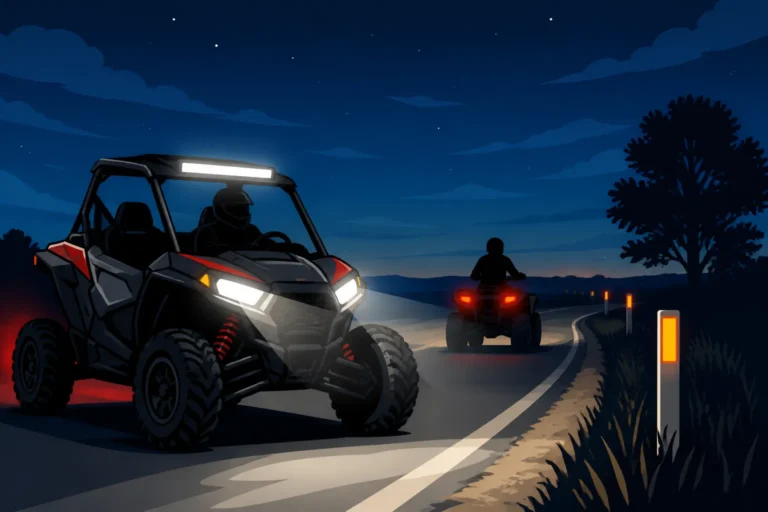
Under state law, if you're going to use your ATV or UTV on a public road after dark, it must be equipped with at least one headlight (which emits a white light) visible from 500 feet to the front, and at least one taillight (emitting a red light) visible from 500 feet to the rear. It's not enough for the lights to simply be there; they must be functional and properly adjusted to illuminate the road ahead without blinding oncoming traffic, and to signal your presence clearly from behind. [Why Your Headlight Must Be On in Daylight] actually highlights the importance of visibility even in daytime, so imagine how critical it is at night.
Furthermore, your machine should have at least one red reflector on the rear, visible from 100 to 600 feet when illuminated by another vehicle's headlights. While many modern ATVs and UTVs come standard with adequate lighting for off-road use, when you add a plow, it can sometimes obstruct or dim the factory lights, making them less effective. Before you head out, always do a quick check to ensure all your lights are clean, working, and not obscured by snow or your plow attachment. For your taillights, [Taillight Rules for ATVs on Public Roads] emphasize the need for a clear, red light to the rear, which is your primary defense against rear-end collisions.
Auxiliary Lighting and Enhanced Visibility
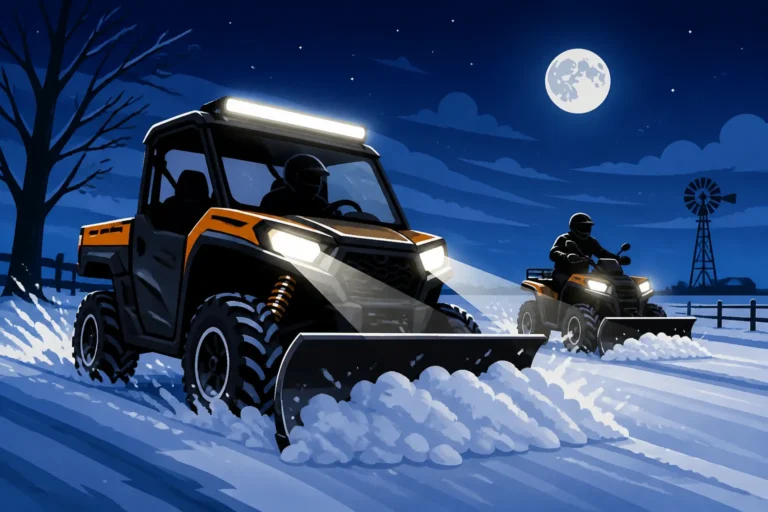
While the state statute specifies minimums, when you're plowing snow at night, minimums often aren't enough for optimal safety or efficiency. This is where auxiliary lighting truly shines. Many riders choose to add extra LED light bars or spot/floodlights to their machines, especially when a plow is attached. These additions can dramatically improve your field of vision, helping you see snowdrifts, icy patches, and obstructions that a single headlight might miss. Brands like SuperATV offer a wide range of robust LED light bars and cube lights that are perfect for enhancing nighttime visibility in challenging conditions. Investing in good auxiliary lighting isn't just about making your job easier; it's a significant safety upgrade.
Beyond just seeing where you're going, you need to be seen by others. Flashing amber lights, often mounted on a pole or the roll cage of a UTV, are highly recommended. While not explicitly mandated for ATVs in the same way they are for some larger utility vehicles, these lights make your slow-moving, plowing machine much more conspicuous to other drivers, especially on rural roads where speeds are higher. Consider a strobe or beacon light that is visible 360 degrees. Reflective tape on your plow, the front and rear of your machine, and even on your helmet or clothing can also contribute to making you more visible to oncoming and following traffic. Every little bit of extra visibility counts when you're working in the dark and snow.
Other Important Rules for Nighttime Snow Plowing
Operating an ATV or UTV for snow plowing at night involves more than just proper lighting; it requires a comprehensive understanding of other road rules that still apply, even under these unique circumstances. These rules are designed to protect not only you but also other motorists who might encounter your slow-moving machine on the road. Ignoring these could lead to serious consequences, from fines to accidents.
Speed and Caution on Snow-Covered Roads
One of the most critical rules to remember when operating an ATV or UTV on a public road in Nebraska, day or night, is the [Nebraska's 30 mph Road Limit]. This speed limit applies even if the posted speed limit for cars is higher. When you're plowing snow, especially at night on potentially icy or snow-covered surfaces, maintaining even 30 mph can be incredibly dangerous, if not impossible. The rule of thumb should always be: as slow as safely possible. Your ATV or UTV with a plow attached handles very differently than a bare machine, and the added weight and drag of the snow further reduce stability and braking capability.
Exercise extreme caution. Slow down significantly at intersections, blind corners, and crests of hills. Be extra vigilant for other vehicles, pedestrians, or even wildlife that might be obscured by snow or darkness. Remember, your primary goal is to clear snow safely and efficiently, not to set any land speed records. If conditions are too hazardous, it’s always better to wait for daylight or for the weather to improve rather than risk an accident.
Safety Flags and Their Diminished Role at Night
Nebraska law typically requires a [Nebraska's 5-Foot Safety Flag Rule] for ATVs and UTVs operating on public roads. This flag, which must be at least 5 feet above the ground and have a day-glow orange triangular shape, is designed to increase your visibility, especially on hills and around curves, by making your machine more noticeable to other drivers. However, at night, the effectiveness of a day-glow flag is significantly diminished. While it’s still good practice to have it mounted as a matter of habit and compliance with the overall statute, its passive reflective qualities are minimal compared to active lighting.
Therefore, for night plowing, your focus must shift predominantly to active illumination. Instead of relying on the flag to be seen, you should use bright, flashing amber lights on a pole, or other similar active lighting devices that are clearly visible from all directions. The flag might still catch a stray headlight beam, but it won't broadcast your presence effectively in the dark. Always ensure any pole-mounted lights are positioned so they don't interfere with your vision or the operation of your plow.
Insurance and License Requirements
Just like any other vehicle on public roads, if your ATV or UTV is used for plowing snow on a public road, you need to meet certain requirements. [Nebraska Requires a Class O License or Farm Permit] for the operator. This means you must have a valid driver's license (Class O) or a farm permit if you are a minor operating for agricultural purposes. Simply having an ATV/UTV doesn't grant you carte blanche to drive on public roads.
Furthermore, [Nebraska Requires Liability Insurance on Roads]. This is non-negotiable. If you're involved in an accident while plowing snow on a public roadway, your liability insurance will be critical. Ensure your policy covers your ATV or UTV for road use, even if it's limited to specific conditions like snow plowing or agricultural work. Many standard off-road policies might exclude road operations, so it’s imperative to check with your insurance provider and confirm your coverage before you even think about putting tires on a public road after dark. This is often an area where riders make assumptions, only to find out they are uninsured after an incident.
Local Ordinances and Common Sense for Night Plowing
While Nebraska state statutes provide a framework, individual cities and counties have the authority to create their own ordinances regarding ATV and UTV use on their roads. This means that the rules for plowing snow at night can vary significantly from one town to the next, or even between unincorporated areas and villages within the same county. It's not a "one size fits all" situation.
Checking Your City or County's Specific Rules
Before you ever venture out to plow snow on public roads within city limits or in an unincorporated village, you absolutely must check the local ordinances. [Nebraska City Ordinances That Open Streets] are becoming more common, but they often come with specific stipulations. Some towns might allow ATVs and UTVs on certain streets for specific purposes, like snow removal, but impose additional requirements such as a local registration fee, specific hours of operation, or even different lighting standards. Others might explicitly prohibit all ATV/UTV road use.
The best way to find this information is to contact your local city hall, village clerk, or county sheriff's office. Don't rely on hearsay from neighbors or what you read in a local Facebook group. Get the official word. A quick phone call or a visit to the municipal website could save you a significant headache and a costly ticket. Remember, a state exception for "clearing snow" doesn't automatically override a local ban on ATV/UTV road use if the local jurisdiction hasn't adopted an ordinance specifically allowing it. This is explained well in [How a Town Ordinance Opens Its Streets to ATVs].
Best Practices for Safe Night Plowing
Beyond legal compliance, a lot of safe night plowing comes down to good old common sense and preparation. Here's a table summarizing key differences and best practices:
| Feature | Daylight Plowing | Nighttime Plowing |
|---|---|---|
| Visibility | Generally good; rely on natural light & flag | Severely limited; rely on active lighting |
| Headlights/Taillights | Required, but less critical for being seen | Absolutely critical; must be bright & functional |
| Auxiliary Lighting | Optional, but helpful | Highly Recommended (light bars, spot/flood lights) |
| Flashing Beacons | Optional | Strongly Recommended (amber, 360-degree visibility) |
| Safety Flag | Required by state law; highly effective | Still required, but less effective; supplement with active lighting |
| Speed | Max 30 mph; adjust for conditions | Significantly slower than 30 mph; extreme caution |
| Reflective Gear | Good practice | Essential (on machine, plow, and rider) |
| Pre-Plow Survey | Walk the area to identify obstacles | Crucial; difficult to spot hazards in dark |
| Weather Awareness | Important for comfort | Critical; impacts visibility and traction dramatically |
Always, always scout the area you plan to plow before it snows, or at least during daylight hours. Identify hidden obstacles like low-lying landscaping timbers, decorative rocks, or uneven pavement that could be obscured by snow. What looks like flat ground during the day can become a jarring surprise at night. Equip your machine with a winch; even if you don't expect to get stuck, heavy, wet snow can surprise you, and a winch (such as those offered by SuperATV) can be a lifesaver when you're alone in the dark.
Dress warmly and in layers. Visibility is low, but temperatures can be brutal. Ensure your personal protective equipment (PPE) like a helmet, gloves, and warm, waterproof boots are up to the task. Keep your cell phone fully charged and consider carrying a portable power bank, especially if you're venturing further from home. Let someone know where you're going and when you expect to return. Plowing snow at night can be incredibly rewarding, but it demands respect, preparation, and an unwavering commitment to safety and legal compliance.
Disclaimer
This article is for general informational purposes only and does not constitute professional advice. Laws, prices and regulations vary by location and change over time. Consult a qualified professional for guidance on your specific situation.