What a Class O License Means for Nebraska Riders
Navigating the rules for off-road vehicles can feel like trying to find your way through a cornfield in the dark, especially when you're looking to take your ATV or UTV on public roads in Nebraska. Many folks are genuinely confused about what kind of driver's license is actually required, and it's a frustration we hear often. This guide is designed to shed some much-needed light on the Nebraska Class O operator's license and precisely what it means for you as an ATV or UTV enthusiast.
Understanding the Nebraska Class O Operator's License
Let's start with the basics. In Nebraska, like many other states, driver's licenses are categorized into different classes, each permitting the operation of specific types of vehicles. When we talk about a Class O license, we're talking about the standard operator's license that most people carry for driving their everyday passenger cars and light trucks. It's the bread and butter of Nebraska driving privileges, allowing you to get around in most personal vehicles.
What "Class O" Really Means for Drivers
A Class O license signifies that you've met the state's requirements to safely operate a regular passenger vehicle, typically weighing less than 26,001 pounds. This means you've passed the written knowledge test, a vision screening, and a driving skills test. It's the license that lets you drive to work, pick up groceries, or head out for a weekend adventure in your pickup truck. For most Nebraskans, the Class O is the only license they'll ever need. It's designed for personal transportation, not for commercial trucking or specialized vehicle operation, though it does grant a certain breadth of driving permissions.
The age requirement for a full Class O license is typically 17 years old, though there are provisions for provisional operator's permits for younger drivers who complete approved driver education courses and meet other criteria. When you walk into your local Department of Motor Vehicles office or county treasurer's office to get your license, this is generally the type of license you're applying for, unless you specify a motorcycle endorsement or a commercial license. It’s the foundational license upon which other endorsements, like for motorcycles, might be added, but it stands on its own as a complete authorization for standard vehicle operation.
How It Differs From Other License Types
While the Class O is common, it's important to understand it in contrast to other license classes. For instance, a Class M license is specifically for motorcycles. You can have a Class O with an M endorsement, allowing you to drive both cars and motorcycles, but you can't just operate a motorcycle with only a Class O. Then there are commercial driver's licenses (CDLs), which come in Class A, B, and C, for operating large commercial trucks, buses, or vehicles carrying hazardous materials. These require much more extensive training and testing due to the size and nature of the vehicles involved.
Beyond these, Nebraska also issues learner's permits (LPE, LPD), school permits (SCP), and provisional operator's permits (POP) for younger drivers still learning the ropes. These permits come with various restrictions, such as supervised driving, time-of-day limitations, and passenger limits. A Class O license, by comparison, offers full, unrestricted driving privileges for its class of vehicles. It’s crucial to know that having a Class O doesn't automatically grant you permission to drive any vehicle on the road; it's specific to the types of vehicles it was designed for, primarily cars, light trucks, and, significantly for our discussion, ATVs and UTVs when specific conditions are met.
Why Your Class O License is Essential for ATV/UTV Road Use
This is where the rubber meets the road, quite literally, for ATV and UTV enthusiasts. Many people mistakenly believe that because ATVs and UTVs are "off-road" vehicles, they're exempt from standard licensing requirements even if they're used on public roads. That couldn't be further from the truth in Nebraska. If you intend to operate your ATV or UTV on any public road where it's legally permitted, your Class O license is absolutely foundational.
Meeting Nebraska's Road Use Requirements
Nebraska law is very clear: if you're operating a motor vehicle on a public roadway, you need a valid driver's license. An ATV or UTV, when it ventures onto a county road or an approved city street, is considered a motor vehicle in this context. Therefore, a valid Class O operator's license is a non-negotiable requirement. It's part of the state's effort to ensure that anyone behind the wheel of a machine on public thoroughfares has demonstrated at least a baseline level of driving competence and knowledge of traffic laws. You can delve more into this topic by reading [Nebraska Requires a Class O License or Farm Permit]. Without that Class O, you're not legally permitted to operate your machine on any road, even if your local ordinance allows ATVs.
Think of it this way: operating an ATV on a road carries many of the same responsibilities as driving a car. You're sharing the road with other vehicles, encountering traffic signals, making turns, and adhering to speed limits. The state requires a Class O license to ensure you understand these responsibilities and can perform them safely. Even if you've kitted out your machine with all the latest road-legal accessories, like turn signals and a horn from a brand like SuperATV, the fundamental requirement of a valid driver's license remains. It's the first box you must check before even considering public road use.
The Farm Permit Alternative
Now, there's often a point of confusion regarding farm permits. Nebraska does offer a farm permit, which allows individuals as young as 14 to operate farm-related vehicles on public roads for agricultural purposes. This might seem like an alternative, especially for younger riders or those who primarily use their ATVs or UTVs for farm work. However, it's crucial to understand the limitations. A farm permit is not a Class O license, and it comes with very specific restrictions on its use.
A farm permit strictly limits operation to agricultural purposes, such as moving equipment between fields, hauling feed, or checking livestock. It's not a general-purpose driving permit for recreational road use. If you're using your ATV to head into town for supplies, or just for a joyride on a county road, a farm permit simply won't cut it. The intent of your trip must be genuinely agricultural. Moreover, the farm permit often comes with distance restrictions from the farm itself. So, while it's an option for some, it's a highly specialized one that doesn't replace the broader utility and legal standing of a Class O license for most road-riding scenarios. For a deeper understanding, check out [Can a Farm Permit Replace a Driver's License?].
Limitations of the Class O License for ATV/UTV Operation
Having a Class O license is a critical step, but it's not a golden ticket that automatically makes your ATV or UTV street legal everywhere in Nebraska. Far from it. The license simply grants you the personal permission to operate a motor vehicle. The machine itself, and the specific roads you wish to ride on, still have their own set of rules and restrictions. Ignoring these can quickly land you in hot water, even with a valid license in your wallet.
Designated Roadways and Local Ordinances
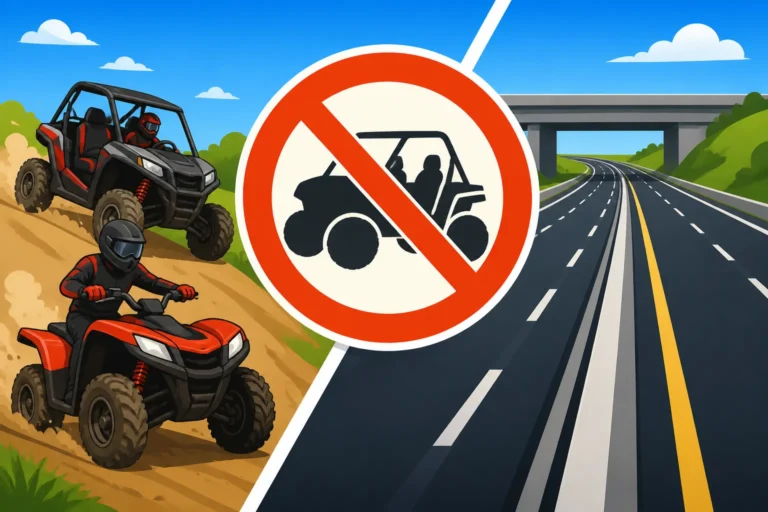
One of the biggest misconceptions is that if you have a Class O, you can ride your ATV on any road. This is absolutely not true in Nebraska. The state maintains a general prohibition against ATVs and UTVs on state highways and controlled-access roadways. However, Nebraska law does provide avenues for counties and cities to pass ordinances allowing ATVs and UTVs on certain local roads or within specific unincorporated villages. This means legality is highly localized.
Your Class O license will only permit you to operate your machine on those specific county roads or city streets where local authorities have given the green light. Before you ever hit the pavement, you must check the local ordinances for the specific city or county you plan to ride in. What's legal in one town might be strictly prohibited just a few miles down the road. This patchwork of rules can be incredibly frustrating for riders, but it's the reality. For more details on this, you can look up articles like [Nebraska City Ordinances That Open Streets] and [Nebraska Rules for Riding a County Road]. Even if you've outfitted your UTV with a beefy SuperATV heavy-duty bumper, it won't protect you from a citation if you're riding where you shouldn't be.
Age and Passenger Restrictions
Even with a Class O license, there are still specific age requirements that apply to ATV and UTV operation, particularly concerning youth riders and passengers. While the Class O is for drivers typically 17 and older, Nebraska has rules about who can operate an ATV or UTV, regardless of whether they're on private or public land. For example, there are minimum age limits for operating ATVs, and usually, anyone under a certain age must be under direct adult supervision.
When it comes to passengers, standard ATVs (quads) are generally designed for a single operator. Carrying a passenger on a single-rider ATV is often prohibited, even if you have a Class O license, because it can compromise the machine's stability and handling. UTVs, designed for multiple occupants, are a different story, but still, passenger rules often apply. For specific age guidelines, refer to [Nebraska ATV Age Requirements] and [Nebraska Rules for a Child Passenger]. It's crucial not to confuse your general driving license privileges with the specific safety regulations that govern off-road vehicles.
Beyond the License: Other Key Requirements for Road-Legal ATV/UTV Use
Having a Class O license gets you past the first hurdle, but it's just one piece of the puzzle. To legally and safely operate your ATV or UTV on approved public roads in Nebraska, you need to consider a host of other requirements, from insurance to specific equipment. Neglecting any of these can lead to fines, citations, or worse, put you and others at risk.
Mandatory Insurance and Equipment
If you're planning to ride your ATV or UTV on public roads, even those allowed by local ordinance, you are legally required to carry liability insurance. Just like with a car, this insurance protects you financially in case you're involved in an accident that causes damage or injury to others. The minimum liability coverage requirements are set by the state, and it's essential to have proof of this insurance with you when riding on public ways. You can read more about this requirement in [Nebraska Requires Liability Insurance on Roads].
Beyond insurance, your machine itself needs to meet certain equipment standards to be considered road-ready. This often includes:
- Headlights and Taillights: Essential for visibility, especially during dawn, dusk, or in inclement weather. [Why Your Headlight Must Be On in Daylight] is a good resource.
- Brake Lights: To signal your stops to vehicles behind you.
- Turn Signals: Crucial for indicating your intentions to other drivers. Many off-road machines don't come standard with these, so you might need to add an aftermarket kit.
- Rearview Mirrors: To see traffic approaching from behind.
- Horn: For audible warnings.
- A 5-Foot Safety Flag: This is a distinct requirement in Nebraska for ATVs and UTVs on public roads, designed to make your lower-profile machine more visible over rises and around corners. You can find more information about this in [Nebraska Safety Flag Requirements].
Many riders turn to aftermarket suppliers like SuperATV for these road-legal conversion kits, which often include lights, signals, mirrors, and horns. Even with high-quality parts, though, it’s your responsibility to ensure they’re installed correctly and meet state and local regulations.
Speed Limits and Crossing Rules
Even on approved roadways, ATVs and UTVs are subject to specific operational rules that differ from standard passenger vehicles. One of the most critical is the speed limit. In Nebraska, when an ATV or UTV is operated on a county road or approved city street, it is generally subject to a maximum speed limit of 30 mph. This is significantly lower than typical rural road speeds and is designed to mitigate the risks associated with these vehicles' handling characteristics at higher speeds. This specific rule is covered in [Nebraska's 30 mph Road Limit].
Furthermore, there are strict rules about how you can cross highways. You can't simply drive along a state highway or interstate. If you need to get from one approved county road to another that requires crossing a state highway, you must do so at a ninety-degree angle after coming to a complete stop and yielding to all traffic. This "ninety-degree crossing" rule is vital for safety, minimizing the time your machine spends in high-speed traffic lanes. More on this can be found in [Nebraska Crossing Rules at Ninety Degrees]. Remember, these rules apply even if you're operating a rugged SuperATV machine built for tough terrain; road laws are about traffic safety, not vehicle capability.
Summary of Key Requirements for ATV/UTV Road Use in Nebraska
| Requirement | Description | Applicability |
|---|---|---|
| Class O Driver's License | Standard Nebraska operator's license. | Mandatory for any ATV/UTV operation on public roads. |
| Farm Permit | Alternative license for agricultural purposes only; limited scope. | Only for farm-related travel; not for general recreational road use. |
| Local Ordinances | Permission from county or city to open specific roads/streets to ATVs/UTVs. | Varies by location; must verify legality for your intended route. |
| Insurance | Minimum liability coverage required. | Mandatory for all ATV/UTV operation on public roads. |
| Safety Equipment | Headlights, taillights, brake lights, turn signals, mirrors, horn, and a 5-foot safety flag. | Required for visibility and safety on public roads. |
| Speed Limit | Maximum 30 mph when operating on approved public roads. | Mandatory on all designated public roads. |
| Crossing Rules | Highways must be crossed at a 90-degree angle after stopping and yielding; no driving on state highways. | Mandatory when crossing any state highway to connect approved roads. |
| Age & Passengers | Adherence to state age requirements for operators and restrictions on passengers (especially on single-rider ATVs). | Applies universally to ATV/UTV operation, even with a Class O. |
Understanding these comprehensive rules, beyond just the Class O license, is crucial for anyone looking to enjoy their ATV or UTV on Nebraska's roads safely and legally. There are [Three Ways ATVs Can Legally Use Nebraska Roads], and each one has its own set of considerations.
Disclaimer
This article is for general informational purposes only and does not constitute professional advice. Laws, prices and regulations vary by location and change over time. Consult a qualified professional for guidance on your specific situation.